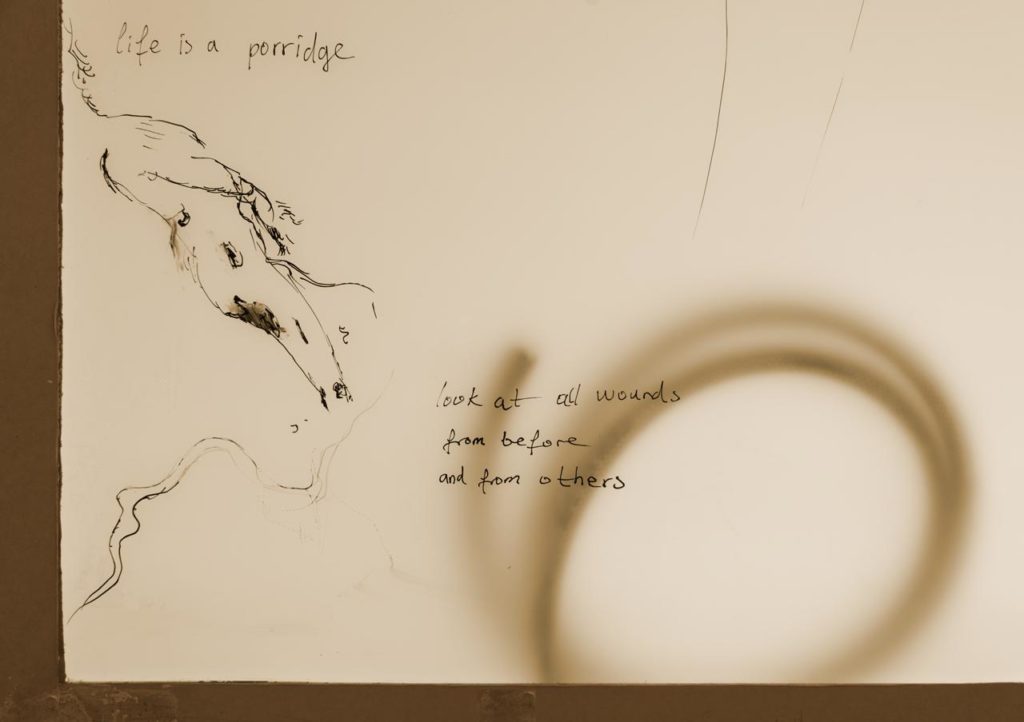
Out of all the possible details – and there are many – that make up Tolia Astakhishvili’s sprawling borderless oeuvre, the one that seems to have permanently lodged itself in my admittedly selective memory is that life is a porridge. A hand-written phrase scribbled on a drawing and pasted onto a wall of The Clerk’s House, one of the oldest buildings in London’s Shoreditch neighborhood and Emalin gallery’s exhibition space, whose interior spaces the artist transformed and reshaped during the course of a month last year into her exhibition “a wound on my plate” (2025). As far as cryptic messages go, this is an invitation to dive headfirst into the rabbit hole of associations that Tolia Astakhishvili’s worlds-within-worlds conjure. For if her work is so often about accommodating the histories and bodies that traverse these carefully constructed spaces, it is also about bringing attention back to the things, both material and immaterial, that move through us. A gluey sustenance so simple and unsexy that it goes unnoticed, a formless mishmash whose edges are hard to decipher, yet whose bulk carries the weight.
In Agnès Varda’s travelogue documentary The Gleaners and I (2000), the filmmaker visits cities, towns, and villages across France, her handheld digital camera in tow, capturing and conversing with those for whom gleaning is not just a hobby, but a way of life. Apple orchards, vineyards, greenhouses, wheatfields, trash bins, sidewalk debris, discarded household electric appliances… No stone is left unturned. If gleaning, the act of collecting grain or other produce left by reapers, was a traditionally female endeavor, at least as presented in the annals of art history (I’m looking at you, Jean-François Millet), in Varda’s hands it becomes not only a socioeconomic and cultural portrait that dissolves gendered boundaries, but also a meditation on need versus want, cinema, the art of observing, care, community, ecology, law, ageing, and death, among countless other themes. As the minutes roll by, what emerges is that gleaning is not a one-way street. It is a circular economy, in which one person’s trash is another’s treasure – or even their lifesaver – and the items that change hands cannot always be irrevocably reduced to their thingness. It requires a commitment to sharing, to gathering not just raw material but also knowledge.
It is no accident that these images take shape in my mind as I think about Tolia Astakhishvili’s multi-media installations, which often consist of a precisely choreographed configuration of sculpture, painting, drawing, architectural interventions, sound, light and moving image, for they themselves are not so distant from Varda’s slow cinema. There is a palpable slowing of time that occurs as one steps over the threshold and into the artist’s work, a sensation that extends to her deployment of scale and space, a series of portals, doorways, frames and interiors that feel unsettling despite, or perhaps because, of their familiarity. In the same way that Shakespeare’s Hamlet once uttered that time is out of joint, out of whack, evoking an internal, emotional world where the distinction between inside and outside is no longer valid, so too might space in Tolia Astakhishvili’s practice be described as disjointed. There is a non-linearity at play, as if one were walking through different planes, no longer bound by the strict rules of chronology and spatiotemporal decorum.
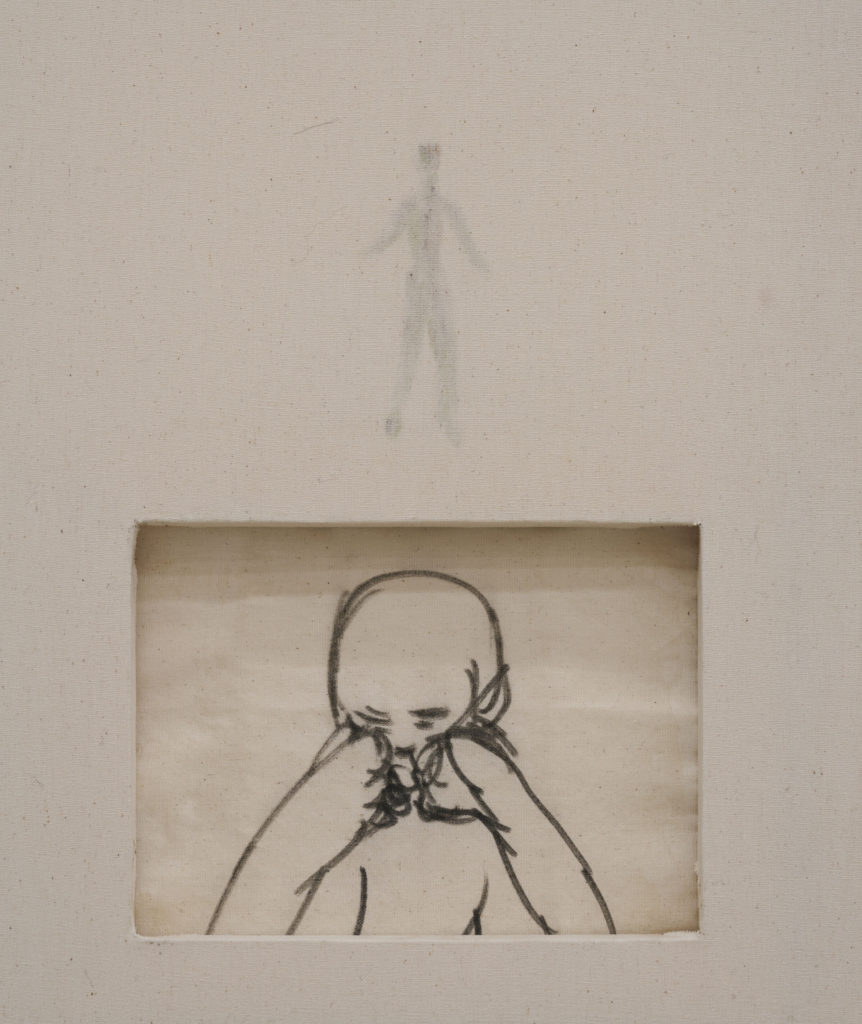
As far as settings go, The Clerk’s House, which Tolia Astakhishvili restructured almost beyond recognition for“a wound on my plate,” perfectly embodies this penchant for allowing different temporalities and spatial modes, almost like archaeological strata, to peek through. Historically a half-place between the church grounds and cemetery, where guards would watch for signs of corpse snatchers, and the secular world, it is a domestic space anchored by its site specificity and the layers of history that haunt it. Wandering through the building’s rooms and floors felt like a game of hide-and-seek or a treasure hunt for objects that may or may not have already been there before, left unnoticed by prying eyes. Plasterboard and plexiglass partitions confused the already unstraightforward architecture and redrew its proportions, creating hidden, backlit cases into which the artist secreted found objects and furniture, only tangentially recognizable from the silhouettes they cast. It felt akin to watching a shadow-puppet play whose barely discernible forms allow the imagination to roam free.
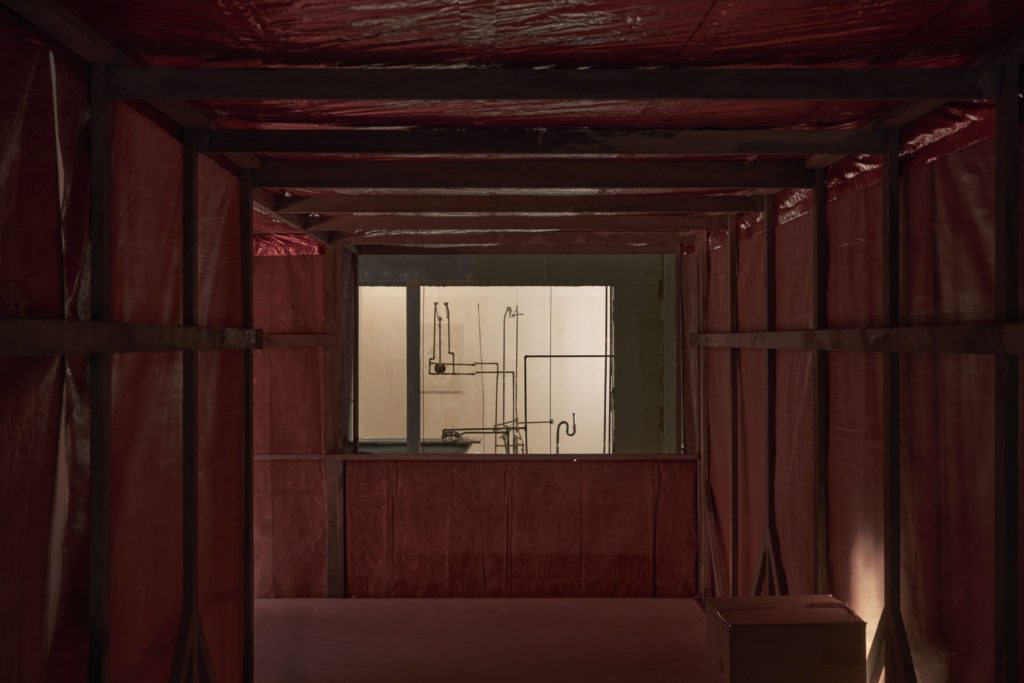
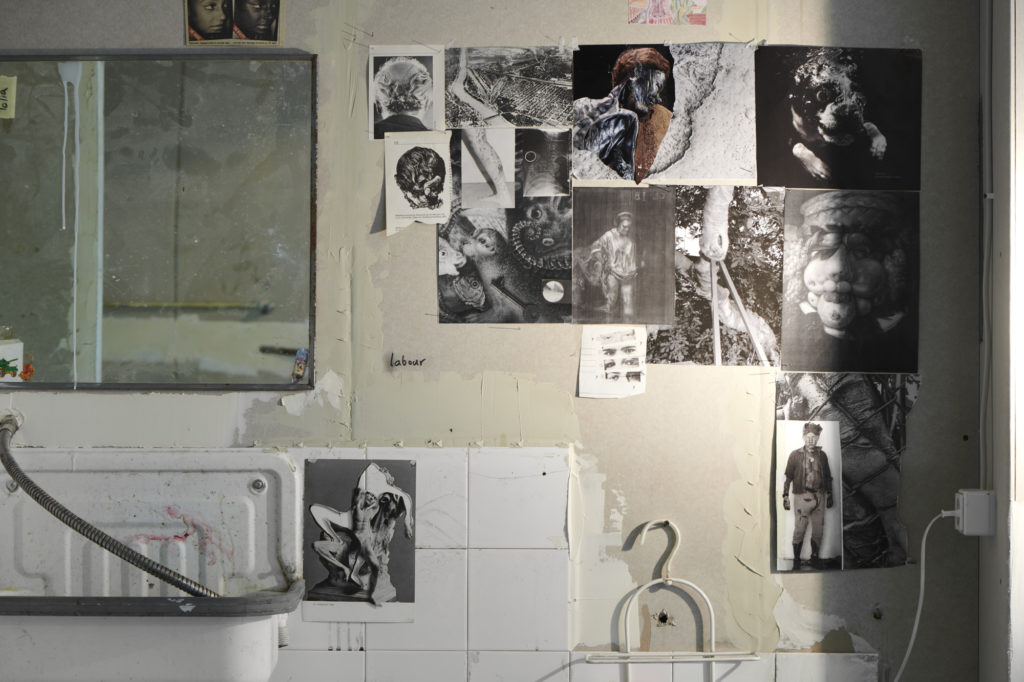
my emptiness, 2025–26. Construction material, excavated pipes, bathtub, shower tray, mirrors, and light. 482.5 × 643 × 431 cm. Photography by Tolia Astakhishvili Studio. Courtesy of the artist; Emalin, London; and LC Queisser, Tbilisi / Cologne.
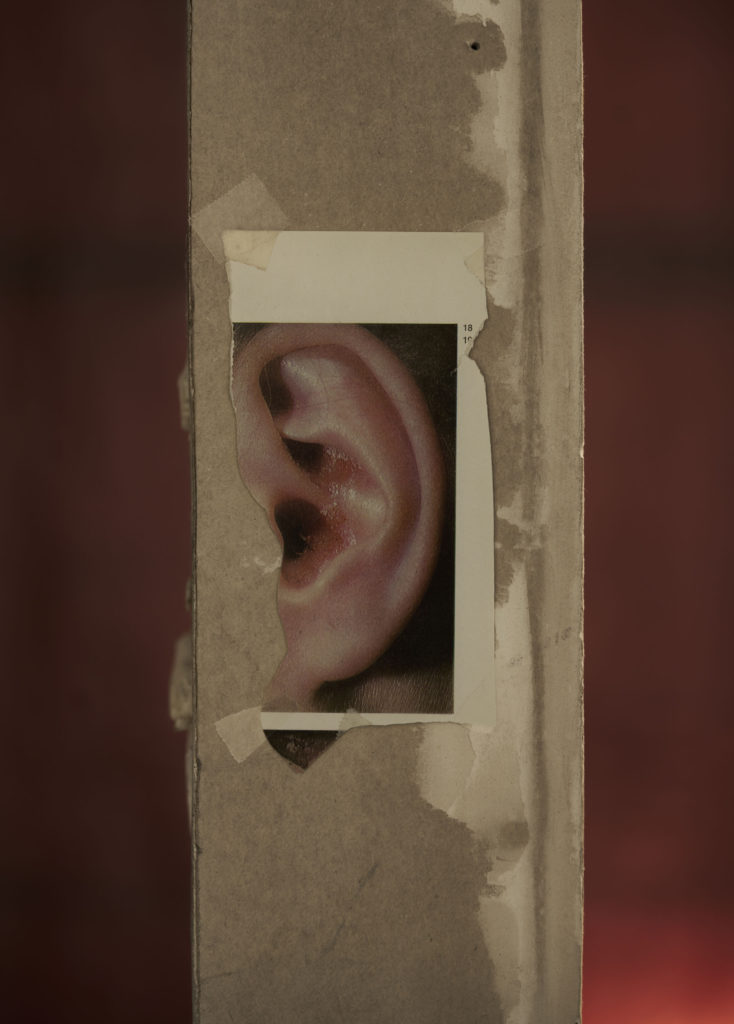
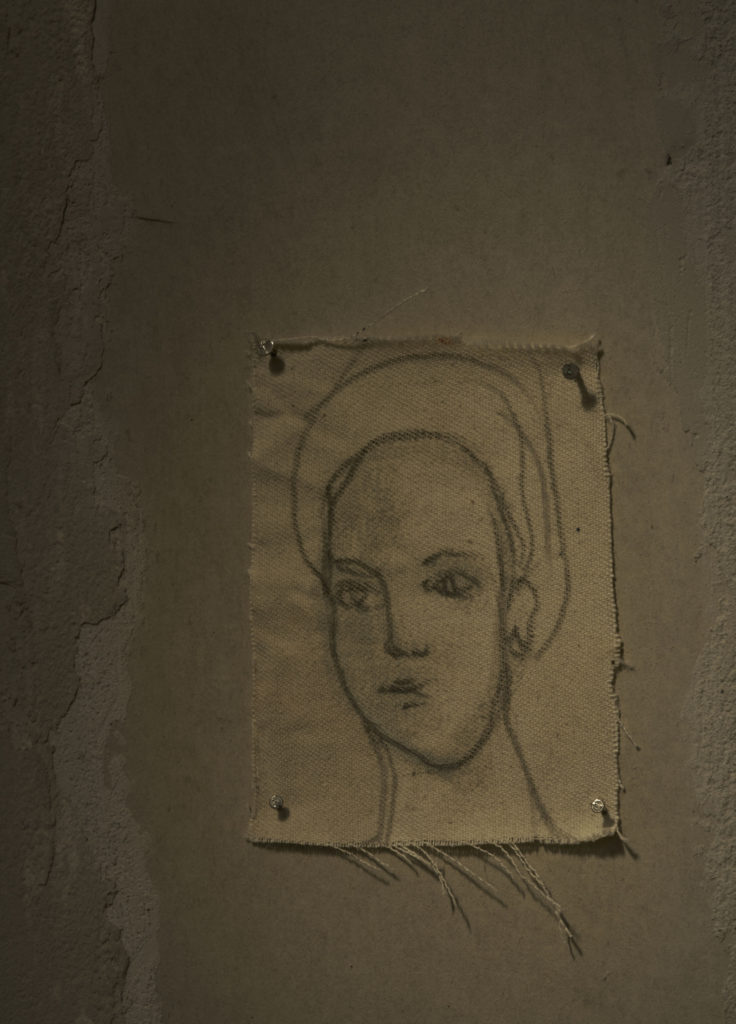
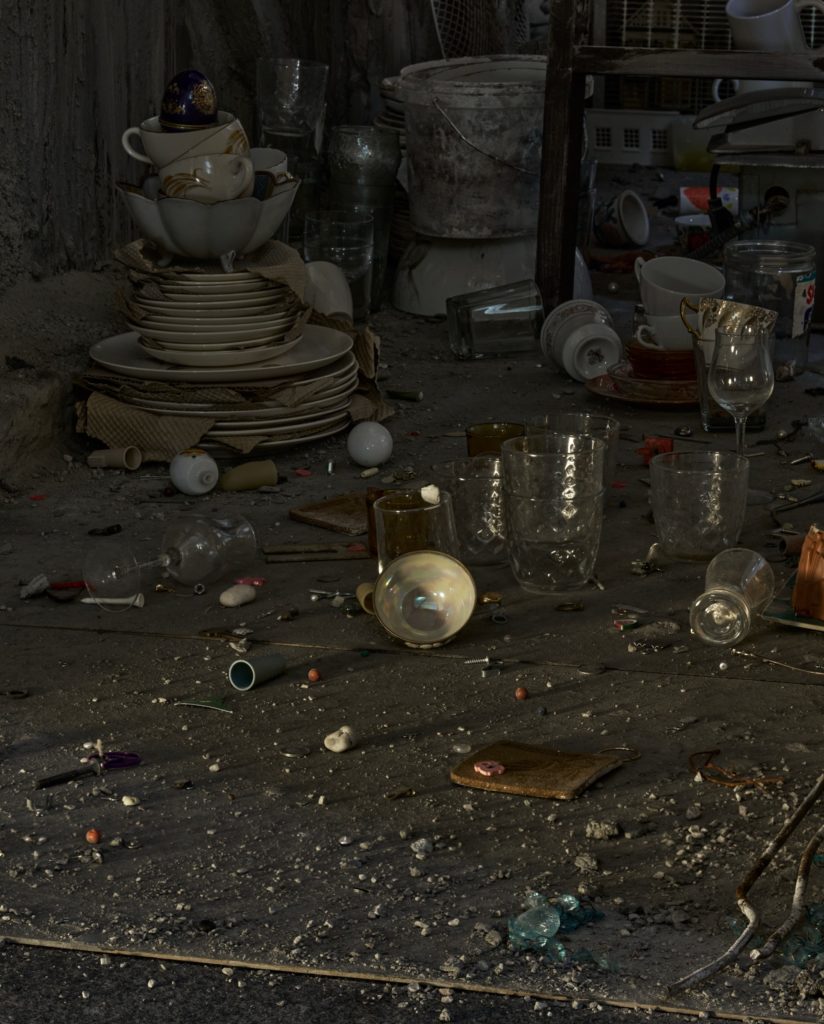
In the ground floor bathroom, a small black shelf held a messy tangle of costume jewellery and metal cutlery. Further up, the attic, its floor left dusty and stained, its perimeter lined with an accumulation of what can probably best be described as the debris from a life (whose?) well lived: CDs and vinyls, cut-out paper masks, empty glasses and jars, cardboard boxes, and Tupperware. The domestic space where traditionally, unused, unwanted bits and trinkets, those that still hold some symbolic value and memory, are placed for safekeeping, only to be forgotten later down the line. In an adjoining room, seen framed by a doorway, From Communion to Cannibalism (2018–25) clicked away, a slideshow made with artist James Richards, in which photographs of earlier installations were juxtaposed with found images, medical diagrams and other fragments, replicating on screen the resemblance in forms and tones already present in every corner and under foot at The Clerk’s House.
Others before me have noted that Tolia Astakhishvili’s exhibitions, even when they are billed as solo, contain a plurality of voices. These range from I can’t imagine how can I die if I am so alive (1986–ongoing), collages of friends and family layered over magazine clippings and newsprint, made by her late father, Zurab Astakhishvili – a lung specialist, alpinist, and doctor who had begun making photo collages in the 1980s, when Tolia Astakhishvili was still a child, and returned to artmaking again later in life, encouraged by his daughter, the artist – to collaborations with longtime companions and friends, among them, James Richards, Dylan Peirce, Ketuta Alexi-Meskhishvili, and Kirsty Bell. In a recent phone conversation, Tolia Astakhishvili described this urge to bring different voices together into a choir as a way out of being alone. For lest we forget, being an artist can ultimately be a lonely process. Which brings me back to the earlier analogy with gleaning. For Tolia Astakhishvili, it’s not about taking, it’s about spreading. In other words, reaping in order to sow. Or taking something in order to give something back. And creating a polyphony in the process, one in which there is no clearly defined beginning or ending.
As if to prove this point, the entrance to Tolia Astakhishvili’s “Figure of the Child” (2026) at Vienna’s mumok – the artist’s first solo museum exhibition which takes up two whole underground levels of the building – is framed by a constructed tunnel, whose title Singing out of doors (2026), echoes one of the linguistic snippets that made up the expanded poetry of the earlier show in London. Tinged deep red, the cavity, like all of Tolia Astakhishvili’s work, bears reference to the body, to living, breathing organisms, and to psychic space inscribed within the very structure of their material skeletons. It’s a psychic geography of sorts – or perhaps “psychodrama” might be a better term – but one that is condensed into a space ostensibly held between four walls.
At mumok, this open-endedness extends to selected works from the museum’s collection, pieces by the likes of Picasso, Nan Goldin, Heimo Zobernig, Charlotte Posenenske, and Ull Hohn, which she has deftly incorporated into Huts, specially built cases, or situated within new architectural interventions. The museum becomes a second skin, an inhabited environment in which the collection not only constitute a history, but takes on the attributes of the marks, traces, scabs and scars that accompany any body through its natural life cycle.
This scarification, and this emphasis on ingestion – the telltale signs of knowing a place and its history inside out – returns to the question of time that Tolia Astakhishvili accords to each project. While she often builds and work from models when necessity and distance dictate, for the most part she inhabits each exhibition space until it effectively becomes part of her. The result is a gesamtkunstwerk, or an, immersive, total work of art, that has none of the megalomaniac tendencies of its forebears, lacking the overpowering and didactic tones of the former, but envelops instead.
Take, for example, the Nicoletta Fiorucci Foundation in Venice, a recent addition to the city’s permanent contemporary art spaces, where Tolia Astakhishvili spent five months living and working in 2025 to create “to love and devour,” a site-specific installation conceived in dialogue with the building’s existing architecture and history, ahead of its renovation. A burgeoning construction site transformed into a repertory of images, fragmented stories and spatiotemporal deviations: bathroom appliances jutting out from walls covered with protective film, which itself became a material support for large-scale drawings; exposed pipes traversing the spaces like an enlarged nervous system or digestive tract that metabolizes whatever came into contact with them.
It’s tempting to ascribe the aesthetics of Tolia Astakhishvili’s practice to her Georgian roots, given that she grew up and spent her childhood in Tbilisi (where she still divides her time with Berlin), a city of palimpsests, where the relative lack of urban planning regulations means that the different sociopolitical strata are materially inscribed in the city’s architecture. But to do so would perhaps be to indulge the West’s exoticizing and dominant thirst for an aesthetics of ruin porn, nourished by flaking paint, skeletal structures and armatures stripped to the bone.
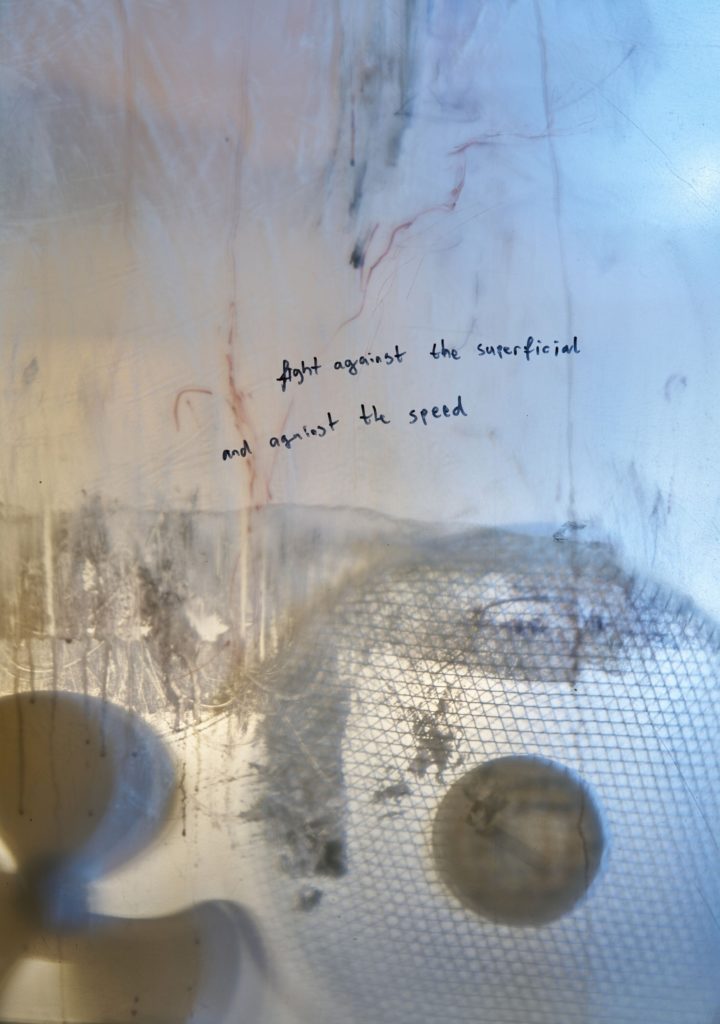
Tolia Astakhishvili’s first love is drawing, and then painting, so the particular color palette and tones that make her work so instantly recognizable (I tend to think of her installations as sepia-toned, almost like an archival print fading and discoloring with age, although this possibly points more to the inherent unreliability of mine, or anyone’s, memory) derive more from this painterly sensibility than anything else. In her hands, drawing escapes the page and spills into the environment around it. Untethered, like the exact replica of the metal structure in the Hermannplatz metro station in Berlin that Tolia Astakhishvili inserted into her exhibition “The First Finger (chapter II)” (2023) at Haus am Waldsee, several kilometers south west of its source. Referring to the part of the human body that an organism sacrifices first in order to survive when exposed to extreme cold, the exhibition took as a starting point this reduction of a body to its life-sustaining core in order to reflect on wider conditions of life and liveliness, protection, care and abandonment. The intimate, domestic rooms of Haus am Waldsee became a setting to explore our contingent relationship to space, and the addition of these foreign elements into an environment that is meant to symbolize a “home” naturally questions the veracity of whether a house is always, or necessarily, a home. Freeing themselves from rhyme or reason, her works have something of the haiku about them in their intent and precision, as well as their celebration of and insistence on the evanescence of all things and the emotions that they provoke. Seen from this angle, life is, indeed, a porridge.