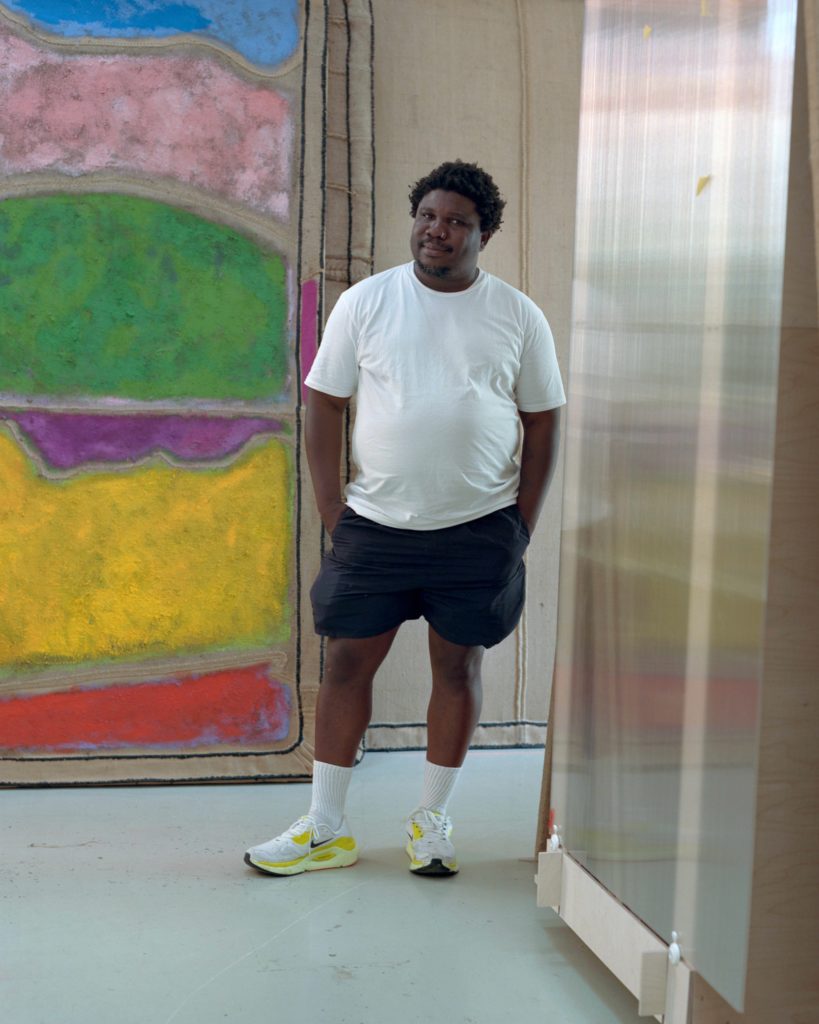
After the below conversation, I came to understand Brooklyn-raised artist Alvaro Barrington as a product of New York City’s 1990’s hip-hop cultural scene: a moment that embraced the troubled edge between ameliorative cultural expression and the expansion of capital and of solipsistic consumption of Black cultures. Cultures produced by ingenuity and failure. Communities withstanding gross systemic attack.
Barrington now lives in London and is working on an awareness campaign to call attention to economic disenfranchisements facing the Caribbean communities that produce London Carnival. Costume designers, food vendors, etc, he says, should share in the income generated by the event, in the form of a tax break. Political movements also employ marketing techniques and are at their most potent when easily understood.
Still, Barrington says he’s most concerned with supporting his family.
Alvaro Barrington: The reason I have a career is because I look at the creative renaissance that I went through… How I understand my life is: I grew up in the greatest cultural renaissance, one only matched by the Italian Renaissance. The amount of creativity that was around me – I’m talking about everything from Michael Jordan, to Oprah Winfrey, to Queen Latifah, to John Singleton, to Spike Lee, to Michael Jackson –
Taylor Le Melle: Nia Long.
AB To Nia Long. Yeah. The caliber of women that existed! The type of pop female musicians. Whitney Houston, Mariah Carey, Toni Braxton –
TLM TLC.
AB Kelly Price, Mary J. Blige. I could go on and on and on and on.
TLM But wait, Alvaro, you’re saying it’s only matched by the Italian Renaissance. Why not by any other cultural moment? Harlem Renaissance. Motown. What maybe was different about hip-hop is that capital really, really got involved?
AB I think it was more about opportunities. In America, the 1970s were such a hard time that industries started to say, You know what? We got to try to figure stuff out. And they were trying everything out. And part of trying everything out was tapping into this community that had always been excluded from owning any type of production. Look at golf: it wasn’t letting any Black person in. And then they let in Tiger Woods. Tennis wasn’t letting people in. And then, Serena and Venus. So I think it was tied to opportunity. Before, you were not going to get a Black TV host. And then, those industries were dying so that they said, We might as well give that somebody a shot.
TLM It’s a recurrent mechanism that essentially, industries look to Black cultures to generate more revenue. In some ways, that’s part of how America got started in the first place.

AB I would argue that America has a Whiteness Project and a Blackness Project. And the Whiteness Project began in Europe. You have all of these different groups who had been warring with each other. Europe, over the last few centuries, has been one of the most genocidal set of communities.
TLM: Yeah.
AB They were committing genocide against everybody. You know, we kind of get this false narrative that Europe was a sort of peaceful place. But Europeans were killing each other for hundreds of years. And now y’all could come to America and become white, give up old world divisions.
TLM Do you feel like that there was also a consolidation into a Blackness Project?
AB Yes. But it’s also led by some of our own interests. [Marcus] Garvey talked about this.
TLM As in, Okay, we need to set that aside right now because there’s something that’s actually affecting us all.
AB Totally. I think Garvey was in reaction to we have the same oppressor. So we need to meet each other, recognizing our shared oppression. But it also became an erasure project because Africa just became Black as opposed to having these myriad identities, people with hundreds and thousands of years of history. And the creation of the nation state ended up functioning the same. Now you’re a Nigerian.
I think this became particularly interesting in America. A very particular type of Blackness, – working-class Blackness – became the defining frame through which every person who shared our skin tone was understood. So everybody got cast upon with that kind of energy, like you must have dealt with like police brutality and crack and all of that. Most Black people are middle class. R&B, Motown, and Quiet Storm were about – and made by – the Black middle class. Hip-hop was born out of the Black working class, but then replaced the R&B middle-class imagination.
And that was similar to what happened under slavery. You had many free Black people in the North writing about love and, you know, being in the ghettos with Irish people, and so on. Then, once people realized they needed to deindustrialize the South, slave narratives became number one best sellers. And what that ended up doing was erasing all the Black people in the North who were writing about being working-class – or even middle class – who had never actually experienced slavery in America. They had experienced indentured servitude; obviously they experienced it from a Black perspective, but at the time, they were working class indentured servants. And so they were writing about those conditions, … But to go back to the question you asked, I have a career for two reasons.
I have a career because, if you ask me who some of the greatest artists to come out of America over the last seventy-five years are, my imagination goes to Michael Jackson, it goes to Prince, it goes to Biggie Smalls, it goes to Tupac, it goes to Missy Elliott – before I say Jackson Pollock, before I say…
TLM Hold on, when you say why you have a career, you mean why you feel motivated to make work?
AB No, I have a career because I go, Yeah, the greatest artist is Michael Jackson or Prince or whoever. And a lot of the people who collect art go, Yeah, you’re right. I like Kerry James Marshall – I’ve known him for a long time – but I wouldn’t choose Kerry James Marshall over Prince. People in the art industry would and that doesn’t match up to the larger world. I think Picasso is the greatest painter of the 20th century but not a greater artist than Michael Jackson cause he didn’t make a greater artwork than Thriller. To me, one of the greatest artworks is the Sistine Chapel. It’s incredible. But if you asked a million people to pick one of these two as the greatest artwork: Michael Jackson’s Thriller with Quincy Jones or the Sistine Chapel. I think that’s going to be a hard decision for a lot of people. Art’s requirement is that people get it, it means something in their lives.
TLM What are you saying about how that relates to you? I get what you’re saying in that Thriller is equal to or surpasses many other things that are considered fine art masterpieces. Right?
AB Yeah.
TLM So then what are you saying about yourself?
AB So if I break it down really simply, art is culture. Culture is the story that we tell ourselves about ourselves. In order to walk into an artwork, you have to have a certain narrative of your identity. In Western culture, traditionally, the narrative you needed to understand was either tied to the church or tied to political power. So to fully enter a Titian painting or a Michelangelo painting, you need some kind of engagement with the notion of Christianity. You needed to know Napoleon if you were walking into a painting because… Because you’re getting the references. And you’re getting also—
TLM – a reinforcement, let’s say, of the cultural story that you’ve already been told in other forms.
AB Right. And so what ended up happening toward the eighteenth century was that religion no longer held that much sway. Nietzsche said, God is dead. People were moving towards republics. America is a republic. France is a republic. So you no longer needed the story of the Church, the royal family, or the ruling class.
So the French artists started proposing that you needed to understand modern life. You sat in the fields and the grass so you could understand this Monet. You went to Moulin Rouge so you could understand Henri de Toulouse-Lautrec.
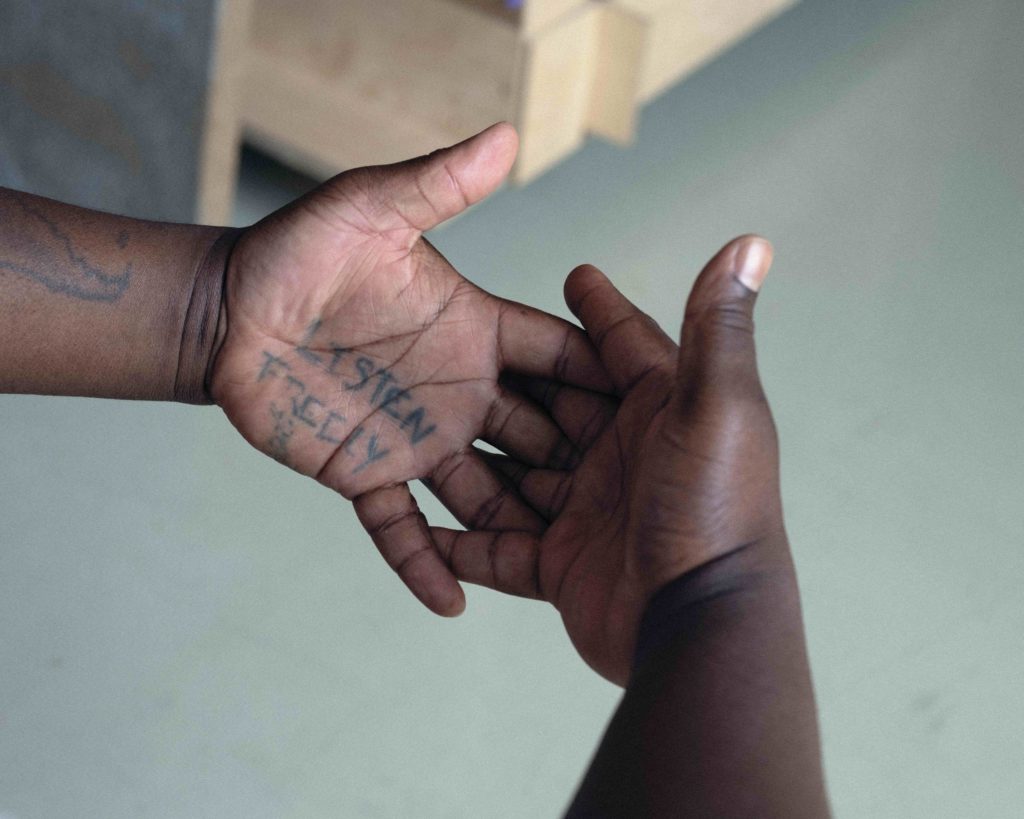
TLM Do you see yourself as depicting modern life?
AB So this is the next phase. The American contribution was not depicting modern life, but depicting cultural life. They were saying in order for you to understand Jackson Pollock, you don’t even need to sit in the park. All you need to do is listen to jazz because the Black people who were fighting in the wars were bringing jazz music with them. Have you listened to jazz? Look at those lines. That’s rhythm. That’s movement. That’s jazz. And then you get the next iteration: Andy Warhol. Those are just disco paintings. If you do cocaine and you go to Studio 54, you understand a disco painting.
TLM So basically you’re telling me you’re making hip-hop paintings, and your proposition is that, if someone understands and has an engagement with hip-hop, they already have an entry point into the work.
AB Yes. Or carnival culture.
TLM Why would you sell that work? Who do you want to buy it? The reason why I’m interested in that is because selling art has its own histories. You’re talking about the Sistine Chapel. Michelangelo had a particular relationship to patronage. Titian might make sixty paintings for one wealthy family. That’s how he’s funded to tell these stories. By the time you get to Jackson Pollock or Andy Warhol, that relationship starts to shift. You get the gallery, a different economic model. Do you think about these things?
AB Yeah, I think about them, but the way we’re taught those stories isn’t really the question for me. Those narratives don’t add up to the questions I’ve actually witnessed in my own life.


TLM What does that mean?
AB How many people in New York are going to remember 2026 as the year the Knicks won the playoffs? Or as the year America turned 250?
TLM It does feel like the Knicks win was more widely discussed among who I know. But why do think collectors buy your work?
AB Because I think, for example, Tracey Emin was creating punk sculptures. During the YBA era, if you were punk, you could understand yourself through Tracey Emin. What has happened with Black culture, now that hip-hop is the most consumed culture –
TLM Wow. So you’re saying that people who buy art understand themselves through hip-hop culture even if they were not a part of it on the ground?
AB Exactly.
TLM Oh, that’s scary and kind of sick, no?
Artist: Alvaro Barrington
Creative Direction: Alessio Avventuroso
Photographer: Alice Mann
Production: Flash Art Studios
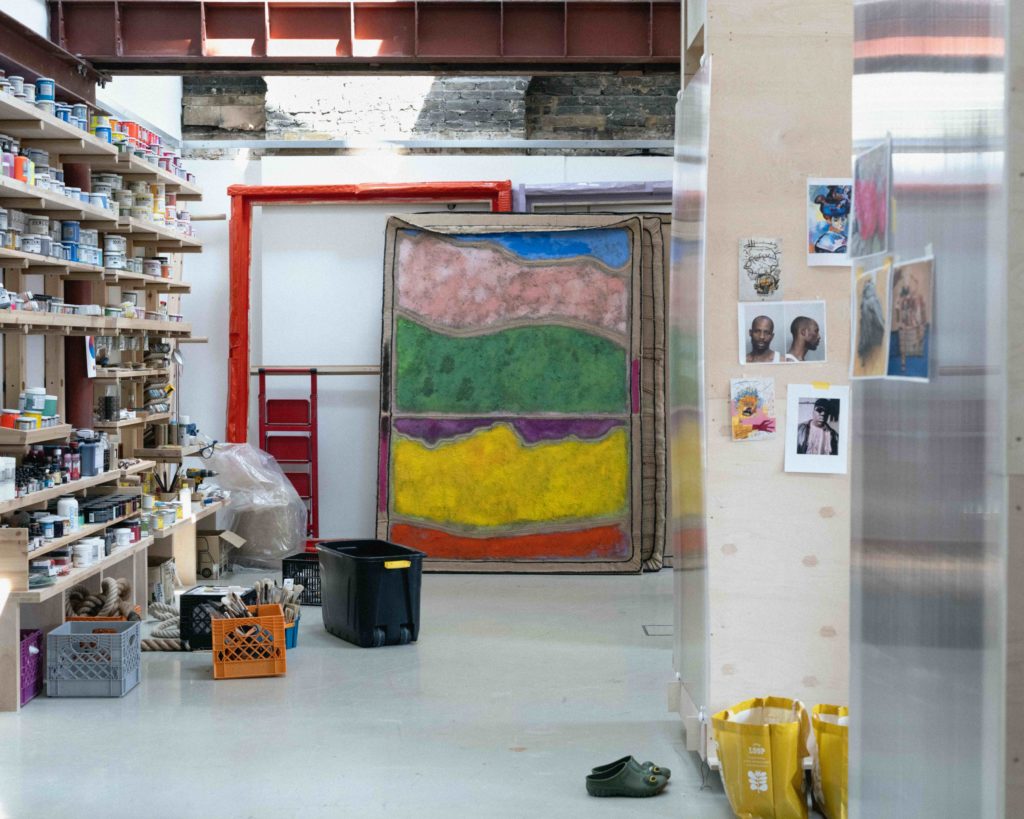
Location: Artist’s studio, London