When I walked into the exhibition, after passing through the Pino Pascali room at GNAMC – Galleria Nazionale d’Arte Moderna e Contemporanea in Rome, I thought I was looking at paintings. Four of them, roughly two meters by one, hung like canvases: off-white grounds, a handful of decisive black marks, hung with the gravity the museum usually reserves for its Kounellis works. I moved closer and the marks resolved into Lagerfeld – sketches enlarged the scale of illustration, roughly human-sized, at least my size. A silhouette reduced to a handful of strokes, reading less as a fashion drawing than as a sign. I had misread them, and the misreading was the point. Nothing corrects you except the title.
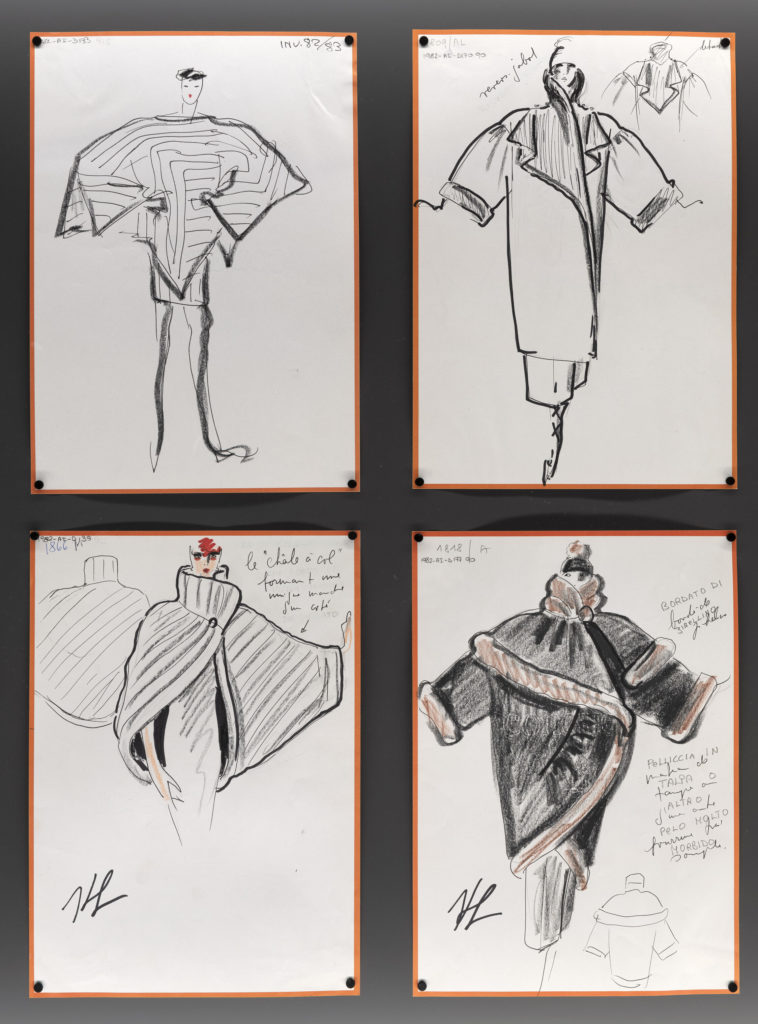
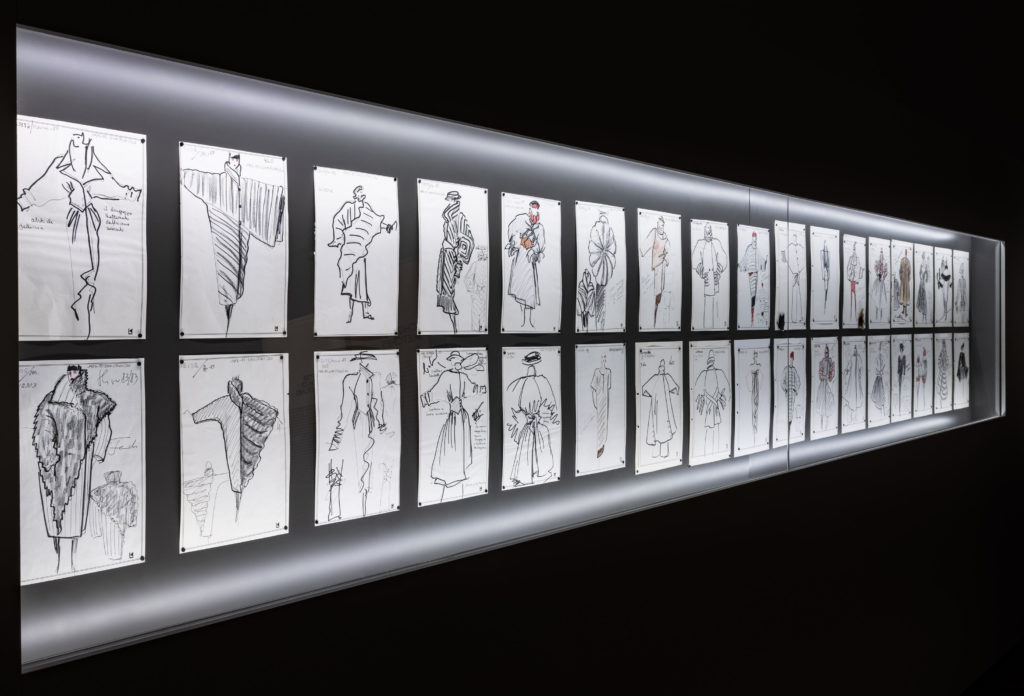
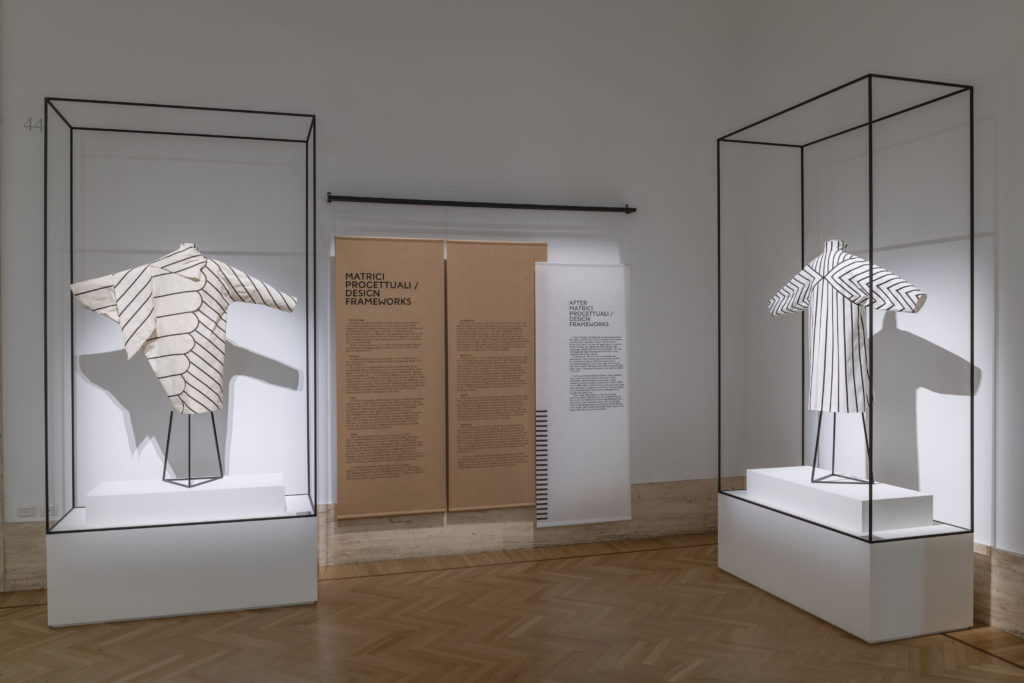
The room is the first – or the last, depending on your route; the wall text is serenely indifferent – of “After Steps Through Work. Fendi / Karl Lagerfeld 1985,” Maria Luisa Frisa’s restaging of the exhibition Karl Lagerfeld conceived with architect Claudio Lazzarini for this very museum in October 1985. It has now been reactivated from an idea by Maria Grazia Chiuri, FENDI’s Chief Creative Officer, who then presented her debut haute couture collection in direct dialogue with the exhibition. The original texts are reproduced verbatim, on the premise that nothing needs adding. The room remains deliberately hermetic: black, white, beige, grey; form without material. It stages two modes of drawing.
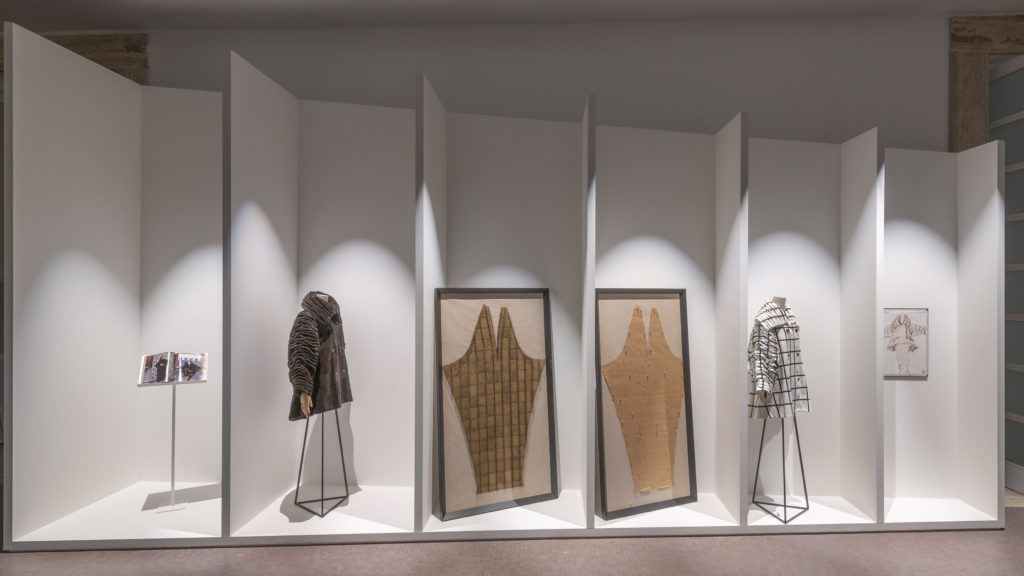
The sketches were selected because they are stripped of detail and chronology, embodying recurring approaches to volume rather than a particular season. Their enlarged scale produces what that text calls “estrangement.” Beneath them, kept strictly at 1:1, lie the cartamodelli: working patterns dense with measurements, arrows, and annotations in red and green. Gesture and score. It is an exhibition about scale, signs and sequence – in other words, drawing.
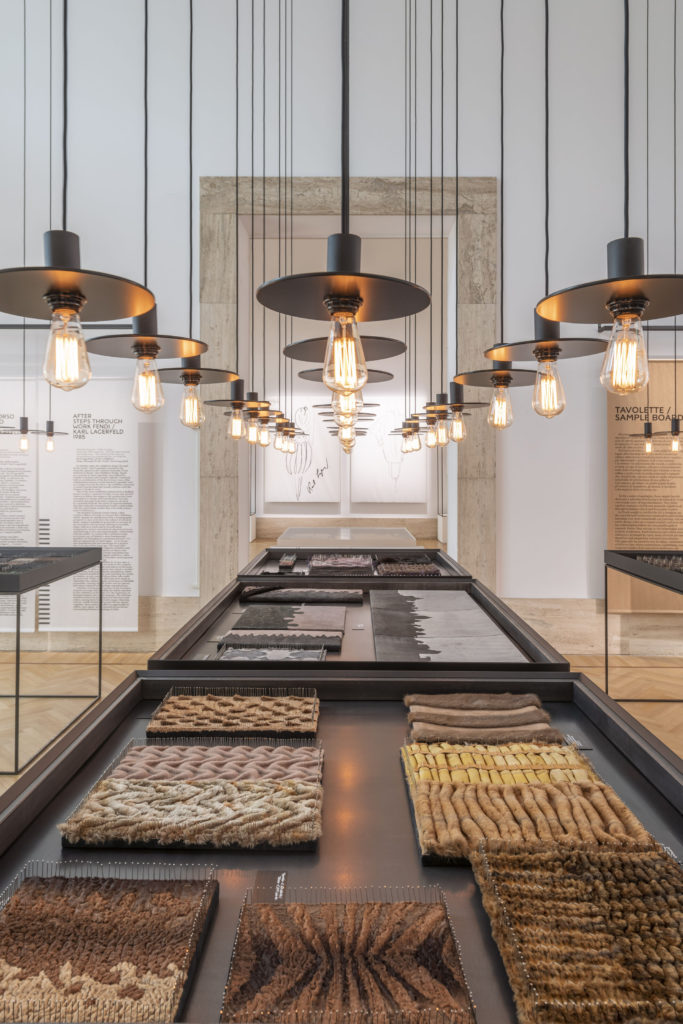
The comparison that kept imposing itself was not with fashion but with Sol LeWitt – who worked in two registers: the freehand gesture and the written instruction, insisting the latter was where the artwork resided. A LeWitt wall drawing exists first as a set of instruction; the hand that executes it belongs to someone else, and the work loses nothing through delegation. Lagerfeld’s patterns operate in much the same way. The sketch is refined to its smallest detail so that anyone in the atelier can translate it into what the curator calls wearable architecture – “the architectural idea that exists in the space between garment and body.”
The pattern becomes the score; the seamstresses its performers; the numbers pencilled onto kraft paper its certificate of authenticity. Even the toiles obey this linear logic: raw canvas traced with black tape, skeleton anticipations of the finished garment, mounted on iron-wire mannequins that are themselves drawings in space. Lagerfeld wrote inside his own sketeches as a third person, narrating himself as a system rather than a hand. The idea becomes the machine that produces the coat.
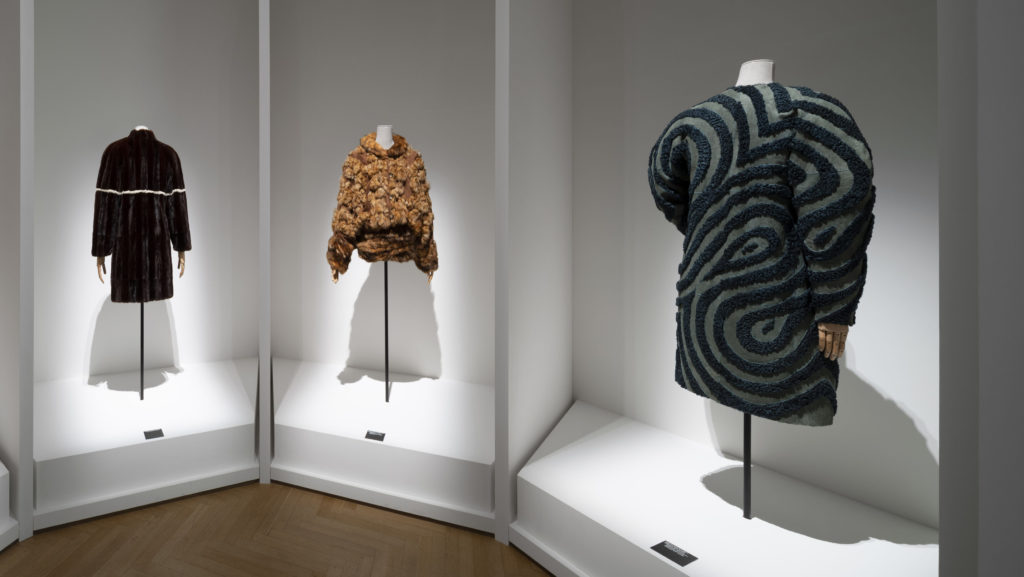
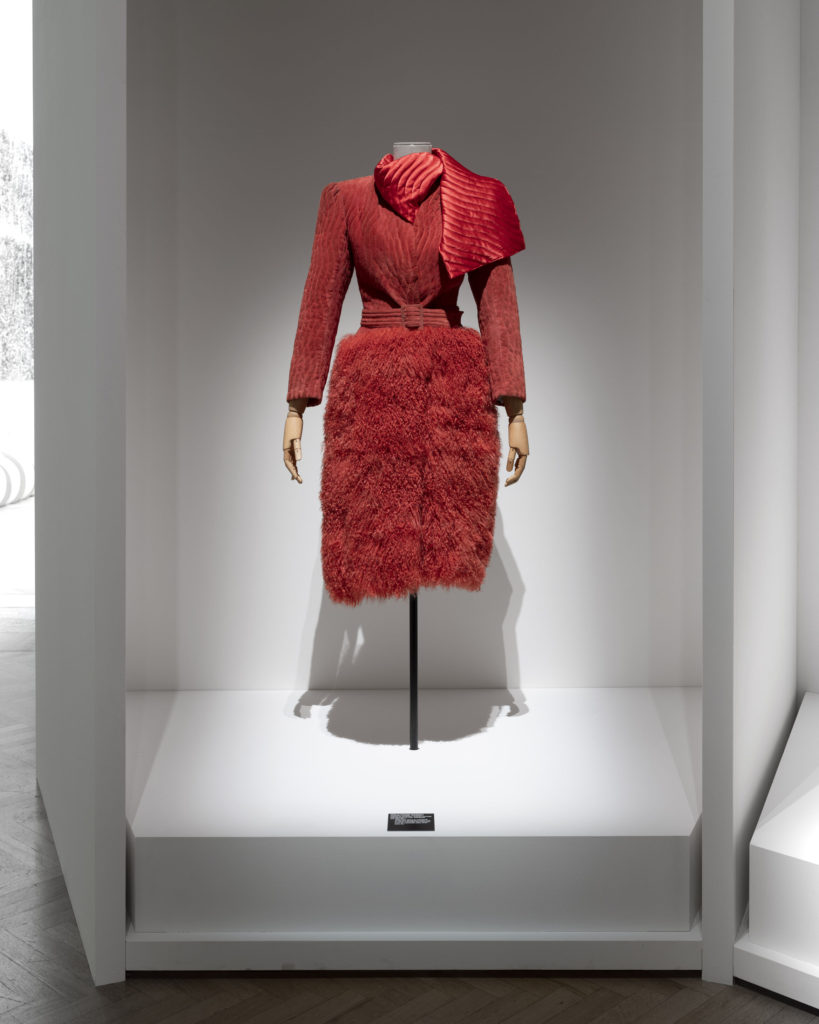
That now reads as prophecy rather than coincidence becomes clear in the next room. Among Lazzarini’s preparatory drawings are storyboards in which Lagerfeld, in 1985, sketches a future video: a tailor wielding a laser scalpel inside an aseptic laboratory; an incubator cultivating artificial fur; the designer transmitting instructions remotely to Rome overnight. He imagined the remote atelier and the lab-grown pelt decades before either had a name. Significantly, what moved him was never the ethical question of the animal but the technological one of the material. Within the vitrine’s archived press clippings, a contemporary called him an “avant-garde futurist;” his interest, he said then, lay only in tomorrow. The storyboards prove he meant it literally. He told the future by drawing it.
The press clippings are the exhibition’s sharpest curatorial gesture. Rather than smooth over the 1985 reception, Frisa presents it intact. The scandal was never the fur but the museum itself. Achille Bonito Oliva’s headline still bites – “Artisti italiani (e invece sono solo sarti),” Italian artists who turn out to be mere tailors – while, in the very vitrine, Vittorio Sgarbi defends fashion as an intuition requiring no explanatory apparatus. The argument remained unresolved in 1985, softened by the contemporaneous alibi of Versace at the V&A, and Italy’s museology of fashion has remained unresolved ever since: a filed everyone practices and no institution fully claims. Forty years later, the objects themselves have quietly resolved the dispute ABO believed he was winning. The tailors were already drawing like conceptual artists; the museum simply took four decades to develop the film.
The curator knows this, and says so with a single, carefully weighted word. The final wall text states that reactivating the exhibition has transformed it “into a kind of readymade.” It is an elegant surrender of authorship. The 1985 exhibition, re-signed and re-dated, becomes an artwork of the present by curatorial declaration, just as Duchamp’s bottle rack did. Yet one section resists reactivation. In the original show, visitors entered a rotating cylinder entitled Il cervello, the brain: Lagerfeld’s mind rendered as a walk-in kinetic sculpture, papered with two thousand drawings. It has not been rebuilt, and its absence becomes the exhibition’s most eloquent space. The archive can be restaged; the instructions can be executed again. The mind that produced them cannot. What remains is what he left on paper – which, the exhibition argues, was always the work itself.