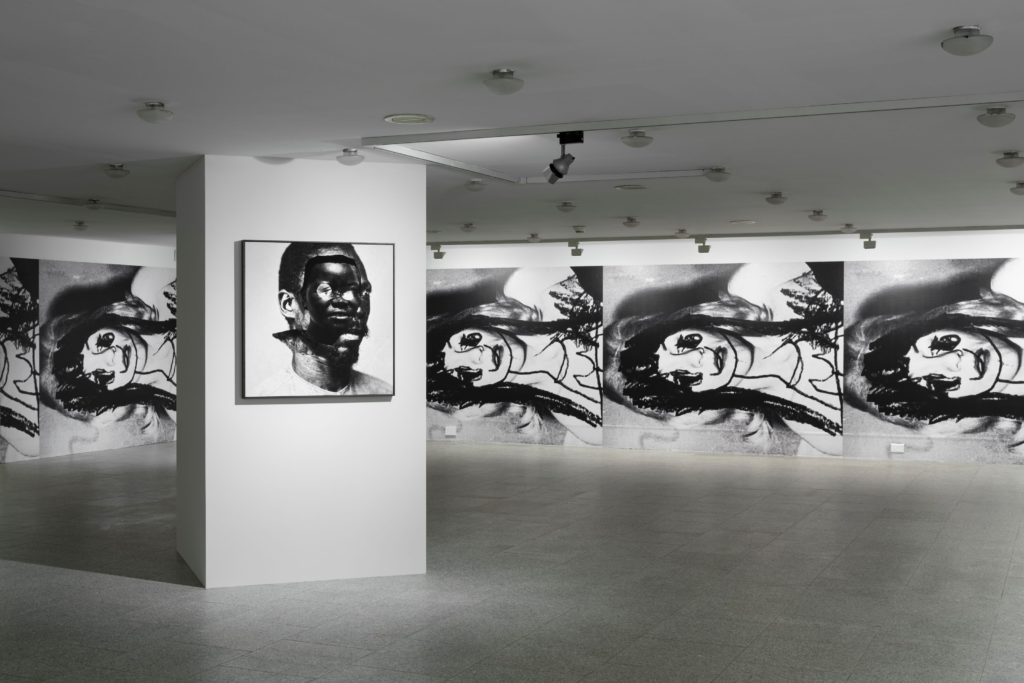
There seems to be no harmless way of looking at another body. Looking always implies framing and interpreting from a perspective that is never neutral. Frida Orupabo’s work is precisely a transformation of that gesture from which the imagery presented in “Cloud of Confusion” emerges.[1] This cloud, referring simultaneously to digital storage and an atmospheric phenomenon, seems to contain a formless, mutable body beyond reach, where everything seems accessible and simultaneously scattered. Orupabo works with images, texts and videos found in digital archives and collected through an Instagram account.[2] Throughout the exhibition, these same images seem to become more real than the reality they record by making visible new configurations of subjectivity, thus returning agency to the bodies, removing them from their original context and re-inscribing them within new relationships, in which they no longer vouch for dominant narratives, but challenge them instead. By recognizing individual experience, Orupabo reveals the systemic web of violence and oppression that underlies it. This process is akin to the notion of critical fabulation,[3] as it reopens the archives of colonial violence to extract from them possibilities for existence that had been made null.
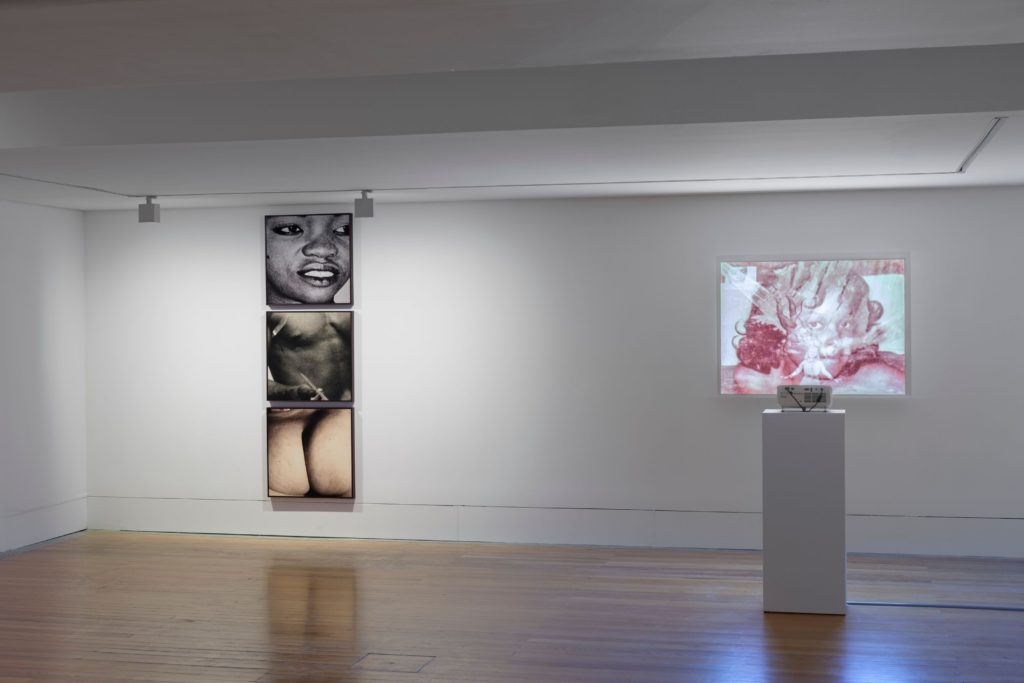
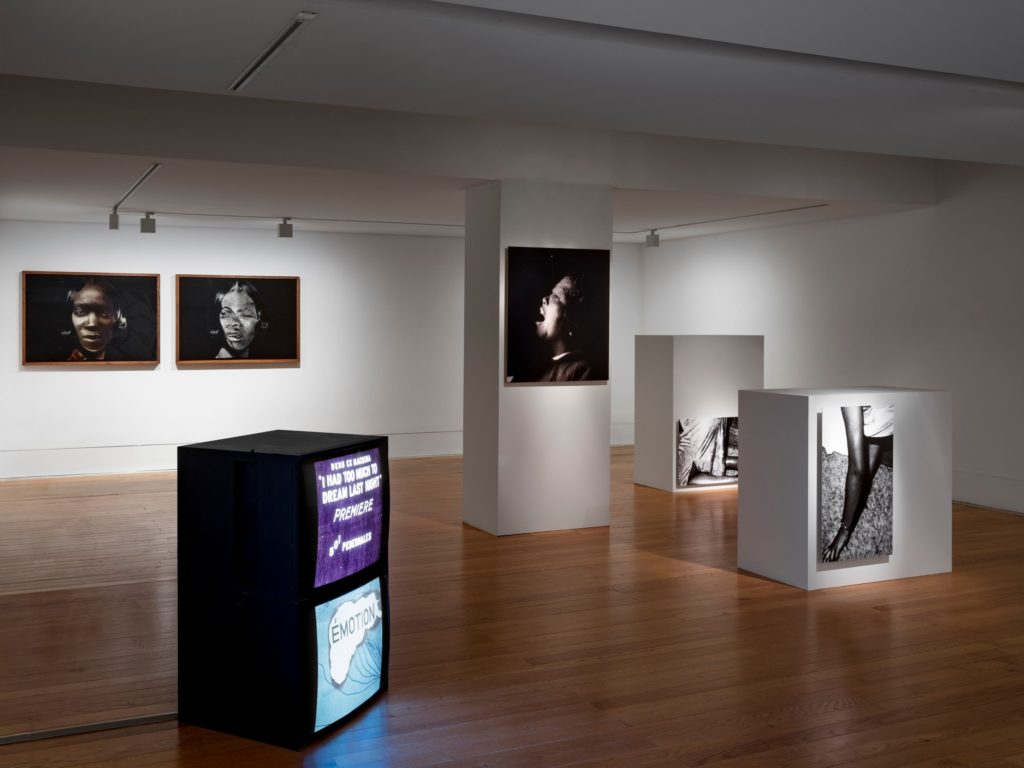
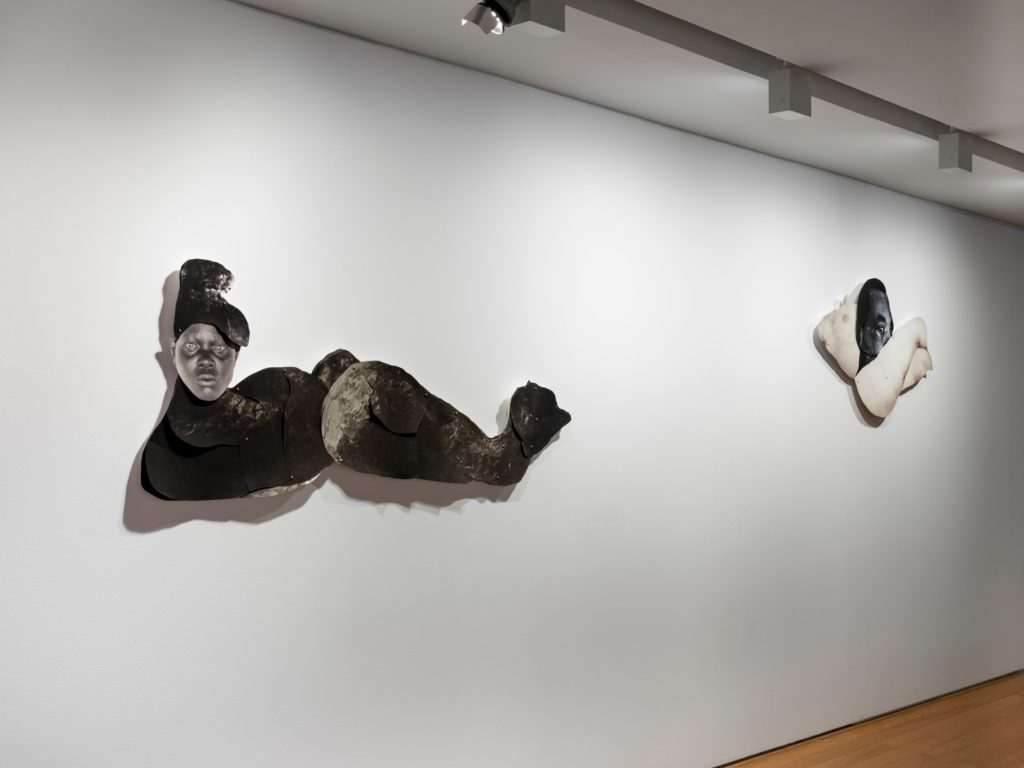
Even before we delve deeper into the show, a wallpaper crosses the entire exhibition space like a continuous flow of images materializing the logic of scrolling as the spectator is already absorbed into a profoundly familiar regime of visual circulation. In this sense, the archive becomes architecture; more than displaying the artist’s visual universe, it forces us to inhabit it. Technology makes things move too fast to be truly seen, and it is precisely that automatism that “Cloud of Confusion” interrupts. The images’ anachronism, in which colonial photographs co-exist with sculptures and video, dissolves any temporal linearity. Orupabo’s bodies exist outside historical time and become a site of rupture where different forces remain in simultaneous latency. This suspension of the gaze is already apparent in The “Haunted” House (2013), a disconcerting video that records a mapping look peering through a fixed mask. Only the eyes move, and it is precisely that economy of the gesture that interrupts and installs an uncomfortable mutuality. Here, the gaze becomes a political language, and it is impossible not to recall the notion of the oppositional gaze,[4] in which looking back is a form of agency in the face of historical regimes of racialized representation. These bodies refuse to remain as passive objects of observation and return the gaze, destabilizing the position of the observer. This reciprocity extends to the physical construction of the works themselves: distributed across several rooms, the wall sculptures, such as Discipline (2022) or Can We Pretend (2024), resemble recognizable human figures, but do not correspond to a unified body. Heads, trunks, and limbs belong to different times, contexts, and archives. Each one is a juxtaposition of fragments that have lost their individual identity to form a new one. These mutant, fierce, deeply unstable bodies and their layers represent not only a system but become the visible form of that system.
Aside from the various videographic installations made specifically for this exhibition, it is impossible to remain indifferent to the projection appearing at the end[5]. A face silently observes the visitor from afar, announcing that the gaze will never be unidirectional, but will always be there throughout the visitor’s trajectory. Even before observing the works, the visitor has already been observed. From the very first moment, the exhibition deploys a fundamental inversion: the spectator no longer occupies the comfortable place of the observer but is instead implicated in the very device of looking. This face, silently declaring, “I’m watching you,” sets the contract for this visit: we will be escorted, from beginning to end, by a gaze that is not only returned, but anticipated. “Cloud of Confusion” ultimately refuses the observer-observed distinction, establishing a relationship of reciprocity in which both are mutually constituted. Orupabo’s figures return the look with an almost unbearable intensity, revealing that every act of seeing is also an act of exposure and vulnerability. In this sense, the exhibition ends exactly as it began, under the observation of a gaze that confronts and recognizes. It becomes a mirror, and although the artist does not attempt to answer the question “Who observes whom?”, she demonstrates that no gaze can exist outside the structures that produce it. “Cloud of Confusion” makes visible the invisible genealogy of observation, reminding us that images never merely represent the world. Ultimately, the challenge Orupabo seeks is to render such violence visible, forcing us to recognize our implication in it.
[1] This is her first solo exhibition in Portugal, presented at Lisbon’s MAC-CCB and curated by Marta Mestre.
[2] @nemiepeba
[3] A concept developed by cultural historian Saidiya Hartman, in her 2008 essay “Venus in Two Acts”
[4] A concept developed by cultural theorist bell hooks, in her 1992 essay “The Oppositional Gaze: Black Female Spectators.”
[5] Cloud of confusion (2026). Images and vídeos taken from the Instagram account @nemiepeba. Edited by Laura Gama Martins