Mimmo Haraditiohadi has a collection of small wooden toy houses, simple block-like forms with hand-drawn windows and doors, their roofs painted in faded reds, blues, and greens. Although they may belong to another time, they are not rarities. Simply made and modest in material, these toy houses still appear with some regularity at flea markets, second-hand shops, and in boxes of old toys. Even for those who did not grow up with them, they feel immediately familiar. They seem like the materialized idea of a house, the concept itself brought into form: each one different, yet each instantly recognizable, with subtle variations within this limited set of characteristics. Their charm lies in this radical simplicity, in their reduction to a few basic shapes, where roof, wall, window, and door become the basic signifiers of the archetypal image of “house.”
The first work I saw by Haraditiohadi was Der Sägefisch (2023), consisting of three paintings of sawfish, each canvas holding a single fish’s snout and head against its own color field: a cold gray-blue, an acid yellow-green, and a bruised violet-pink. Across the three canvases, the motif remains formally close. One has a few more teeth, in another, both eyes happen to be visible, yet they read less like separate fish than like variations on the same imagined motif. With their button-like eyes set unusually far forward above the teeth and their broad triangular spikes along the saw, the images move toward cartoonish exaggeration. Once noticed as such, the actual animal itself begins to seem absurd. Mimmo didn’t paint them from a photograph or from life, but from whatever picture the word “sawfish” evoked in his mind. The works follow the logic of the common name: an idea of the animal rather than an observation of one. Only a few viewers would know or look for the anatomical markers that distinguish a sawfish from a sawshark. The paintings keep only what is needed for recognition and leave out what would make the animal specific, showing how little knowledge is needed to establish an image, and how confidently that image can stand in for the thing itself. The gap between what the animal is and what we have quietly decided it looks like.
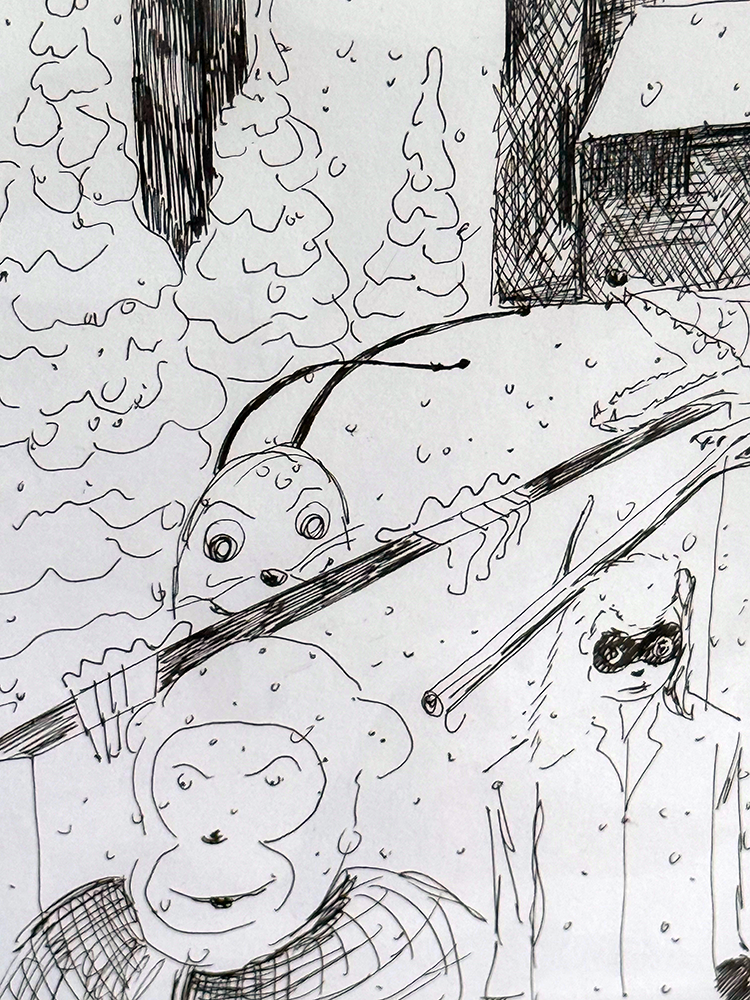
More recently, Haraditiohadi has been drawing a cast of small-time animal crooks, rendered in a dense, crosshatched pen technique that recalls Dark Romanticism, like illustrations by Alfred Kubin or James Ensor, while their wobbly lines and gloomy interiors also bring to mind the phantasmic edge of comics. Each figure wears a domino mask, that old device for marking someone as a villain. As a piece of visual shorthand so outdated that it barely gets used anymore, it still reads instantly. The mask reduces the crook to a few agreed- upon signs, the minimum needed for the type of crook to become recognizable. Some motifs and images work long after the thing they were drawn from has disappeared, held in place by collective memory. What the masks no longer do, however, is make the crooks look dangerous. Their eyes, wide and a little too round behind the cut-out holes, give them away as anxious rather than in control, which is presumably why Haraditiohadi calls them “worriers,” a pun on “warriors” that leaves them braced for trouble rather than causing it. It is tempting to place them next to Peter Wächtler’s washed-up figures of failure, who carry a real, particular pathos of their own. Haraditiohadi’s characters carry none of that individuality. Their faces are masks in the most literal sense, interchangeable from one drawing to the next; the crook becomes a type whose only specificity is a disguise, a marker of identity designed to erase it.
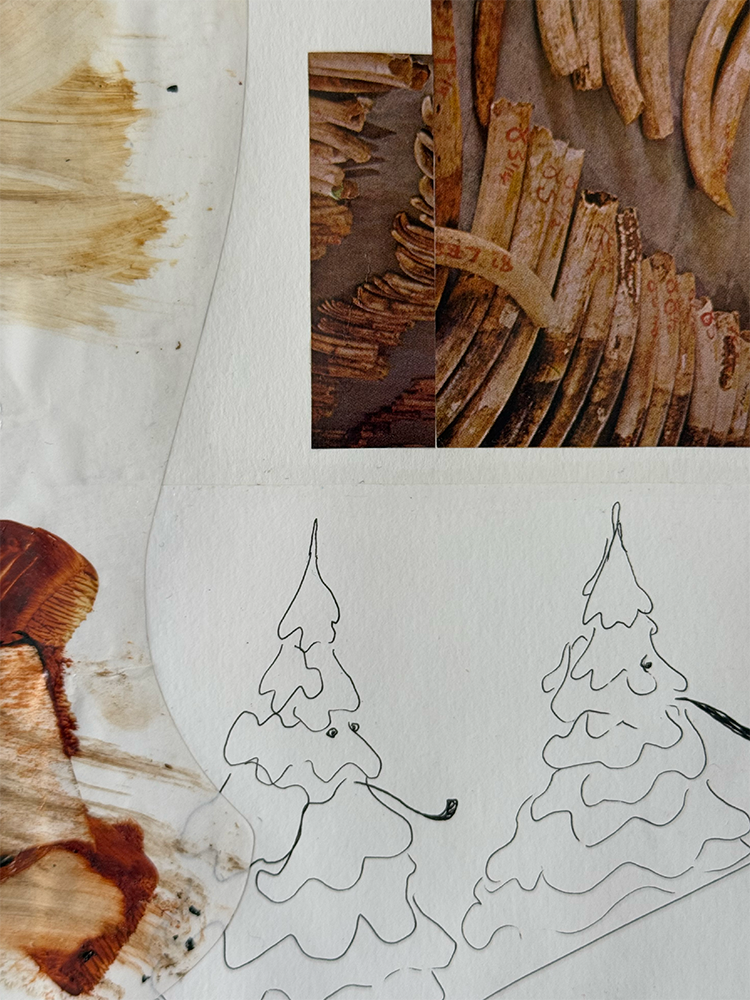
Among his protagonists that have stayed with me is another unnamed figure: often small, dark, and faceless, appearing as little more than a black silhouette, sometimes with a walking stick or a hat, sometimes as a humanoid beetle seen from behind. It often stands alone, without a mission, inside surroundings that seem just as familiar and unspecific: stylized forests, snow-covered paths, distant houses, villages reduced to roofs and walls. The lone wanderer is one of those tropes that has been lodged in collective memory for more than a century. Unlike the solitary figures in Romantic landscape painting, set as small points of relation against overwhelming nature, Mimmo’s version is far more prosaic: there is no sublime encounter, no illusion of an expansive world. The figure remains graphic, almost cut out, while the landscape is assembled from reduced, familiar elements. And yet the images arrive at atmosphere through reduction. Their abstraction is a form of concentration: a simplification of form and motif through which very little is needed to produce an otherworldly unease. This estrangement does not depend on the figure alone, as many of Mimmo’s pure landscapes show.
Even without a wanderer, his environment feels familiar but not quite inhabitable. Where the figure does appear, it sharpens this misplacement. In Visitors (2026), for instance, the man with a walking stick stands beside another figure, yet the space that would make either of them belong remains withheld. The title itself does much of the work: to be a visitor is to be present without fully belonging. The figure becomes a lonesome character stranded in a world made from familiar signs.
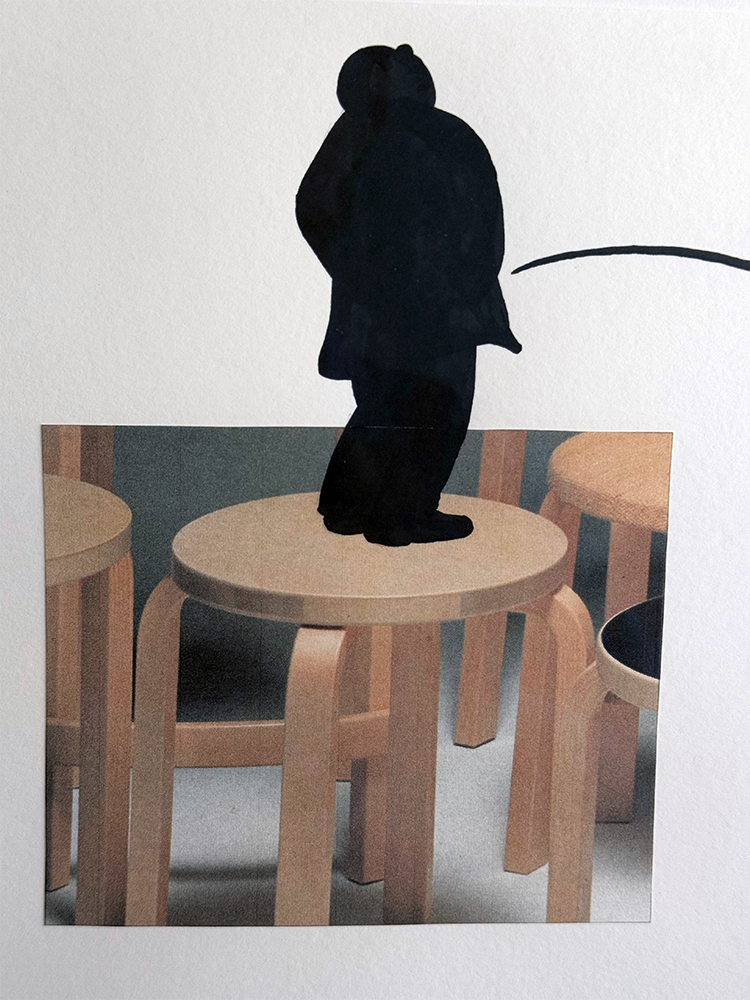
This sense of displacement becomes more tangible in the works Finnish Wood 1–8 (2025), in which the figure is placed within photographs of stools and chairs, as if it were a small, puckish protagonist peeing down from them. As in the landscapes before, familiarity comes with an ambiguity of specificity. The photographs show design classics, highly specific and yet strikingly generic: forms developed through reduction to embody the type “stool.” In this, they recall Haraditiohadi’s wooden toy houses, which materialize the idea of “house” through the simplest possible form. Photography adds another layer to this familiarity, carrying with it the promise of a real object, something that once stood in front of the camera. Against this indexical ground, the shadow figure appears as a graphic intrusion, unknowable and cartoon-like, belonging to another order of reality. Mimmo’s addition tilts the image into the haunted. What should be stable — furniture, function, domestic design — becomes a plinth or stage for the figure’s cheeky relief.
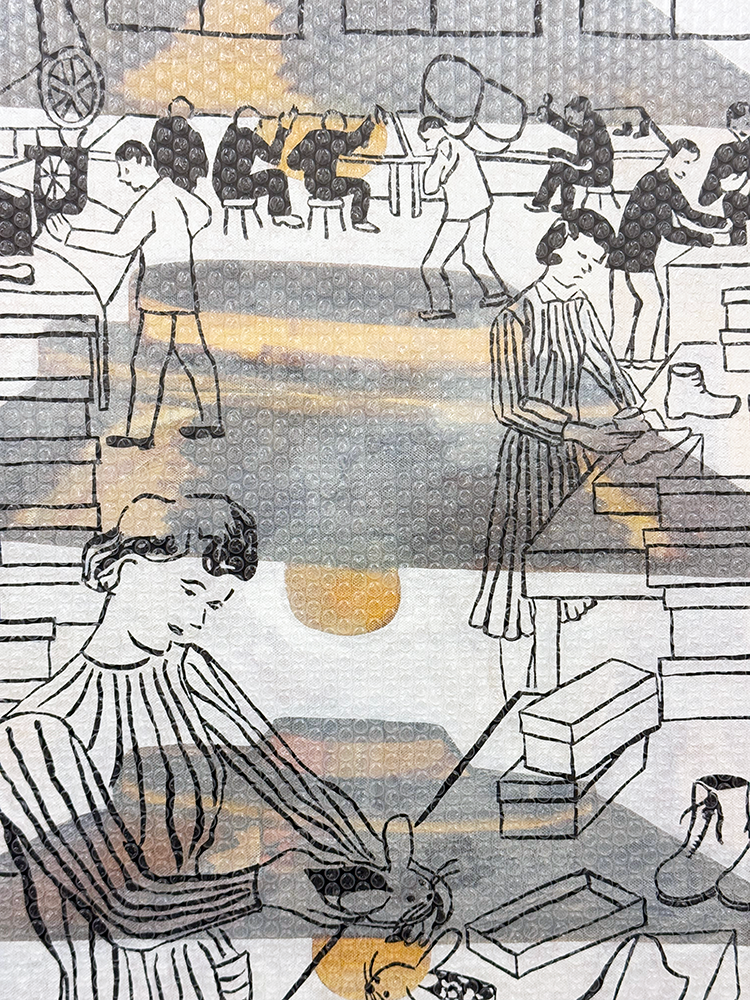
This estranged familiarity is closely tied to its apparent genericness: Haraditiohadi’s images often seem approachable, while quietly refusing to lead back to one specific source. This also helps to understand the works in which he draws on the language of older illustrations and comics. The references feel familiar without becoming immediately identifiable: no specific character or image one could name, but a shared illustrative iconography, already half- remembered before it can be located. Often, the graphic element appears as the last step in his works, placed over an already modeled ground. In the painting Lampen (2026), for instance, three sharply rendered lampshades form the underlying image, while a black-and-white illustration from an old children’s book is redrawn across them at a larger scale. Rather than making the motif look simply vintage, this graphic step exposes a procedure: an already modeled image is interrupted by line, and the redrawn illustration begins to suggest a scene, even a fragment of narrative, while making the image itself less stable. What first appears as a painted arrangement of lampshades starts to shift between object, backdrop, and stage, while the illustration on top keeps slipping between a narrative scene and a graphic sign.
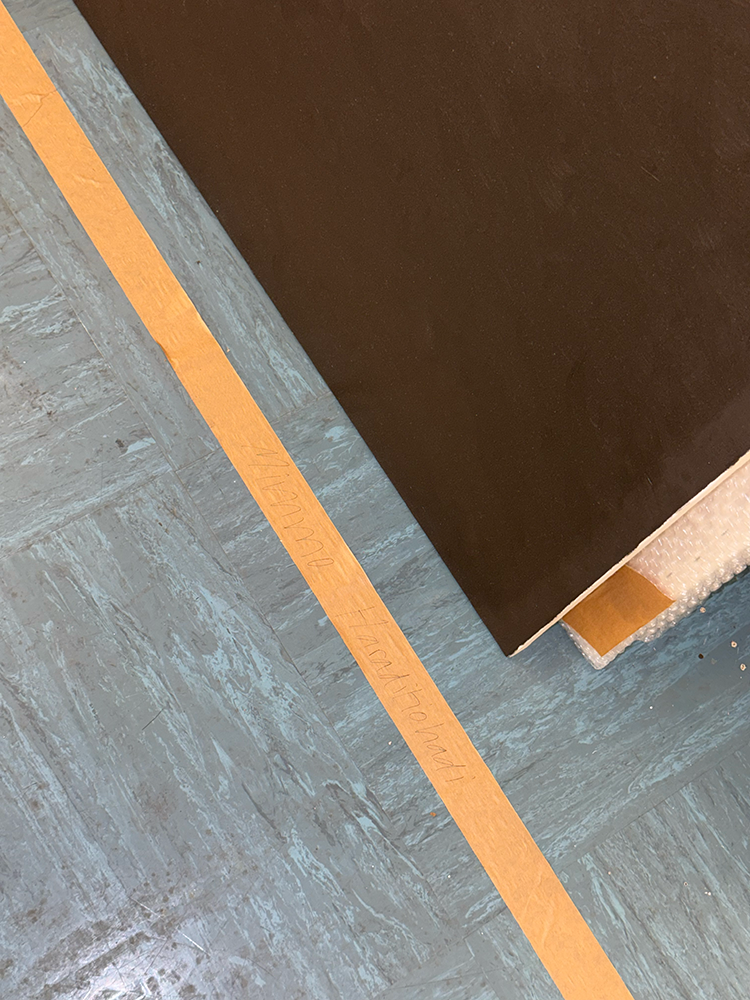
A similar procedure returns in the most recent landscape paintings Haraditiohadi showed me. They begin with photographs taken during walks he takes with the group of people with dementia he works with. From there, Haraditiohadi acts on the found image material by adding snow to the motif or altering the buildings into closed cuboid forms with pitched roofs. Snow becomes an artistic intervention into the source material, covering detail, softening specificity, and shifting the landscape toward abstraction. Yet the scene never becomes fully nonobjective. It remains suspended between a particular place and a pictorial type, between landscape and typology. The houses, too, return as basic volumes, close to the same vocabulary of reduced forms that runs through the toy houses and the drawings.
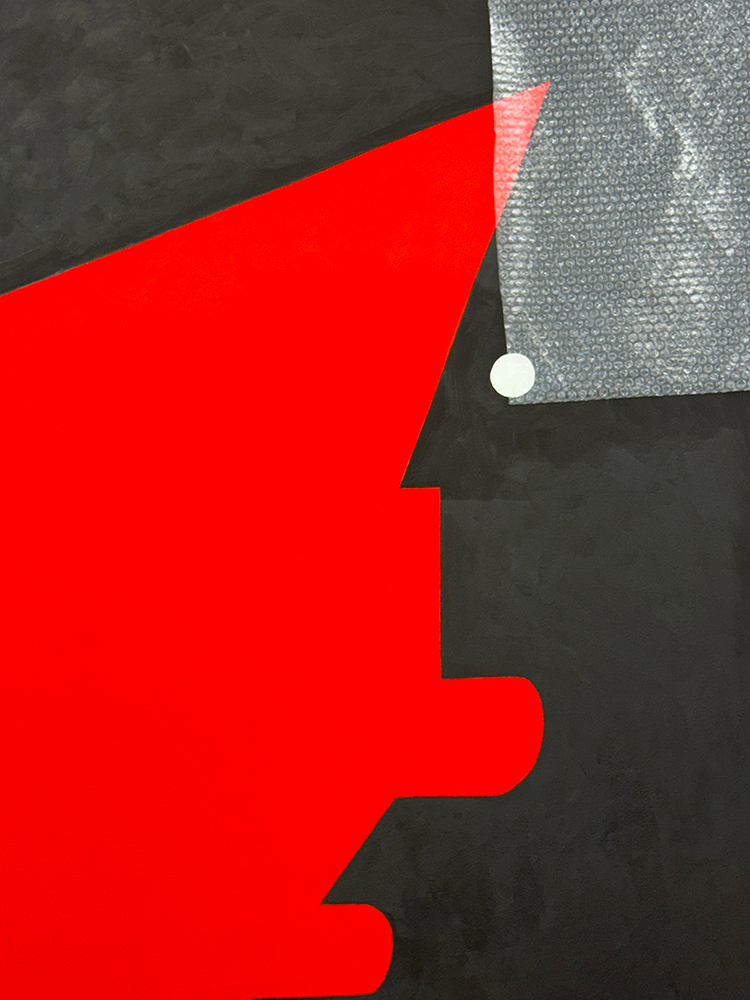
In one of the latest works in this series, Untitled (Paths and Lines) (2026), Haraditiohadi paints a black cross over the landscape. At first, the mark may read as a negation of the motif, but it also works as a decisive reattachment: a gesture that pulls the image back to the surface and makes visible the artist’s handling of the source material. Like a kind of tipping image, the painting no longer settles entirely as either a landscape or an abstract composition; it keeps switching between the two. In this sense, the cross clarifies a procedure already at work in the images with the peeing shadow figures and in Lampen: a familiar ground is subjected to a graphic intervention. The small shadow figure on the furniture, the redrawn illustration over the lampshades, and the black cross over the landscape all act on an existing image, suggesting either a scene or artistic control over common tropes while destabilizing the image beneath. The work still carries the old promise of the image as a window into another world, while the graphic flatness of the overlay recalls Clement Greenberg’s insistence on the self-reflective painting as a made surface.[1]
In Haraditiohadi’s place, the return to the surface reads less as autonomy of the image than as artistic agency over images already in circulation. It belongs to the same graphic mode of working that appears elsewhere in Haraditiohadi’s practice: a movement from representation to illustration, from illustration to graphic art, and from graphic art toward abstraction, without letting the image fully leave the world of recognizable things. Across these works, the supposed genericness of Haraditiohadi’s subjects always carries imaginative potential. Houses, stools, wanderers, lamps, and snowy paths appear as forms already carried by collective memory, by design history, by children’s books, toys, and the everyday images through which things become recognizable. They embody ideas as much as objects. Again and again, they keep what is needed for recognition and leave out what would make the subject specific. Their familiarity depends on this reduction, but also on circulation: on the fact that they seem to have passed through many hands and many images before arriving here. Later, Mimmo tells me that he does not keep the little wooden houses for himself. He likes to give them away. They have no fixed place, and so they continue to circulate. At the end of my studio visit, he says in his gentle and generous way: “Please choose one, I have more.”
[1] For painting as a window into another world, see Leon Battista Alberti, On Painting: A New Translation and Critical Edition, ed. and trans. Rocco Sinisgalli (Cambridge: Cambridge University Press, 2011), 39; for Greenberg’s understanding of modernist avant- garde painting as foregrounding the flatness of its medium, see Clement Greenberg, “Towards a Newer Laocoon,” Partisan Review 7, no. 4 (July– August 1940), 296–310.