Kaare Ruud’s artistic practice unfolds within interiors and their overlooked margins, where disparate belongings accumulate without clear hierarchies. These materials resist clear interpretive guidelines, operating instead through partial recognition. Objects from one’s own childhood or mundane daily life recur: abandoned Formica tables; wristwatches; the distinct but loaded contents of a father’s nightstand drawer.
All these items were part of the recent exhibition “Business doing pleasure with you” (2025) at Femtensesse in Oslo. The gallery is located in what used to be a milk shop in the 1930s, an architectural example of constructive Scandinavian functionalism, aligned with the ideological rise of social democracy. In the exhibition, familiar perspectives were twisted; a child’s perception and position were manifested by seven tables that wobbled on oversized metal legs, with tabletops facing the ceiling. By positioning viewers beneath the tables, the installation enforced a physically subordinate viewpoint.
Three drawers were mounted low on the wall, filled with a curious assortment of trinkets — such as keys and picture frames — rediscovered from Ruud’s childhood home, without further composition. Ruud had spray-coated and treated the surfaces with fibers to resemble deep red, blue, and green velvet. The unpresentable — junk and minor necessities banished to the drawer — now had an aura of soft and uniform oblivion. The drawers resembled sentimental jewelry boxes caught in a fuzzy time capsule, muffled and exuding sabotaged functions. The artist himself describes these drawers as homes within a home, not meant to be seen. Each drawer suggests an interiority that remains private and inaccessible.
Ruud, through simple measures, manages to activate various sculptural tableaux with great precision. Objects seem to have been pulled out of abandoned interiors, processed, and invested with heightened attention. What others would see as trash gains personality. Time can be said to freeze but tick on relentlessly. One piece in the exhibition, Clockwork (2025), is made of clock mechanisms whose swarm of hands forms the word “STAY” once a day, for anyone fortunate enough to be present at 12:35. Everyone knows that even a broken clock is right twice a day. For the remainder of the day, the dispersed clock hands resemble fine, erratic markings across the wall. The treatment of time and the suggestion of loss seem effortless and light, achieved by a sleight of hand. Perspectives and scales appear consciously undefined in Ruud’s works. The animated objects convey craft confidence and intuitive invention yet refrain from engaging in clever arguments. Instead, they are anything but dogmatic; rather they are empathetic, even earnest.
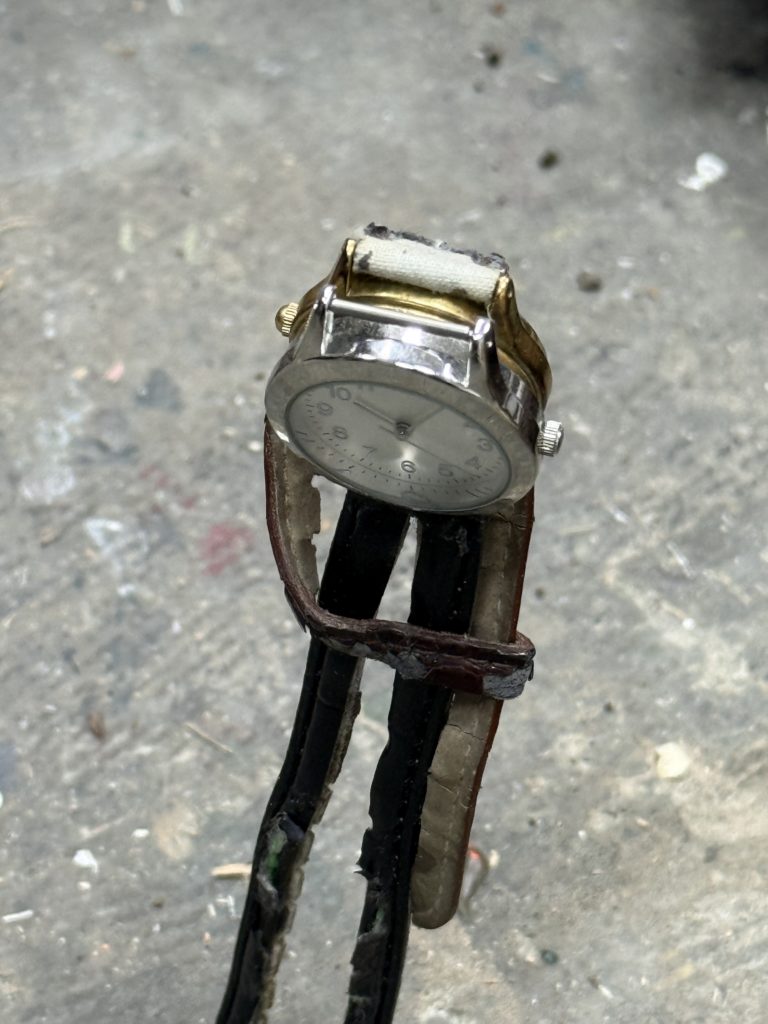
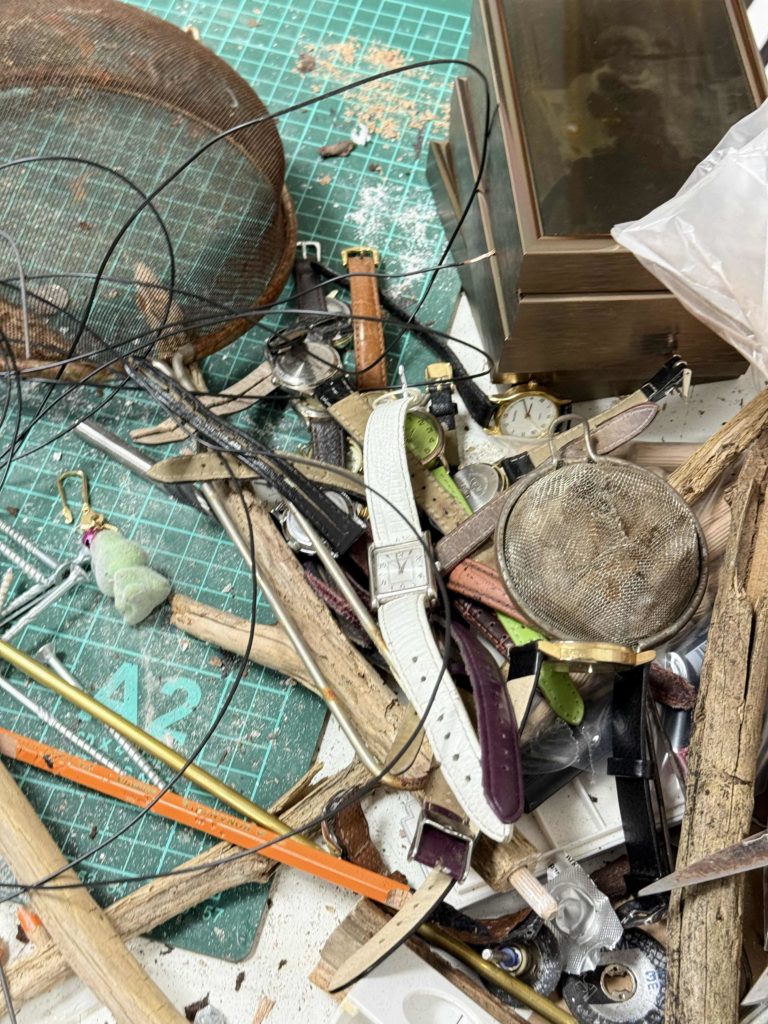
This disarming quality attracts people, as seen at Paris Internationale 2025, where Ruud exhibited reworked wristwatches found at Parisian flea markets. Mounted as a group, there was a fluctuating balance between the number of viewers and the number of watches. Split watch straps acted like outstretched arms and legs — gesturally expressive, conveying both something curious and awkward. Some appear awkwardly exposed, as if caught between display and withdrawal. The watches resist posing or asserting significance. The slender outlines, once functionally ticking on wrists, now embody a state of playfulness. Time’s strict framework is brushed aside, and the moment is open, at least for a little while. Untitled Rose Sculptures (2022) also express this nearly impossible fragility, like a three-dimensional croquis drawing. Withering red roses project slapstick, embracing each other or climbing up a wall.
This suspension of fixed roles recalls Simone de Beauvoir’s philosophical essay Pyrrhus and Cinéas (1944), in which the human situation is compared to a child’s amusement in trying out various roles before realizing they have ended up in a world full of fixed things and standardized objects. Within bourgeois thought, the world is understood as something fixed and stabilized. Ruud, however, seems to insist on a raw slice of the absurdity of material life in contrast to generic scenarios — for instance, art-making as anti-digital protest. In the group exhibition “Dizzy Spell” at MELK in autumn 2023, Ruud installed an old, withered window found in Bulgaria, a readymade filled with minuscule debris such as creaking bits of dry leaves and dead insects. An echo of Duchamp’s The Bride Stripped Bare by Her Bachelors, Even (The Large Glass) (1915–23), upon which dust was allowed to accumulate as part of the composition, is one of several possible threads here, even though the paraphrase of the avant-garde is understated. Ruud opts for relaxed poetry rather than hardcore conceptualism.
Objects become protagonists, but what kind of narrative do they carry, and what do they want from us? In George Perec’s 1965 novel Les Choses, the young couple Jérôme and Sylvie are lost in material dreams. In the book’s opening pages, the ideal, tasteful home is rendered in great detail, room by room: a divan in matte black leather, books scattered haphazardly in a cherrywood bookcase, an old nautical chart. With Ruud, the world of objects is markedly less stylistic, lacking outward aspiration. Emotionally tactile and dug out of stacks of memories, they are anything but arrows shot into a promising future. Rather, they are an expression of collapse, both conceptually and materially. The material is clearly physically inadequate; it can crumble at any moment and is burdened by memories and decay. Nevertheless, Ruud’s remakes are grafted with a narrative spark and potential force, whereby everything and nothing carries meaning.
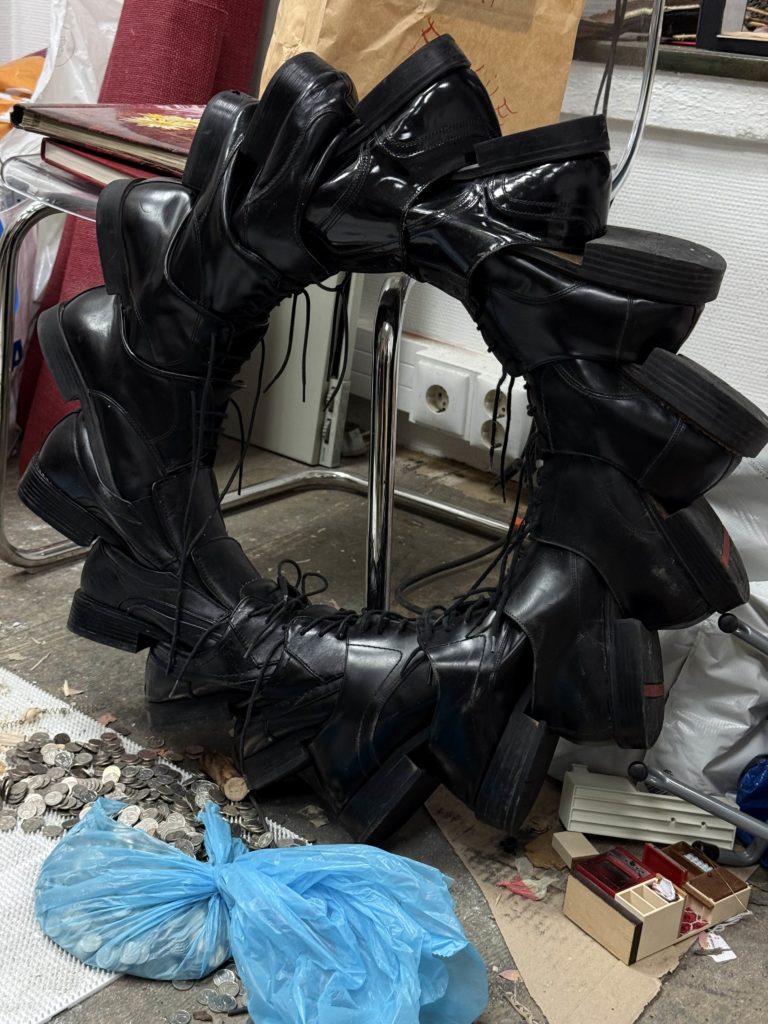
A group of low-mounted nests, Portrait of Matter (2024), exemplifies this logic with particular clarity. The three bedraggled bird nests have been hastily cobbled together from various makeshift objects — dust bunnies and straw, twigs and toothbrushes, carnations and cigarette butts. Yet these small and insignificant things take on a kind of necessity and gravity. In Ruud’s own phrasing, he runs with his heart in his hand toward the wall. Ruud literally swept the floor of his father’s home after his death, and these nests emerged as a direct and accidental result. The material forms a fragile mental image of precarious temporariness.
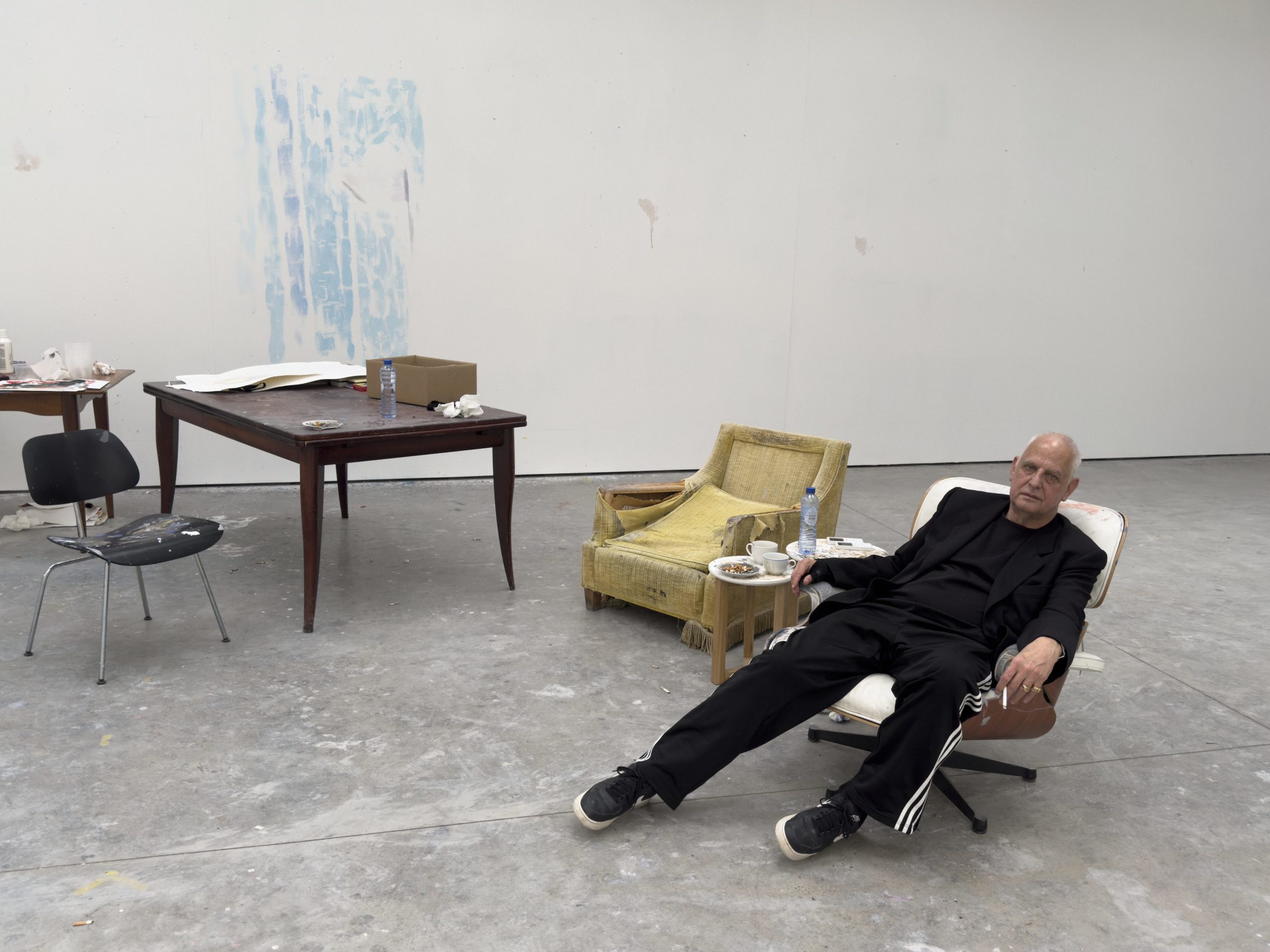
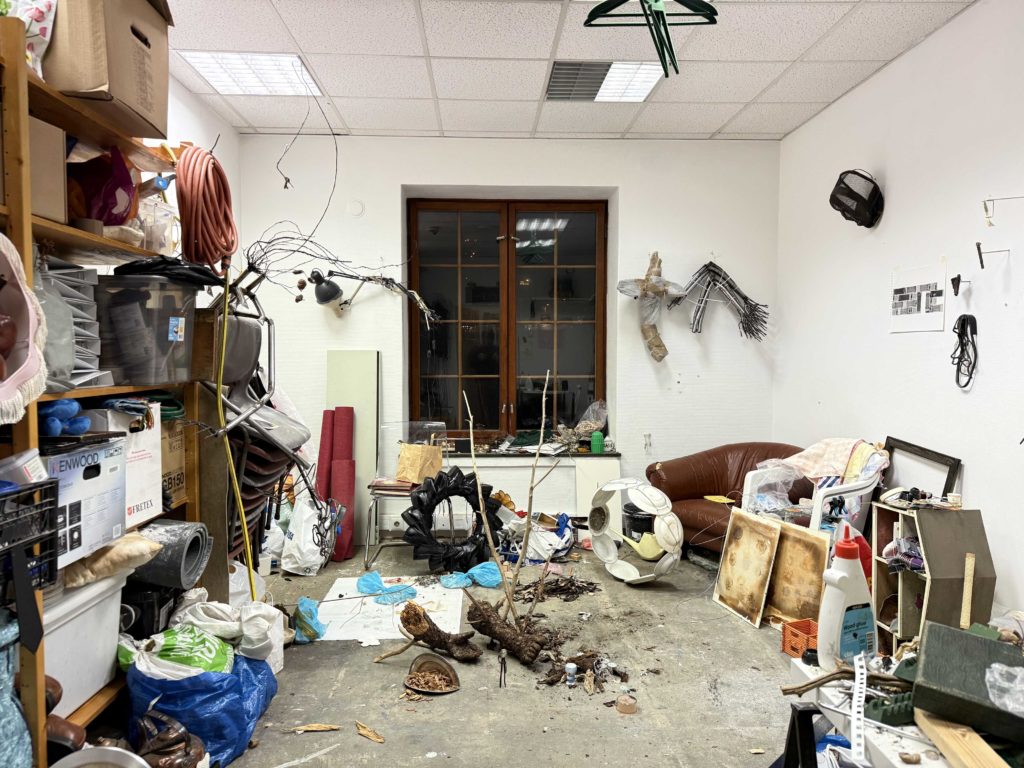
Home and studio, the private and universal, are constantly in correspondence in Ruud’s work. When we met for a conversation just before Christmas, he talked about the difference between remembering and recollecting — how memory and trauma enter from the outside and alter the path you are on. How typical it was that we ended up sitting on a sofa in the hallway outside his studio — it was too messy in there — when studio practice is, after all, part and parcel of his art. The stockpile of chance materials accumulates ideas. Gulping down coffee and Moomin biscuits, I glimpse a teeming mass in the studio behind me.
Ruud graduated from the Oslo National Academy of the Arts (Kunsthøgskolen i Oslo, or KHiO) in 2020 and has since maintained a discreet yet distinct presence on the Norwegian art scene, primarily within Oslo’s still-vital circuit of artist-run galleries, where Ruud also contributes as a curator. There is a generosity in this engagement that feeds into the backbone of the increasingly precarious position of art within larger society. If the studio can be seen as an ongoing gathering of talkative recycled things, a place where production and processes are set in motion, collaboration in a broader social sense is a premise for Ruud’s art. As a curator he has challenged institutions and artistic practices in playful and irreverent ways. Otherwise closed or invisible spaces have been highlighted.
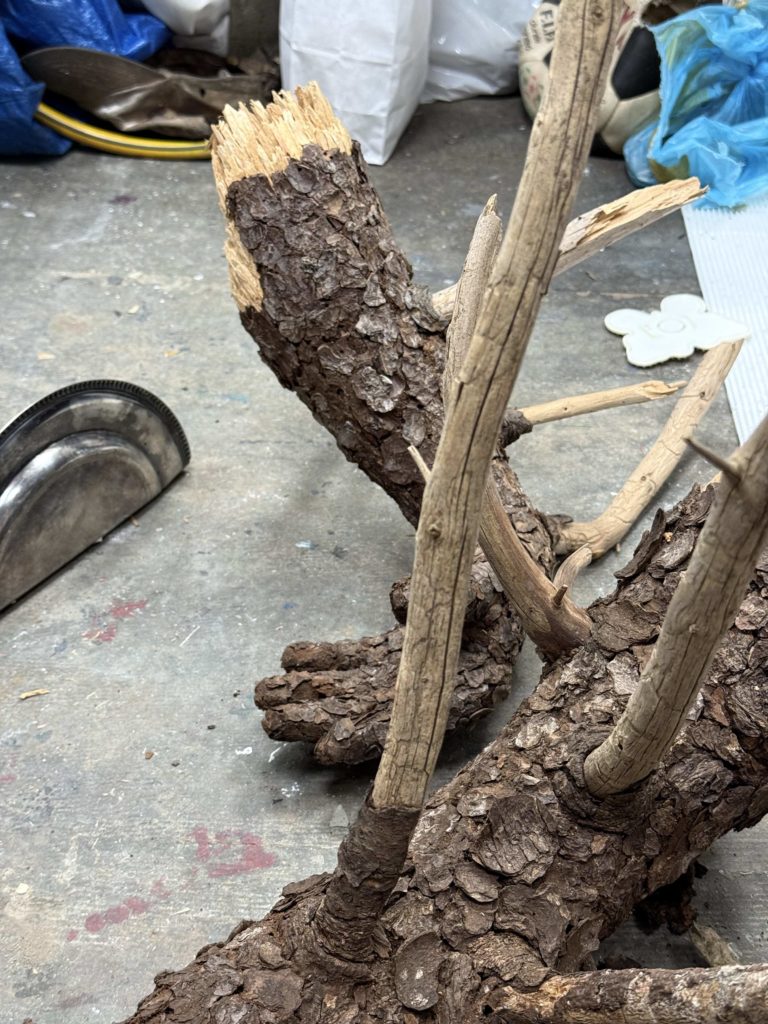
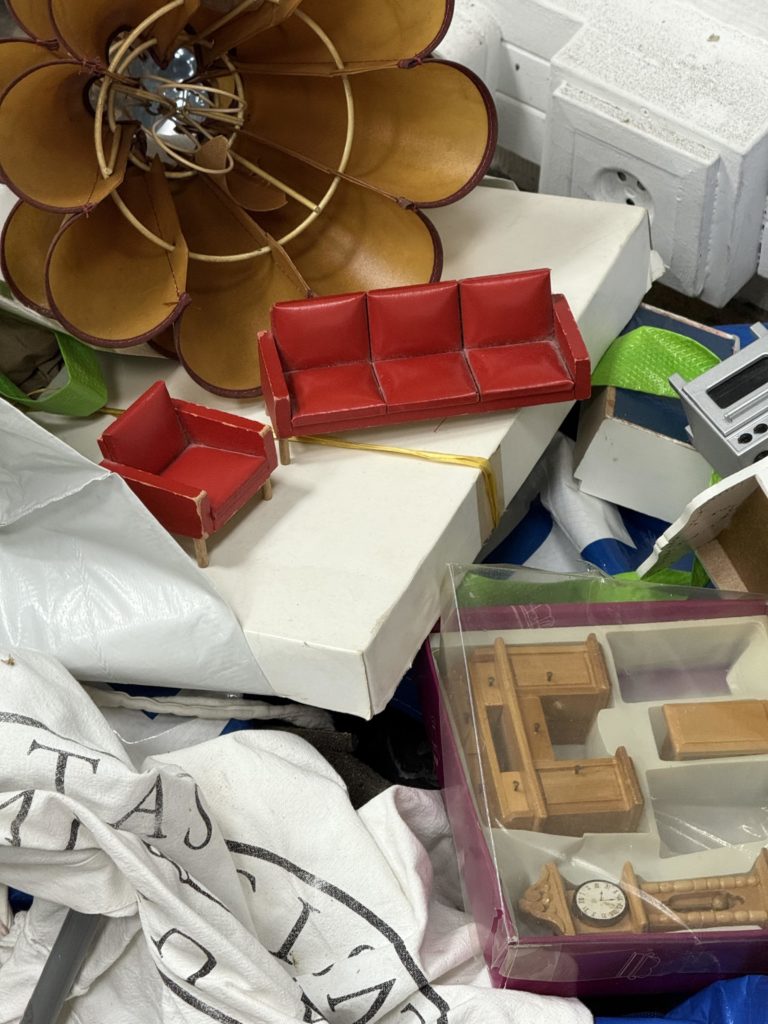
In the 2024 group exhibition “Where are my dreams stored?” at Hulias, an artist-run space in Oslo, Norwegian sculptor Ørnulf Bast (1905–1974) was present through the remnants left in his studio. Bast is particularly known for his many sculptures in public space, not least the two decorative bronze lions gnawing away at the lampposts outside the artistic bastion Kunstnernes Hus in Oslo. The exhibition was crafted as a posthumous narrative, turning dreams into physical manifestations focusing on Bast’s various studio experiments. The works, carried out in solitude and not necessarily intended for anyone’s gaze, echo the privacy found in Ruud’s own sculptural drawers. Based on Bast’s sketches and photographs, Ruud created contemporary installations of long-dormant ideas now brought to life in a gallery space. Bast’s sculptures and plaster fragments — some displayed in the crates in which they were found — were rearranged with things such as flowers, stones, and shells. The result was highly atmospheric, at times surreal. An overarching theme was the artist’s legacy: How can it be managed? The exhibition resonates with the films of Dag Johan Haugerud in its active and humane dismantling of established boundaries between the public and the personal. The possibilities of community are sketched as provisional and mutable. Everything remains underway and in motion, demanding to be stretched and bent.
In spring 2021, Ruud was orchestral in the group exhibition “Album/Volum” at the Norwegian Sculptors Society, during which the venue underwent a similar reversal of ossified form. The old wooden villa housing it was more or less turned inside out, with the entrance relegated to the basement. As a result, the villa itself was dramatized, placed upon an imaginary stage.
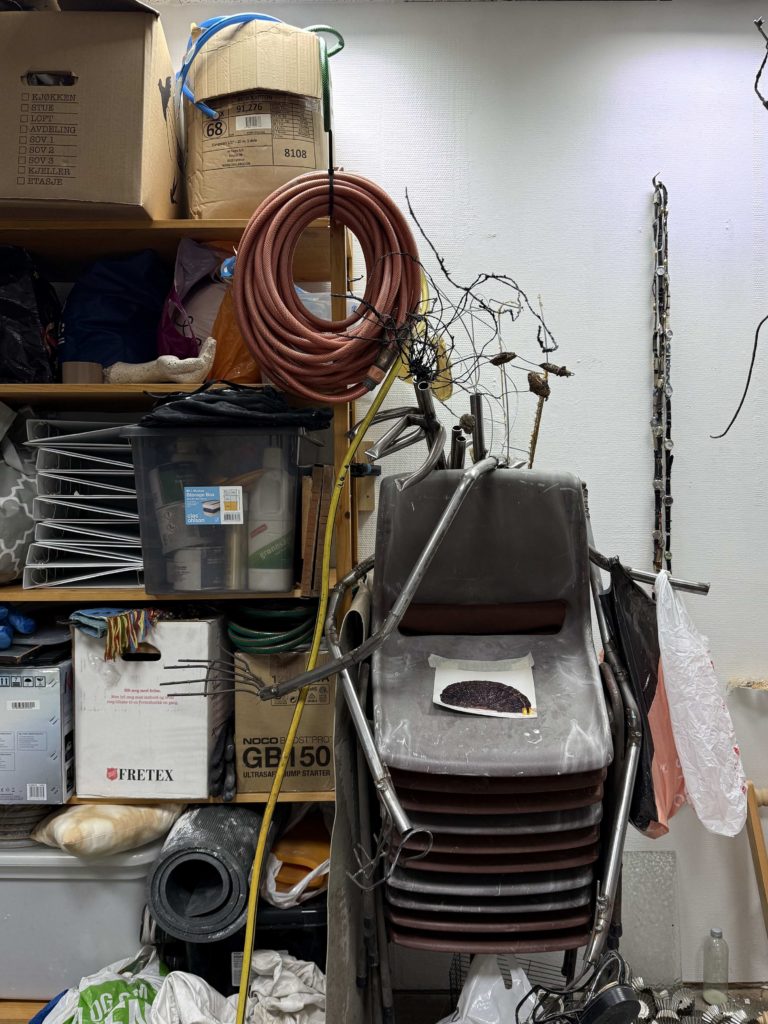
What had previously been stowed away in the cellar was now displayed in the main hall, with works by Ruud and colleagues scattered throughout the house and the backyard, where Ruud had set up plastic chairs pierced by black cable ties like long spikes. Artist colleagues were invited by Ruud to intervene; others were represented by reframed works that roamed freely about the house, stored over time from various exhibitions and perhaps forgotten. Ruud had, among other things, installed a green garden hose that wound through the basement like a snake, with nozzles poised to bite. Collective history hisses like a snake if it is brought to life or disturbed.
In the ongoing series “Untitled Pencil Sculpture” (2022–), the house that ties together the loose ends in Ruud’s work is more than a meaning-laden container; it is the subject itself. Ruud has built a number of houses using pencils in different colors as building blocks, so they resemble notched log houses. The everyday pencil one doodles with becomes an extension of the hand, perhaps full of nervous bite marks. The house sculptures hang freely in the room, at the height of the artist’s heart. Even if they might look like standardized models, they share a common source, since they all portray actual houses from Ruud’s hometown of Gausdal, Norway. These are spaces he has been in, each with different communal functions such as a prayer house, the local sheriff’s residence, and a pigsty. Seen from the outside, as a stranger, the structures become both legible, in an apparently technical way, and quite enigmatic. Memories hidden for the viewer are concretized in physical form, constructed at a distance yet constantly threatened by collapse — as fleeting as a pencil line.