Merde. This is the first thought that takes shape in my head once I’ve acclimatized to the mammoth undertaking that I’ve just agreed to. Koyo Kouoh may have titled her Venice Biennale “In Minor Keys” to underscore the need for communal listening, for tuning in to quiet, poetic moments that reveal themselves slowly, with time. Yet time is the very thing in shortest supply during every single Biennale pre-opening week, as queues spring up like mushrooms after the rain and the beckoning pull of a Cynar spritz is only ever two steps away. I have never experienced jealousy quite like watching other writers and editors scurrying around from the Giardini to the Arsenale and back again, trying to squeeze in an opening in a far-flung corner of Giudecca, followed by an hour- long private boat ride to an abandoned island before making it back in time for aperitivo, dinner, and at least two It Parties at night. Experience has taught me that making plans in Venice is equivalent to setting oneself up for failure, yet the first hours back in the Laguna already had me hyperventilating from my carefully cultivated lack of preparation. Call me a masochist, if you will.
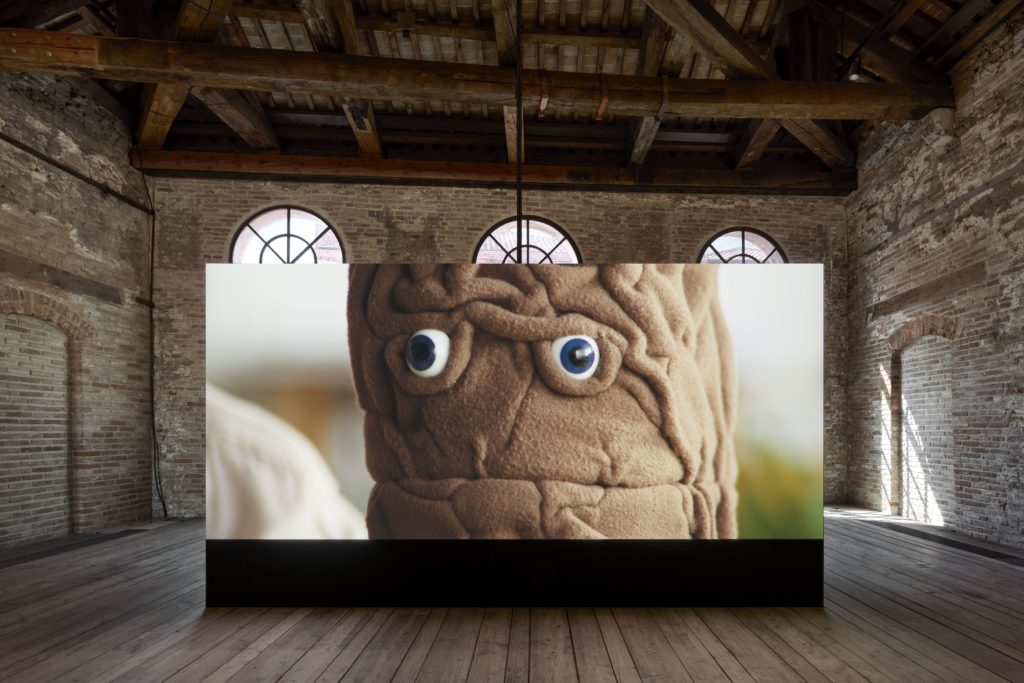
With this in mind, and feeling somewhat giddy, it only makes sense to make some quality time for La Merde (2026), Aline Bouvy’s film project for the Luxembourg Pavilion, in which the protagonist is a humanoid lump of shit. In her signature humorous style, Bouvy offers up a modern-day fable in which excrement is not only lifted out of the annals of history to take on the lead role, but it effectively becomes our dirty (and dirty-minded) doppelgänger, the one we hastily push under the carpet in the hope that no one else will notice. In a bar, an initially prudish woman finds comfort and solace in the gooey, brown folds of the embodied turd. In a performance later on, the leery-eyed figure proceeds to handpick candidates for public humiliation and discomfort. In both cases it is shame, the instrument which Western society and culture uses to reject and sideline those of its choosing, that gets a starring bill. As far as toilet humor goes, Bouvy is on a par with Jonathan Swift, whose seventeenth-century satirical essays, novels, and poems, such as A Beautiful Young Nymph Going to Bed (1731), used scatological themes to bring to light the societal hypocrisies of his time. If cleanliness is next to godliness, then we should take a good look around and climb down from our moral high horses.
This year’s Biennale is marked by loss, pain, and disappearance more than any other in recent history, so perhaps it’s unsurprising that humor and the absurd appear in different guises across various projects in town. Because sometimes, what else is there left to say? Not that anybody needs a recap at this point, but the days preceding the Biennale and the pre-opening week resembled something akin to the plot of a telenovela crossed with a Hollywood thriller. On April 30, mere days before the VIP opening, the international jury selected by Koyo Kouoh issued a collective resignation letter, citing their Statement of Intention, published one week earlier on e-flux, as the reason for their mass refusal to comply with business as usual, and in which they promised to “refrain from considering those countries whose leaders are currently charged with crimes against humanity by the International Criminal Court.” Let’s call the elephant in the room by its name, or rather their names: Russia and Israel. Add to this the heightened carabinieri presence; Israel’s relegation to the supposedly safe haven of the nearby Arsenale; a Pussy Riot and Femen-led joint protest in the Giardini — pink balaclavas, colored flares, and punk music in tow — that forced the temporary closure of the Russian pavilion; and the first strike in the Biennale’s 131- year history on May 8, organized by the Art Not Genocide Alliance (ANGA) together with local activist groups, which resulted in the full or partial closure of over twenty-five national pavilions. Top it all off with reports, originally published by Italian news agency Adnkronos and then relayed to an international audience by Hyperallergic, that the real reason behind the jury’s resignation was a threat by Belu-Simion Fainaru — the artist representing Israel — to file a lawsuit in the European Court of Human Rights for “racial discrimination” and “antisemitism,” potentially leaving the jury members exposed to being “held personally liable for damages in case of a dispute,” and writing about the actual art begins to feel like a futile task worthy of Sisyphus.
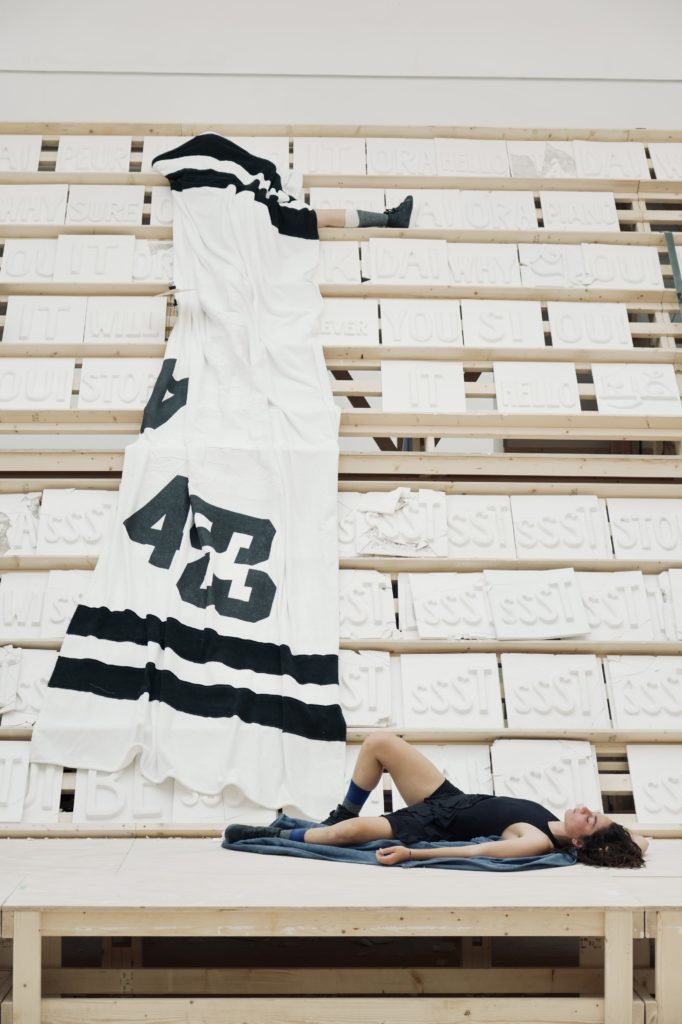
Forgive me, then, if I seek occasional respite in an uneasy laugh. Historically, fables have served the purpose of influencing public opinion by embedding moral lessons within their stories. In the darkened Czech and Slovak Pavilion, Jakub Jansa’s standout film The Silence of the Mole (2026) centers on the anthropomorphic titular character of a beloved children’s animated series that first aired in the 1950s, and more specifically on Mr. M., the performer who embodied the character of the mole his whole life. Acting as a substitute for life becomes a double-edged sword as Mr. M. transforms into an increasingly Kafkaesque figure teetering on the brink of emotional and psychological collapse. In one scene, he asks, “Will we be good today?” to which the answer is a resounding: “No, no, no way.”
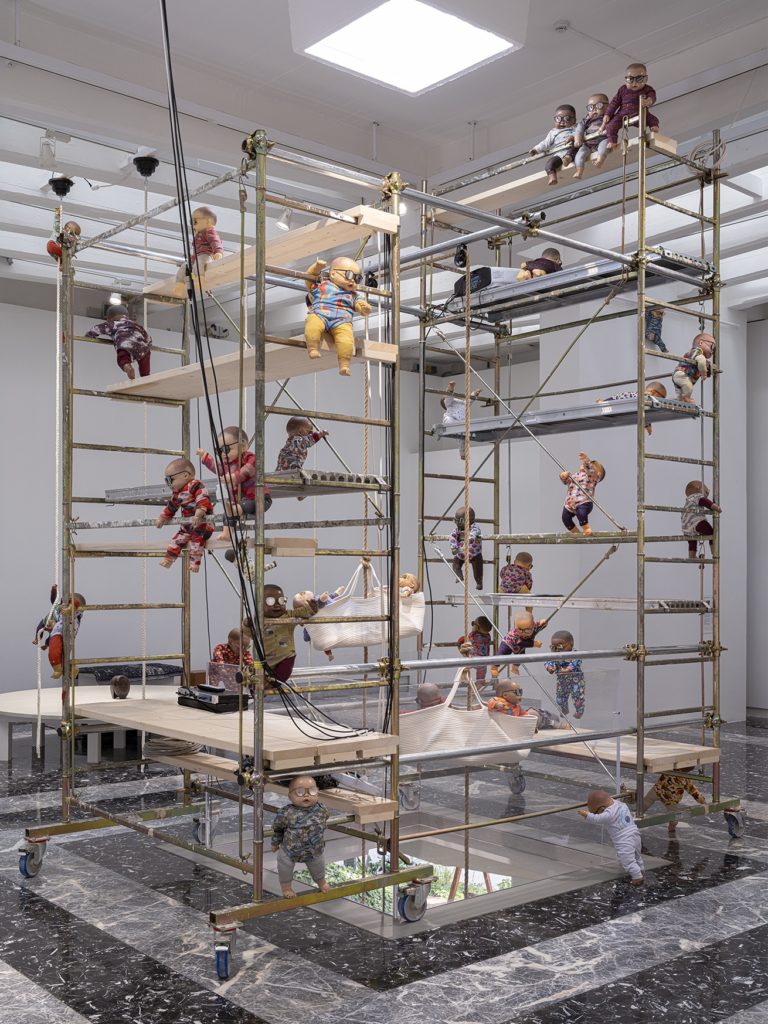
I’m still pondering the inherent meaning of “goodness” in today’s global shitshow, framed by megalomaniacal madness and the daily pressure exerted on anyone’s sense of humanity, when I gingerly step into the Japan Pavilion where Ei Arakawa-Nash has assembled a nursery of more than two hundred baby dolls. Ignoring the fact that visitors are meant to carry a doll while surveying the other pieces on display — including a video of Arakawa- Nash’s own twins watching video excerpts relating to the world (and its politics), a baby-changing station, or dates that anchor the act of childrearing and queer parenthood within a wider constellation of historical narratives — I walk around taking it all in, until I bump into a friend who, seeing me empty-handed, promptly transfers his doll into my reluctant arms. Although this does seem to be the “happy” pavilion, once I’ve come down from the unexpected baby high, I’m left with a troubling aftertaste. It may be stating the obvious, but as one fellow curator pointed out: How are we to reconcile the disparity between grown adults laughing and walking around armed with baby dolls, all of whom look like they could be at a rave, with images of atrocities committed against real infants in Gaza (as one example)? Have we become so desensitized? Or is this part of the spectacularization of art that Venice knowingly trades in? In Maja Malou Lyse’s film with DIS Things To Come (2026) at the Danish Pavilion, the question of fertility is a similarly high-stakes issue — giant bouncing breasts and waxed crotch shots threaten to almost swallow the unsuspecting spectator. Faced with a global decline in male fertility, porn becomes mankind’s savior, based on a scientific study that shows a direct link between immersive VR porn and improved sperm quality. If this makes it sound like the days of the alpha male are numbered, in an adjoining gallery, tiny monitors inserted into the surface of a clinical display of cryogenic boxes used in fertility clinics screen clips of “sperm races,” a recent and growing phenomenon that feels like masturbation crossed with extreme competitive sports and a Red Bull sponsorship.
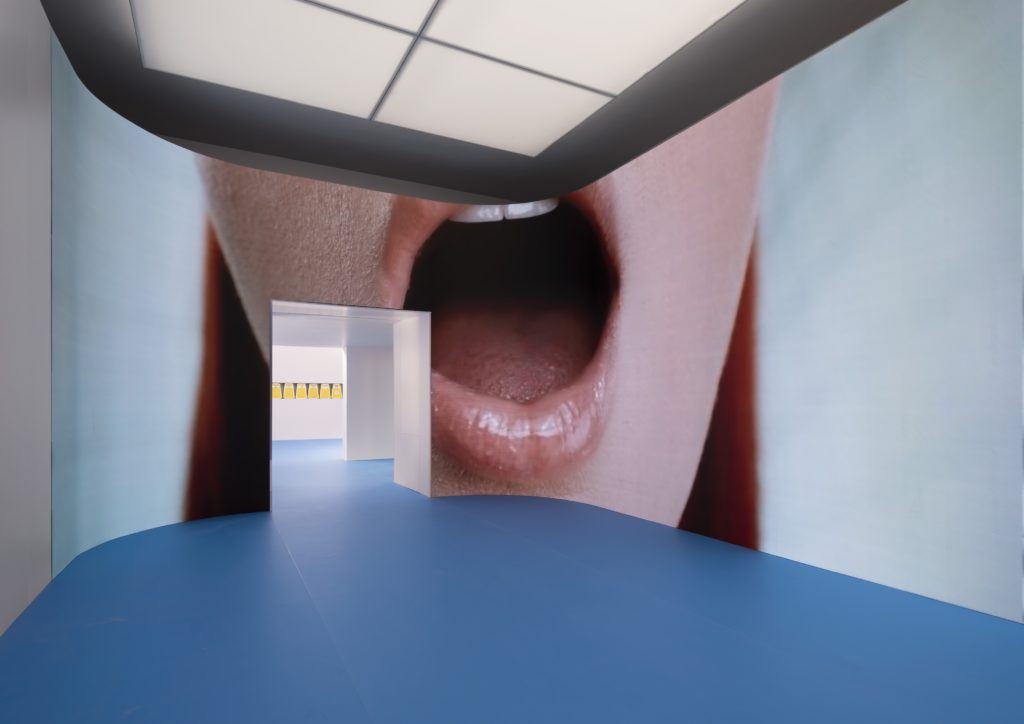
I decide to skip the queue snaking its way around Florentina Holzinger’s piss-and-aqua-themed exhibit and instead seek refuge with the Greeks, directly opposite. Two semi-flaccid soft sculptures bearing digital prints of ancient Greek ruins pave the way to the pavilion’s entrance. Billed in the press release as “a present-day Platonic Cave,” in which “digital illusion, post-truth, and cultural consumption” collide, Andreas Angelidakis’s installation feels like stepping into the dark room of a gay sex club only to find oneself in a history lesson about what constitutes (modern) Greekness, all while under the visual stroboscopic effects of MDMA. As I leave, I overhear Angelidakis explaining to a journalist that the thin black veil covering the entrance is a quiet reference to Vaso Katraki, a Greek artist who won a prize at the 1966 Venice Biennale but was later imprisoned for her political beliefs. And just like that, there it is — one of the minor keys extending beyond the main exhibition and revealing itself in the interstices.
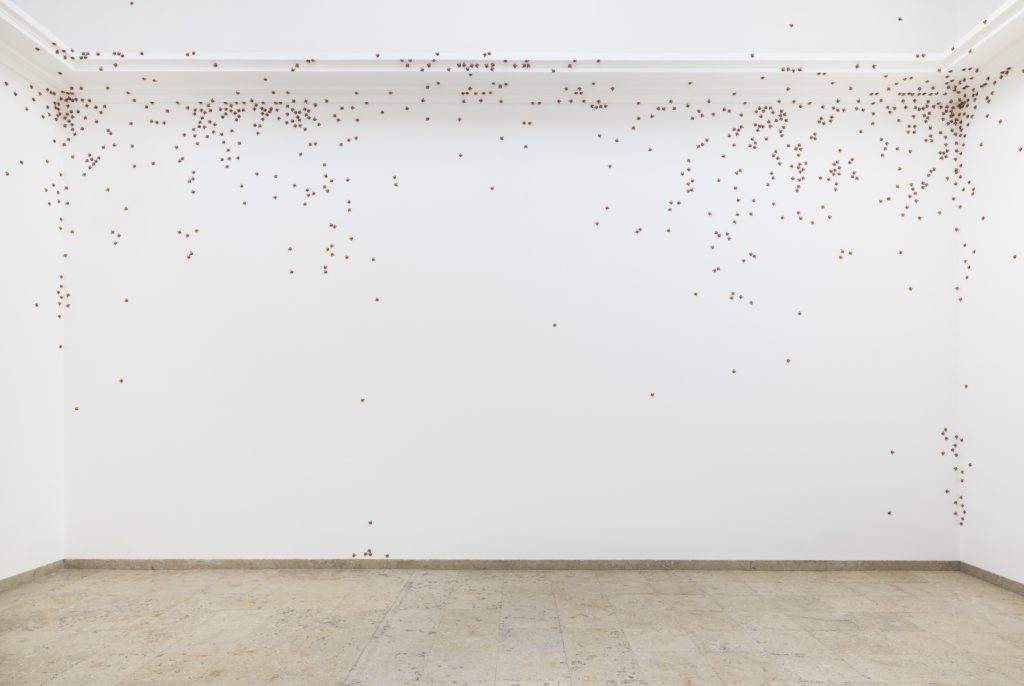
Ruins of a more recent past, that of the former GDR, are unearthed and cover the façade and interior of the German Pavilion in a joint presentation by Sung Tieu and Henrike Naumann. While their formal vocabularies could not be more different, this pairing makes perfect sense. Tieu has hidden the pavilion’s imposing Nazi-era façade behind a trompe-l’oeil mosaic that depicts the remains of what could be any East German prefabricated apartment block, but which was once the artist’s childhood home and one of the largest dormitories for Vietnamese contract workers. Despite its scale, the work is so subtle as to be almost imperceptible, until your eye falls on the graffiti — “Refugees,” “Enzo” —that Tieu has diligently transferred onto the mosaic. The work feels like the artist’s most personal to date, and in the pavilion’s inner wings Tieu presents a series dedicated to her mother: the human body broken down into units of measurement. Naumann’s installation, completed before her untimely passing earlier this year, excavates ghosts that, for her, had never resolutely stayed in the past. Set against a sickly mint-green backdrop, the same color that was used in the former Soviet army barracks of the GDR, is a hieroglyphic bas-relief composed of chairs, injured curtains, and other small-scale objects (keys, table lamps, candlesticks, and so on). They are presided over by two murals: an interior in the style of New German Design, and a reinterpretation of a Socialist Realist mural that was originally created by the artist’s grandfather. Deploying strategies of furnishing, (re)covering, and inhabiting, the artists’ practices converge to bring to light alternative histories of their country, including those that have been pushed aside but that have also resisted being interiorized by mainstream politics.
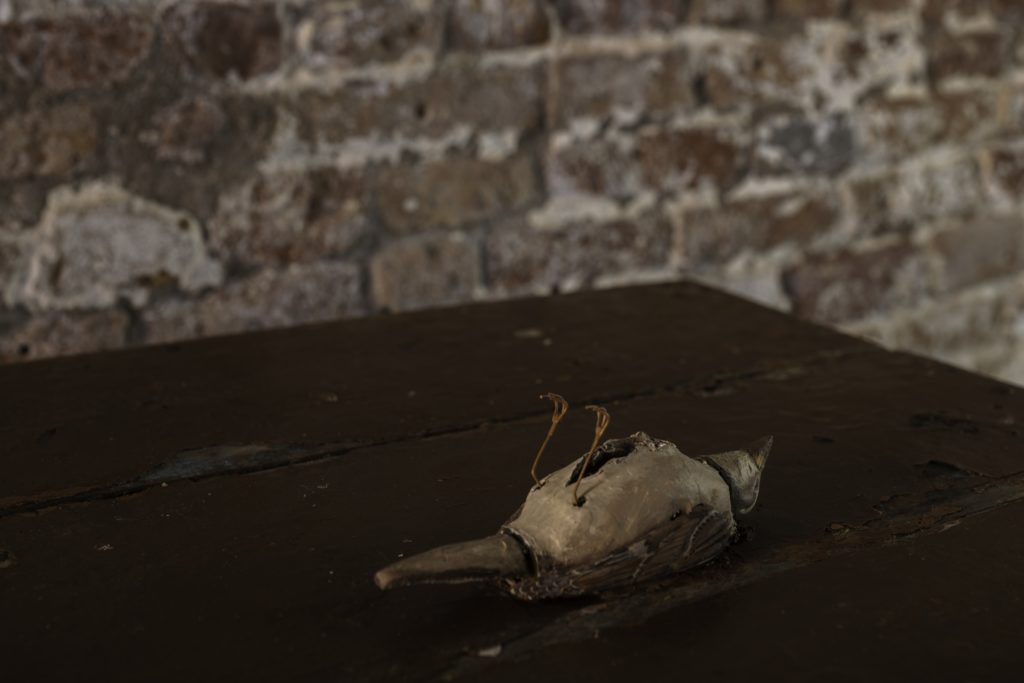
Venturing into the “outside world,” it is once again the quieter, less obviously spectacular works that remain with me. I make time to allow my mind, eyes, and ears to become enveloped by Marina Xenofontos’s beautifully lyrical project for the Cypriot Pavilion, hidden just around the corner from the Arsenale, and which, like the German Pavilion, is something of a family affair. The space, upon first entering, looks entirely empty. As I know that appearances can be deceiving, I persevere. Right above me hangs a wooden ceiling with a perfect circle cut through its center, revealing it to be one of the works: an exact replica (based on the only existing photograph) of the modernist ceiling of a no-longer-existing nightclub in a no-longer-existing city, the ghost town of Varosha, which since 1974 has been abandoned due to its geographical situation, sitting snugly in the militarized buffer zone that cuts the island in two. However, it is another form of (oral and aural) archive that resounds from time to time in this space and which is the most moving part of Xenofontos’s project. You presented the most beautiful. And the most beautiful is the wound on your chest (2026) is an audio composition of folk songs, which in Cyprus, a still deeply religious and patriarchal society, would have been traditionally sung by men. Yet here, they are performed by the older women of Xenofontos’s family, a simple but radical positioning of themselves within their community and a form of cultural transmission that draws its strength from female solidarity and friendship.
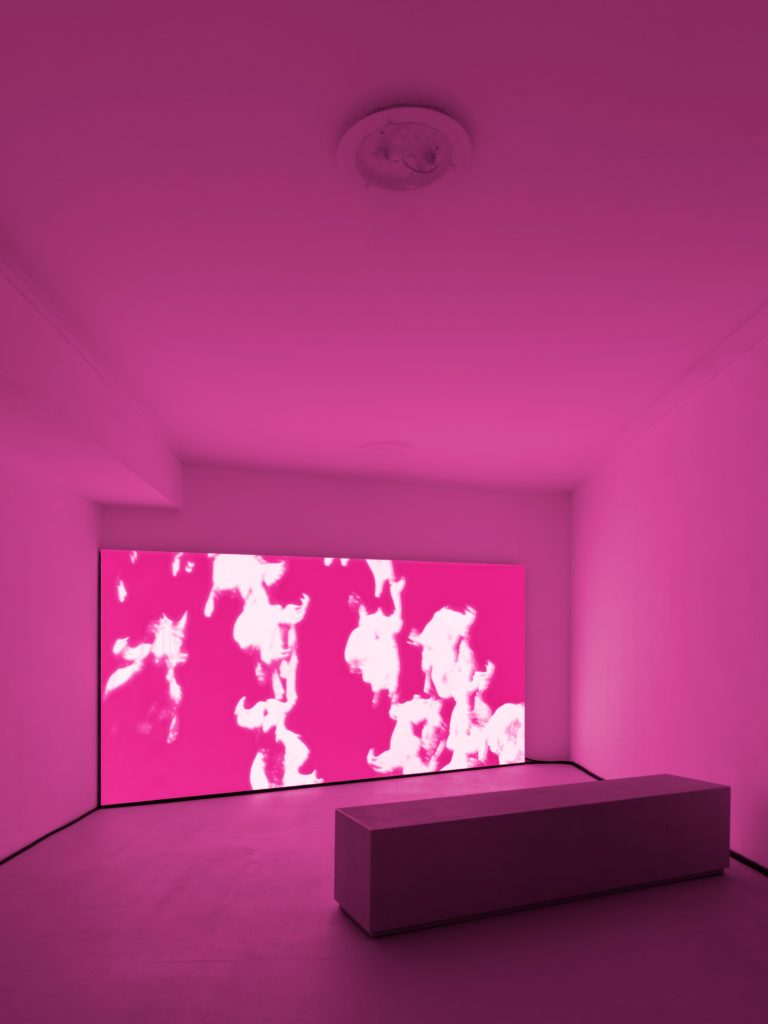
My taste for abandoned cities and ghosts leads me next to the Nicoletta Fiorucci Foundation where Lydia Ourahmane has taken the Venetian island of Poveglia — for a long time considered to be haunted due to it previously being used to house an asylum for the mentally ill, and therefore avoided by locals — as muse. Simply titled “5 Works,” it is an exercise in elegance and restraint. Over one ton of decommissioned Venetian hotel bedlinen, parked in tall metal laundry baskets, becomes a sculptural assemblage. It’s also a stark reminder of the invisible labor that ensures that tourists to the city, including the Biennale crowd, keep coming back. In another room, a pot of vegetables bubbles away on its own, releasing steam and barely-there savory aromas into the air around it. I make a mental note to myself that this is where I will most likely be searching for comfort by the end of my trip. Last but certainly not least in my whirlwind tour is the place I always go to when everything — people, vernissages, the amount of Campari coursing through my veins — becomes too much. “Canicula” is the third and last exhibition in the cycle organized by Fondazione In Between Art Film at Complesso dell’Ospedaletto. It is, as always, meticulously produced and presented (considering that half the time in group exhibitions in Venice is spent figuring out which artwork belongs to which artist, I cannot emphasize my gratitude to the curators for this). Glistening male torsos dancing in abandon at a rave in a meat refrigeration facility (Janis Rafa, Baby I’m Yours, Forever, 2026); machines and humanoid robotic figures caught in a slow dance of incessant optimization, in which the end point is never in sight (Yuyan Wang, Boring Billion, 2026); or a series of filmic tableaux in which Ukrainian actors play the role of elderly Russian soldiers, confounding the separation line between staging and testimony, confession and propaganda, forgiveness and responsibility (Roman Khimei and Yarema Malashchuk, Wishful Thinking, 2026): it would be more than easy to lose myself for a whole day in the vast spaces of the former hospital in which “Canicula” is held. Alas, the vaporetto to the airport waits for no one — certainly not me — and so I must leave, casting behind me a last, forlorn look of arrivederci.