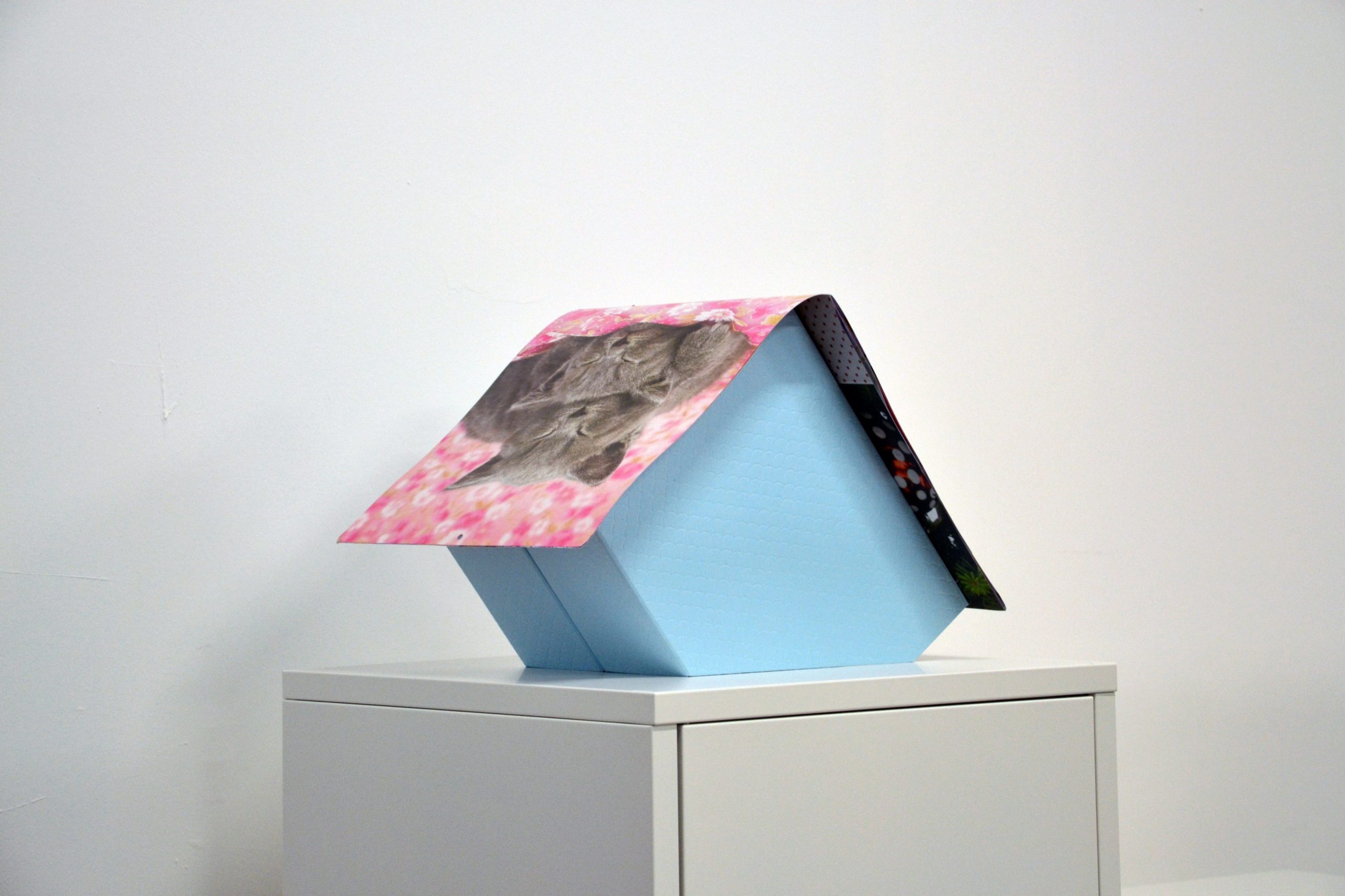
Nancy Lupo’s forthcoming exhibition “Meow Meow Real Estate” at the Nicoletta Fiorucci Foundation’s London location inside of a Chelsea townhouse shares its title with her forthcoming novel, which she is both writing and saying she is writing. The novel and the exhibition emerged intertwined from a period, beginning in 2023, when she was leaving Los Angeles but not really living anywhere else. This drifting state turned the question of finding a place into a fixation that insinuated itself into all aspects of her life and work. The apartment became fantasy as cruel optimism — the belief that “if I can just find a fucking apartment, life can somehow actually, finally begin,” as she said in a recent phone call. In lieu of actualizing that fantasy, she was continually shadowed by the nagging question of why exactly it eluded her. This tension then unfolded a spectrum of emotional and narrative drama that Lupo identifies as the novel’s through line: “It’s about a woman looking for an apartment.” This premise has also served as the scaffolding for a succession of exhibitions including “Final Closet,” “Disko,” “Hallelujah Electricity,” “Princesslesslethewind,” “Our Villas,” “irrealis,” “Max Payday,” and “Hark.”
The works included in these exhibitions form a trajectory connected to the novel with each project informed by, and feeding back into, the book: “I think that I am building.” The unfinished quality of the remark points, on the one hand, to the literal construction of exhibitions, and on the other to something more slippery: the formation of an apartment’s existential equivalent. The search for an apartment has shifted from a logistical concern to an orienting arc through which she seeks to locate herself and to fill a void that remains, in itself, idealized.
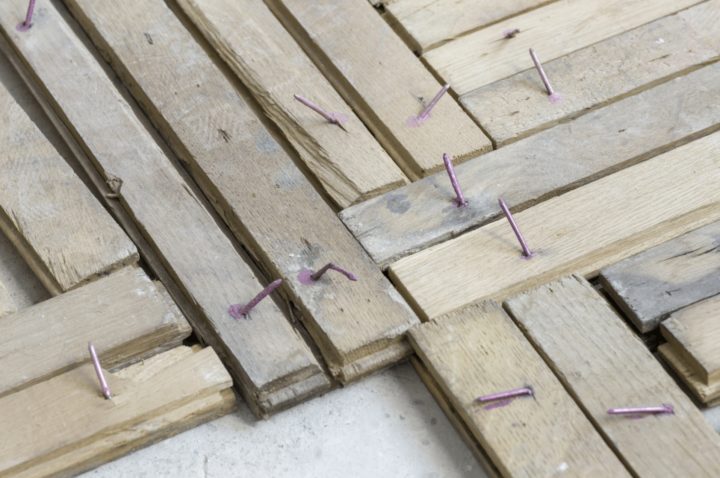
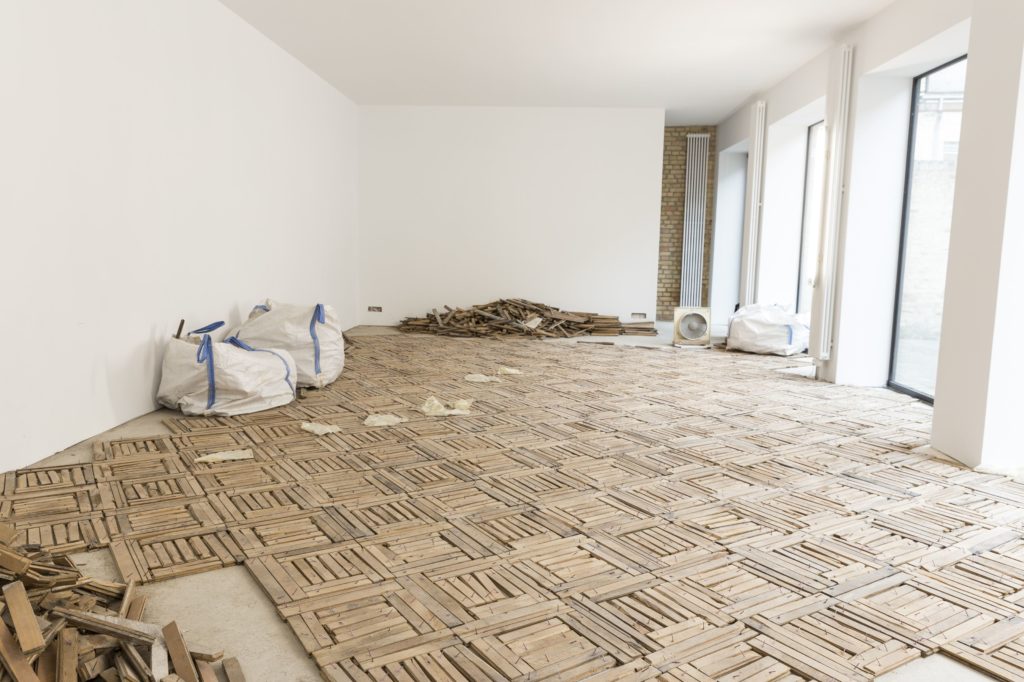
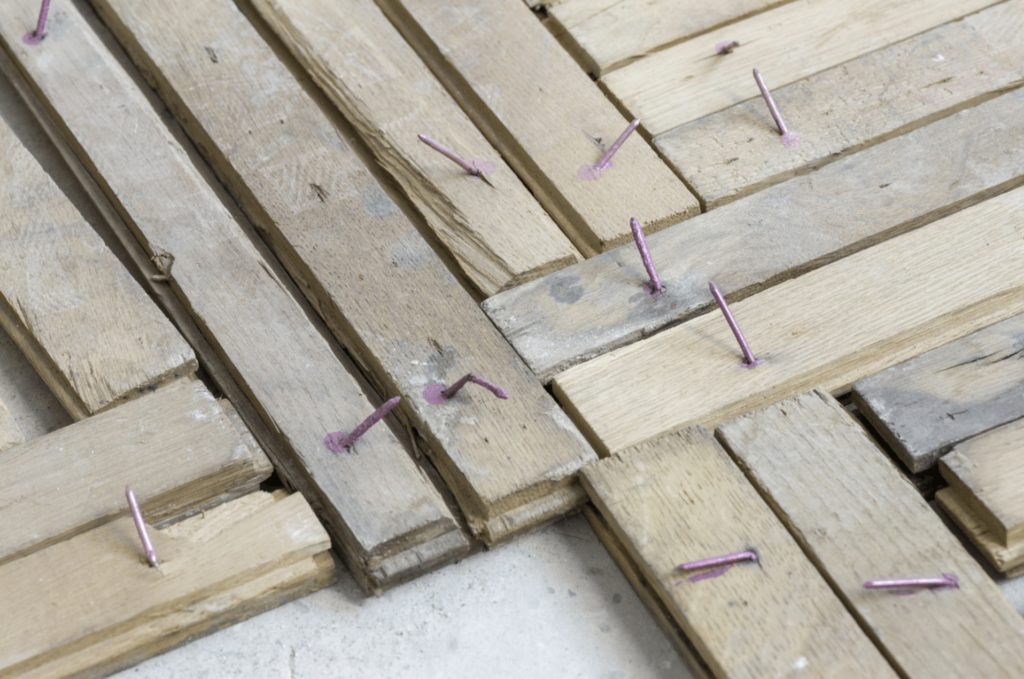
In “Our Villas” (2025), presented at the Apollo, Kunsthochschule Mainz, Lupo animates the idea of a house — or villa, or place — through something that was once great and still holds the potential to be so again. The work takes a singular form: roughly two tons of oak flooring that once served as the ground layer of the top floor of a midcentury Athenian apartment located next to where she stayed for part of a summer. A pile of discarded flood boards was transported to the exhibition space, where they were reconfigured upside down in their presumed pattern. The nails that once secured the boards remain embedded, sometimes puncturing the planks twice, now facing upward rather than anchoring the surface to its substrate. The nails were painted with dupe versions of Chanel Charmer nail polish — “a particular holographic deep pink.” This cosmetic embellishment, suturing human extremities to the edges of interior space, is described by Lupo through the use, if not metaphorical application, of the nail-polish emoji, which signifies things being “extra.”
This ineffable quality of excess — of something spilling over and generating affect openly and unapologetically, or what she evocatively describes as the “exploded glimmering fallout of some fancy and faraway place” — is strongly present in the exhibition. Yet, through its disposition, the feeling does not simply dissipate. By constituting excess as diffuse from the outset, the work allows it to endure, behaving unlike most forms of excess, whose tendency is to dissolve the very affect they produce. Here, excess remains evasive and suspended, retaining a measure of resistance to uneven circulation or appropriative logics. In this sense, Lupo references Chris Marker’s Sans Soleil (1983), where “tracking banalities with the relentlessness of a bounty hunter” lends emotional force to noise, naming a cultural residue that persists as visual vibration.
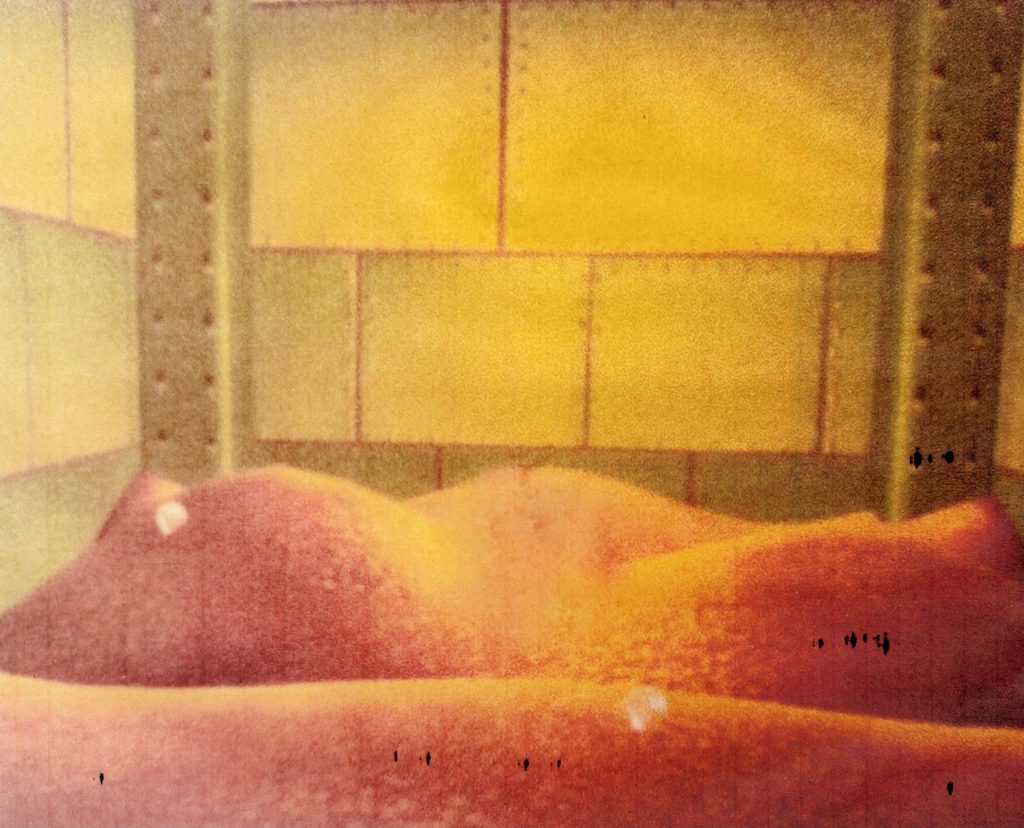
On the cover of the book produced for her exhibition “Max Payday” (2023) at Móran Móran, Mexico City, she features a similarly decentered image: Scrooge McDuck’s swimming pool of money, partially obstructed from view. What remains is a golden haze that recalls her earlier exhibition titled “Golden Shower” (2021) at Jan Kaps, Cologne, as well as the chromatic register of Andres Serrano’s Piss Christ (1987), inflected by a comparable sense of emotional incongruity. Here, money appears less as a repository of wealth than as color turned setting, with opulence operating as a site of feeling that exceeds both its metric of value and its more received notion of glamour.
In conversation she recalled a photograph a friend sent her of the discarded floorboards in Athens — later used in “Our Villas” — piled after removal and carrying the residual affect of something that once held a bourgeois coherence, now released as garbage. She also spoke of her childhood home, where her father collected toilets, floorboards, and other salvaged materials, forming an infrastructure that evoked both self-consciousness and wonder, as this accumulation slipped into a field of unstable meaning — objects hovering in a liminal, animated state, like a provisional treasure.
A A related tension between re-signification and the deployment of affect and excess appears, in a very different political and ideological context, in Joseph Brodsky’s essay “Spoils of War” (1995). There, Brodsky reflects on the arrival of foreign objects in his childhood Leningrad — objects encountered without instruction or explanatory context. He writes of canned corned beef whose packaging no one could decipher which circulated among schoolchildren as barter for war relics; of Philips radios improvised into working condition under the threat of persecution for listening to Western broadcasts; and of foreign films — largely Hollywood or prewar — screened without credits or actor identifications. One formative memory he recounts involves hearing Ella Fitzgerald’s “A-Tisket, A-Tasket” (1938) drift from an open window in a grim industrial courtyard:
“Good Lord, I remember thinking, how many records must they have produced for one of them to end up here, in this brick-cum-concrete absolute nowhere, amid not so much drying-up as soot-absorbing bedsheets and lavender underpants! That’s what capitalism is all about, I said to myself: winning through excess, through overkill. Not through central planning, but through grapeshot.”[1]
The essay closes on a reckoning: once contact with the West ceased to be fantastical and became materially accessible, that fantasy inevitably fractured. Yet Brodsky holds onto a tender admission:
“So with eyes shut, let’s admit it: we recognized something in the West, in the civilisation, as our own; perhaps even more so there than at home. What’s more, it turned out that we were prepared to pay for that sentiment, and quite dearly — with the rest of our lives. Which is a lot, of course. But anything less than that would be plain whoring. Not to mention that, in those days, the rest of our lives was all we had.”[2]
Taken together, these passages reveal a structure that resonates deeply with Lupo’s writing and installations. In “Our Villas,” it is precisely the fantasy of something never fully accessible — or only partially accessible — that is embraced, as it produces a different kind of excess: an excess of meaning. While an apartment can, in fact, be found and a sense of home provisionally constructed, the fantasy itself remains structurally loose, held open rather than resolved. What matters is not the stability of the fantasy, but the integrity of the feeling it contains. Like Brodsky’s encounter with the West, the pursuit carries a cost — financial, logistical, existential — yet that cost functions less as a corrective than as a way of honoring the intensity of attachment itself.
This honoring is echoed in the way she welcomes the practical arrangements she encounters in the exhibition space itself. During the preparation of “Our Villas,” installation was delayed for a month as the building — being inaugurated for the first time as an exhibition space and still under renovation — began to flood. During this period, Lupo stayed in a hotel and made drawings on napkins taken from breakfast, copying the script from a welcome mat in pencil triptychs. Even near the opening, moisture remained in the room, and fans were installed. Rather than remove them, she left them in place. “It was perfect,” she writes in the book, “because the air they generated caused the napkins to dance around the room until they got caught in the exposed nails.”
The unfinished building and the undone floor converged in the image of the Tarot’s Hanged Man. The gesture extended an existential void that had to be filled with something — here, circumstantially, the fantasy of an apartment, installed within a space still in the process of drying out. At this point in our conversation, Lupo turned to King Ludwig II’s castle in Bavaria, often cited as the inspiration for Disney’s Sleeping Beauty castle and also Jean Cocteau’s in Beauty and the Beast (1946), where people become objects and objects become people, “maybe out of loneliness,” she wondered. “What was his particular derangement?” It is a question about longing itself, paired with the recognition that its object can never really quell the longing. “In the end,” she said, “What I want is not fully locatable.” In this way, the reciprocal disruption between space and sculpture — the figure of the Hanged Man — becomes an extension of Brodsky’s willingly paid cost, allowing Lupo to desire without satiation or justification.
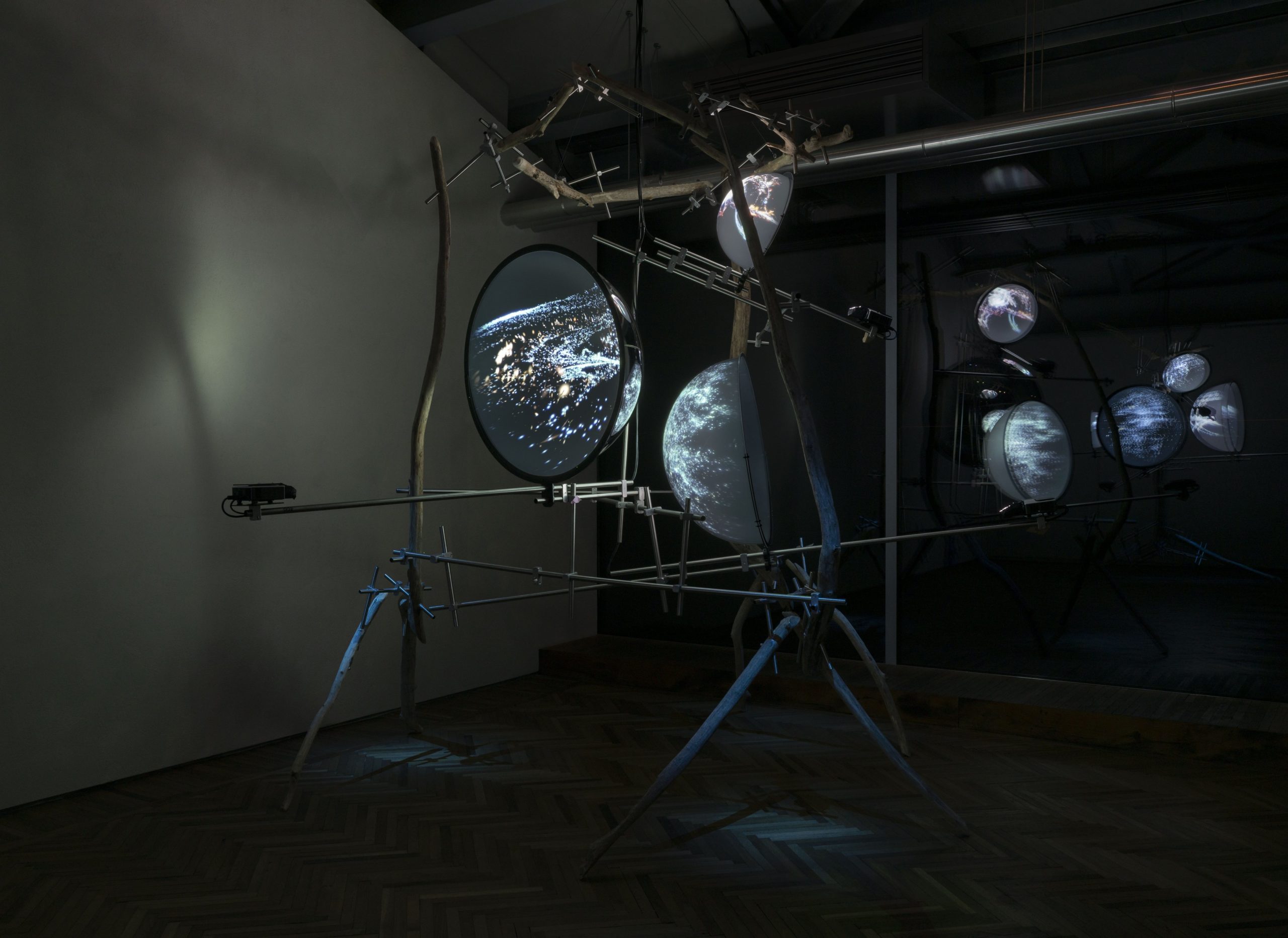
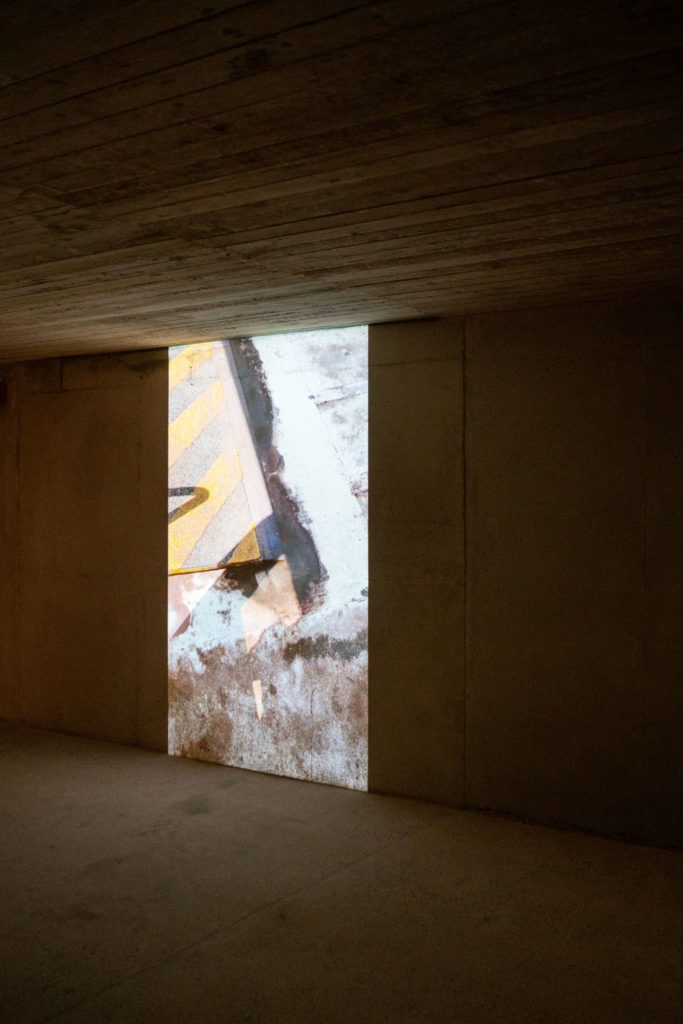
A related attention to anchoring and movement appears in a video shot in Venice and installed in a basement, titled Princessletthewind (2025) — also the name of a subsequent exhibition. The work focuses on a section of dock where one part is planted in the ground while another shifts, registering the movement of one platform against another. The opening notes of Nina Simone’s “Wild Is the Wind” (1966) play almost as a vibration coming from below; their anticipatory thundering enters the ground floor through doors on either side — an excess that recalls Brodsky’s encounter with Fitzgerald. His “drying-up as soot-absorbing bedsheets and lavender underpants” finds an echo here in the aired floorboards, pierced by nails that snag napkins-cum-welcome mats, their surfaces shimmering in holographic Chanel-pink nail polish — not magenta.
Like the shifting platforms she observes in the video, Lupo’s writing moves between positions. In the book, she shifts from: “It’s about the aspiration for a house but better two or three, as fancy and extensive as possible. Short of that maybe any structure or space or maybe just the trimmings or skeleton will do. The point is the fantasy of being moored, the thicker the rope the better,” to a different register altogether, where “Our Villas” ultimately becomes the romance of what might be — “not the violin strings of suspense, but waiting for it. Death, no — hibernating? Not mammalian, not earthbound. Not letting things become, but allowing them to float, or hover, suspended in the moment before, not en route to anywhere really.”
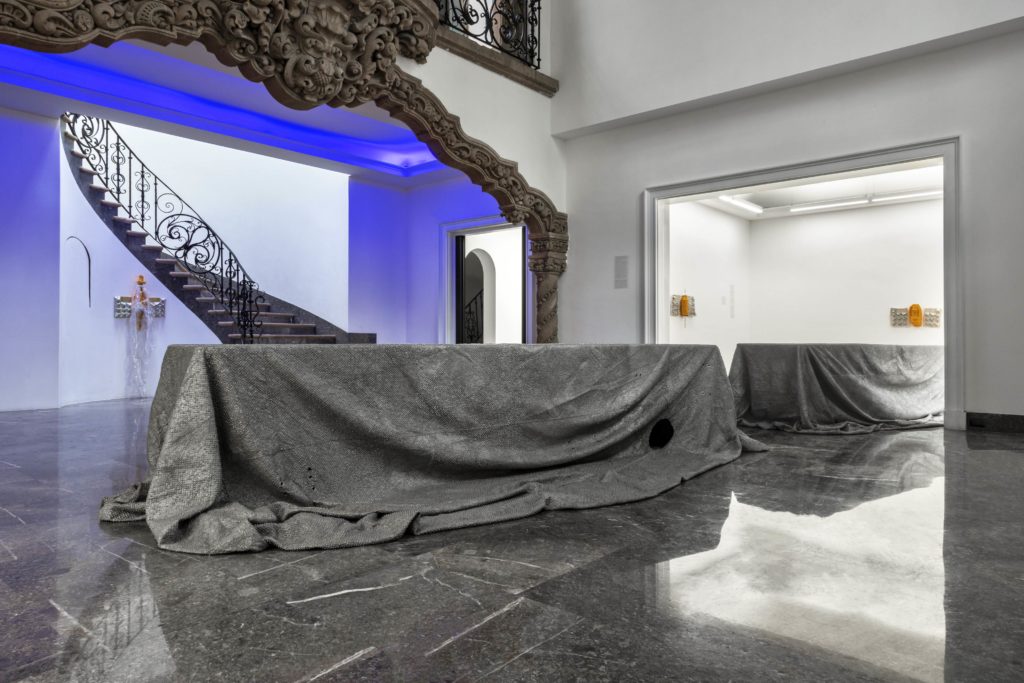
A final note — or coda — to this line of thinking can be found in the earliest exhibition in this informal series, “Max Payday,” mentioned earlier. If “Our Villas” stages suspension through reversal and delay, “Max Payday” approaches it through accumulation, weight, and obstruction. In this exhibition, Lupo presented a series of car covers, part of an ongoing project that has existed for many years, made from covers she used for cars she has owned in real life, including a Dodge Caravan.
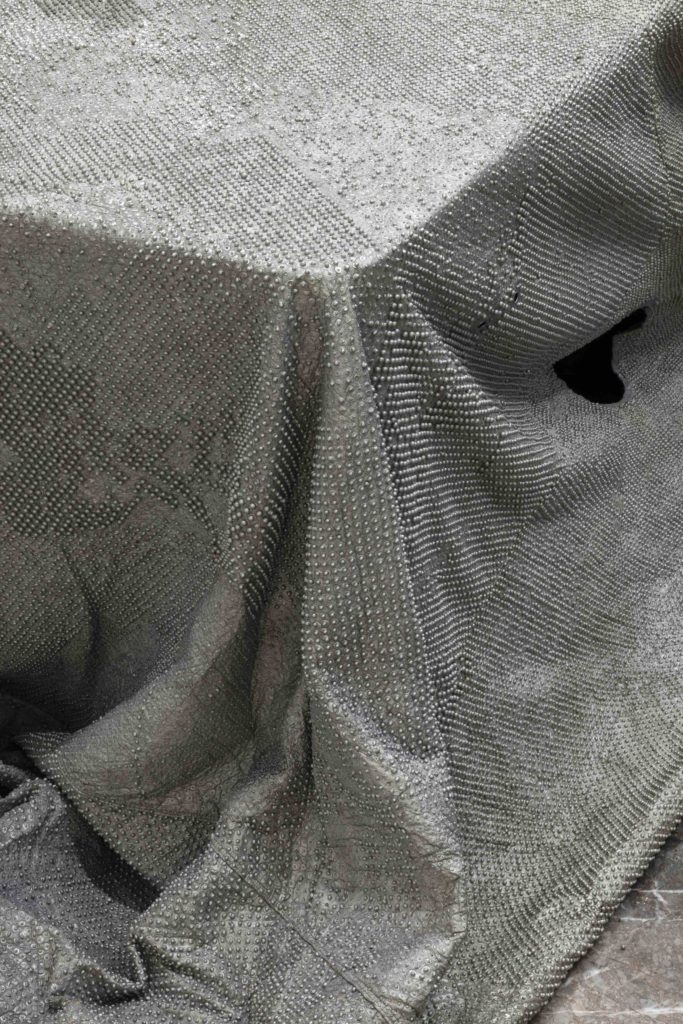
The heat-sealed covers are constructed with a dot-grid pattern of marks that unite several layers of material. Onto this preexisting grid she glues small pellets of material — peppercorns, BBs, birdshot, plastic stress pellets and whatever else is at hand—and then paints over this added layer with aluminum roof tar, a substance used to coat roofs. The resulting surface is shimmery and preservative, yet every time the works are moved, significant amounts of material fall away, rendering their exhibition an anxious affair. These sculptures concentrate an enormous amount of labor and are admittedly high- maintenance. The labor, which leads nowhere in a utilitarian sense is almost celebratory in this futility. Physically heavy and time consuming to produce, the unproductive logic of these sculptures is precisely what gives them their force in encounter.
Years after the close of the exhibition , when Lupo attempted to retrieve the covers from storage to stage them in the context of another group of works, the gallerists informed her that the works, although safe and well packed, were being held — hostage perhaps — and could not, for a complex series of logistical reasons, be released. As with the flooding during the install period of “Our Villas,” the work here again encountered a real-world obstruction. The covers, unwillingly, moored by circumstance will likely play into future appearances when they are finally freed.
While Lupo’s work might purport to traffic in the aspirations around fantasy, in fact her work offers precisely the opposite. Things remain in pieces as they always were, on exhibit, in transit, in storage, etc. In whichever configuration, the sculptures hinge on the words of Nikki Giovanni’s “Choices”: “If I can’t do what I want to do, then my job is to not do what I don’t want to do. It’s not the same thing, but it’s the best I can do. If I can’t have what I want, then my job is to want what I’ve got and be satisfied that at least there is something more to want.”
[1] Joseph Brodsky, “Spoils of War,” in On Grief and Reason: Essays (New York: Farrar, Straus and Giroux, 1995; London: Penguin Books, 1997; London: Penguin Classics, 2011), 11.
[2] Brodsky, 19.