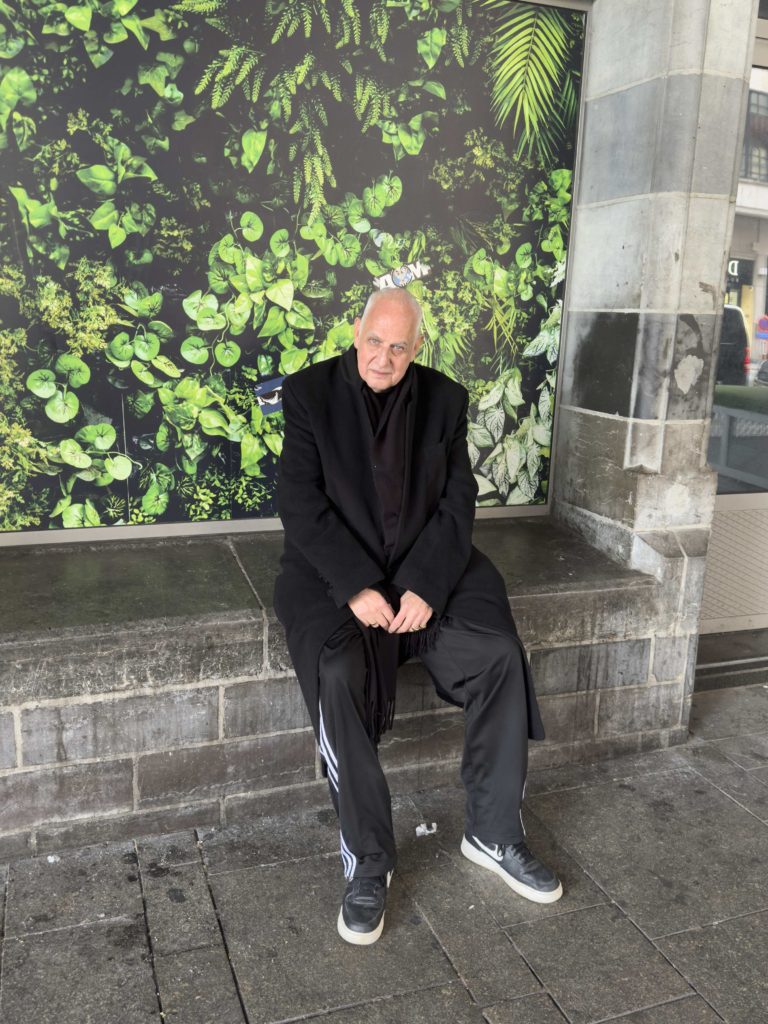
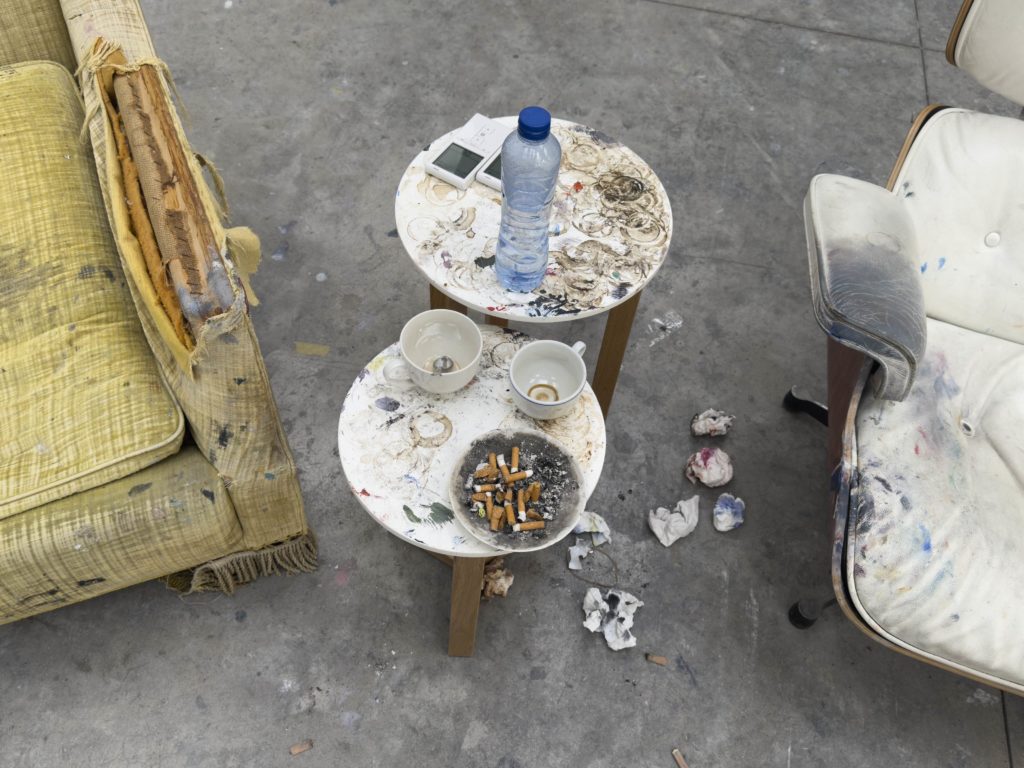
Luc Tuymans is smoking a cigarette outside of his studio when I arrive. It’s October 12, 2025 – a Sunday – in Antwerp, and the streets are vacant, save for the artist. We walk through a garage-like passage where the studio opens up, and I encounter the new paintings that comprise Tuymans’s latest exhibition, “The Fruit Basket,” presented at David Zwirner’s New York and Los Angeles galleries, one after the other, on a bicoastal tour.
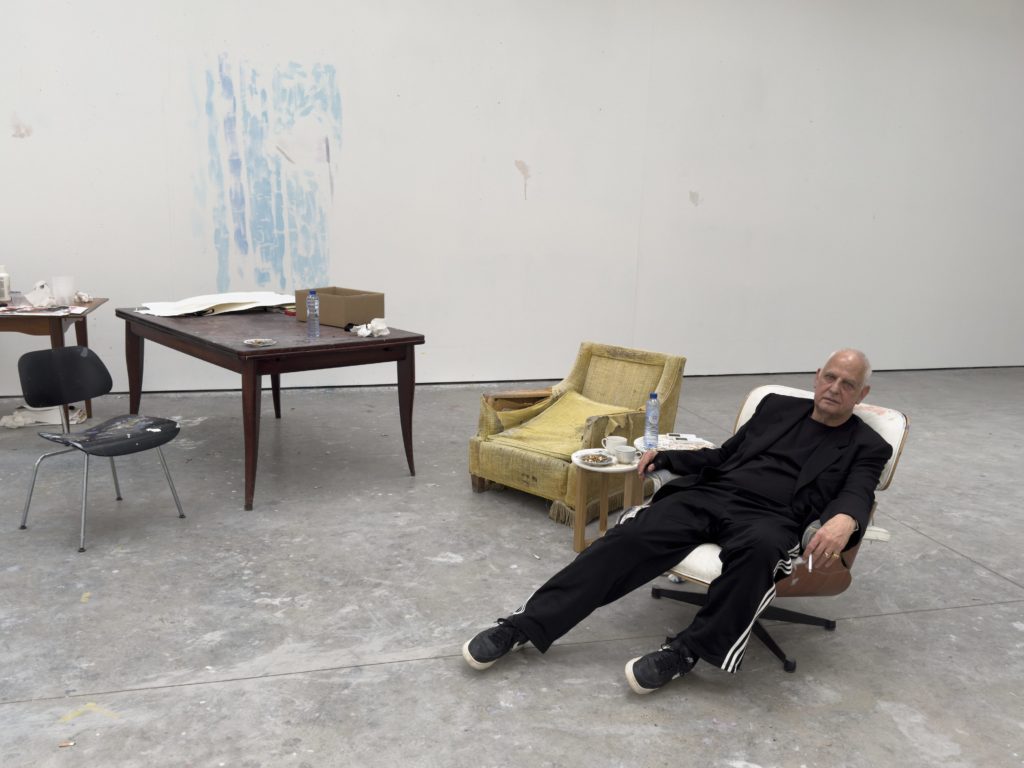
I see the entire show, but scrambled in his studio. The title work, a twenty-three- foot-wide painting in nine parts, is partially deconstructed and spread across two walls. Cast in a palette of hyperlink blue, the massive still life depicts a basket of fermented fruit traditionally given to winners of the Premio Malaparte.Tuymans was present in 2022 when American writer Daniel Mendelsohn was awarded the Italian literary prize, and he first saw the basket projected on a television screen as it entered the frame of an abandoned camera that had been left recording. The object was both pathetic and endearing: a vessel of tradition, but one that felt empty and sickly.
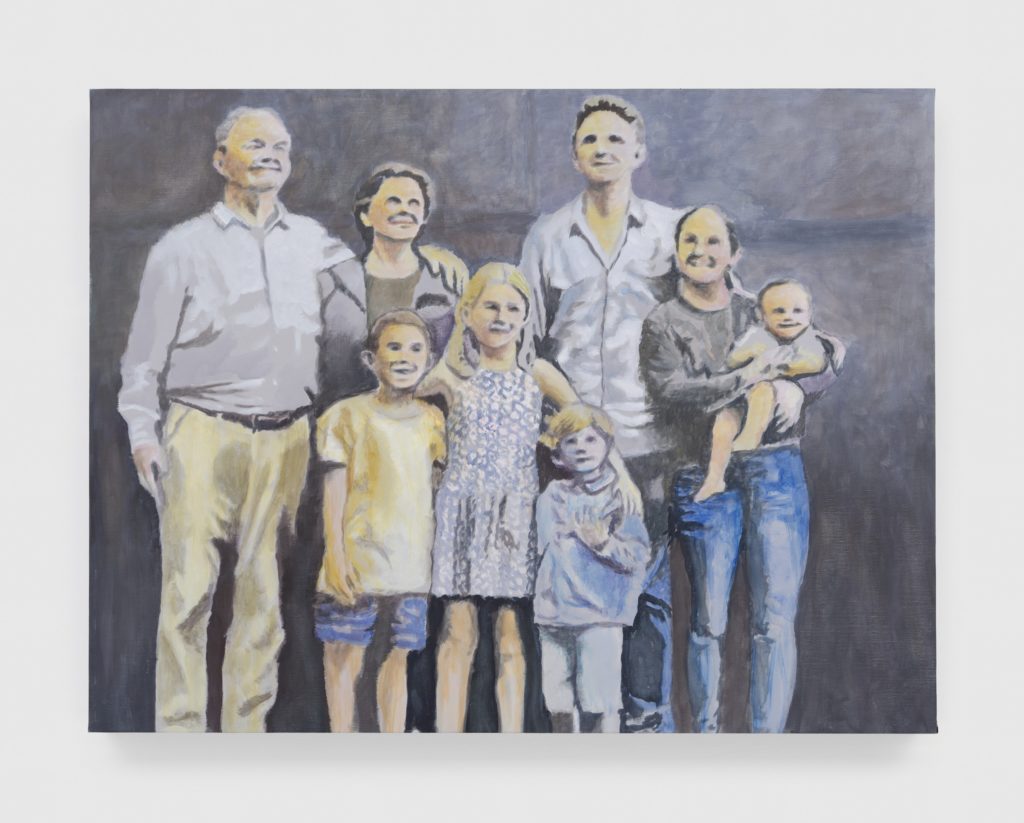
A series of paintings showing 3D-printed miniatures of humans hang around the room. Families and football stars transmit blank grins, indistinguishable from their animate models. Tuymans tells me that four abstractions, framed in an inky bluish-black, are ultra-magnified projections of illuminated manuscripts undergoing conservation. Their foreshortened perspectives were inspired by a photograph of Mark Rothko reclining in a lawn chair, gazing up at one of his paintings. His “Seagram Murals” (1958–59) count among Tuymans’s favorites.
A painting of a mask’s interior, a magnified maggot, and a bird’s-eye view of migrants at the US-Mexico border round out the collection. We sit in chairs in the center of the room and begin our conversation.
Daniel Merritt: Is “The Fruit Basket” the empty prize America deserves?
Luc Tuymans: I have nothing against the States. I have a lot of friends there, as well as my career. But everything is just insane. Rothko, who committed suicide in the 1970s, ended his life in a time of extreme conspiracy theories in the United States. There are different links that you can make. It’s not so much about making a laughing stock out of the US; it’s a bit more serious than that. It’s actually a very sad show.
DM: Rothko is a sad avatar in American art. There’s an undercurrent of melancholy, but the way those paintings circulate as the most vaulted cultural outputs in the United States in the twentieth century can obscure the sadness.
LT: I mean, it was interesting because he, Jackson Pollock, and many others were implicated within covert operations of the CIA, which was very smart because had they known, they would have never participated. But that made the United States important coming out of two world wars and claiming culture as their entity. The works that I really, really love of Rothko are the “Seagram Murals.” I think these are extremely strong, and they’re about portals: you have all these elements that come together. You have the illuminations, and the big still life. Then you have “these” that are painted differently, and these are more painted as I usually paint.
DM: Are the figures, when they’re 3D-printed, to scale or they are in miniature?
LT: They are in miniature.
DM: Which fulfills this strange, novelty way of seeing yourself that is bound up in early histories of photography.
LT: That’s one thing. It’s also a question of the impossibility of a depicted reality. And if you come closer, they’re also painted in a way, of course, that you feel that 1) they are not real, and 2) that they are on the verge of disintegrating. You can see that they’re built up.
DM: I am interested in the way you render eyes. Even looking at the painting of the maggot, it has quite an ocular feel to it. Though in contrast, one sees these voids recessed in the grinning faces of the 3D-printed figures. Their eyes are not very present.
LT: They are actually completely muted. It is just a muted form that is actually made as a proposition. The family, which is, as I said, this element of the impossibility of the idea of a reality. I mean, they’re still smiling, and they’re also white, which is, of course, an important proposition. This is the image that is propelled, and that image is rather insecure as we speak.
DM: But the way life manifests across this work is so thin and precarious. I mean, the only real human life that you see in Migrants (2025) is zoomed out and on the verge of disintegration, and the maggot that thrives off of decay. And then you have these lifeless plastic bodies that are more legible, but still uncanny.
LT: And then you have the idea of beauty with these illuminations, so to speak. I mean, because they could be seen as beautiful.
DM: They are quite beautiful.
LT: And they have a certain monumentality and scale, a revival of some kind of abstract expressionism. I had a lot of fun making it, it’s true. It was still very difficult to make them. I had to stay concentrated to keep that going.
DM: Seeing Migrants next to the illuminated manuscript paintings makes me think about what’s left out, what does not enter the frame. Paintings build upon the decision to not include certain elements.
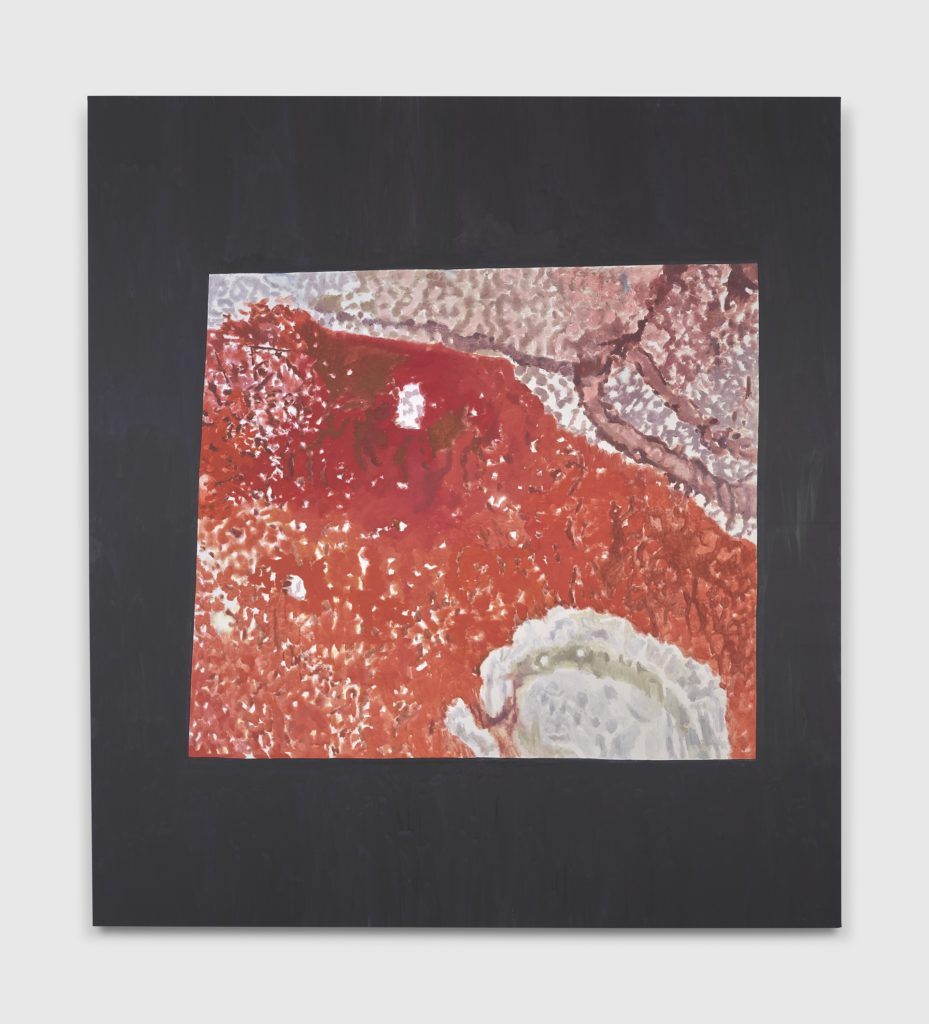
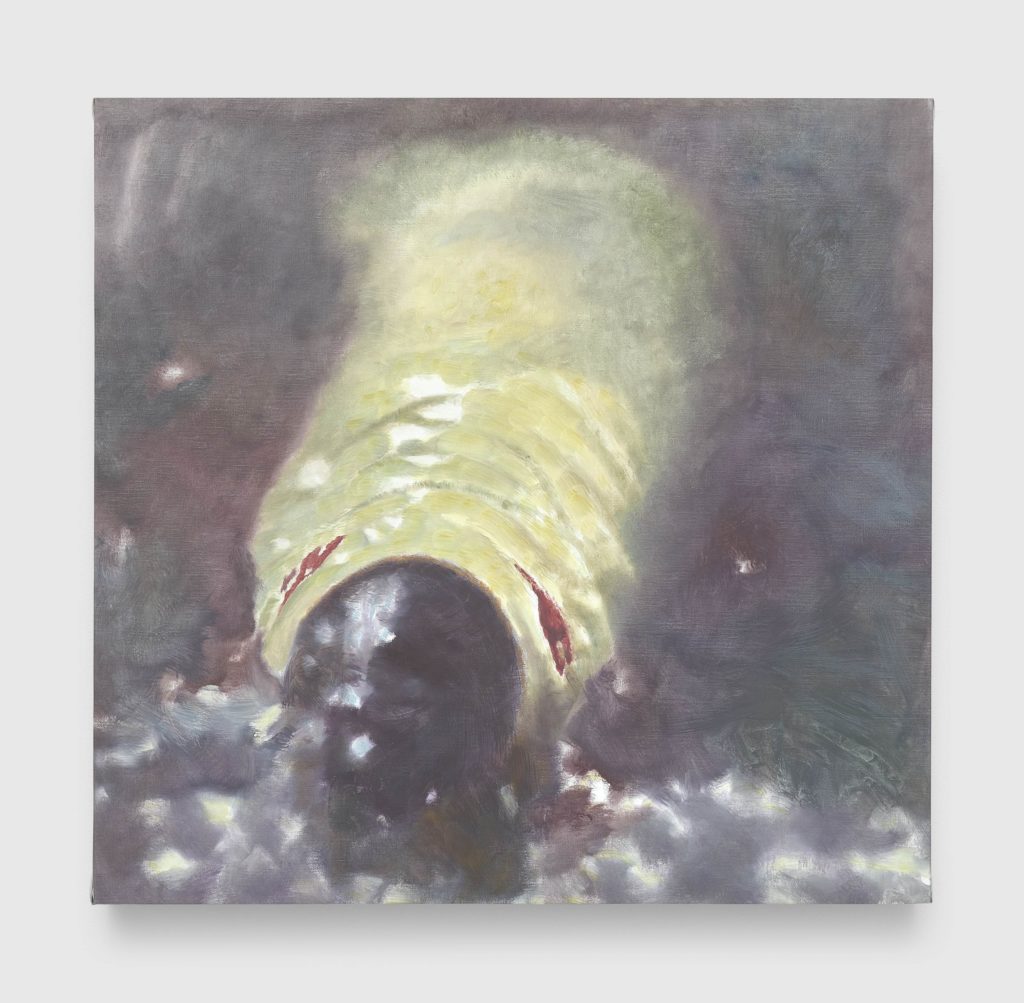
LT: Yeah. The interesting thing is that the painting of the maggot exemplifies that to be monumental. Things don’t have to be large or big. So you can see these two things from miles away. Once you get closer to the painting of migrants, the people disintegrate and become garbage, which is part of the idea. And also the light, the heat, all those elements that, because that is the only painting that actually gives a certain temperature, the rest are quite cool. Even the red is not really warm, so to speak. So this is the only one that actually sort of has a ticking heart, or is related to this reality.
DM: When you are painting, when do you stop thinking? When does thinking become an impediment?
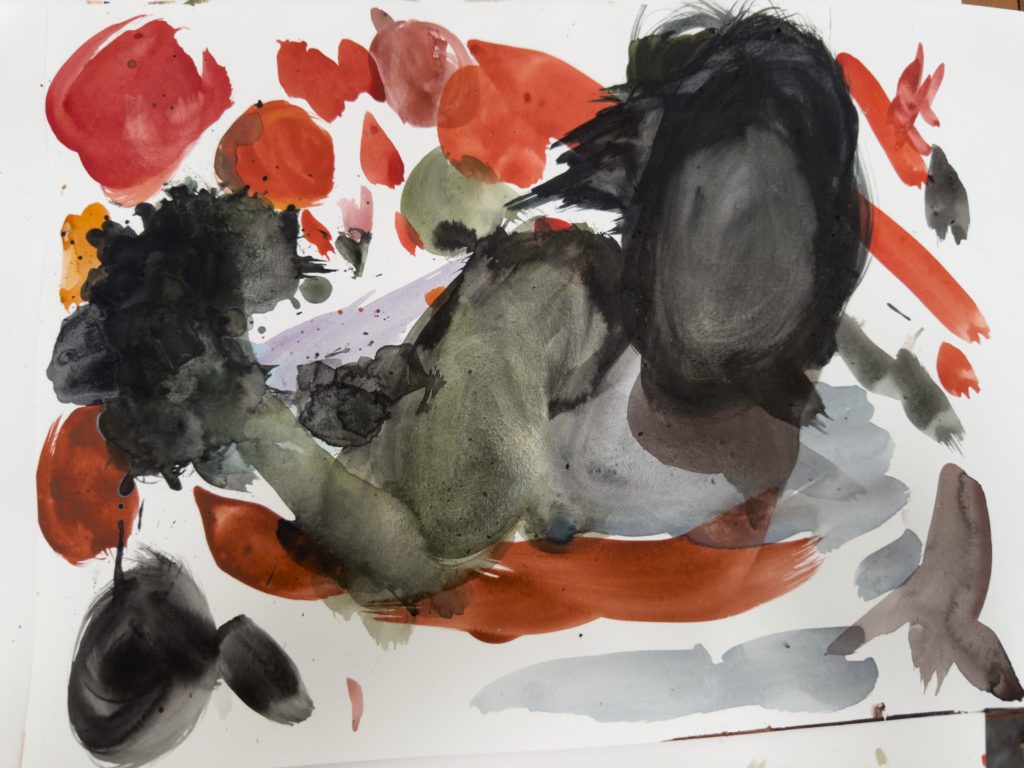
LT: I mean, the first gallery show I did here in Antwerp was a selection of fourteen paintings out of one hundred and fifty. And the second show was an entirely new show. So all the shows, every gallery show, is a new show. But the biggest work is to figure out what I am going to paint, and then figure out how I’m going to paint it. But before the painting process really starts, all that work has been done. And it has been done through numerous drawings, watercolors, working with the computer — working with anything to formulate the imagery. And then one by one the image is made. I have to prepare myself mentally to do that. They’re usually made in a day. The maggot was painted in about four hours. And of course, The Fruit Basket (2025) took a bit longer, of course, to make, and it was also difficult to get the same color back every time. But that was a more systematic way of going about it.
DM: But do you feel like this period of preparation and rehearsal allows you to enter kind of a flow state in which the act becomes so much more physical?
LT: Yes. In that sense it just kind of comes out. I’m still extremely nervous and extremely afraid that it will fail. If I don’t have that feeling anymore, I’m just doing a job and I should stop. And at that point, I don’t want actually my brain to interfere. I mean, I don’t want to be thinking on the canvas. Other people do. All the intelligence has to go to the hands. Before I started, it was quite analytical, which also probably then gives you this element of detachment, which you can see in the painting. I actually stopped painting from 1980 to 1985 and worked with film. Painting became too existential and too tormented and too stupid. So I needed distance, and through the whole film adventure, through the lens, I got the sense that there is a huge similarity between painting and filming in the sense that both are about the approach of the image and the fact that you can over-paint painting, which you cannot do with a drawing, for example. But you can edit a film. So in that sense, that helped me a lot. And then I came back to painting. And then this time around I was finally able to catch this digital light, which I was trying to catch for a long, long time.
DM: I am curious about your decisions around perspective and subject. I’m thinking now of The Man from Wiels II (2008); that painting is so vivid in my mind for the way the man’s face is framed, both in this kind of wide-screen style, but also ever so slightly from below. It feels cinematic. It also feels forensic, but then it detaches and situates it in the imaginary. Could you speak about your instinct for perspective, because this show deploys it in so many radical ways.
LT: Yeah, it’s something of course that’s been in the making or sort of always present. The idea of distance is quite important. And every painter works with a mirror. I also work with a hand mirror. Richter does that too. Everybody does that in order to put the imagery upside down, but also to double up the distance. The final process of making an image happens when the spectator looks at it. The viewer finishes the image. That distance is already present while you’re making it. And also I think it’s important that art is relevant, because when it’s not relevant I’m not really interested in it. But of course painting is a very archaic thing.
DM: I was looking at these James Ensor drawings of masks at the Royal Museum of Fine Arts before coming here. Masks have been an enduring image or approach in your work from the very beginning. I’m wondering how that manifests in this show with one very overt reference in the painting Hollow (2025), but then also across these frozen faces that are integrated into the bodies of the printed figures.
LT: That’s an interesting question. When I started, there was much more stasis. In 1992, as I opened my show at Kunsthalle Bern, I started to want to paint portraits again, dreamt-up personas. At that opening, I met a psychoanalyst and I asked him if they still produced these medical handbooks in which a subject would be photographed, and then from there a diagnosis could be made. And he sent me one which was called Der diagnostische Blick (The Diagnostic Gaze). And that was interesting for me because it allowed me to paint a portrait again without psychology. So this has always been an important thing. The paintings contain a naturalism that completely misses the real because it becomes symptomatic.
There’s always been a strange situation with me and the idea of persona in the painting. It probably pops up even in Body (1990), which depicts a doll from my childhood, which you could open up with a zipper and then make it come alive. That’s probably a bit of a morbid practice.
DM: When painting a portrait, how do you calibrate the distance between living, known people and a completed artwork?
LT: I did paint people from life and I stopped doing that. So that was a clear decision. There was an entanglement that would actually not permit me to make the distance necessary to make work. And that’s also what I explained with this element of the existential. The torment. Not that I don’t like it, I mean, I do like movies and all that, but that is a clear decision, a clear decision where you make a measurement towards what you are actually portraying and also what the visual calibration is in terms of how you then position yourself. And also the fact that it is also not going into the realm of morality, which for me it’s important that art doesn’t do that. I think that’s one of the major mistakes. So I don’t say that’s an objectivity, but there is an element of indifference to a certain extent. And that’s where also the idea of a figuration and abstraction, kind of in a very weird way, meet. I’ve always been kind of wary of what is really real and what is really fake. So there is this huge distrust towards imagery, even my own, and that was, in that sense, visionary because that’s what we’re basically living.
DM: But it’s an outcome of the high level of observation. I mean, there’s an attunement to the world as it’s happening. And I think if you pay attention, it positions you to understand the future when it finally arrives.
LT: Of course, but then when it happens, you are also — I mean, in a certain moment it’s like you feel paralyzed because it really happens, which is still something completely different. The consequences are real.
DM: Do you think “The Fruit Basket” is an exhibition of paralysis?
LT: To a certain extent it is, but it is also quite a statement in that perspective, and this impossibility of reality to a certain extent, and also to paint the title work at this size. Now is the time to go all out.
DM: I’m thinking about Still Life (2002). How do you feel about this work in relation to “The Fruit Basket”?
LT: There is a clear relationship. There also would be a clear relationship between this and Peaches (2012), which were also enlarged fruits. Still Life came about because my wife and I were in the States during 9/11. And I was in a hotel room, seeing people literally jumping out of a building and all the planes going in from all the different angles you could think of. I thought this was something you could not at that point depict. So I started to think about what would be the opposite, which would be delicate, the lowest denominator within painting, which is still life, and then to blow it up and to take down the contrast so it becomes a projected image that floats within nothing. That was basically the state, which is an apolitical thing, therefore very political. of course, The Fruit Basket is a bit different because it’s more graphic and it plays with digital art, but it has the same element of dystopia.
DM: In writings on your work, and “Dark Modernity,” a recent essay by Jonathan Crary, nihilism emerges as a thread. What do you make of that?
LT: To be really cynical is not a possibility. I just can’t do that. I mean, it’s possible that there is an element of pessimism, but this is a Belgian quality that you may not know of. When we turn our back, we already know what happened. So we have plan A, B, C, and D, but organizing ourselves outside of our country is fantastic. Inside of the country it is disaster. It’s never structured.
DM: Because of this kind of spirit of individualism?
LT: To a certain extent, it must be something in the DNA. It has something to do with the nihilism that writers perceive, which then is not only mine, but that of the entire region of Belgium. There is a sort of detachment and assessment, which is quite tough, which is quite hard to deal with. But that’s one of the major qualities when it comes to a visual.
DM: I feel like the way you deal with that is by making works like these illuminated manuscripts. They feel like something of a salve, thrown against the intensity of these other images in the show. I think it makes a viewer want to blur their own vision beyond recognition. There’s a kind of pleasure in that. It’s like getting high.
LT: That is the idea, that you have the disruption of these elements that come together in one show. And also the idea not to show all these illuminations together, but to spread them out across the entire show as sort of points, attention points that you can look at or not. And they stand for the idea of a certain idea of pleasure if you’d like, or beauty, or whatever it can be, but it’s distorted. And so, yeah, I think coming back to what Crary wrote, I completely could underwrite a lot. He wrote something really interesting about the “Arena” paintings (2014), which was I thought very true to the matter. Actually, the first work in the series from 1978 is a collage, a mixed- media work. And it was a sort of predecessor before I went to film. It was my first image about the idea of violence. That goes back to the old idea of the arena from Roman times
DM: Migrants feels placed in that continuum. I mean, the space of gathering and convening is very different. It’s depicted in a different way from the “Arena” paintings, but this depiction of temporary inhabitants feels quite connected to that world.
LT: Yes, absolutely. And there is a similarity to this idea of people that are reduced to blobs. In Migrants, from a distance, you can actually see a distinct guy with a cell phone, but once you approach the painting it completely disintegrates. But there’s another painting which was called Mayhem (2003), that shows this image of a paintball contest in Detroit. I found this image that shared a clear reminiscence with the idea of Bruegel, who also portrayed people quite small and also painted them naked and then started to dress them up. Belgian people don’t really get Bruegel to a certain extent. I have to look at the films of Tarkovsky, where you can see all these images of Bruegel.
DM: In this part of the world, Bruegel does feel at odds with Rubens and Van Eyck. The entire atmosphere.
LT: It was also something that was quite suspect to King Philip of Spain, who burned some of them because he thought they were different, and he believed there was information in terms of military settlements and things, which was of course, not true. But nevertheless, Bruegel was quite controversial at the time that he was working.
DM: But it goes back to this need to resist dogma. And I think that might make you annoying, but that’s important.
LT: That’s interesting. Picasso’s Les Demoiselles d’Avignon (1907) — I mean, it’s just a very annoying painting. When I go to MoMA, I always go to look at it because it’s something I remember much more than Guernica (1937). Or The Third of May 1808 (1814) from Goya, which is insane. This is probably one of the first political paintings where you have the acts in the image, which was really important for people like Manet or even Jeff Wall for that matter. There’s no clear distinction in that sense. It’s not a sort of linear way of understanding painting.
DM: It can reach across centuries with ease. But living within painting’s constant endgame is also liberating.
LT: No, that’s a very good remark. Because I think also, I mean, there’s been a lot of stuff about painting being dead or alive. There are different ways that you can make a painting in assessment. David Lynch is extremely painterly. Exactly. Hitchcock has an intelligence which is physical within the framework of filming. And I think most artists never made that remark about painting’s endings. But of course critics, curators, and art historians did. And it is, I think, a nonsensical discourse. And the beauty is that at a certain point, painting was at the so-called periphery. I mean, especially when I started to show it, and it became more powerful.
DM: It is impossible to pin down. I find painting to be this endlessly elusive way of reflecting the world.
LT: Also an element of escapism, of course. And that’s the worst part of it, which is, and of course is still the most powerful and expensive artifact, which is a fact, which is still the case in a sense, which is quite funny and ironic in a way, because the material you need is actually not that very expensive.
DM: Like you said, these are stupid things.
LT: I always compare it with a diamond trade to a certain extent, which is a trade built on trust and air. It’s about the way the diamond is cut.
Photography and Layout: Juergen Teller
Creative Partner: Dovile Drizyte
Post-production: Louwre Erasmus at Quickfix
Location: Artist’s studio, Antwerp