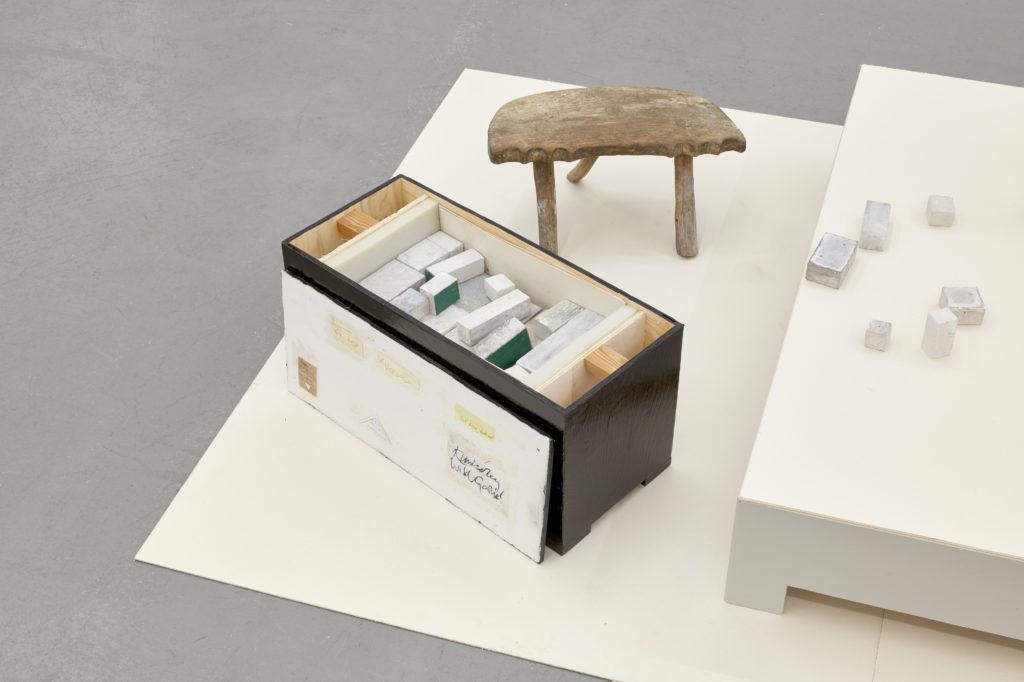
Little pools of ash, left behind by compressed ash blocks, gather on cardboard surfaces spread across the floor. Surrounded by a series of five C-print photographs, hung low beneath the high ceilings of the ground floor of Kunstverein in Hamburg, the collection “Ash (or ash to the plastic number)” (2026) forms part of “Sample Question” by Nina Porter.
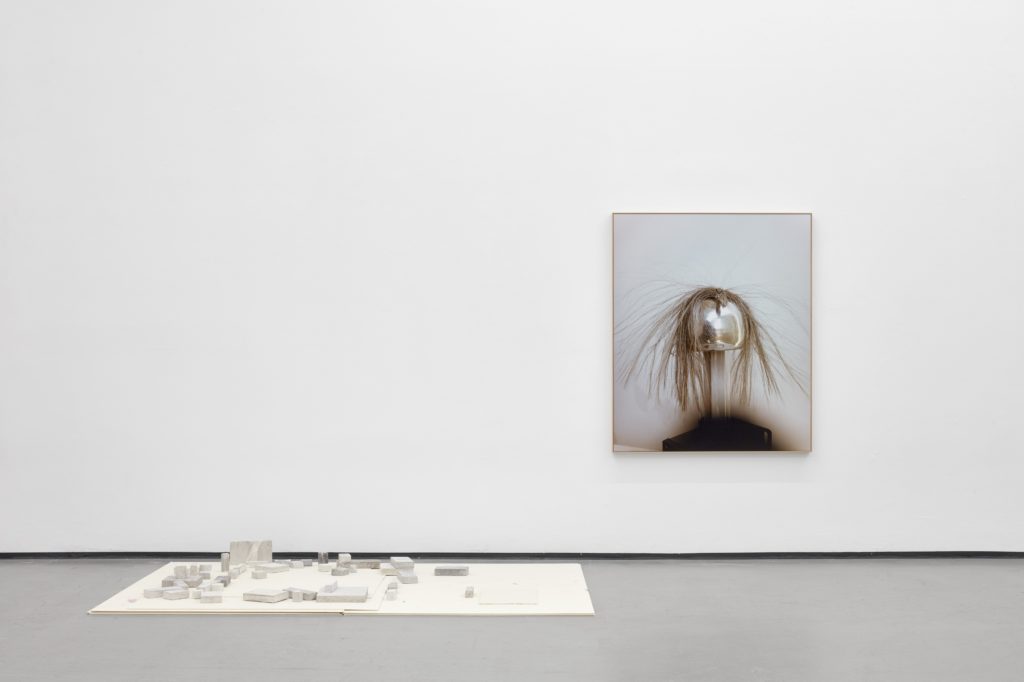
For “Ash (or ash to the plastic number),” Porter collected ash residues from the fireplaces of households in Norfolk, eastern England, contributed by voluntary participants. By compressing the ashes into rectangular blocks, each block preserves traces of a single household, at times still showing residues of their source materials. Embedded within a system of narrow tables, wooden boxes, and stools, the blocks form a system of intervals, varying in size, spacing, and relation to one another, some arranged on the cardboard surfaces, others stacked on top of each other.
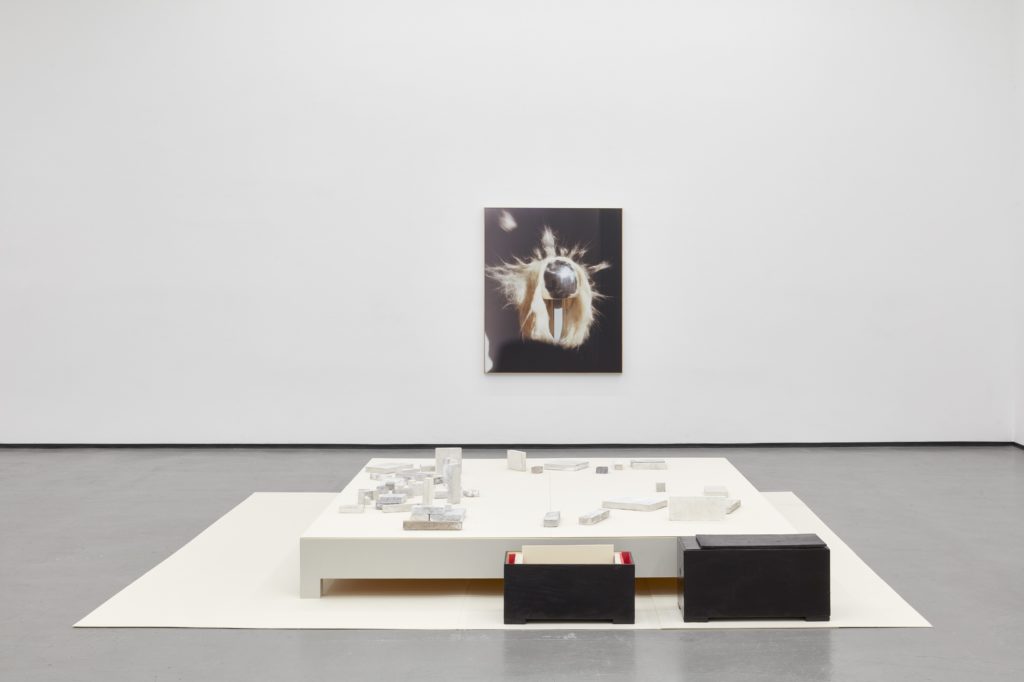
Within this installation, the arrangements of compressed ash blocks draw on the principles articulated by Hans van der Laan, a Dutch monk and architect whose work was developed in the second postwar period. His theory of numerical ratios in architecture — the “plastic number” — orients architectural form around human perception. It argues that spatial awareness arises through proportional differences. Structurally speaking, when two units are identical, they are read as countable units; when they differ by a 3:4 ratio, perception shifts, and space becomes readable through comparison.
According to van der Laan, architecture should be oriented toward the human understanding of space. Central to this idea is the body and its sensory capacities as the means through which experience of the world is produced. Meaning emerges through proportional relations; perception is never detached from embodied encounter. His theory supports an understanding of space as becoming legible through its physical properties and, ultimately, through interaction.
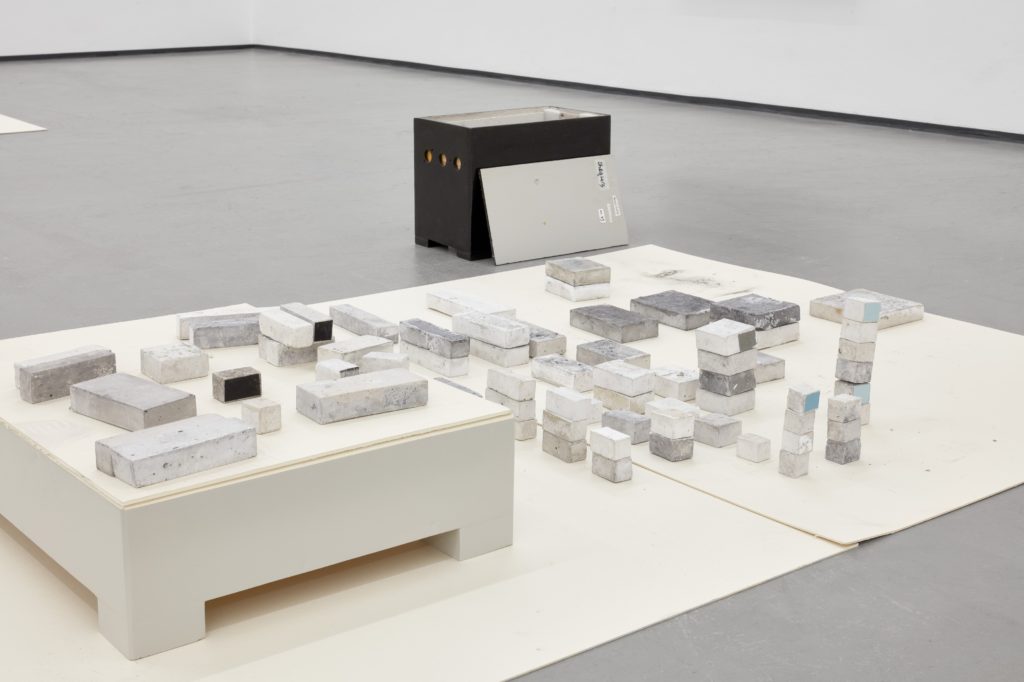
Although absent in representational terms, the body is constitutive of Porter’s work. As an absent operator, it acts as a condition of production. In a quasi-alchemical logic of material reconfiguration, the ashes return as geometric forms. They also shift from being a remainder of something that has happened to something that still carries the capacity to create. As Ned Lukacher writes in his introduction to Jacques Derrida’s Cinders (1991), a cinder “is a very fragile entity that falls to dust, that crumbles and disperses. But cinders also name the resilience and the intractability of what is most delicate and most vulnerable.”[1] Ash thus appears as one of the weakest construction materials, gradually breaking down under the softest touch, yet simultaneously carrying the potential for future formation. As the smallest measure of both physical and metaphorical construction, it points toward future potentiality.
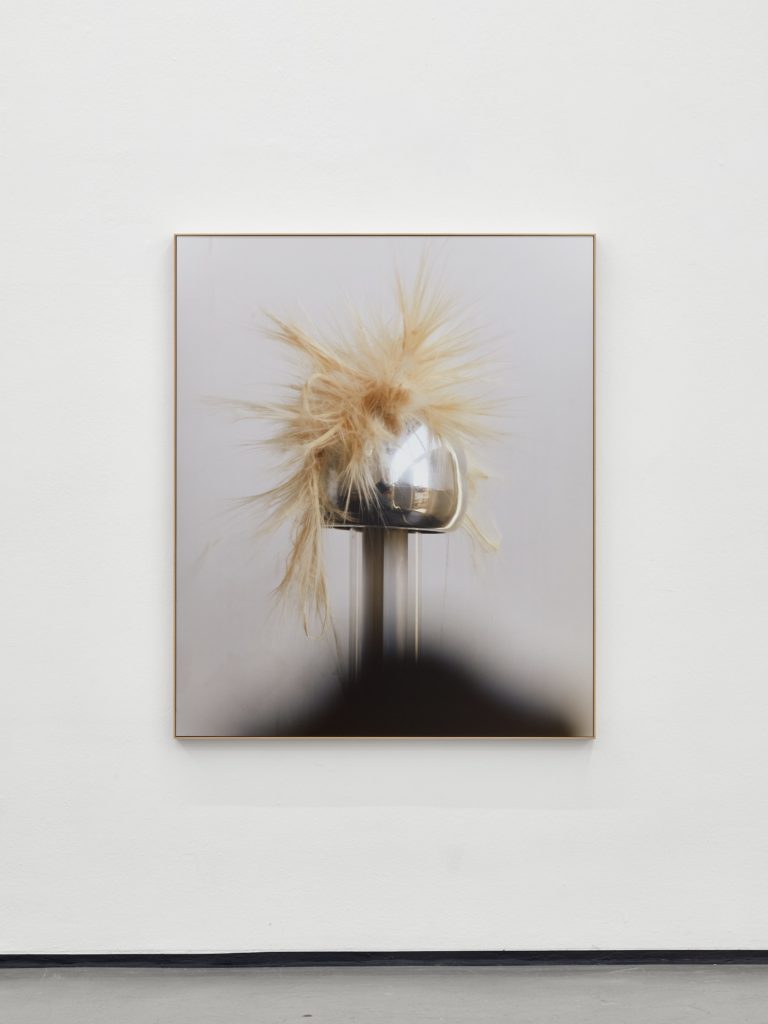
Within Porter’s practice, experimentation becomes a fundamental condition for engaging with the world. The five photographic works in “Sample Question” take the curiosity for unseen yet present physical forces as a starting point. Titled flax and human; horse and linen; dog, sheep, human; linen and horse; and silk and soy (all 2026), they are compositionally reminiscent of a classical portrait layout: a front view of a subject composed against a neutral background. At the center of each image a Van de Graaff generator — a mirrored sphere resting on a slender steel support — suggests the form of a head. Like hair gravitating toward the edges of the frame, fibers protrude from its surface.
Porter has been gathering fibers derived from animal, human, and plant matter, sourced from industrial weaving residues and offcuts. Electrified by voltage, they frame the metal apparatus of an electrostatic generator, which demonstrates the invisible phenomenon of electrostatic charge. As an apparatus that renders this force visible by making its effects perceptible, it invites tangible testing and produces an indirect form of knowledge generated through material behavior.
The tilted surface of the sphere exceeds the limits of the visible field: the convex mirror expands perception beyond what would normally be accessible. The image allows the viewer both to trace the room in which the generator sat — the high ceiling, the bright windows — and to understand how the image was constructed. Porter appears in each photograph, her mirrored figure reflected in the surface of the metal dome. Along the visual border of the pictured sphere, her outer form dissolves into a soft blur, with her face turned downward toward the camera’s viewfinder.
Understood through relations, objects are treated as active forces. Within this system, the human body serves as a site of ignition, where transformation is set into motion through contact and perception. “Sample Question” proposes multiple modes of engaging with the world. In a practice devoted to materials and their potentiality, the works operate as an experimental setup. Ultimately, this allows for a continuous negotiation of how meaning is produced.
[1] Jacques Derrida, Cinders, trans. Ned Lukacher (Lincoln and London: University of Nebraska Press, 1991), 2.