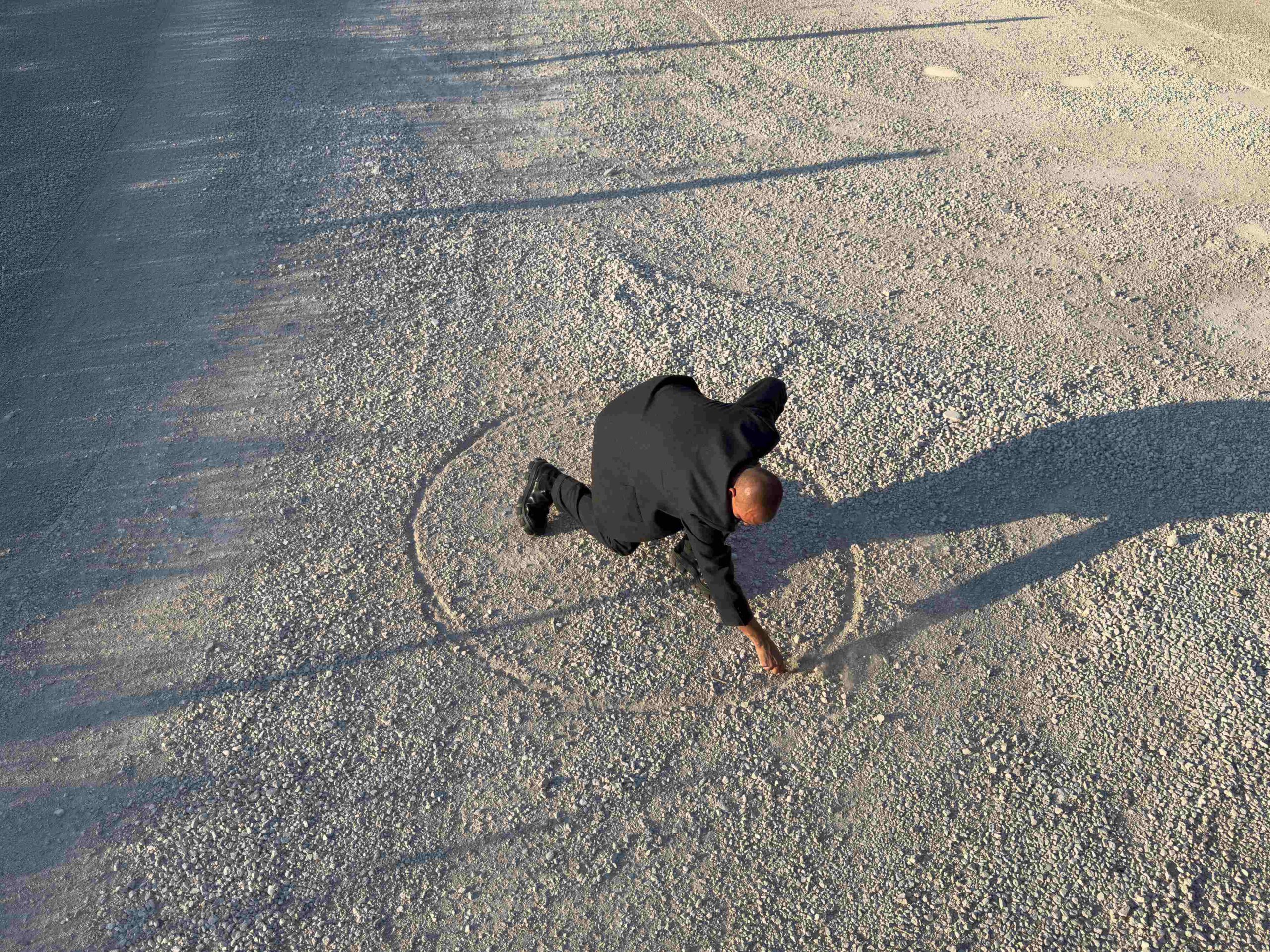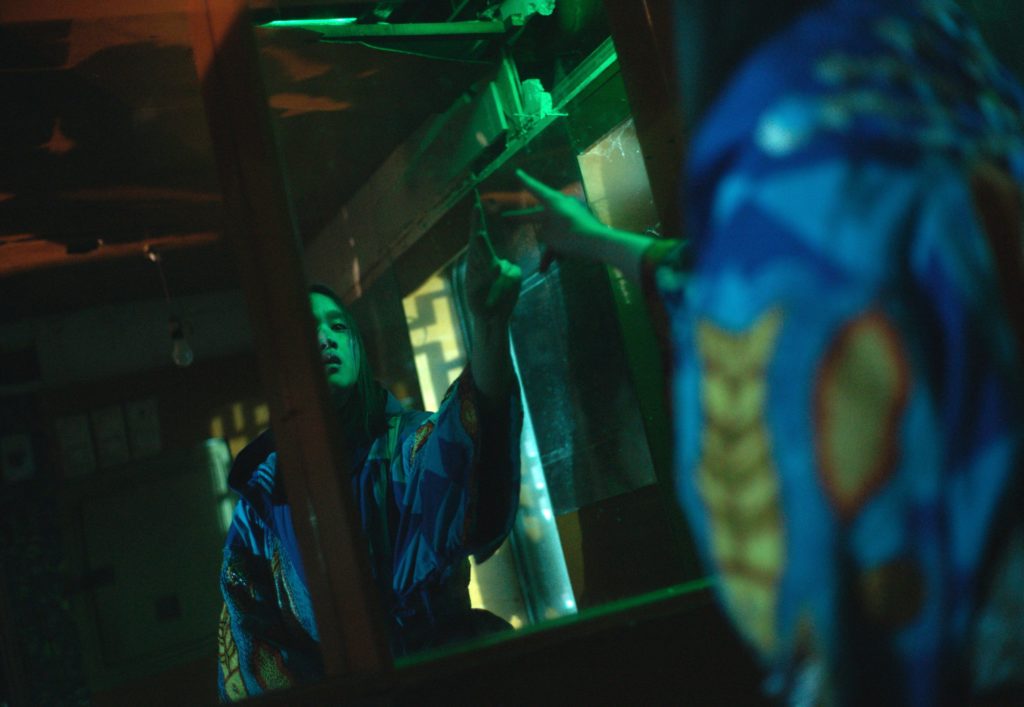
In Lap-See Lam’s works, her personal memory meets the tide of history like two opposing currents, their collision throwing up a burst of white spray that leaves the viewer bedazzled and enchanted, completely unaware of the possible obscurity she embeds in this fleeting moment of audiovisual brilliance. In a vast ocean of meanings and movements, Lam constructs an evolving narrative world for the Cantonese diaspora in which migration, mythology and performance continually reshape one other. She has an instinct for operatic potentials while maintaining a unique political subtlety. Following her practice feels like watching a small vessel chart a long course through different seas, connecting the ancient legacy of Silk Road trade to emergent imaginings of diasporic futures.
One of the shared experiences among second-generation Chinese immigrants in the West is growing up in a family-run Chinese restaurant, where washing, chopping, and stir-frying happen alongside doing homework, praying to ancient deities, and arguing with parents. The familial bond simmers in a soup of sacrifice, guilt, and love.

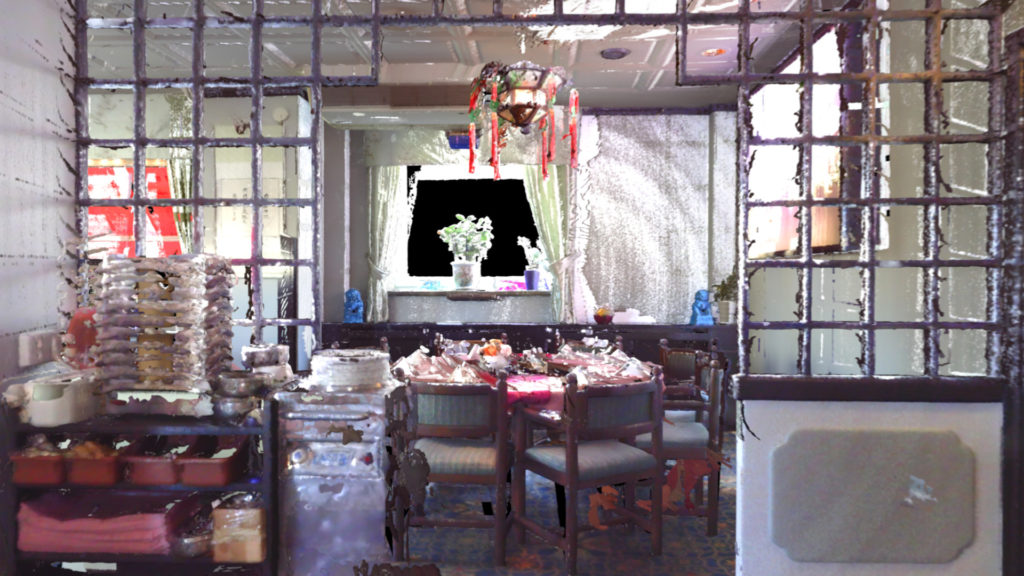
When Lam’s family decided to sell Bamboo Garden, the restaurant established by her maternal grandmother after a journey from Hong Kong to Stockholm via a decade in London, Lam began 3D-scanning typical Chinese restaurant interiors across Sweden. Noticing how the ornaments are designed to cater to and reinforce racial stereotypes, she started making artworks that explored the performativity of these design choices and turned them on their head. Beyond Between (2018) is a 3D-milled model of a typical ancient Chinese temple roof of the kind used in Chinese restaurant interiors in Sweden. Lam leaves it half-finished, signaling a constructed fantasy and reflecting the spectator’s gaze back at them.
Lam discovers fictional attributes of Chinese-ness not only in these ornamental interiors, but also in the irony of the Chinese banquet as a local family gathering place, in contrast to the reality of her own family’s emotional distance while running the restaurant. Lam speaks about the term “generation loss,”[1] which, in video editing, refers to the loss of data during transcoding and the resulting glitches in digital archives. It coincides with what is lost in translation across the generational divide within an immigrant family. Something is missing from the narrative of the past. Something is missing from intergenerational exchange.
In Mother’s Tongue (2017), Lam and Wingyee Wu invite viewers on an app-based walking tour of places tied to current or former Chinese restaurants in Stockholm, listening to monologues about the diasporic experiences of three generations of women. When the restaurant interiors are isolated in virtual space, it becomes apparent that this extravagant scenography was constructed to optimize the viewer’s exotic experience as if they were talking through a movie set or fashion runway. The dramaturgy of the dialogues loosely follows the walkthrough in the digital restaurant environment as the space itself gradually comes to embody the longing, suspension, and reincarnation of the speaking subject.
Lam’s methodology of excavating cultural history not as a static, categorical proposition but as a generative continuum gives her creative journey a strong sense of agency and profound possibility. From her early VR projects to her most recent video installations and bamboo sculptures, she has created an extraordinarily expansive world built upon carefully researched references specific to Hong Kong and to Cantonese migrants’ encounters with the Western world.
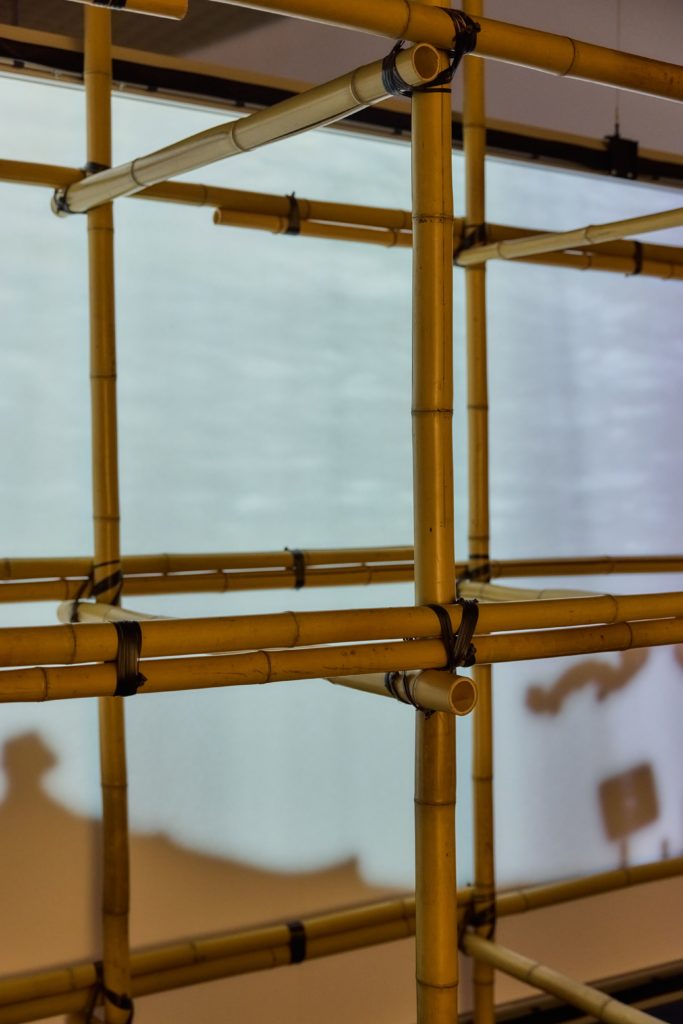
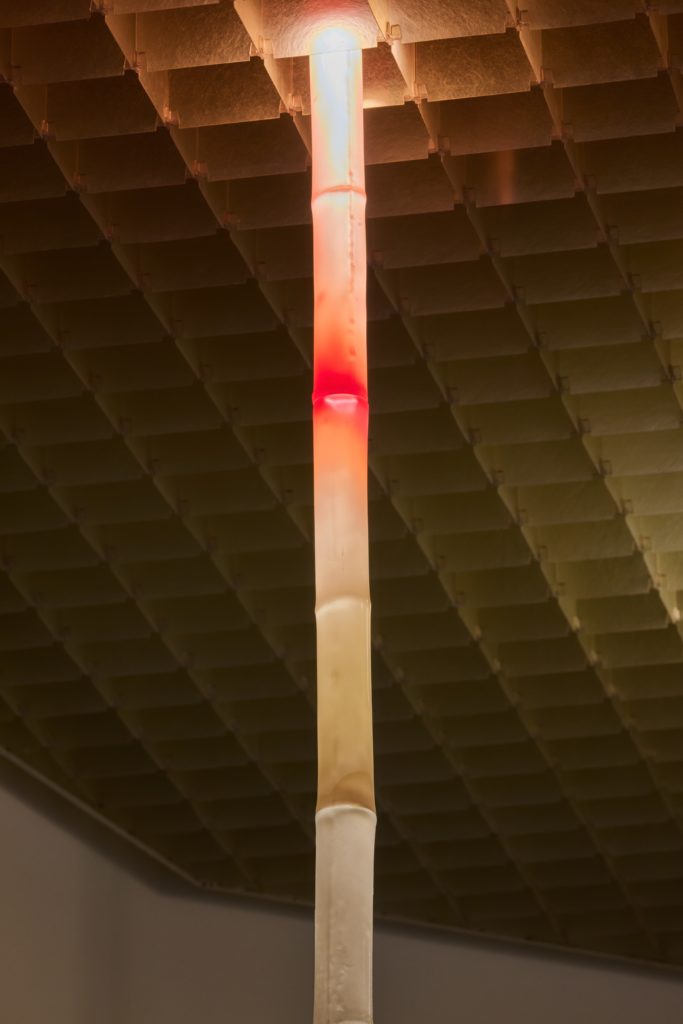
In a recently published text on Lam, bamboo is mentioned both as a symbol of resilience that Lam’s family used in naming their businesses and as a rhizomatic plant that characterizes Lam’s multifaceted practice across different media.[2] However, within the context of Hong Kong, bamboo, especially bamboo scaffolding is a loaded subject. Hong Kong is one of the last cities in the world that still uses bamboo scaffolding on a large scale, both for the preservation of its cultural identity and reverence for the craft. From building Cantonese opera stages to working on construction sites in Hong Kong’s extremely narrow streets, there are contractors who have preferred bamboo to metal, although the former unfortunately poses greater fire-safety concerns and may soon be restricted by policy changes.[3]
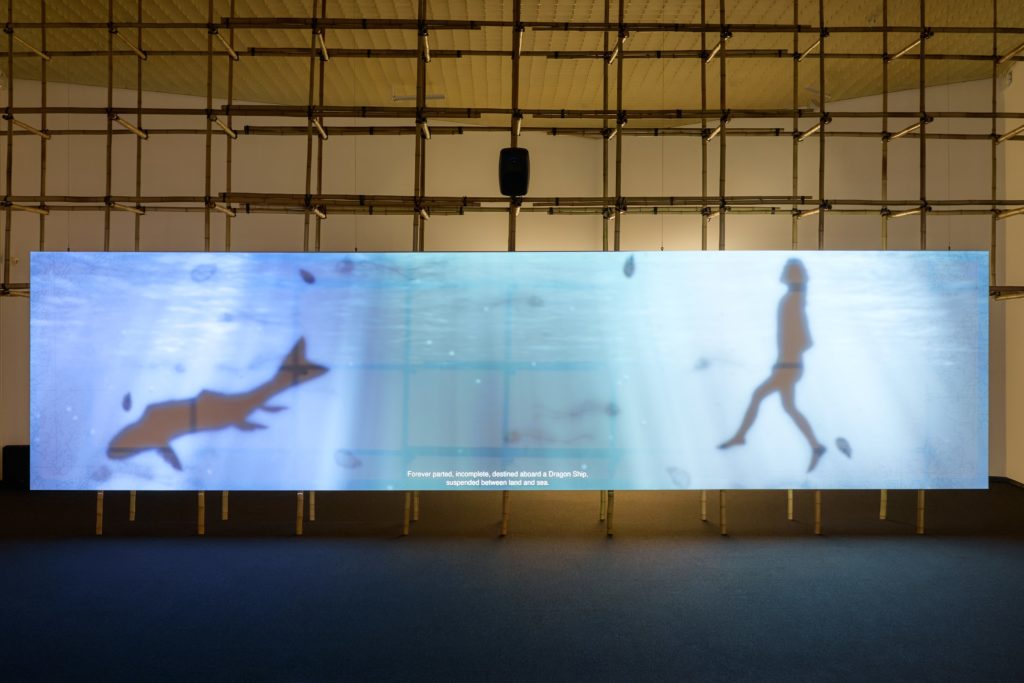
In 2024, Lam presented her most significant work, The Altersea Opera, at the Venice Biennale, representing the Nordic countries (Sweden, Finland, and Norway). The work was inspired by the Red Boat Opera Company, the most influential and successful traveling Cantonese opera troupe in the Pearl River Delta during the late Qing dynasty. The Red Boat Opera Company has a long history of associations with kung fu, dragon boats, and eccentric fugitives. Many of these associations have since become stereotypes of the Chinese diaspora, although they were originally romanticized as forms of camouflaged defiance against the Qing imperial court.
The Altersea Opera was conceived by Lam and created in collaboration with the experimental composer Tze Yeung Ho, who brings together an extraordinary pop-baroque score with libretto, poetry, and lullabies, and textile artist Kholod Hawash, who created costumes featuring intricate embroidery and quilting traditions with mythological imaginations. In a sense, Lam explores the collaborative nature of Cantonese opera by deconstructing its forms and reconstructing them through multicultural influences in mind, a bold reinterpretation that propels this tradition into a contemporary synergy.
Moreover, Lam worked with master bamboo scaffolder Ho Yeung Chan to create a massive vertical bamboo structure, placing the viewer in the mood for a good opera, a temporary escape from the present. In the performance video, artist Ivan Cheng plays a future incarnation of Lo Ting, a mythological half-fish half-human figure who longs to return to Hong Kong only to discover that it has transformed beyond recognition. Flamboyant and self-indulgent, Cheng’s version of Lo Ting sings of the sorrow of displacement and drifts into fantasies about past relationships with humans.
Historically, Lo Ting is a singular and elusive figure with whom few Hong Kong audiences identify.[4] In classical Chinese literature, the name Lo Ting often refers to an ethnic minority group rumored to be descended from an anti-dynasty rebel who fled to the margins and later became integrated for their skills in weaving baskets and oceanic navigation.[5] Lam re-mythologizes Lo Ting as a victim of the insatiable greed of the human race, blurring the lines between desire for consumption and erotic pleasures. This subtle shift transforms a regional tragic narrative into a broadly recognizable trope of global extractive capitalism.
Lam has always had bigger plans for Lo Ting – not to bind the figure to its original context, but to let it act as a storytelling agent in different spaces and times. An earlier exploration of Lo Ting appeared in the exhibition “Tales of the Altersea” shown at Portikus, Frankfurt am Main, and at the Swiss Institute, New York, in 2023, which delved into negative stereotypes surrounding Chinese culture in the modern European context. Inspired by an abandoned dragon-themed restaurant ship, which in the 1990s traveled from Shanghai to many European ports, The Floating Restaurant Sea Palace, commissioned by Chinese-Swedish entrepreneur Johan Wang, Lam created eight-channel videos to explore existential questions regarding migration, aspiration, and misconceptions.
The Floating Restaurant Sea Palace was a magnificent project, adorned with the auspicious Chinese symbol of the dragon, yet it was later perceived by Stockholm locals as a haunted attraction and eventually abandoned.[6] Can Lo Ting one day be Kun Peng, the gigantic mythological bird that signifies ambition and power? Lam juxtaposed many Chinese references in uncommon pairings, questioning hierarchies of high and low culture, as well as what overseas immigration means economically, culturally and existentially for Chinese communities. This inquiry gets more complex and intriguing if one considers the history of Chinese immigration movements since World War II: those following the Great Leap Forward, those of the late 1970s, and those of the 1990s. Hong Kong has long been –– and in many ways remains –– the port of departure for aspiring Chinese migrants by traveling by sea. The city is always in a transient state, bearing constant movements in and out, between the mainland and the West.
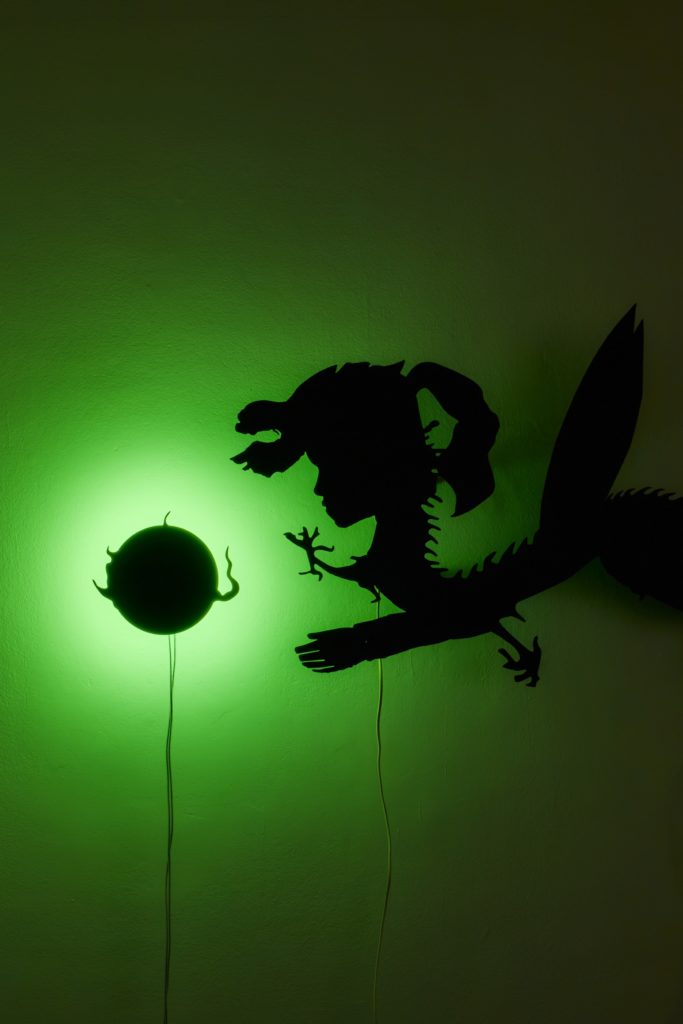
In 2026, Lap-See Lam’s most recent exhibition “Ombres” at Henie Onstad Kunstsenter, Oslo, draws on the term “Ombres Chinoises,” the European designation for Chinese shadow play puppetry introduced through Silk Road trade. Today, there’s little awareness in China of the extent to which the import and export of cultural forms during early globalization contributed to the formation of Chinese identity overseas as a marker of class. Yet through Ombres Chinoises and various forms of Chinese culture preserved in European museums, one can get a glimpse of the elevated, aestheticized, and ultimately incomprehensible image of China that was once projected to the world. Who would have thought Ombres Chinoises was mostly a folk practice and a collective memory, whose seamless blend of real historical events and fairy tales captivated the general public, especially the children?
Guided by the storytelling form of Chinese shadow puppetry, the viewer experiences the constellation of Lam’s references not only with wonder but also through opacity — in shadow puppetry, the viewer can never see the characters clearly with only their blurry shadows. “A right to opacity” as Édouard Glissant would put it.[7] Keeping it not readable becomes conscious resistance to the western consumption or the identitarian social mechanisms in today’s art world. Lam’s works grant the most iconic dragon to be hard-to-read, admitting a part of its interiority impossible to grasp. As a contemporary artist, she is stepping away from a series of historical performing models that used to camouflage the performers’ true identity in order to entertain the innocuous audience for survival needs. Instead, she is utilizing her artistic agency to claim a new sense of authenticity, re-mystifying and re-enchanting a set of relations that open the diaspora identity to the past and future.
Committed to complex storytelling, Lam continues to make her cinematic, large-scale installations ever more intricately interwoven. She both identifies and disidentifies with any fixed expectations of what she might represent, a position that prevents her from becoming either a spokesperson for crisis or a cultural informant amid today’s shifting geopolitics. With her deft political awareness, Lam’s practice remains consistent in the subtlety of its positions, allowing the art to speak for itself.
Lam is one of the most exciting artists working on Asian diaspora identities. She created an entire universe of Cantonese motifs — bamboo scaffolds, restaurant interiors, shadow puppets, dragons, Red Boat, Lo Ting, and the shifting waters that carry them. These motifs do not settle into fixed symbols, nor do they ever signify conformist views. Instead, they form a living vocabulary that she continually recombines, allowing one story to open into another across generations. Within this universe, Cantonese culture is set in motion as a speculative grammar and still capable of transformation.
[1] Rebecca Liu, “Artist Lap-See Lam: ‘My Work Is a Way to Connect Generations,’” The Guardian, September 9, 2024, https://www.theguardian.com/artanddesign/article/2024/sep/09/lap-see-lam-artist-floating-sea-palace-studio-voltaire-london.
[2] Andrew Russeth, “Through Bamboo, a Swedish Artist Explores Her Family’s History,” New York Times, March 24, 2026, https://www.nytimes.com/2026/03/24/arts/design/hong-kong-lap-see-lam-exhibition.html.
[3] Bamboo scaffolding was speculated as the cause of fire spreading.
https://www.nytimes.com/2025/11/26/world/asia/bamboo-scaffolding-hong-kong-fire.html?eafs_enabled=false
[4] https://aaa.org.hk/tc/like-a-fever/like-a-fever/lo-ting-and-hong-kong-cultural-identity-part-two
[5] “卢亭者,卢循昔据广州,既败,余党奔入海岛,野居,惟食蚝蛎,叠壳为墙壁。”
Liu, Xun 刘恂. Lingbiao luyi 岭表录异 (Records of the Unusual from Lingnan). Compiled in the late 9th century.
[6]In The Altersea Opera at the Nordic Countries Pavilion, Lam also recreated this restaurant ship where the bamboo scaffolding structure replicated the ship at full scale. Bookended by the ship’s original dragon head and tail, the structure reimagined the ship as a stage, recalling the temporary bamboo theatres of Cantonese opera—as if the Red Boat had reincarnated as The Floating Restaurant Sea Palace, only to be pieced back together in Venice.
[7] Glissant, Édouard. (1997). Poetics of Relation (Betsy Wing, Trans.). University of Michigan Press. (Original work published 1990).