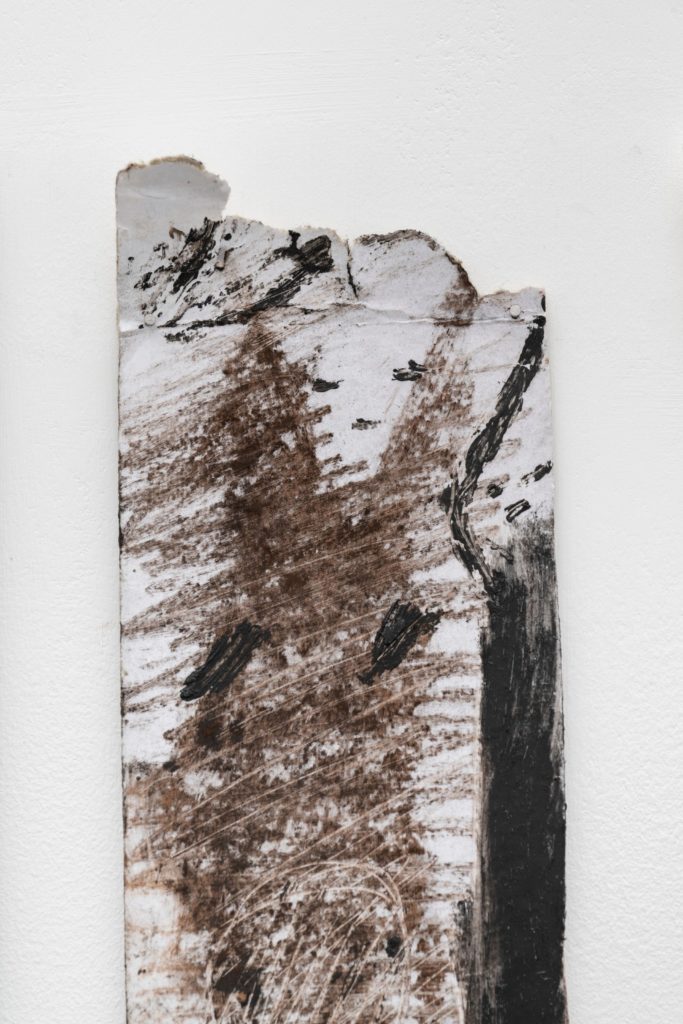
Paper occupies a peculiar place in the history of art. It is among the most fragile supports, yet also one of the most enduring. It records everything that comes into contact with it: the pressure of a hand, the hesitation of a line, dust, light, humidity, the slow discoloration brought by time. Unlike stone or bronze, paper never fully conceals its own vulnerability. It continues to change long after the drawing has left the artist’s studio.
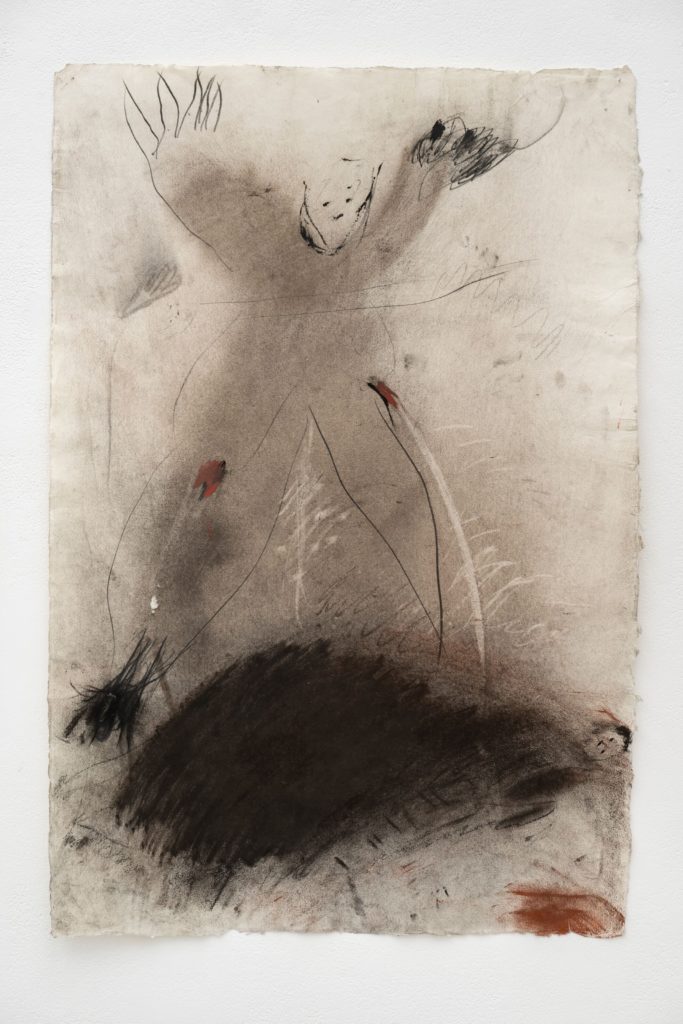
I was thinking about this while visiting Satine gallery in Venice last December. The space is run by a friend, and I had stopped by as much to see her as to see the exhibition. What I remember most vividly, however, is not our conversation but the wall. Armineh Negahdari’s drawings were attached directly to them with drawing pins and small nails, without frames or glass, as if they had only just been taken down from the studio. They seemed remarkably at ease in that condition. Nothing separated them from the space around them; nothing attempted to protect them from the city itself.
Venice has always complicated the idea of permanence. Water continuously redraws its edges, while humidity settles patiently into walls, wood, and paper alike. The city teaches its inhabitants and visitors that preservation is never the opposite of transformation, but one of its forms. Standing in front of Negahdari’s drawings, I found myself wondering whether it was possible to look at them without also looking at the paper that carried them. The images were compelling, certainly, but so was the fragile material that received every mark while remaining itself. The support was not neutral. It seemed to participate in the work, insisting on its own susceptibility to time.
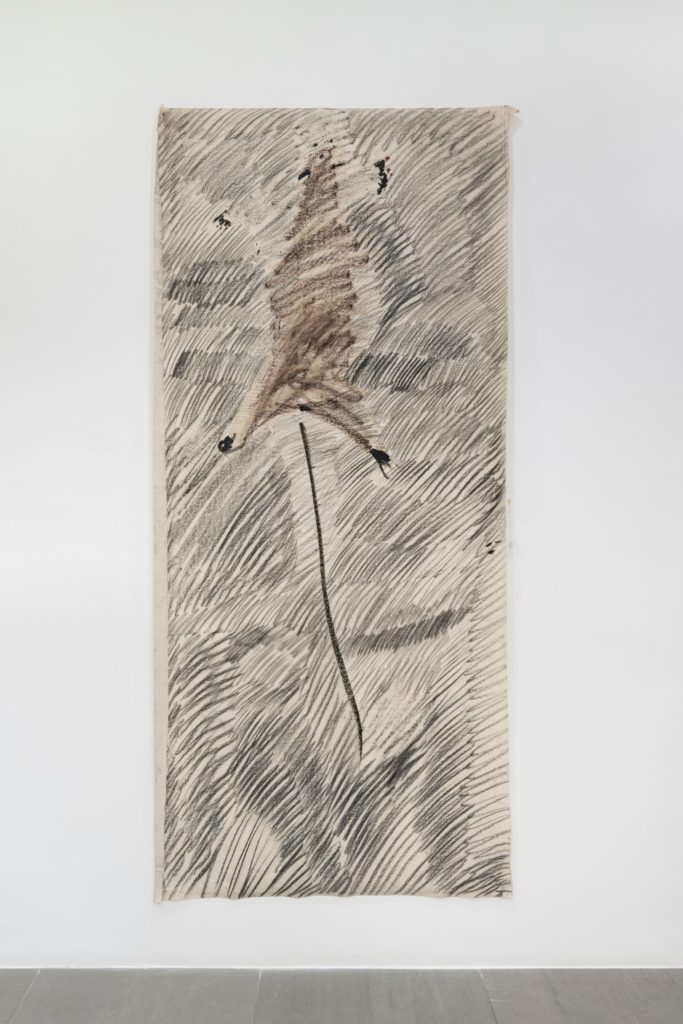
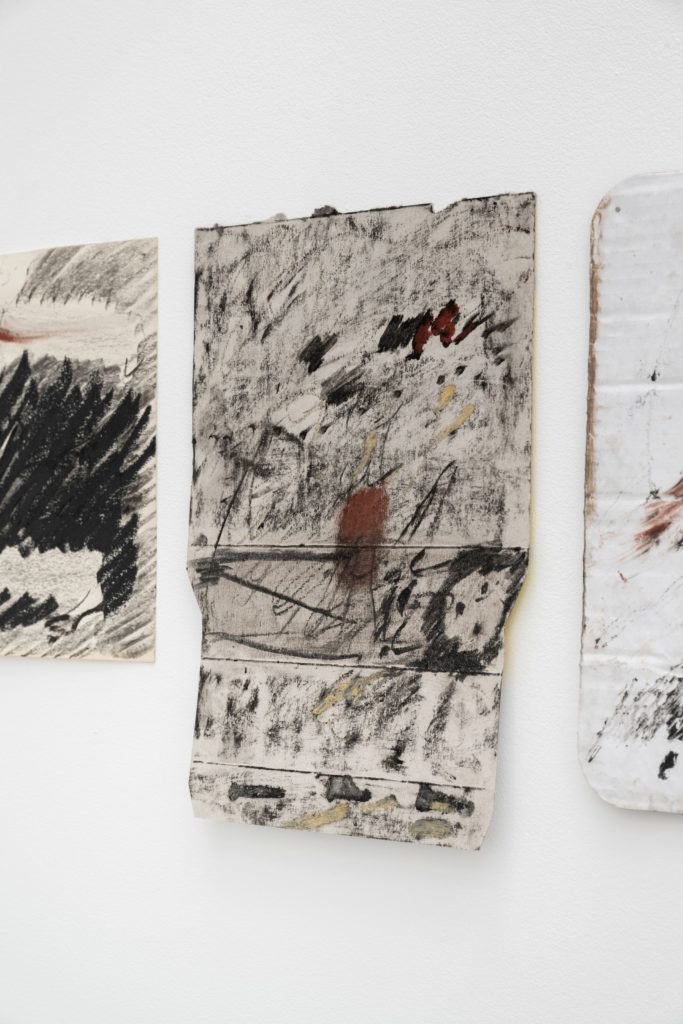
The exhibition, “Full-Handed” (2025), takes its title from the gesture of working with one’s hands. As Negahdari later explained to me, the title evokes “hands at work, with so much to give.” It also carries the idea of “sowing on paper and seeing the lines grow like grass: open, lush, infused with growth and wind.” The image is a revealing one. It shifts attention away from the finished work and towards the slow, patient act of making, where drawing is understood less as an act of representation than as one of cultivation. Yet it was not this idea, nor even language itself, that first held my attention. It was the sensation that these drawings had somehow escaped the stillness we usually expect from works on paper. They felt provisional. Not unfinished, but unwilling to settle into the fixed condition that exhibitions demand. They almost looked like visitors temporarily inhabiting the walls before continuing elsewhere. The figure in Mes pieds faisaient rouler des pierres (2025) seems to emerge only to dissolve again, while À grand peine on m’a réveillée (2025) suggests a body moving forward as though caught in the act of crossing rather than arriving.
Months after my visit to Venice, in the midst of an unusually hot summer, I was exchanging emails with Negahdari and I asked her whether exhibitions ever interrupt what she often described as “the continuous flow of her practice.” Her answer surprised me for its simplicity. “An exhibition is more like a pause,” she wrote. “It offers a moment to stop, look back at what I have done, and see how others respond to it.” A pause is not an ending. It belongs to movement. It allows something to become visible without bringing it to a conclusion.
Looking back, I realized that this was exactly what I had sensed in Venice before I had the words for it. Those drawings did not appear unfinished because they lacked anything. They appeared open because they refused to coincide entirely with the moment of their display. The exhibition did not complete them but slowed them down long enough for someone else to encounter them.
Negahdari’s description of the exhibition as a pause also changes the way one thinks about the individual drawing. We are accustomed to encountering works on paper as self-contained images: complete, autonomous, and finished. Museums, catalogues, and collectors all reinforce this habit of looking. A drawing begins and ends with the edges of the sheet; an exhibition gathers these discrete objects into a coherent body of work.
Negahdari’s practice resists this logic. Her drawings rarely announce themselves as singular statements. They seem to belong to a much larger movement in which forms return with subtle variations, figures dissolve into flowers, mountains become bodies, hands become branches. Looking at them individually is never enough. No single drawing claims autonomy. Each gains meaning through its proximity to the other, as though every single sheet belonged to a larger constellation that could never be fully grasped at once.
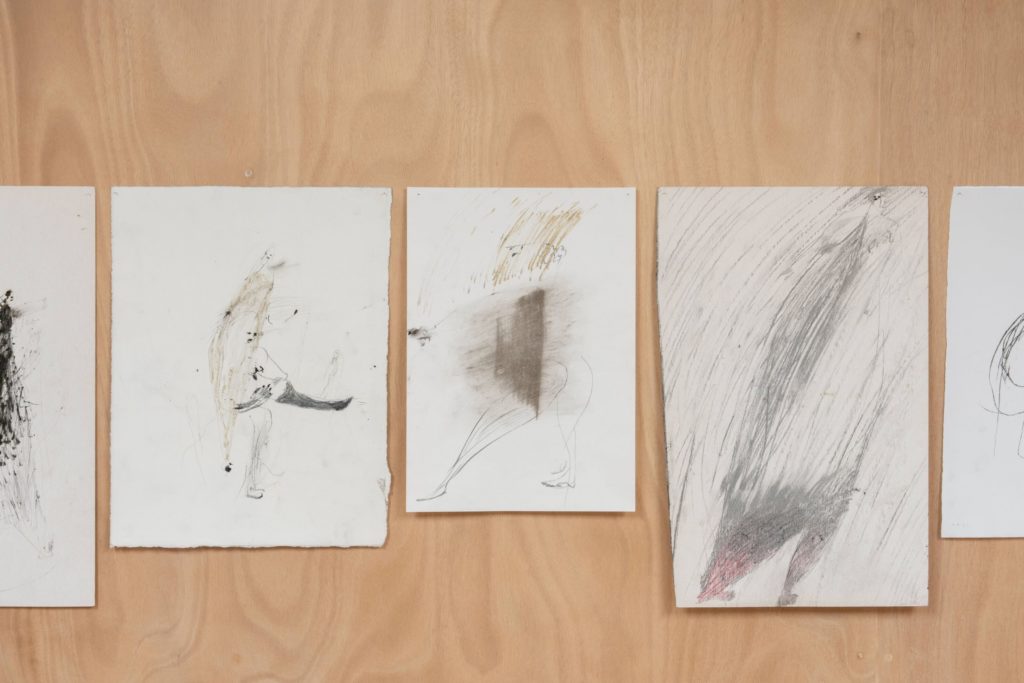
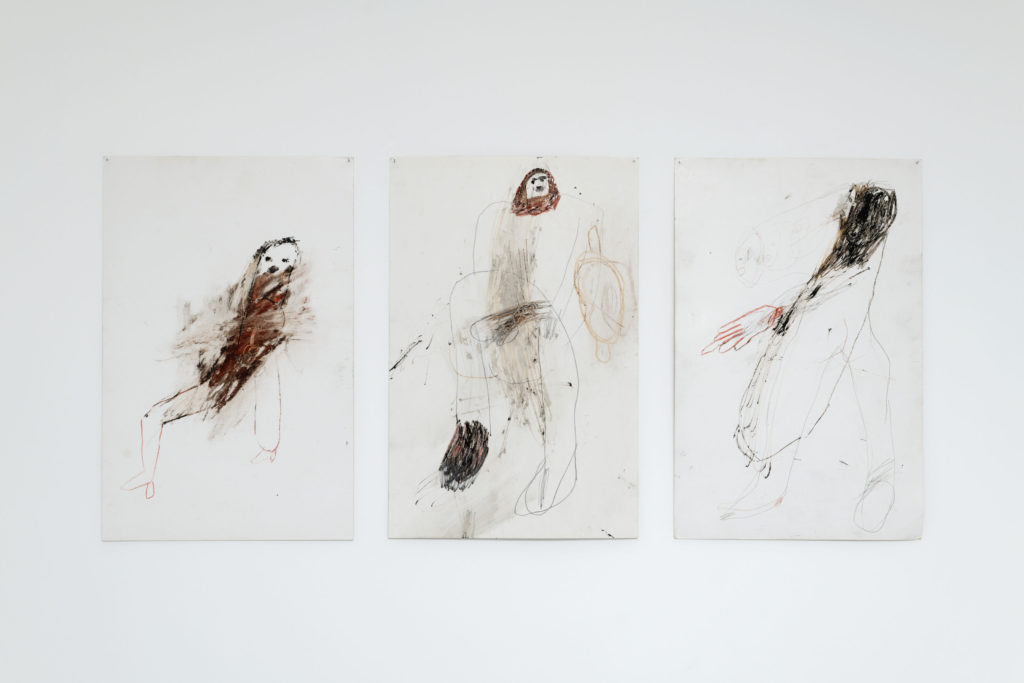
When I asked her whether finishing a drawing ever feels like reaching certainty, her answer once again displaced the question. “Certainty is an illusion,” she told me. “Finishing doesn’t mean resolving everything — the flow continues, like a river. Does a river ever really end, or does it simply know where it is going?” It is difficult, now, to imagine a more precise description of her practice. Completion, here, is not the opposite of incompleteness. It is simply the moment when one drawing gives way to the next.
This continuous movement explains why repetition occupies such a central place in her work. Faces return, bodies reappear, gestures echo one another across hundreds of sheets.Yet repetition never produces sameness. It functions more like rhythm. A line repeated is never precisely identical to the previous one. It carries the memory of earlier gestures while opening itself to unforeseen variations. The work advances in this way: by allowing each drawing to remain in conversation with those that came before and those still to come.
This may explain why Negahdari speaks so little about inspiration. Waiting for inspiration would imply that creation begins at a particular moment. Her practice suggests the opposite. Drawing is already underway before the artist sits down at the table. It continues in the studio, in the slow accumulation of paper spread across the floor, in the light entering through the window, in the habit of returning every day to the same gestures. Images emerge from this rhythm, they do not interrupt it. They are moments of heightened attention within an activity that never really stops.
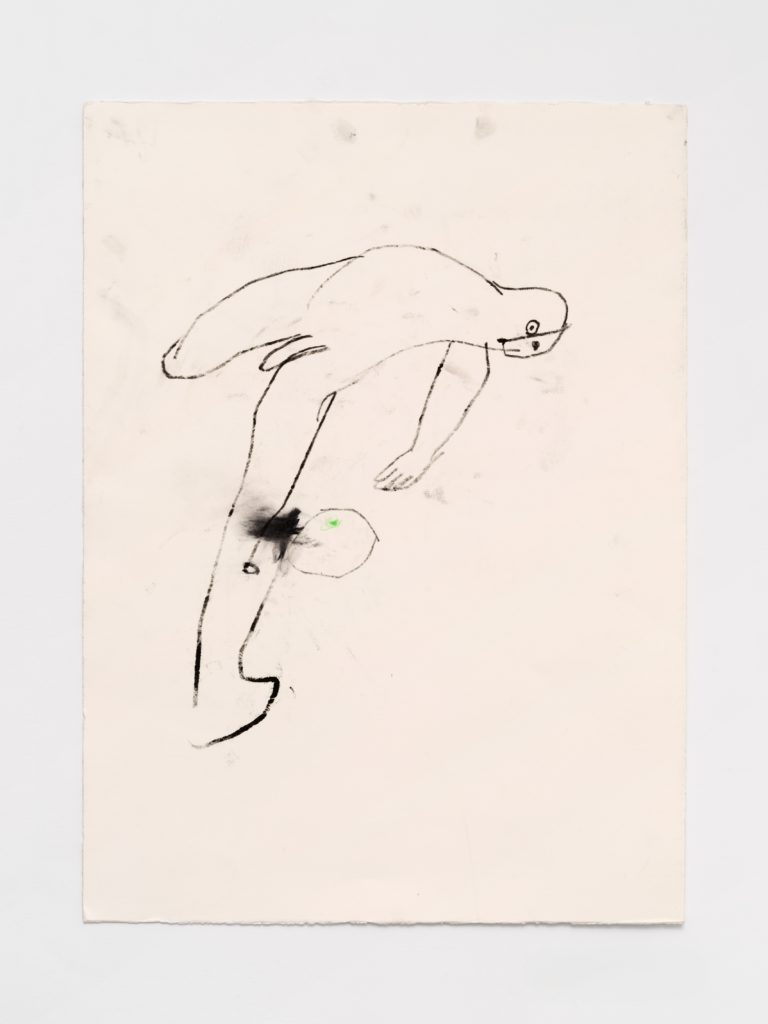
If “Full-Handed” introduced me to the fragile materiality of Negahdari’s drawings, “The Living River” (2026), recently presented at Cell Project Space in London, revealed something else. The exhibition unfolded through drawings that seem to migrate across the space, each sheet echoing another through recurring figures, gestures, and forms. Rather than appearing as isolated works, they suggested a larger visual current in which no single image could exist entirely on its own. Walking through the exhibition, one had the impression of entering an environment where images continued to unfold across the walls, each drawing extending the life of another.
Although no sculptures were included in “The Living River,” Negahdari’s sculptural practice extends the same logic into another medium. First presented in her first solo exhibition, “Dans la chambre d’ami.e.s” (2023), at Marcelle Alix in Paris, and later at Art Basel in 2025, these works might be describe as drawings made solid; yet even that feels slightly misleading. Negahdari herself resists such distinction. “Drawing is always my starting point,” she told me. “Even in sculpture, I pay more attention to the surface than to the volume.” It is a striking observation: sculpture is traditionally understood through mass, weight, and occupation of space. Negahdari approaches it through touch. Her figures retain the sensitivity of paper. Charcoal, graphite, scraps of fabric, found pieces of wood or clay are less materials to be mastered than companions in an ongoing conversation that begins with the hand.
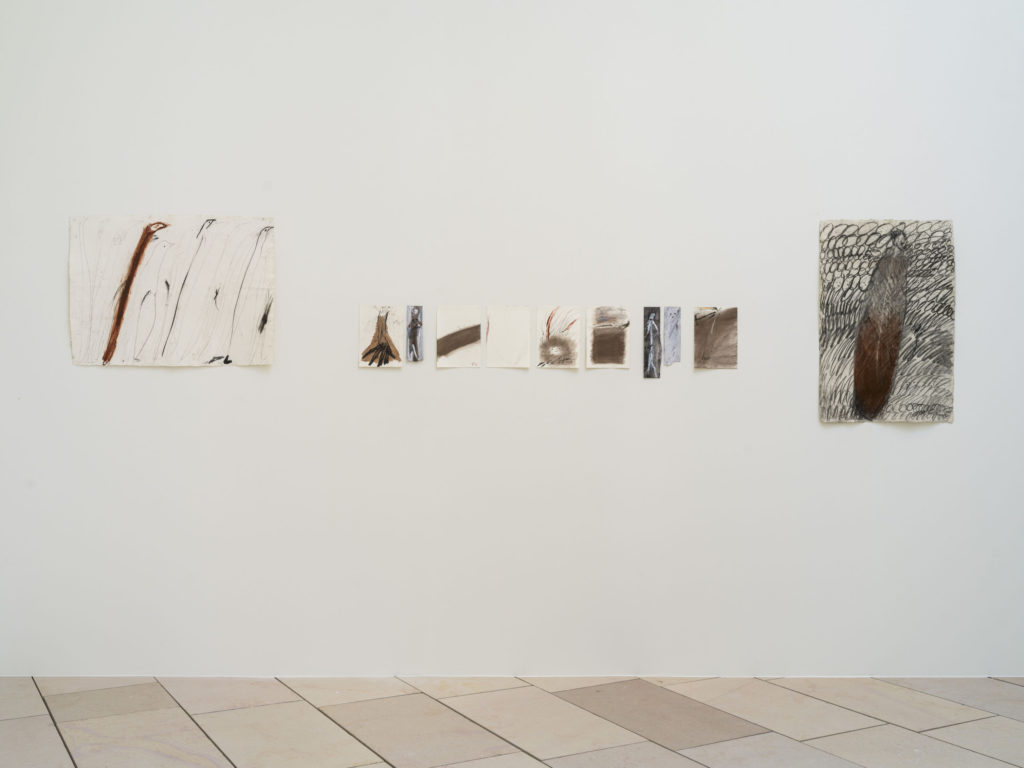
Seen in this light, the dialogue between drawing and sculpture is not a matter of translation from one medium to another. It is more a question of continuity. A gesture migrates from paper to clay without changing its nature. The same attention to traces, to abrasion, to the fragile life of surfaces, persists regardless of the material at hand. Even the sculptures resist monumentality. They stand together almost like a small community: quiet, vulnerable presences whose strength lies in refusing to dominate the space they inhabit.
Only gradually, then, does the title of the Cell Project Space exhibition begin to resonate. The living river is not an image represented in the works but a way of understanding their movement. The river is not found in charcoal lines or clay bodies; it exits in the passage between them, in the sense that nothing is ever fully concluded or definitely separated. Drawing continues into sculpture, sculpture returns to drawing, and each work seems to carry within it the possibility of another.
If there’s one medium that accompanies Negahdari’s work as persistently as drawing, it is poetry. Yet poetry rarely appears in her practice as a source to be illustrated or translated into images. Among the poets who have accompanied her most closely is Forugh Farrokhzad, to whom Negahdari dedicated her Art Basel Statements presentation, “The Horizon Is Vertical” (2026). Farrokhzad’s writing, much like her drawings, allows images to remain open, fragile, and in continuous transformation.It inhabits the works differently, as a way of moving through language. “Language, however, can accompany us,” she wrote to me after insisting that images do not need to be explained. The distinction is subtle but decisive. Language is not asked to complete the image, just as the image does not refuse language. They simply proceed alongside one another, preserving the distance that allows each to remain open.
This became particularly clear in “What Color Is Your Sky Today?” (2026), her exhibition at Fondation Louis Vuitton in Paris. The title is borrowed from a poem by Hushang Ebtehaj and arrives as a question that asks nothing that can be answered once and for all. Like the drawings themselves, it remains suspended, changing with the person who encounters it and with the moment in which is read. The sky, then, is never described, but addressed.
When I asked Negahdari whether moving to France from Tehran had changed her relationship to reading, she spoke less about language itself and more about rhythm. In Iran, she explained, reading had been constant, almost instinctive. Today she often rereads, in French, poems she first encountered in Persian. “It feels as though I am trying to recover that same rhythm, but the language is no longer the same, and neither is the geography.” It is a striking way of describing translation. Meaning survives, of course, but what she seeks is something more elusive: the cadence of a sentence, the movement of a poem through the body, the sensation of recognizing oneself in a voice that now reaches her from another language.
Poetry, then, occupies a singular place in her practice. It’s not there to provide subjects or narratives, but to offer a rhythm that drawing can live in without becoming illustration. Looking at Negahdari’s work, one is reminded that images, like poems, do not always ask to be understood, but only to be accompanied.
There is one final thought that has stayed with me since our correspondence, one that reshaped everything I had been trying to understand about Negahdari’s work. “I have been making work for many years,” she wrote, “but it has not been very long since I became a viewer of my own work.”
We often imagine artists as the first interpreters of what they make, as those who stand closest to the meaning of their work. Negahdari suggests something quite different. Looking, for her, is also a form of arrival. The drawings leave the intimacy of the studio long before they become fully visible, even to the person who made them. Perhaps this is why they continue to resist any closure. They are never asked to settle into a single meaning because their maker continues to encounter them as someone who is still learning how to look.
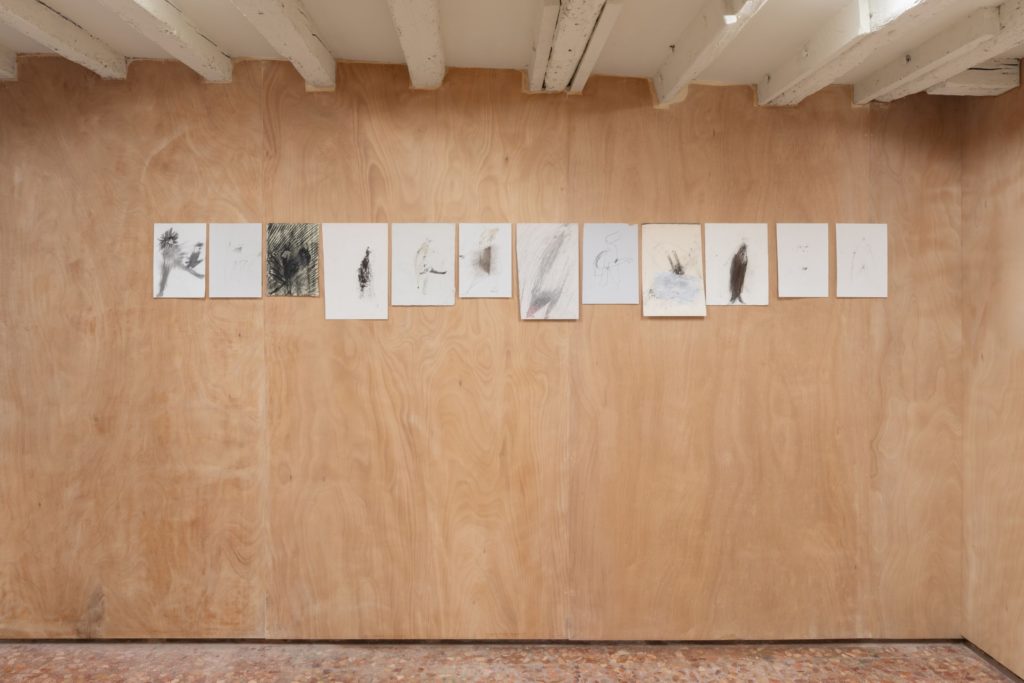
I think back to those sheets of paper pinned directly onto the walls at Satine. At the time, I understood their vulnerability almost exclusively as a material condition: paper exposed to light, air, and the dampness of Venice. Now I see something else: their openness was never simply physical. It belonged to the images themselves, to their refusal to become fixed, to their insistence that every encounter remains provisional.
Perhaps this is where the question of borders finally emerges. Not as a line separating one territory from another, nor as a threshold between image and language, drawing and sculpture, Persian and French. Negahdari’s work proposes another understanding altogether. A border is not where something ends. It is where something remains capable of changing. It is the place where an image continues to move after the hand has left the paper, where a poem finds another rhythm in another language, where a drawing pauses long enough to be seen before setting off again.
The river, after all, never crosses a border only once. It redraws it every day.