Xochi-Calli is a multisensory, immersive work by Mexican architect-sculptor Carlos H. Matos, set within the woodlands of the Lacasapark Art Residency in upstate New York. The project is an open reinterpretation of a temazcal, an ancient Mesoamerican sweat lodge typology.
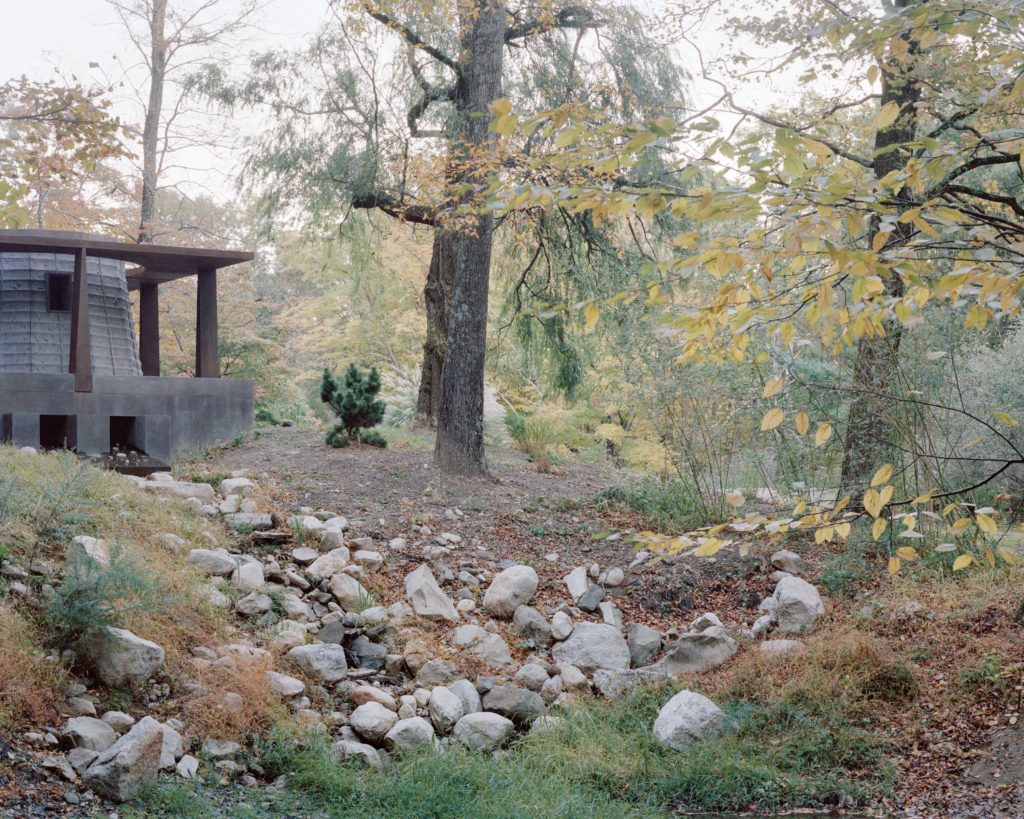
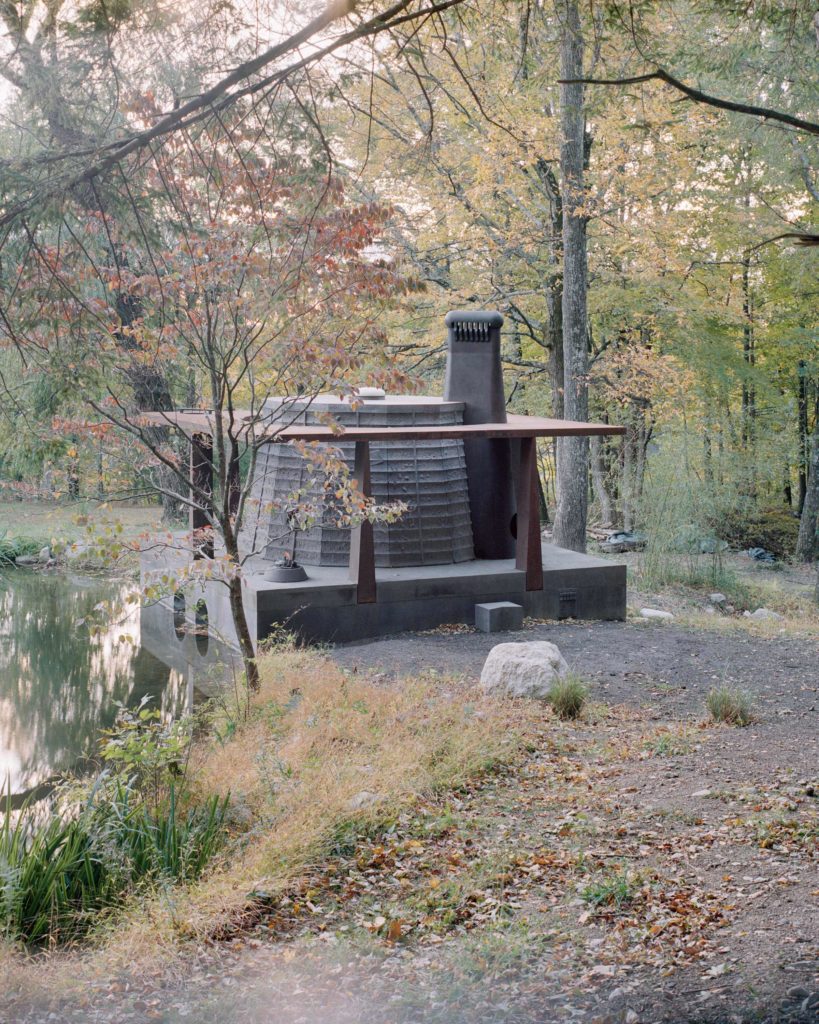
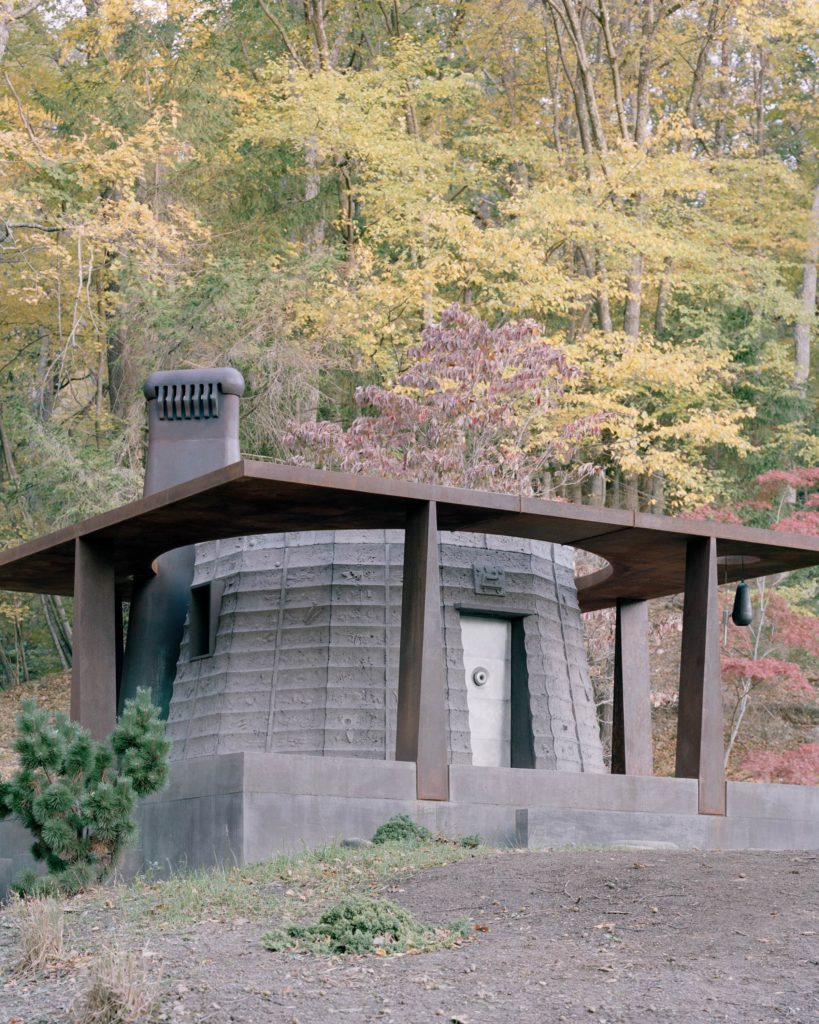
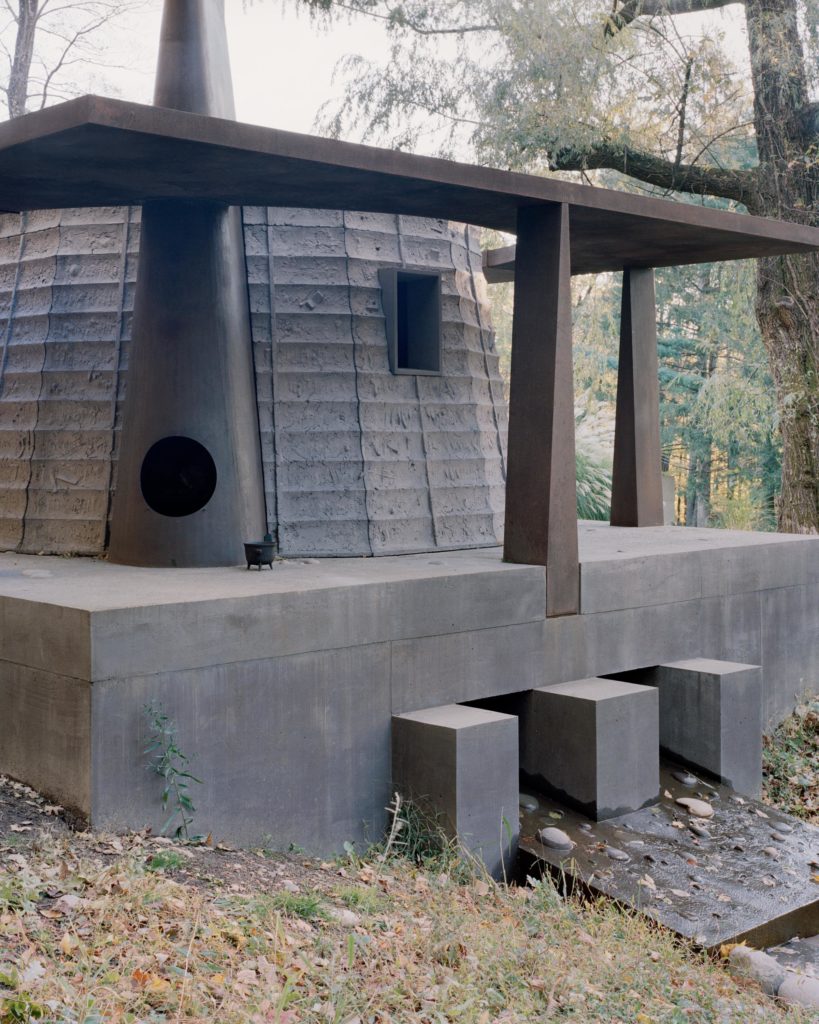
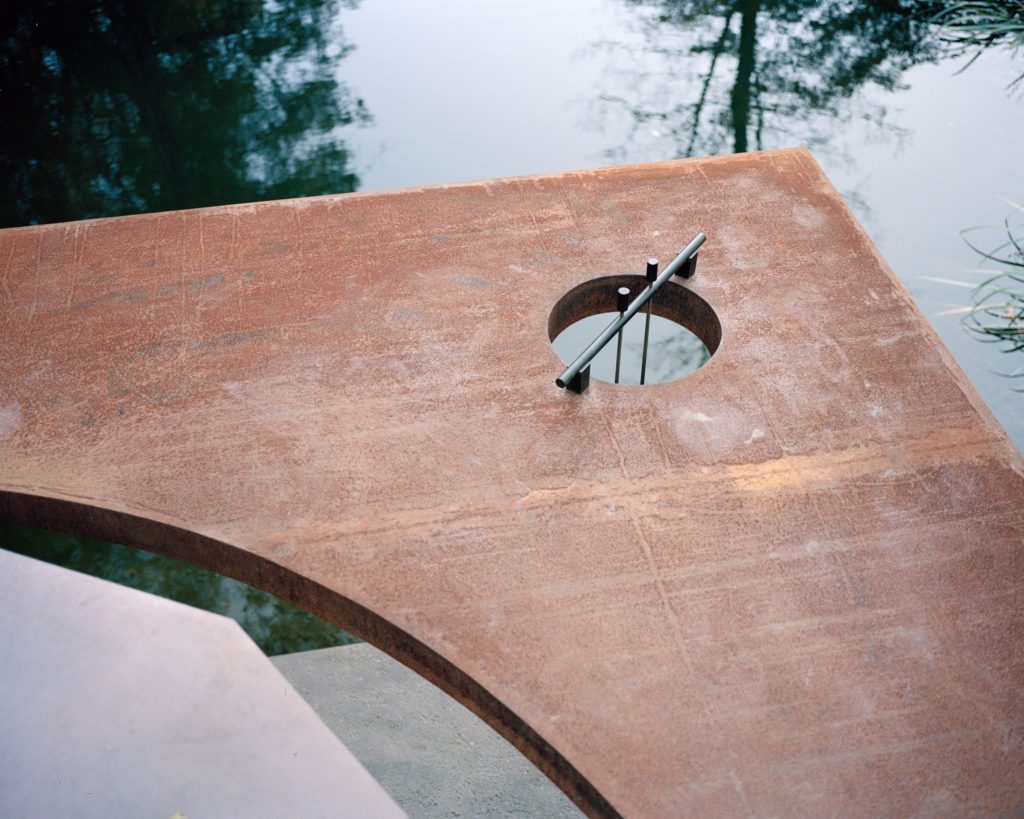
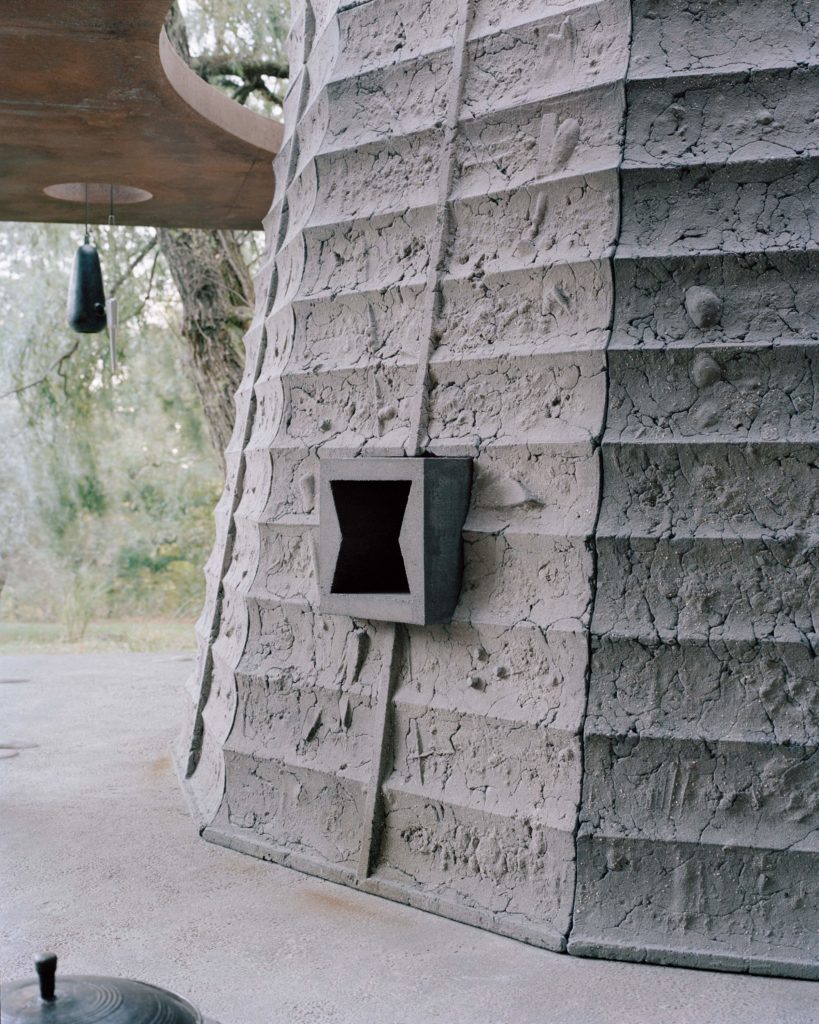
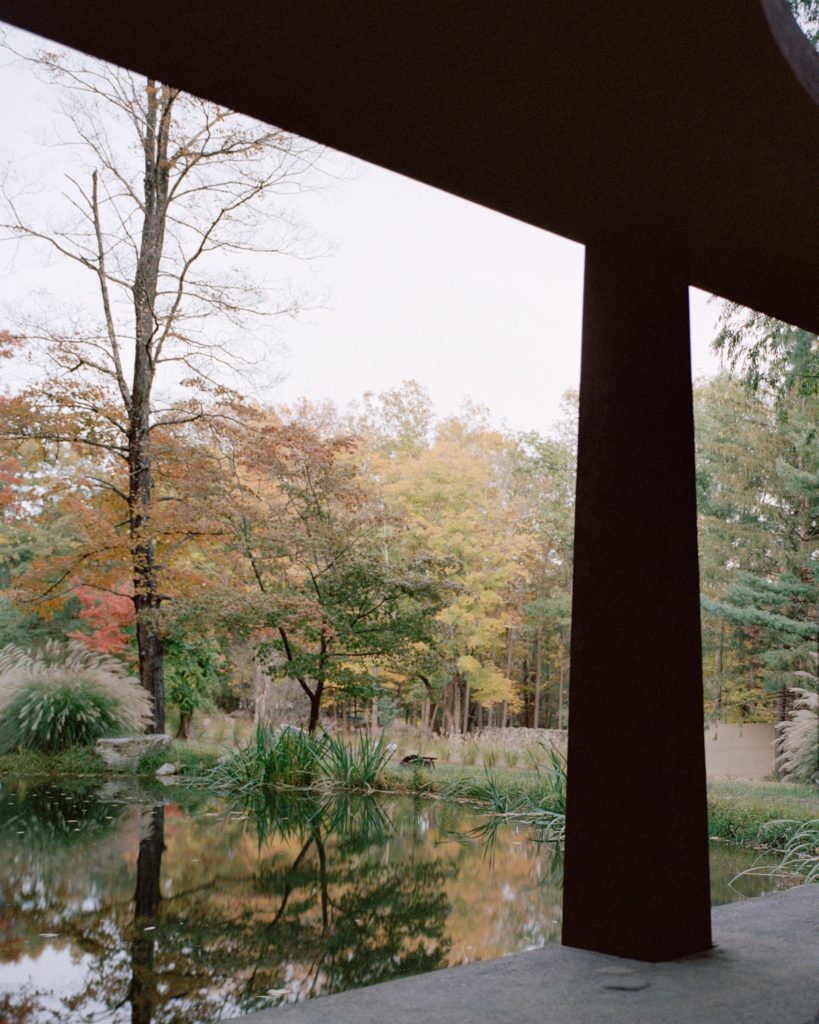
A rectilinear plinth anchors the architecture to the landscape, its thick concrete slab pierced by two semi-submerged apertures recalling roadside culverts and maritime portholes. Above this base rises a faceted conical mass that pierces a steel canopy supported by tapering columns. Rusticated concrete surfaces writhe with half-buried aggregations, suggestive of fossil or mineral clusters, evoking the longue durée of geological time.[1] A sculptural chimney tower ascends to one side, oscillating between the primordial and the technological. As evocative of megalithic tumuli grave sites as of the machine aesthetic, Xochi-Calli suggests a spatio-temporal duality that is at once ancient and futurist, vernacular and mechanical, monolithic and biomorphic.
Xochi-Calli is deliberately opaque. This ambiguity functions as a polysemic subversion of conventions of form, context, and narrative, foregrounding the multiplicity inherent in architectural experience. It offers no singular perspective or authoritative reading. The temazcal is traditionally associated with purification, healing, and rites of passage. Rooted in pre-Hispanic cosmologies, it remains spiritually significant for many Indigenous communities. Symbolically understood as a microcosm of the cave as a liminal gateway to the underworld and afterlife, it exemplifies hierophany: the delineation between sacred and profane.[2]
But above all, the temazcal is a process of transformation. Steam, obscurity, enclosure, and bodily exposure dissolve the primacy of visual perception, replacing it with a multisensory engagement that foregrounds heat, humidity, and temporality. Architecture here becomes inseparable from ritual change. From the body’s sweating and panting vulnerability is exposed, becoming a mechanism of spiritual and social recalibration. Matos maintains fragments of this ritual grammar in Xochi-Calli while departing from its prescriptive fidelity. Matos does not literally reconstruct the temazcal in its original cultural context so much as instrumentalize it, rearticulating its ritualistic potency within a contemporary register. The building becomes an apparatus of transformation and less of a cosmogenic symbolic order than a catalyst for experiential meaning.
The Grotto and the Grotesque: Topos Antagoniste
In its deeper registers, Xochi-Calli recalls the grotesque and the uncanny. It is associated with the domain of the unconscious and the archetypal, invoking an architectural analogue to psychic depth. Freud and Jung invoked the grotto as a metaphor for the unconscious, a cavernous spatiality constituted by interiority, introspection, and recursion.
The project resonates with the grotto’s historical complications of the natural and the artificial; as both cultivated landscape and primordial terrain. Historian Hervé Brunon has described the grotto as both locus amoenus and topos antagoniste: a site simultaneously constructed and excavated, protected yet destabilizing.[3] Xochi-Calli extends this lineage, producing a spatial order that collapses distinctions between deep time and architectural fabrication.
The building challenges the ocularcentrism of reason, privileging the tactile, the thermal, the temporal, and the atmospheric. The grotesque body becomes an epistemological register. The architecture negotiates between the body as abject and the body as transcendent, producing an experience in which perception is continually recalibrated. Opacity here is not simply the suppression of visual clarity but a visceral reorganization of sensory perception. It embodies change, fluctuation, and the inchoate, what Colin Rowe describes as a space that is layered, inviting “reading after reading.”[4] The project is thus a polysemic experiential apparatus, its meaning generated through encounter rather than formal clarity.
National Identity and the Res Publica
To situate Xochi-Calli exclusively within phenomenological discourse overlooks its historical, cultural, and political nuance. The project is also self-aware and self-reflective about architecture’s instrumentalization in the formation of national identity. The early twentieth century was shaped by the essentialist ambitions and reductive formalism of the International Style that had become defined by inter-war architects like Walter Gropius and Le Corbusier. But as modernism disseminated globally, its ostensibly universalist principles underwent a process of critical and cultural relativism, becoming recalibrated to the diversified contingencies of specific cultures and climates.
In Mexico during the 1930s and 1940s, this transformation was particularly pronounced. Architecture became a mechanism of statecraft and nation-building, contributing to the reconstitution of the res publica within the rapidly urbanizing milieu of Mexico City. Pre-Hispanic symbolic systems were mobilized to articulate national identity and demographic unity, attempting to institutionalize a shared canonical heritage within the public imagination.[5]
Xochi-Calli participates in this lineage while simultaneously problematizing it. In its references to the temazcal as a Mesoamerican ritual, the project is cautious in its invocations of the original and ongoing spiritual valance of its cosmology. It eschews a strict fidelity to historical precedent to entrench itself in a critical, present-centered historicism. As per Rowe, it is an architecture that invites “limitless possibilities of alternative readings,” operating as a palimpsest in which historical and cultural mimesis coexists with deliberate anachronisms.[6]
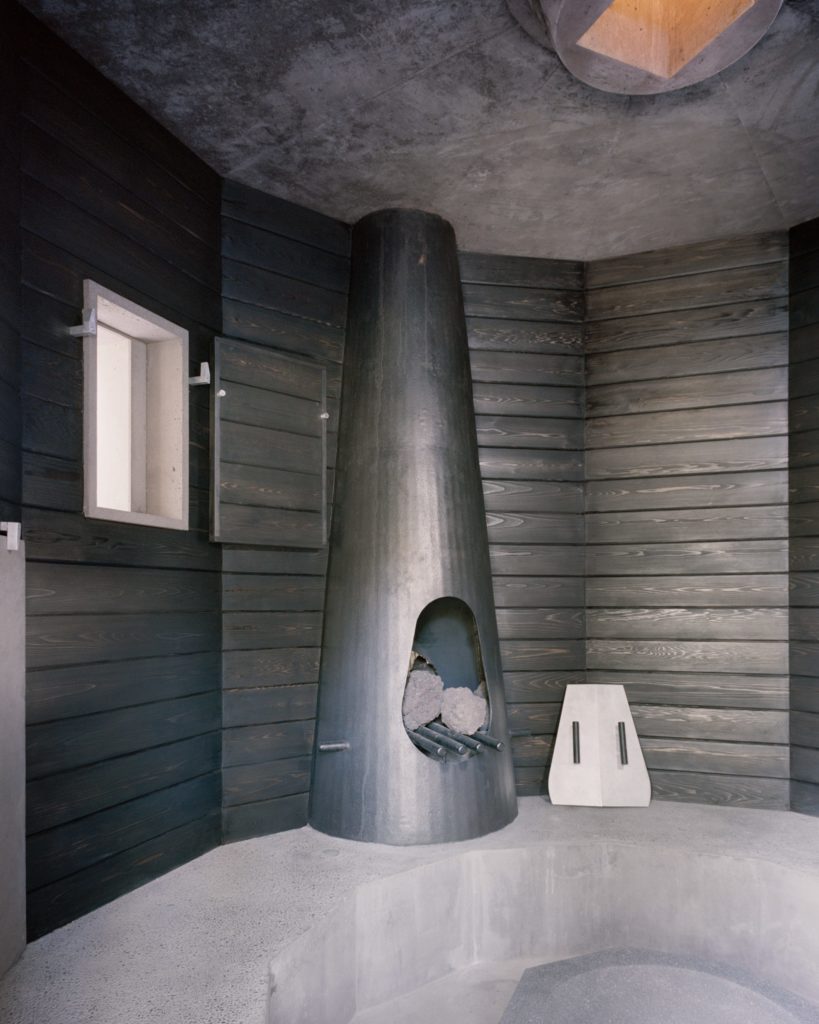
The insertion of contemporary technological elements — for example, the large and conspicuously modern speaker system that is set into the austere interior sanctum of Matos’s temazcal — foregrounds the overlap of historical memory and contemporary practice. The meticulously carved stone vessel in which the heated stones are set to be doused with fragrant waters was sourced from an ancestral quarry now on the edge of the conurbation of Mexico City. Matos individually selected these hearthstones for the temazcal in Mexico and brought them to New York, but these were collected spontaneously and unexpectedly on the side of a highway in Mexico. Matos does not see these as being any more or less sacred than any other volcanic stone, which have served as central and important cultural artifacts across the long history of pre- and post-Columbian life. The translation of the emplacement of this heritage to the context of New York reflects the entanglement of material heritage with processes of urbanization and globalization. Sacredness here resides not in the specificity of place but in the broader cultural continuum of the materiality and meaning of artifactuality.
In resisting the prescriptive codification of ritual practice, Matos probes questions of historical authenticity, cultural ownership, and history’s political reinterpretations. Instead, Xochi-Calli proposes the meditative, subjective, introspective value of ritual, reframing identity as inevitably both individual and collective, as a mutable and experiential process of negotiated power dynamics and lived experience rather than an affixed hegemonic paradigm.
Authorship, Estrangement, and the Archaeology of Knowledge
Matos’s design methodology is enigmatic. It has developed from a hermeneutically oblique archaeology of estrangement: an excavation not only of material entities but of emblematic residues and of practices and memories sedimented in the public imagination. And crucially, it asserts that Matos is himself an active participant in this publicness. The project affirms an ontological multiplicity that resist singular attribution. Its opacities are not fortuitous but profound and nuanced and structural.
In this way, authorship begins to dissolve into a distributed, decentralized field of intentionality, and eventually of adaptation and inhabitation. The space emerges not just as the ideated design of the figure of the architect as some supposed genius-virtuoso but as a durational sedimentation of lived experience that defies the expectation that the building should be a resolved object with an unequivocal program. Xochi-Calli is deliberately framed as an apparatus — an experiential and subjective performative entity in which many narratives can be continuously rewritten and reappraised.
With an awareness of its own reflexivity, irony, and playful inquiry, Xochi-Calli appeals to authenticity through mythopoeia. The process of design becomes a creative Borgesian froth of fictions and phantasms: a speculative imaginary, an ecstatic truth, akin to what David Foster Wallace described as the lies we tell to tell the truth.[7] Xochi-Calli’s project is engaged in folkloric, cultural, and mythological imageries and ideologies. Referents are constructed from the contradictory pluralism of identitarian tropes that multifariously intertwine the Mayan, the Mesoamerican, the pre-Hispanic, the Mexican, the modern, the postmodern, and the cosmopolitan into a discursive construct of subjecthood to reflect the instability of the referent and the fallacy of metanarratives. These symbolic registers collide rather than cohere to form a cultural production somewhere between historical determinism and poetic license, described by Rowe as “a continuous dialectic between fact and implication.”[8]
Urban Palimpsest and Petit Récits
Matos insistently identifies the city as a primary matrix of reference and inspiration. Mexico City particularly epitomizes urbanity as palimpsest: a heterotopic assemblage of temporal discontinuities, cultural sedimentations, and architectural anachronisms. Its fabric negotiates the dialectic between revivalism and revisionism, socio-political belonging, and the tensions between memory and progressivism in the project of history. This sensitivity to the vagaries of the past evokes the political constructions of historiography: of the early modern antiquarian, the Romantic idealist, the historicist eclecticism of the nineteenth century, the encyclopedic scientism of Positivism, and the utopian tabula rasa of modernism. These are bold yet incisive confrontations of the problems that have haunted history as a discipline and of the problematic patterns of cultural appropriation today. Matos’s work questions teleological metanarrative, but meditatively and idiosyncratically ruminates on the personal value of the fragmentary and of petit récits.[9] His practice oscillates between exegesis, prognosis, and participation, seemingly to affirm that architecture remains relevant as a cultural and political and social project. Within this framework, Xochi-Calli engages with past, present, and future as living imaginaries, positioning the palimpsest and the ritual as operative mechanisms that recognize authenticity as invention. Authenticity becomes neither origin nor essence but a construct of continual re-evaluation; of recursivity and contingency.[10]
Fictions, Mythos, and the Sophistry of Form
Matos demonstrates acute awareness of the colonial, neocolonial, and neoliberal ideologies that have shaped the temazcal in the economies of knowledge and culture. Despite his apparent comfort with esotericism and anachronism, Matos maintains that he is somewhat skeptical of the ersatz essentialism of new spiritualism and the phenomenon of the so-called “plastic shaman” that have plagued the temazcal as a spiritual form and its importance to indigenous peoples. He is careful to insist upon the subjective, meditative value of the ritual as a distinctive and idiosyncratic iteration of a cultural practice that emphasizes the experience of everyday life.
The project’s historical and cultural syncretism is admittedly delicate. It is haunted by a specter of substitution, or of charlatanism, or of becoming a kind of Potemkin Village of reenactment. Matos is not naive or averse to such critiques. By foregrounding the possibility of deception, Xochi-Calli exposes and instrumentalizes architecture’s complicity in the latent sophistry of rhetorical problems.
Matos is not dogmatic about the cosmology or mysticism or the work. Xochi-Calli might evoke a sense of spirituality, but it is ultimately, not unlike its architect, quite outwardly agnostic. Xochi-Calli remains resolutely non-denominational. But this does not preclude that there is value in more quotidian rituals, nor that they can also serve as a way of delineating the scared from the profane. The work and its worldview is not coy about its sincere appreciation for the phantasms of the mythological, metaphysical, and the mystical, but reframes them as relational constructs rather than absolutes.
Architecture as Transformational Apparatus
Ultimately, Xochi-Calli frames architecture as a historically, culturally, socially, and politically actuated process. It is a space of opacity that obscures expectations and inverts convention, neither by nostalgic reconstruction nor purely formal experiment. It instead it operates as a cultural mechanism through which ritual, identity, and sensory experience intersect.
If the temazcal was originally the marker of a threshold between worlds, Xochi-Calli extends that threshold from the past to the present and into the future. It implies that identity is an atmospheric condition in flux: as thick and saturated with steam as with history. In an architectural culture still haunted by modernism’s presumption of universalism, Xochi-Calli proposes an alternative trajectory grounded in multiplicity, transformation, and ambiguity. It makes no presumptions to resolve or clarify the tensions between tradition and invention, but rather inhabits this contradiction, insisting that the most radical potential of architecture lies not in clarity but in the productive opacity of becoming.
[1] Fernand, Braudel, “Histoire et Sciences Sociales: La Longue Durée,” Annales 13, no. 4 (1958): 725–53. See also: Richard E. Lee, “Lessons of the Longue Durée: The Legacy of Fernand Braudel,” Historia Crítica 69 (2018): 69–77.
[2] Mark B. Child, “The Symbolic Space of the Ancient Maya Sweatbath,” in Space and Spatial Analysis in Archaeology, ed. Elizabeth C. Robertson (University of Calgary Press: 2006): 157–67.
[3] Hervé Brunon, “Du songe de Poliphile à la Grande Grotte de Boboli: La dualité dramatique du paysage,” Polia, Revue de l’Art des Jardins 2 (Autumn 2004): 7–26. See also: Luke Morgan, The Monster in the Garden: The Grotesque and the Gigantic in Renaissance Landscape Design (University of Pennsylvania Press: 2015): 2–3.
[4] Colin Rowe and Robert Slutzky, “Transparency: Literal and Phenomenal,” Perspecta 8 (1963): 51.
[5] Edmundo O’Gorman, The Invention of America: An Inquiry into the Historical Nature of the New World and the Meaning of Its History (Greenwood Press: 1961).
[6] Rowe and Slutzky, “Transparency,” 49.
[7] Werner Herzog, “On the Absolute, the Sublime, and Ecstatic Truth,” Arion: A Journal of the Humanities and the Classics 17, no. 3 (2010): 1–12. David Foster Wallace, This Is Water: Some Thoughts, Delivered on a Significant Occasion, about Living a Compassionate Life (Little, Brown & Company: 2009).
[8] Rowe and Slutzky, “Transparency,” 51.
[9] Jean-François Lyotard, The Postmodern Condition: A Report on Knowledge, trans. Geoffrey Bennington and Brian Massumi (University of Minnesota Press: 1984).
[10] Yuk Hui, Recursivity and Contingency (Rowman & Littlefield: 2019).