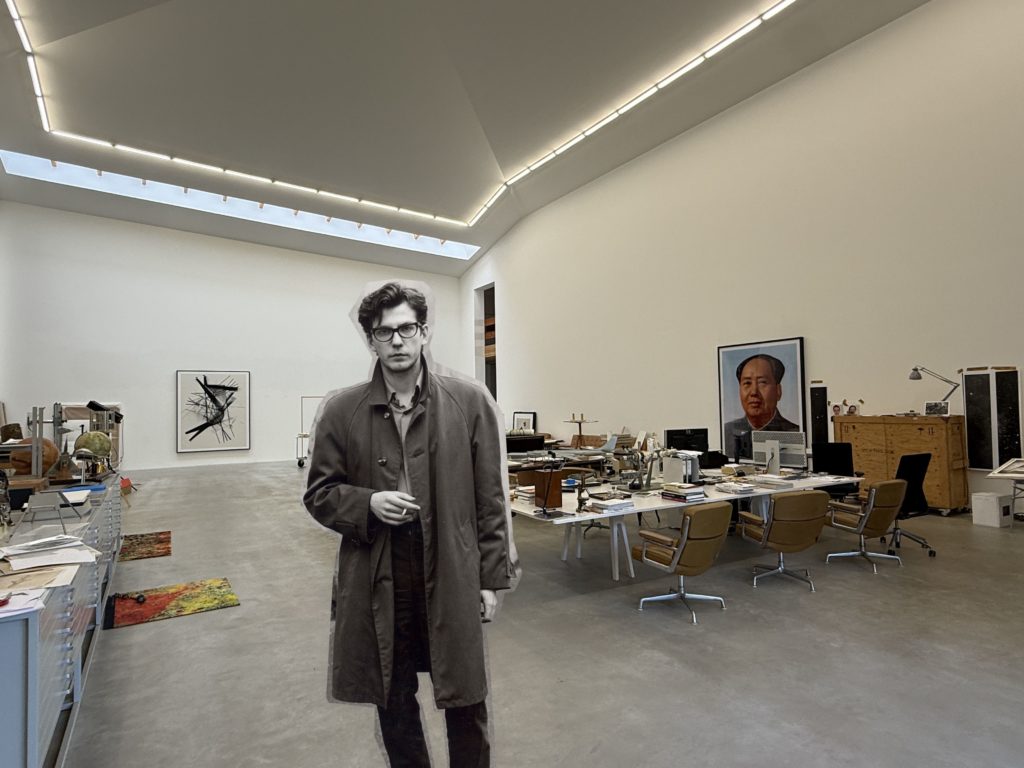
Thomas Ruff is already on holiday on an island off Italy’s coast when I interview him. When he picks up our Zoom call via his phone, the connection is initially a little shaky: Ruff’s suntanned face blurs in and out of clear definition, glasses, hair, and skin distorting briefly into an instant of abstraction. The artist himself becomes a streamed image that shifts in and out of focus with changing moments of clarity.
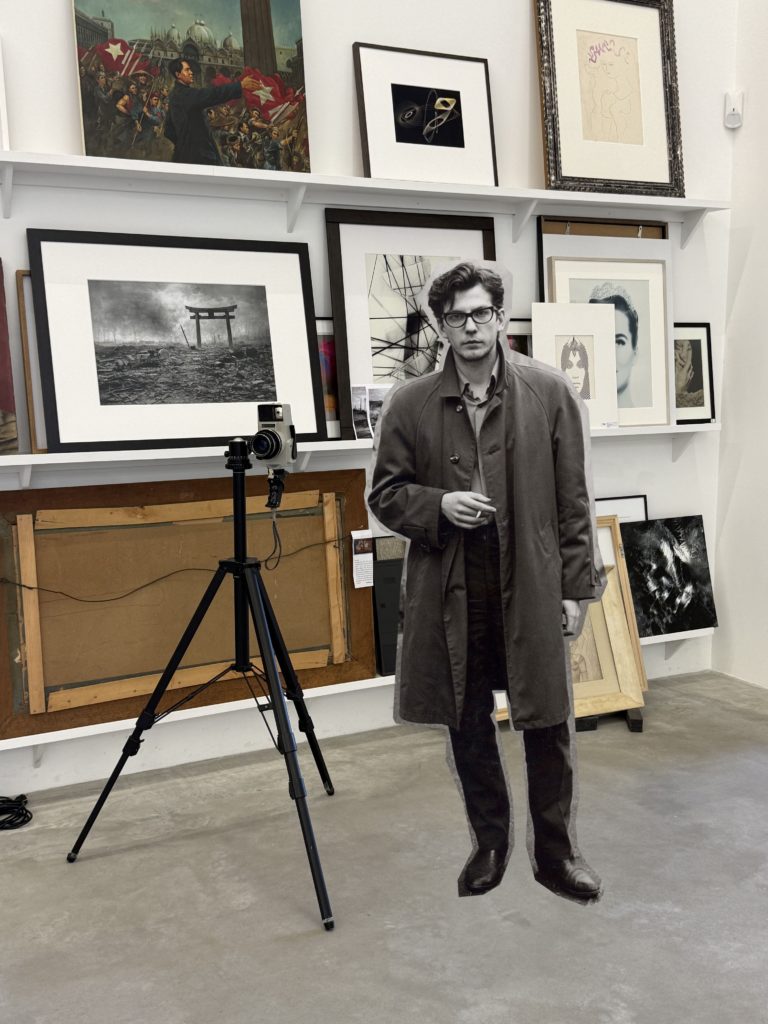
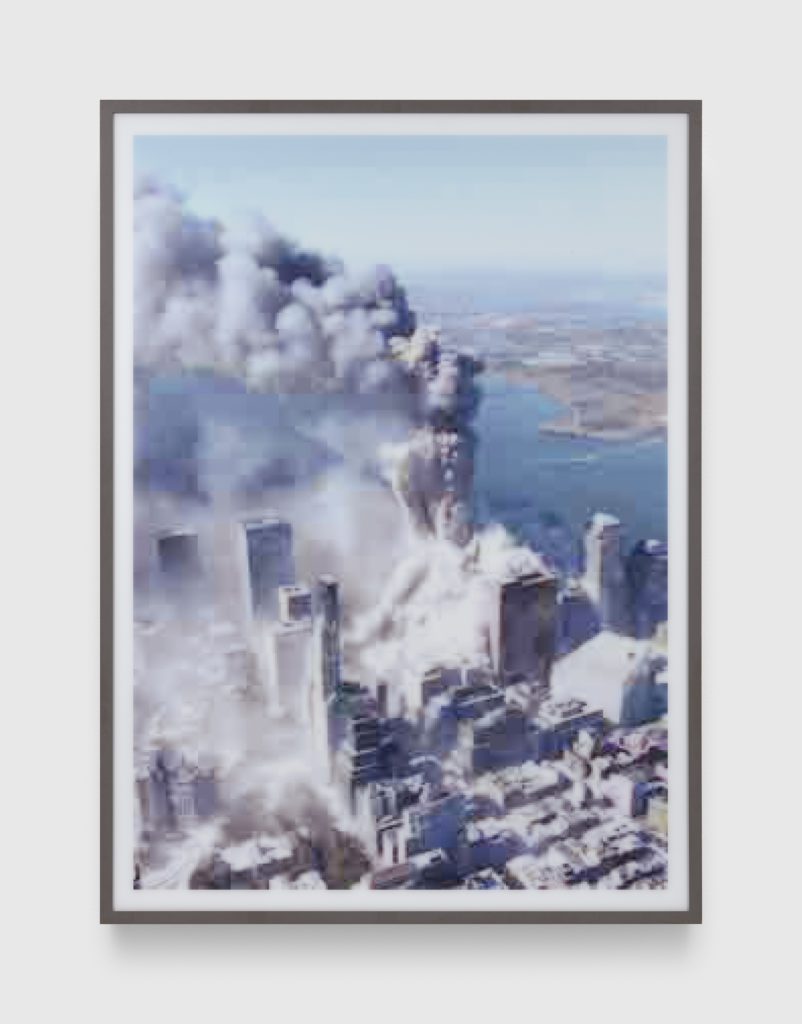
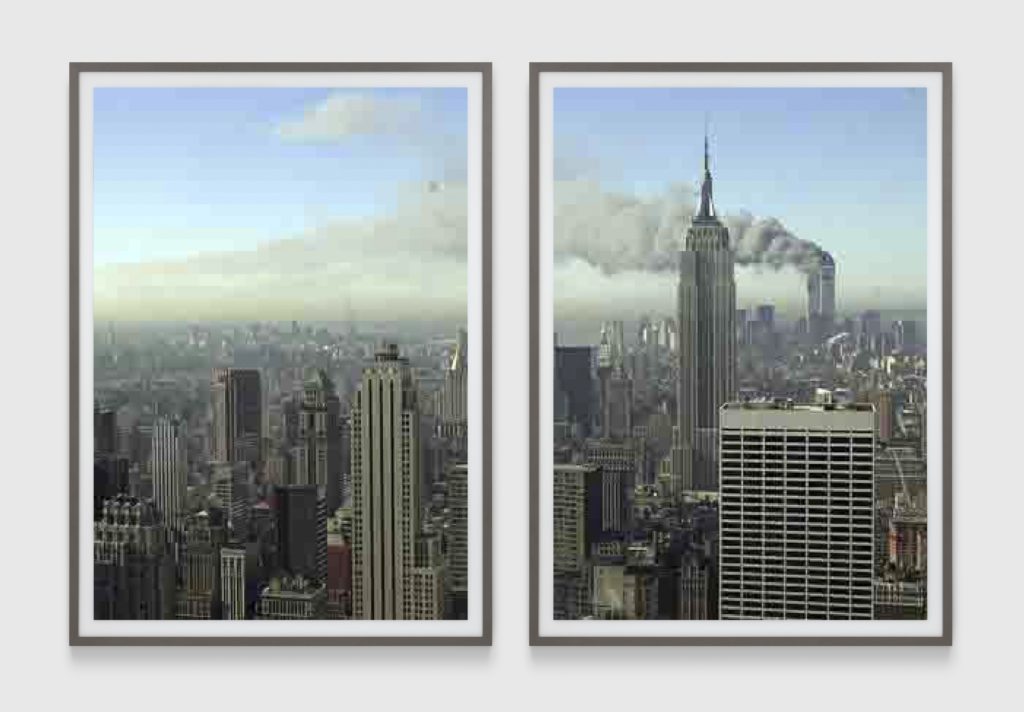
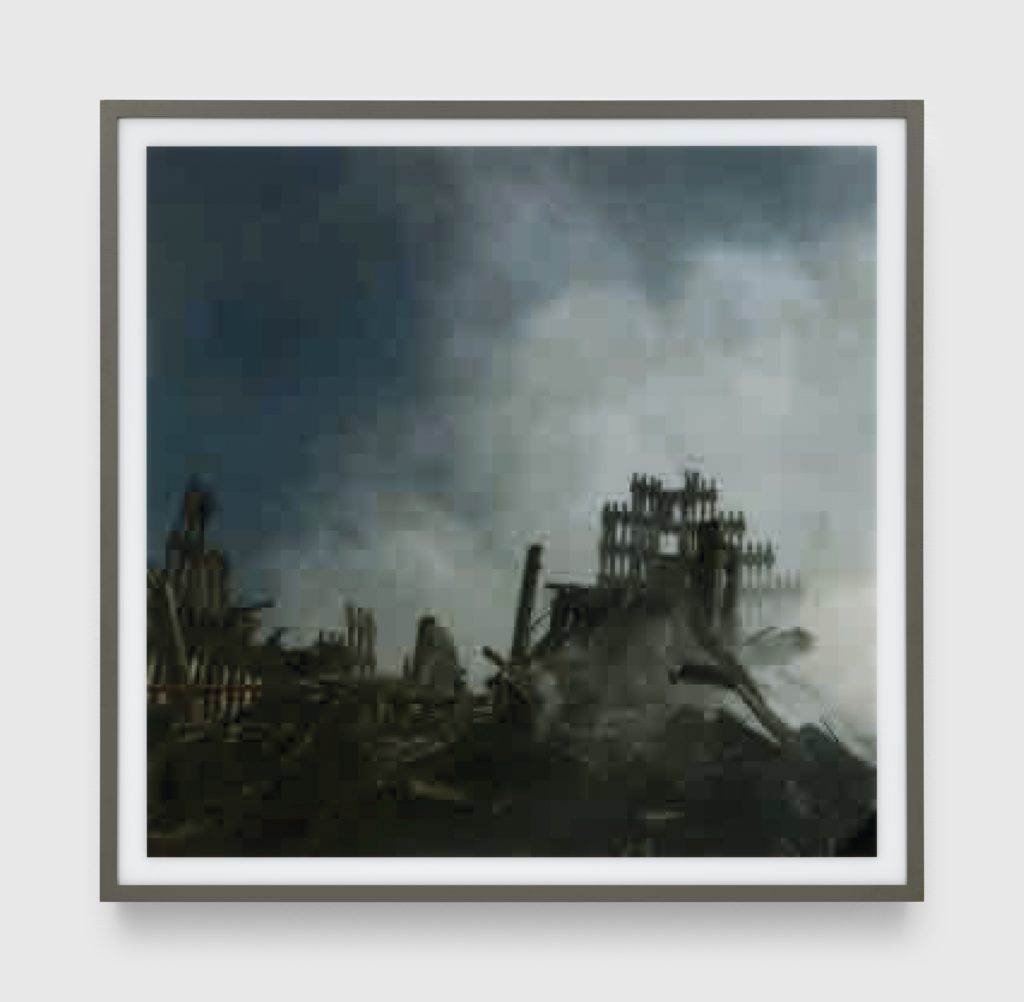
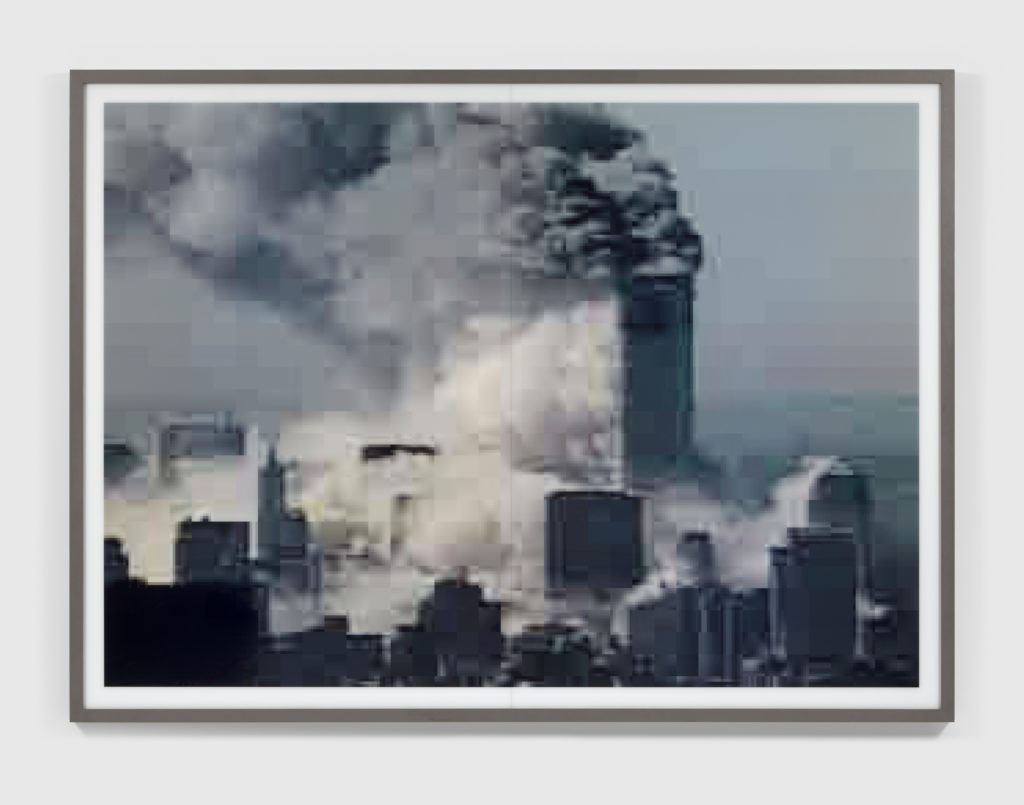
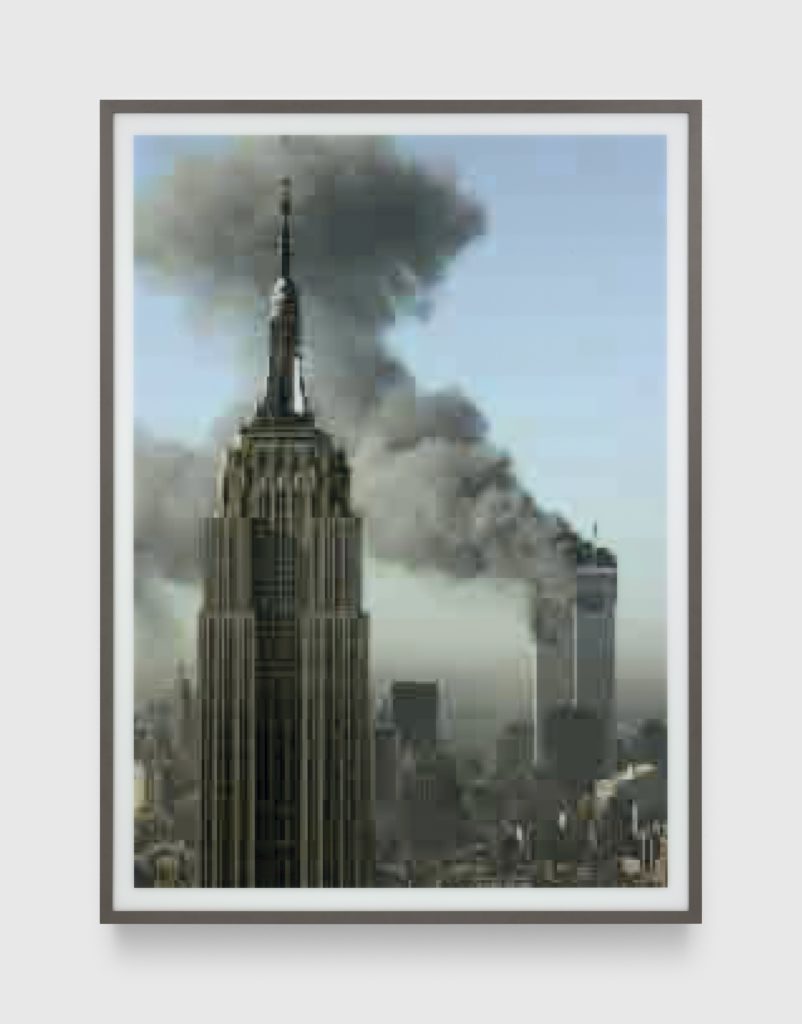
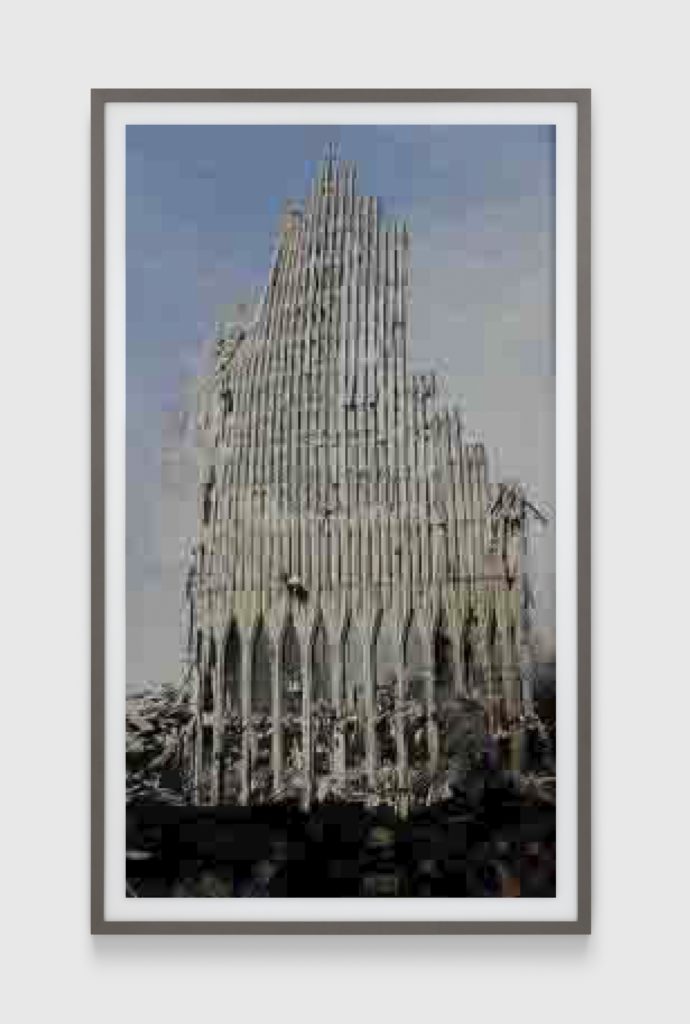
This feels fitting, in part because it is also a key aspect of his “jpegs” series (2004–22), which is currently being exhibited at David Zwirner, New York — images captured via the internet that become more and less recognizable depending on how near or far you stand from their surfaces.
Now one of the most celebrated artists of his generation, Ruff initially studied photography at the Kunstakademie Düsseldorf in the late 1970s and early 1980s with Bernd and Hilla Becher. It was here that he learned and honed a conceptual approach to photography. Over the past five decades, Ruff has become known for his enquiry into the question of what it means to take a picture. This was the starting point for our conversation, during which Ruff also reflects on the relationship between technology, perception, and pictures, as well as his own autobiographical impetus in his imagemaking, and the tenderness of scale.
Louisa Elderton: I’d like to start by talking about the more philosophical side of your practice and approach. To what degree are you interested in the specific formal characteristics of photography, or even in the camera as an apparatus? Would you say you are essentially preoccupied with the idea of “what it means to make a picture,” or in different types of images? What does making a picture mean to you?
Thomas Ruff: When I started in 1978 as a student, first I was shooting interiors, later on portraits, houses — a lot of different things. I didn’t realize immediately, but only after ten or twenty years it became obvious that my work also connects with an ongoing exploration of technology, history, and perception of photography. There’s a kind of addition to the image: What does it mean if you take a photograph? What does it represent? How is it perceived? The subjects that I choose are all still autobiographical. For example, I have a big affinity for astronomy, space, cosmology –– which you can get an idea of with my stars, the “Cassini” (2008–09), and the “ma.r.s” (2010–12) series. And if it comes to political images, of course, I’m a real person, I’m interested in politics, I’m part of our society and I have to deal with that. Actually, I never can tell which part is more prominent: whether it’s the image or subject or thinking about the media — sometimes it’s 50/50, or maybe 60/40, it changes all the time.
LE: Your early works such as the “Interiors” series (1979–83) looked at your own and others’ domestic spaces and at the distinct tenor of German culture and society, while another series such as “Stars” (1989–92) (by which I mean the earliest iteration of this series) captured the universe in the night sky via telescope technology. What interests you about moving between micro and macro subjects in your work and do you see a connecting thread — so, to what degree does the autobiographical run through your oeuvre?
TR: When I started shooting the “Interiors,” I had just left my parents’ home to go to Düsseldorf to study photography with Bernd Becher. So that was definitely autobiographical shooting after leaving home: the apartments, houses, interiors of my family and the parents of my friends at that time. The next series was the “Portraits” (1981–91). I was shooting my friends — in Düsseldorf I only knew my generation and I didn’t know anybody older or younger. Another example would be how when I finished high school, I had two interests: either becoming an artist working with photography, or studying astronomy. So that’s another autobiographical aspect of my background that has actively shaped my approach. All my work comes from my daily life and reacting to the things that flow. I’m not a cold, conceptual photographer.
LE: What is your day-to-day process or daily routine?
TR: In student times, I did not have a studio. I went out shooting with the camera, and then I went to the darkroom to develop and print the work. Now I have a pretty regular daily routine: I do my correspondence, I read the newspaper, I watch TV. While I’m in this routine, there are some images that show up — either in newspapers, news, on TV — that I cannot get out of my head. And if I don’t get it out of my head, I start an investigation on it. Quite often, it then develops into a kind of image idea. If it’s interesting, I continue; if not, I give it up.
LE: You’ve also talked about the importance of meeting Benjamin Buchloh and the conceptual artists that he introduced you to, including Lawrence Weiner. How did this time and context of both art school and the wider scene in Düsseldorf shape your development as an artist?
TR: It was almost from the very beginning of my studies with Bernd Becher that Benjamin Buchloh was introduced to the students of the Kunstakademie Düsseldorf. I joined his seminar, I liked it and continued visiting it with my friends who were art students, sculptors and painters — we were a pretty nice group interested in Conceptual and Minimalist art. We also enjoyed cinema and music too. At that time, Minimalist and Conceptual artists became our heroes. That’s why I developed the idea of trying to make the most minimalist portrait, to really bring the portrait back to point zero, erasing everything — conventions and tradition — and showing only the face.
LE: You’ve described your love of Piero della Francesca’s painting. What are your thoughts on the relationship between photography and painting, and how important is this connection for you as an artist?
TR: It’s not only Piero della Francesca’s paintings that have influenced me — you can really go through the history of portraits. Becher always told us to look at the history of painting. There are great portraits by Otto Dix, Christian Schad, and others. It’s not just that it has something to do with the realistic quality of those portraits that makes them so attractive. There are other German painters with a pretty rough brushstroke –– take, for example, Lovis Corinth. But they are all portraits and they are perfectly created within this medium and the time in which the artist lived. So it’s really not only the Medieval or the Early Renaissance; it’s the whole history.
LE: And the history of portraiture as a genre in its own right, perhaps?
TR: Of course — if you’re an artist in Germany, you grew up with the history of thousands of artists and paintings.
LE: Do you have specific museums in Germany that you regularly visit? What’s your relationship now with looking at more historical — or even contemporary — work within the German tradition?
TR: Besides the Kunstsammlung Nordrhein-Westfalen, no. Though, of course when I’m in a city like Munich, I go to the Alte or Neue Pinakothek; if I’m in Frankfurt, I go to the Städel Museum; if I’m Hamburg, I go to the Hamburger Kunsthalle. They all have really great collections with fantastic artworks. If you’re in Cologne, you can go to the Wallraf-Richartz-Museum with medieval paintings. Germany’s very rich in terms of that. And of course, if you are in Italy, you find even more crazy, crazy stuff.
LE: Let’s turn to discuss your exhibition at David Zwirner in New York, where you’re showing twelve works that depict images of the World Trade Center attacks in New York on September 11, 2001. You were in New York on that day and you had your camera with you; what was that day like for you?
TR: It was really strange and really dramatic. In the morning of 9/11, I was at the hotel. I remember I had ordered in breakfast, but the breakfast didn’t come. At a certain point, I heard an airplane flying rather low above the hotel. And I thought, this is strange, because I don’t think that airplanes are allowed to fly so low over New York. And then I heard a very strange sound I could not identify. So I switched on the TV and then I saw the first tower burning. I thought it was an accident. But when I saw the second airplane crashing into the other tower I realized, “Oh, shit, this is not by accident, this is by intent.” I went down on the street and it was completely crowded; everyone was crying, shouting, whatever. And I had my small camera with me.
LE: What kind of camera were you using?
TR: It was a small Minox, an analogue camera with a black-and-white film. So yes, as naive as a tourist, I was shooting the twin towers burning. At a certain point, they collapsed, and the crowd got really crazy. I didn’t know what to do. Actually, that day we wanted to install my exhibition “l.m.v.d.r.” at David Zwirner, which would open in a couple of days. So I decided to go to David Zwirner gallery, which was in SoHo at that time, and of course everybody there was shocked. A lot of young men came down the streets going south to help at Ground Zero, and we gave them all the water and other kinds of things they needed. Over the next couple of days we just watched TV and saw the images again and again and again and again and again. We decided not to have an opening: no celebration. Only then did I realize that the sound that I’d heard, which I could not identify, was the sound of an airplane crashing into steel and glass, and this was, of course, something I hadn’t heard before.
LE: And something that you also can’t capture with a camera, through a photograph — this sound, this essence of horror, this implacable noise.
TR: Exactly. When my stay in the New York was over and I flew back to Germany, I had the film developed and there was nothing on it. Even now, I don’t know whether it’s because of the battery in the camera or whether they raised the X-ray levels at the airports to see every detail of people’s luggage that were leaving or coming into New York. I had no images, so I started searching like crazy for images of the attack on the internet. At that time, I was already working and experimenting with the jpeg compression rates, as I was interested in the artifacts that show up. I then combined my found images from the internet with my compression rate experiments, and with that, I had my first Jpeg. I really was worried about how people would react to these images, because I thought they might say I was making art out of tragedy, but it was completely the other way around. When I showed them the first time in 2006 at David Zwirner in New York, people seemed to be relieved at seeing these images.
LE: Where do you think responsibility lies within this context of an artist responding to tragedy? It sounds as if you thought deeply about the ethical question of how art and imagemaking relates to tragedy, or rather, what is at stake in capturing and artistically responding to an event.
TR: That’s a good question. I don’t know the percentage of images of catastrophes in the news, but it’s probably 30% to 40%. Images of catastrophe have always been fascinating for people — I don’t know why; maybe you’re happy to have survived. I don’t know what the psychological reasons are; we’d have to ask a psychiatrist.
LE: I suppose I was interested in that question less from of a psychological perspective and more in terms of your own artistic sense of, firstly, what it meant to you to have been present at this tragedy, but also, whether images of such tragedy enter the realm of voyeurism or fetishization? What exactly was it that you feared? Do you think that related in part to this question of having a “responsibility” to respond to tragedy, and whether or not there can be a contention in that? Or was it that you had experienced your own profundity that needed to be processed and thought through as art, and you wondered if it would resonate with people?
TR: In a way, things coincided. First, I was in New York on 9/11. Second, I did not have any images of the disastrous collapse of the Twin Towers. Third, we already had access to the internet, and I found images there. And fourth, at that time, the image files on the internet were still pretty small and had a bad resolution, because the internet was still slow. The files that were circulating were compressed, and the smallest images circulated the fastest and the most. And, again, these images are a mix of autobiography. So, really, it’s a coincidence, and the initial ignition could only have happened at that time.
LE: Do you think so much of artmaking is, in the end, the result of coincidence?
TR: Yes, it’s what happens, and how it is that you do or don’t choose to process it.
LE: How does scale factor in relation to these “jpeg” works in particular? Because, of course, scale is so important within your practice. You first enlarged your photographs as part of your “Portraits” series to underline that there is a difference that separates the photograph from reality. Susan Sontag has written so much about the constructed nature of photography, beyond the mimetic. At this stage in your career, how do you now think about scale, its importance in your work, and the way in which that has developed for you over the years?
TR: When I made the first large-scale portraits, people were really shocked by the precision and the physical presence of the faces. Of course, I was not the first one that did that — the big photograph was in the air in the mid-1980s from my fantastic colleagues. I also think scale helped photography to be accepted as, let’s say, art in the first degree. Now, photography could compete with the size of paintings, which was also important at that time. But I’m working with a mix of different scales: I have works that are small, more intimate, and there are works that you would call mid-size and then the large-scale works. For the “jpegs,” I decided to use the largest scale that was available at my lab. The “jpegs” are very much about how you perceive a digital photograph. If you enter the gallery and you look at the work from a far away distance, you think you’re looking at a photograph in which you can recognize the subject; then you go closer and it becomes almost painterly. The artifacts of the compression remind me of brushstrokes. If you go really close, you cannot recognize anything anymore because you just stand in front of thousands of pixels. So the size of the “jpegs” seemed obvious for me: they should be large.
LE: You then also went on to look at journalistic photographs of war more broadly.
TR: The attack happened because the United States invaded Iraq. So I then started searching for images from the US bombing of Saddam Hussein’s palace and the Iraq War, as well as in Kuwait. But then it’s not just the US, the Russians did the same in Chechnya, and so I continued to look all around the world at all the war scenes and the footprints of men destroying his fellow man, or destroying nature. After that I decided that I would like to create a kind of visual encyclopedia of the images circulating the internet. This work goes one step further with perception beyond the real photograph; they need this kind of scale because it combines photographic imagery with abstraction.
LE: Yes, when you’re really close up and it essentially dissolves into abstraction and a confusion of pixels. Do you seek a moment where you feel a certain disassociation from the magnitude of what it is that you’re really looking at — is that intentional?
TR: I actually wouldn’t call it a confusion, it’s just that the image becomes unrecognizable. You don’t know what you’re looking at. If you’re too close, you don’t recognize the image, you only see the structure of the image. Just remember Michelangelo Antonioni’s film Blow Up (1966) — it’s the same procedure. You try to zoom in, and the more you zoom in, the less you can recognize. So it’s very much about that kind of constructed image.