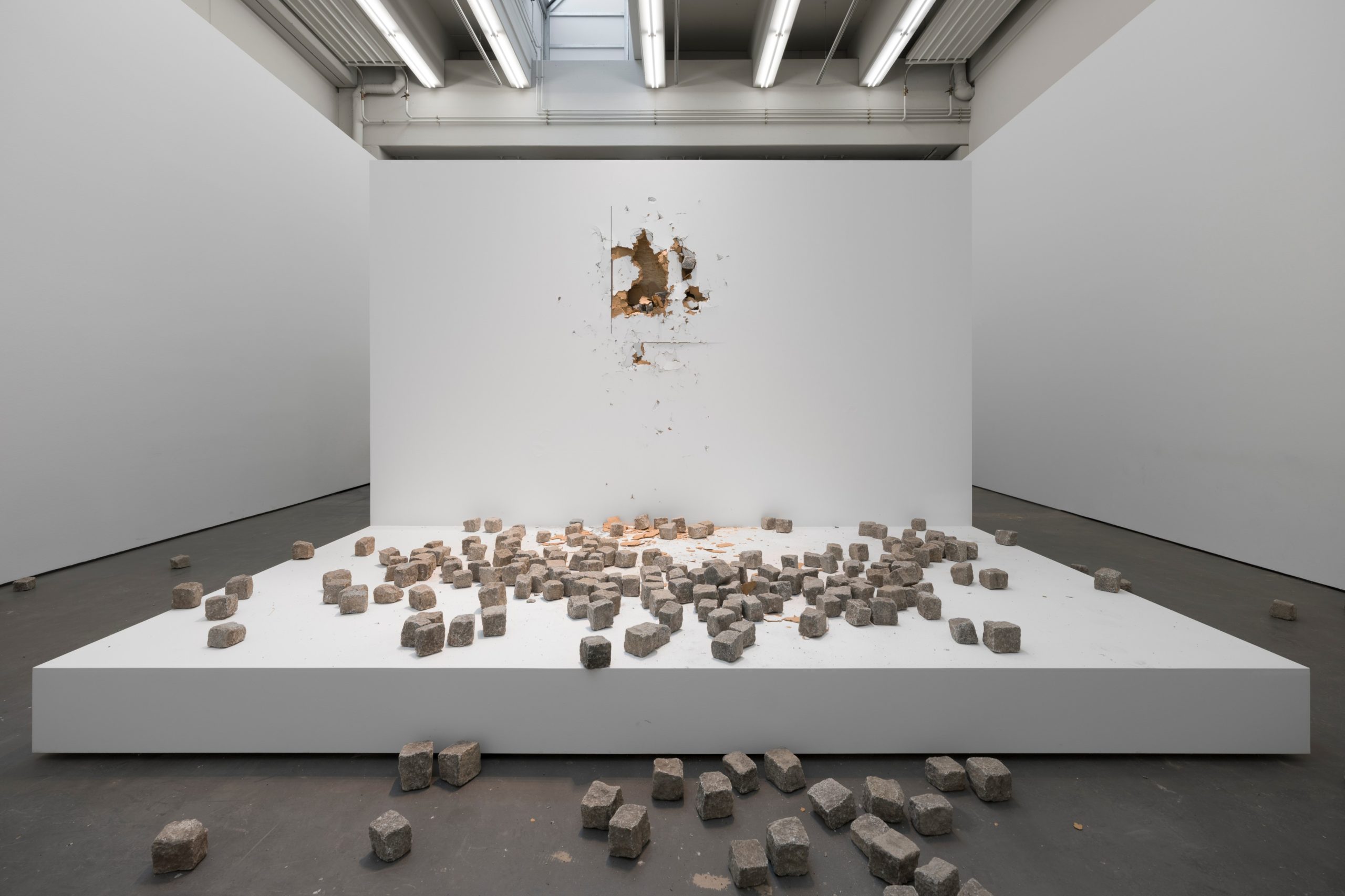
Michael Sailstorfer is no stranger to disruption. For his 2016 installation, Berlin Depression, for instance, the artist repeatedly dropped a massive cast-iron sculpture onto the asphalt from a crane, creating a crater, in which the piece then nestled. He has also launched trees in the air, had tourists ransack a beach searching for buried twenty-four-karat gold bars, and once detonated a sheet-metal house.
Compared with such pyrotechnic flavored acts, Sailstorfer’s new installation, “Pull the Rug”(2026), at Galerie Judin in Berlin, commissioned specifically for the space, is loud, yet eerily devoid of spectacle. The gallery has been partly closed off to accommodate it.
At the gallery, visitors are immediately confronted with staccato mechanical noise. Sailstorfer layered the floor with eight thousand paving stones typical of Berlin, collected from a local construction site. Every fifty to sixty seconds, an assistant picks up a stone – sometimes first loosening it from the gravel – and carries it, one by one, to a slot in the wall.
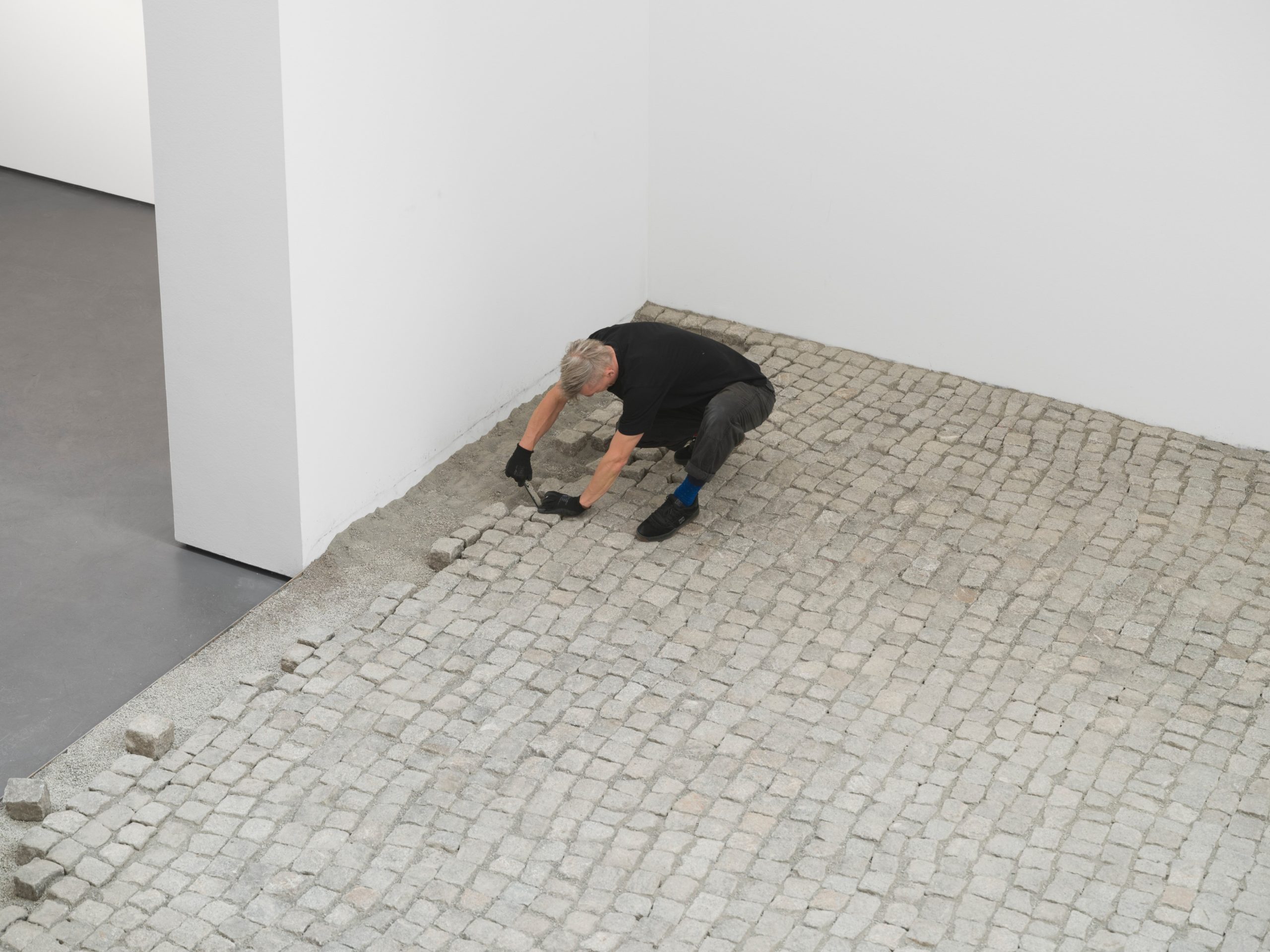
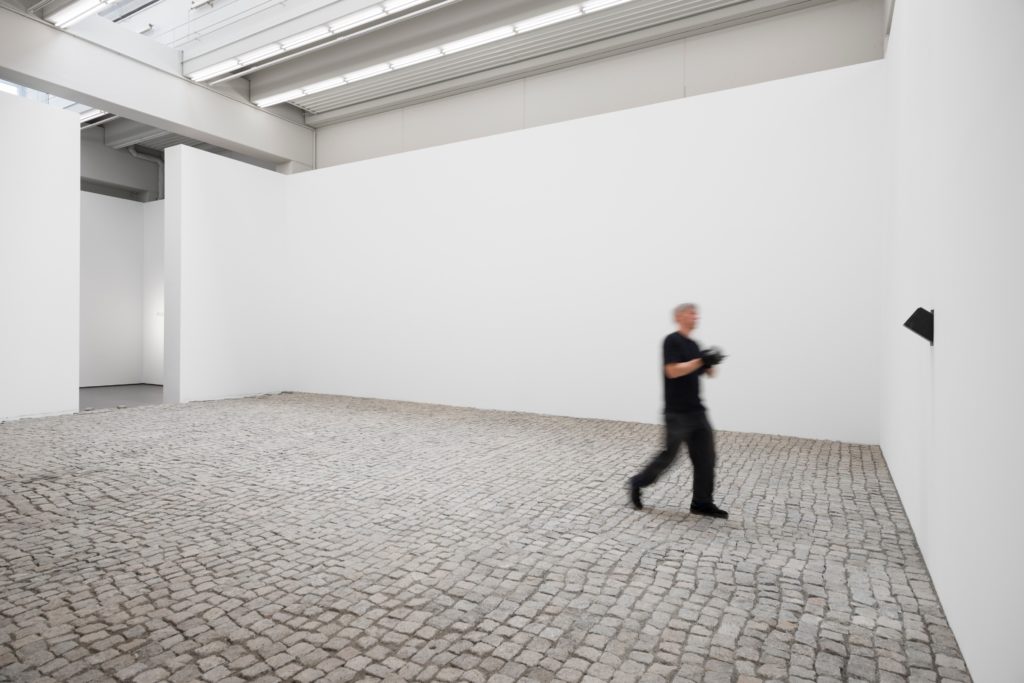
The day I visited, half the floor was already gone, revealing fine gray gravel. In the dusty room, as stones dropped into the hole, one could hear clatter suggesting a conveyor belt, and loud, dispersed thuds, as the stones were catapulted – on the other side of the white wall, invisible to the viewers. Flung into space? Flung against walls? Possibly both.
The violent yet occluded action elicited a certain feeling of powerlessness, as if to stress that viewers were witnessing a process they could only half-understand; a scenario in which the performer’s observable actions seemed obvious and prosaic, yet whose consequences (the stones’ trajectory and impact, perhaps even their destruction on the other side) could not be foreseen.
Overall, this deliberate cumulative removal felt like a grim prognosis for Berlin, as the material of its built environment was being activated – or dismantled? – in the process. In this sense, it’s hard not to see in Sailstorfer’s work echoes of the sense of foreboding currently felt by many Berliners, prompted by the encroachment of public space and the loss of affordable housing, and, on the political front, by the drastic chipping away at the country’s cohesive democratic foundations, to name a few.
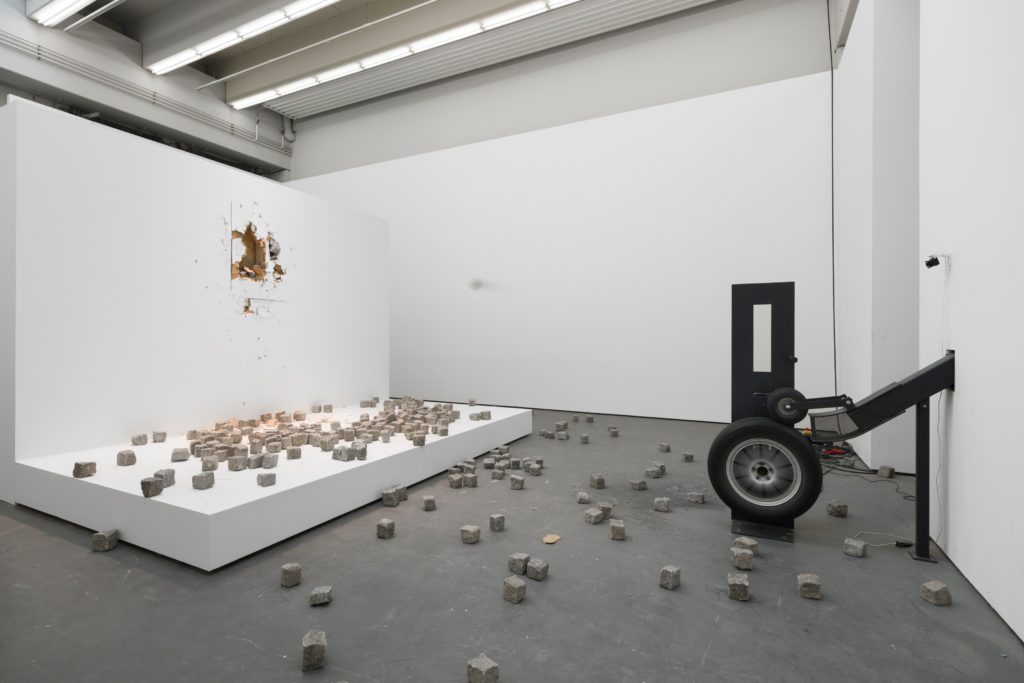
Beyond social allusions, the work conveys a broader sense of perceptual disjunction, in a world in which manual and industrial labor is displaced, and our relation to machines and processes becomes destabilized, and, increasingly, destabilizing. In the show, the percolating sense of violence emanates not just from machine power, but also from its invisibility – as it does in the case of a computer, blockchain, or an AI agent. Our relationship to the machines and processes may be banal or tedious, as the stone-stripping and the clickety-clack suggest, and yet tinged with growing apprehension.
At the same time, the show’s title, “Pull the Rug,” when read as a command, sounds rather tongue-in-cheek. Indeed, the artist intends to stop the machine at the show’s end, and open the back wall to reveal what his work has wrought. As in his previous shows, one expects to find an element of ludic surprise in the wreckage.