At its junction with the 10 and the 5 freeways on the southern edge of Boyle Heights, the 101 freeway snakes north and then east, crossing over the steady trickle of the Los Angeles River into the city’s administrative core. From dawn through the early evening this drive is often slow, the eternal congestion of overlapping vehicular arteries staging a tedious descent into LA’s historic Civic Center. As the freeway jogs right, it drops down below the city; the hazy vista of Downtown’s dense smattering of skyscrapers and the rail lines radiating out from Union Station give way to the shadow of overpasses and concrete walls, graded freeway ramps, and buildings seen from a frog’s-eye view.
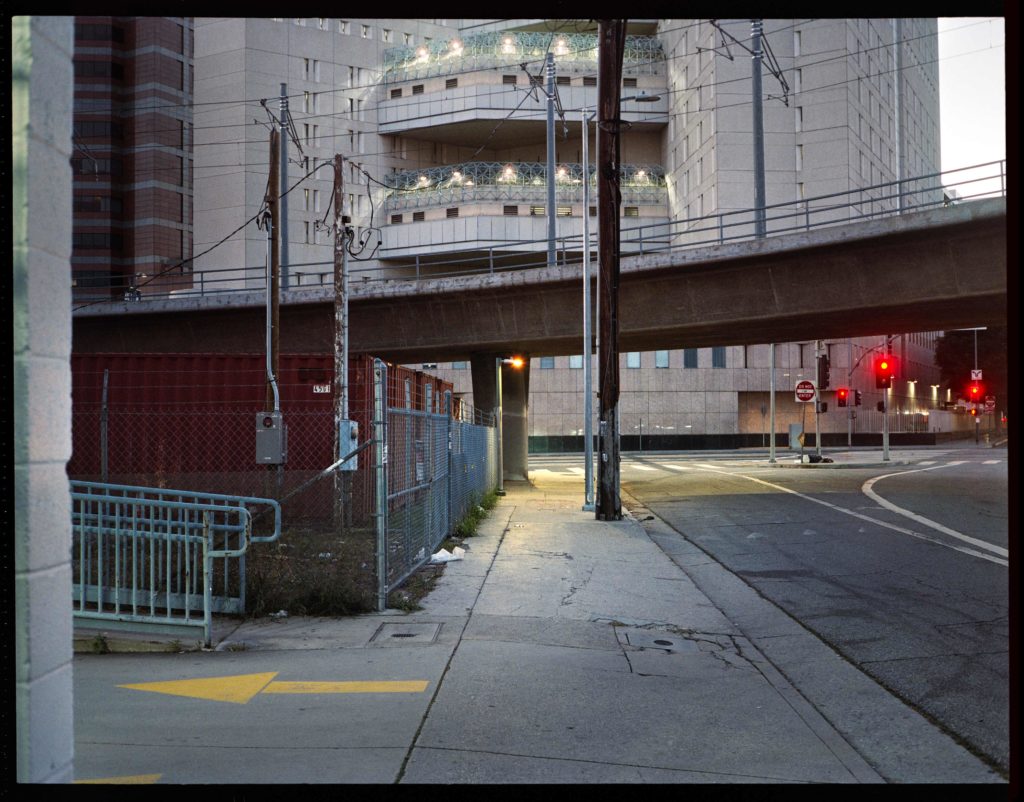
Looming over the curve of the freeway from above, the gateway to Civic Center from the east, is the Metropolitan Detention Center (MDC). A federal prison that has “more the look of a downtown office building,” as one Los Angeles Times article put it upon its opening in early 1989, the facility typically detains around one thousand inmates awaiting trial or deportation.[1] Rising ten stories above the 101, the facility’s butterfly- shaped design and dull concrete exterior allow it to covertly recede into the cluster of more distinct governmental properties in the area, including the late modernist Federal Building (LA’s administrative home of ICE), the art deco City Hall, and the new Los Angeles Police Department headquarters, its reflective windows recalling of the Westin Bonaventure Hotel.[2]
The administrative posture of MDC’s architecture and location are, of course, grotesquely by design. Save for a few telling details, namely the slits of its barely- there vertical windows and the web of fencing shrouding its cross-sectional walkways, its carceral character is unnervingly insidious, submerged beneath the drabness of Civic Center’s administrative energy. Most commuters pass by completely unaware of their adjacency to one of LA’s central nodes of state violence and containment. But this is MDC as seen from the private vantage point of the moving car; to witness it on foot from street level presents an altogether different story and set of relations. In LA’s Civic Center, public space is created and controlled according to increasingly punitive logics of surveillance. In his watershed 1990 text City of Quartz (whose original cover is emblazoned with an image of MDC), Mike Davis adroitly chronicles LA as an experimental arena for increasingly brutal and privatized tactics of policing and surveillance. Many of these, he intones, have the intended effect of “kill[ing] the street” as a site of heterogeneous community evolution and cultural exchange.[3]
Perched at the corner of Alameda and Aliso Streets, MDC is wedged between the transit hub of Union Station and the borders of Olvera Street, Chinatown, Boyle Heights, Skid Row, and historic Little Tokyo; neighborhoods where some of the city’s most ardent anti-gentrification efforts and cop-watching programs have been underway for decades. For all the density of these adjoining neighborhoods, the pedestrian areas around MDC are deliberately dispersed. Pushed out by the violence of private development and LA’s infernal rent crisis, unhoused people living nearby are often swept by police, perpetuating a messy choreography of displacement.
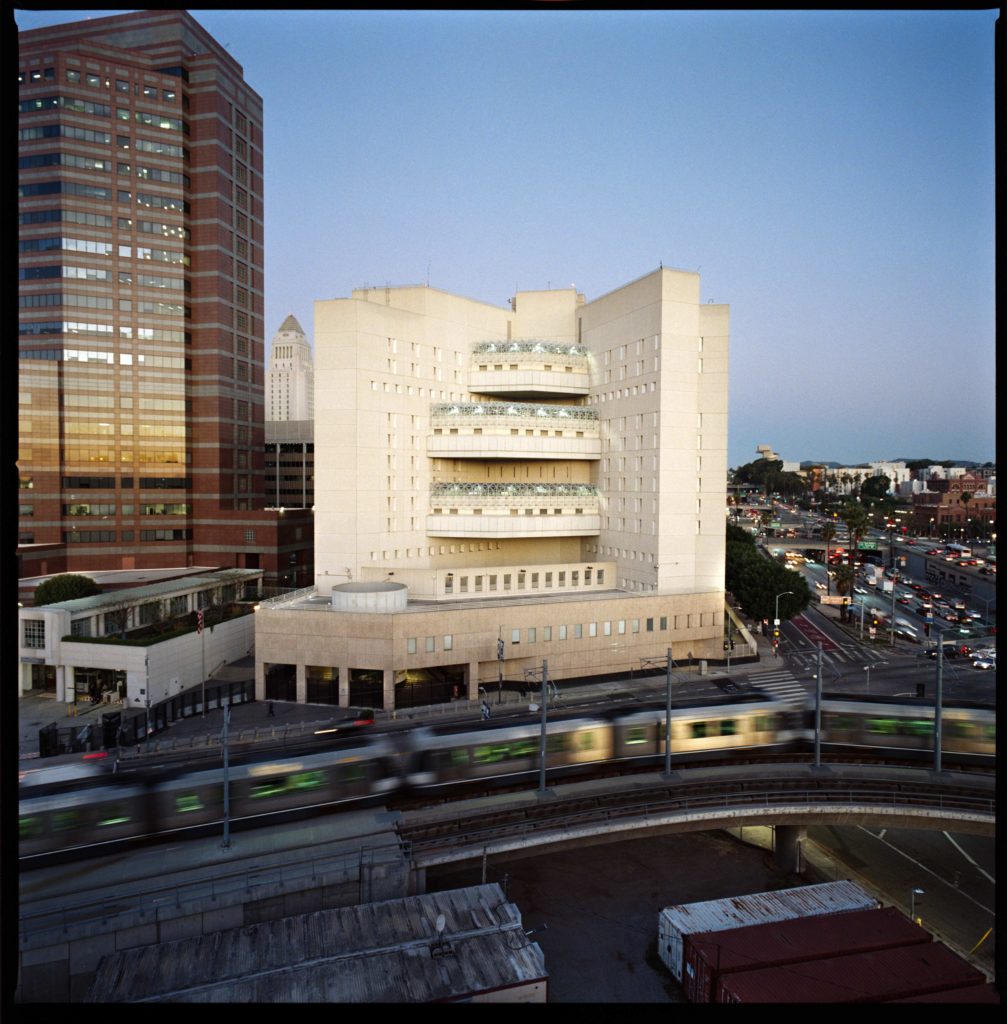
The outside of MDC is fortified by brute concrete barriers, hydraulic gates, and the shadow of razor wire. The geographic placement of MDC is not merely symbolic — it is where the lived manifestation of the surveillance state, military and police administration, and the spoils of speculative investment and real estate development come to a brutal head. Perhaps no urban infrastructure is as Californian as the prison industrial complex.
The prescriptiveness of carceral zoning, however, is not a given. Since the prison’s inauguration on the eve of the 1990s — a decade marked by the anti-white supremacist ardor of the 1992 Los Angeles Uprising and the televised spectacle of O. J. Simpson driving his white Ford Bronco at low speed along the Interstate 405 freeway while evading the cops — organized struggle has often transformed the MDC’s architecture of isolation and containment into a confrontational zone of resistance.
One of LA’s well-trodden demonstration routes begins at Placita Olvera, the site of the Pueblo de Los Angeles and the originary germ of the city as colonized Spanish settlement, and ends at City Hall, the contemporary locus of civic power in the form of a hulking white spire flanked by two rectangular wings — a design that proffers an especially lazy psychoanalytic punchline. Along the way, the route proceeds past MDC. As marchers approach, they are sometimes met with a cacophony of banging from beyond the prison walls, silhouettes of those inside just visible through window slits. Even on the open street, we are never far from those held captive within.
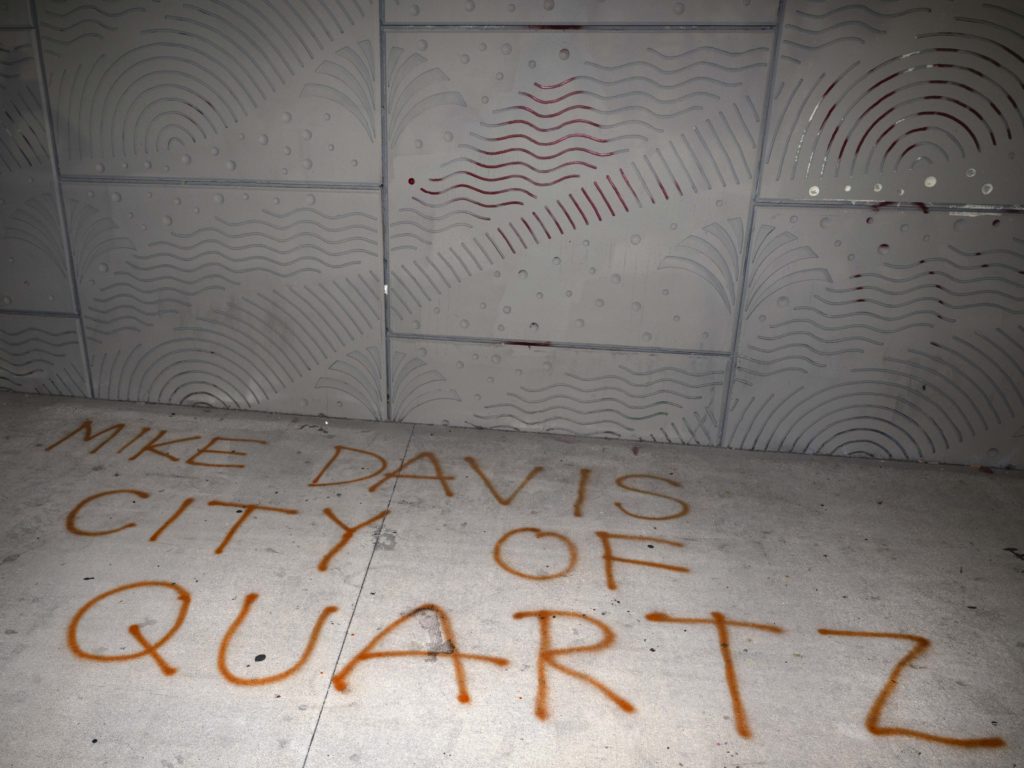
Such an experience of anti-carceral communication inspired the National Day Laborer Organizing Network (NDLON) to establish a weekly “Chant Down the Walls” protest beginning in late 2014. Every Monday evening, NDLON members would gather in front of the prison on the corner of Alameda and Aliso, chanting and singing to those inside, joining their family members who often gathered across from MDC with signs bearing messages of love. “No están solos/You are not alone.”
For years NDLON has led these concerts, often with the participation of Los Jornaleros del Norte, the day laborer band who formed after an immigration raid at a mobile health clinic in a South LA neighborhood in 1996. The band plays a set largely of cumbia and norteño, “the evergreen genres of working-class Mexican and Central American immigrants” who largely make up the MDC’s population.[4] During nighttime concerts, the lighted slits of cell windows blink on and off in tune with the music.
Jornaleros, or day laborers, form the spine of LA’s workforce, and their presence and status have been at the heart of the response to the ICE raids that have unrelentingly assaulted LA since last June. Raids have targeted manufacturing plants, car washes, and Home Depot parking lots where day laborers congregate each morning for construction jobs; ICE agents in gaiter masks have descended upon the sidewalks and street corners where food vendors set up shop each day, disappearing workers into unmarked vehicles bound for detention centers with inhumane conditions.
Many migrants initially responded to ICE’s aggressive presence by staying home, with communities fundraising to cover lost wages. Local groups such as Unión del Barrio and the Los Angeles Tenants Union organized robust rapid response and ICE-watching networks, supported by volunteers who returned to raid sites daily to patrol and warn neighbors of threats.[5] While these efforts have not halted the hundreds of raids that have torn the city apart, they have succeeded in interrupting ICE’s momentum. Hyper-local knowledge and relationships, the kind that cannot be perceived or understood from the outside, have snared the tactical gear and weaponry of an ICE force shipped in from anywhere across the country.
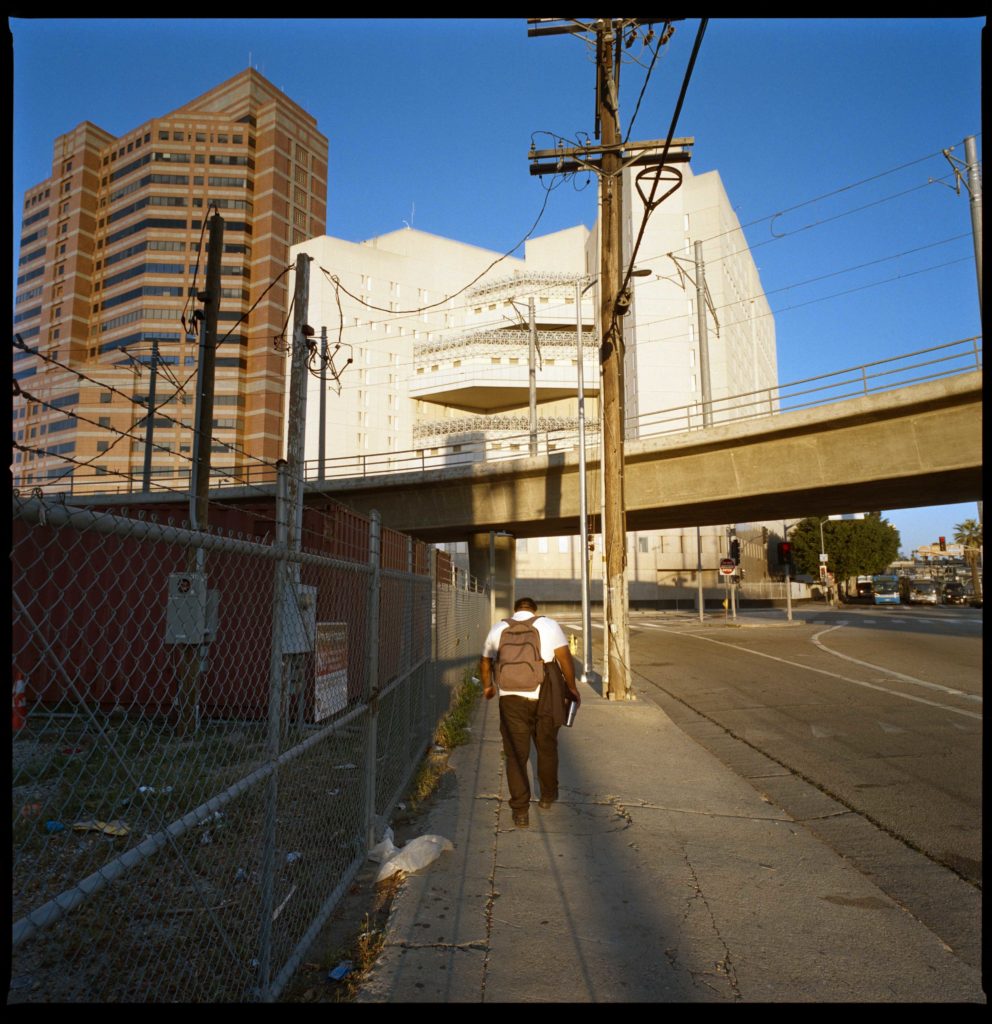
Since the raids began last June, MDC has served as a confrontational flashpoint for anti-ICE revolt in the city. During the initial days of escalation, protesters began to gather in front of the prison’s loading bay where ICE and US Department of Homeland Security (DHS) vehicles would enter and exit. Whenever the loading door would slowly roll upward, it revealed agents dressed in full tactical gear, brandishing so-called less lethal weapons. The assembled crowd would press toward the building as agents assembled in a vulgar skirmish line before being chased back inside, resulting in a chaotic game of cat and mouse. Even when masked, we could see the fear in these agents’ eyes.
On the third day of revolt, a beautiful sun-drenched Sunday, thousands of demonstrators gathered at MDC and the adjacent blocks, stretching as far as Placita Olvera to the east. Protesters quickly overtook the streets and spilled down the freeway ramp onto the 101, covering the steep concrete walls with the resonant call of “FUCK ICE.” Lime scooters were hurled down from above onto the hoods of cop cars trapped in the underpass, as the Los Angeles Police Department (LAPD) and United States National Guard responded with tear gas, flash bangs, and rubber bullets. The searing image from the day is of a masked, shirtless protester standing jubilantly atop a torched Waymo, holding a Mexican flag flying above the billowing black smoke. Even after the driverless cars — yet another tool of corporatized surveillance — had been mostly reduced to ash, you could feel the heat emanating from their burned-out frames.
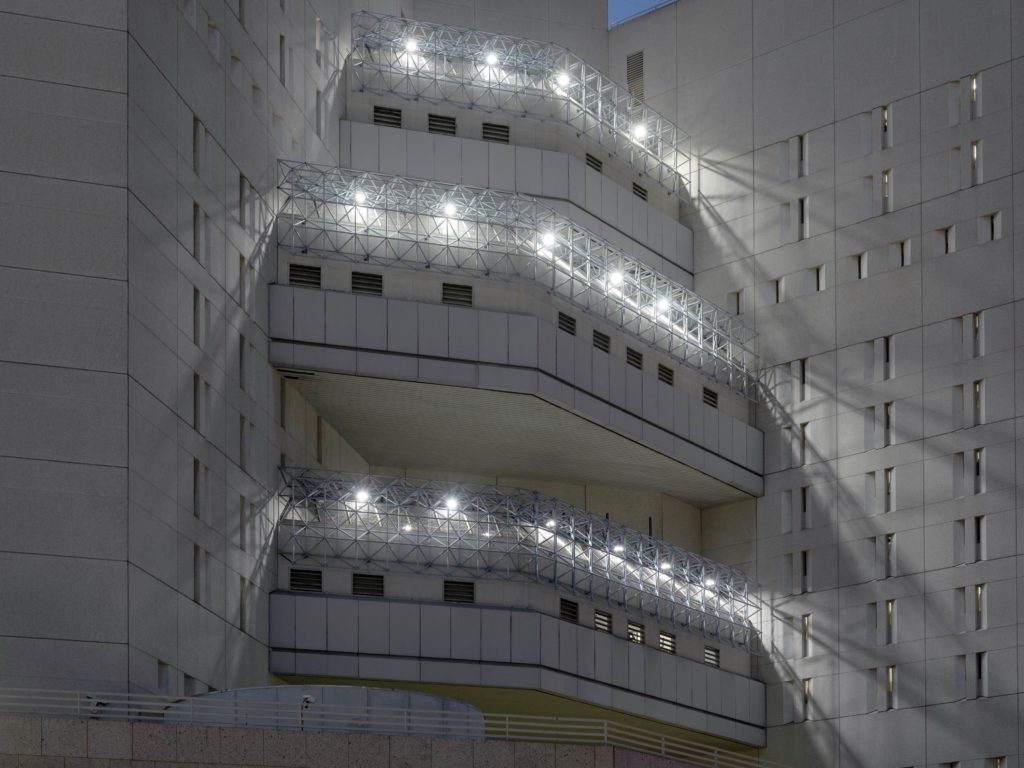
Crowds continued to return to MDC in the days following and throughout the summer. There, a short-lived encampment supported by J-Town Action and Solidarity grew after a city-ordained curfew was lifted. By then, barricades had been erected around the prison loading bay. On one bright morning I returned to find a small group looking up at one of the window slits. Someone on the inside was holding up a hand-written sign, barely visible, beckoning to the group below.
Taking to the streets and fighting for your city demands nimble action in excess of the visible limits of the built environment, a redoing of the controlled architectures of public space. The power of response resides in knowing your neighbors, in knowing your city better than the cops, in traversing space in ways that are unknowable and unpredictable, in brave defiance of the reflective mirror of militarized surveillance. As the sign flashed in and out of view, the crowd cheered back messages of love, their voices carrying up and through the windows.
[1] Kim Murphy, “U.S. Opens a High-Rise Prison in Civic Center,” Los Angeles Times, January 3, 1989, https://www.latimes.com/archives/la- xpm-1989-01-03-me-145-story.html.
[2] In Postmodernism: The Cultural Logic of Late Capitalism, Frederic Jameson famously writes of the Bonaventure as the ür-example of postmodernist architecture, and the “glass skin” of its windows which “achieve a peculiar and placeless dissociation of the Bonaventure from its neighborhood: it is not even an exterior, inasmuch as when you seek to look at the hotel’s outer walls you cannot see the hotel itself but only the distorted images of everything that surrounds it” (42); Special thanks to my friend and collaborator Simogne Hudson for drawing this comparison between LAPD HQ and the Westin Bonaventure.
[3] Mike Davis, City of Quartz (London: Verso, 1990), 231.
[4] Josh Kun, “Sidewalk Serenade,” The California Sunday Magazine, February 2, 2017, https://story.californiasunday.com/sidewalk- serenade.
[5] Tracy Rosenthal, “Immigration Raids at This Home Depot Got More Aggressive but Less Effective. The LA Tenants Union Knows Why,” Hammer & Hope, 2025, www. hammerandhope.org/article/los-angeles- tenants-ice.