Anarchitecture
The term “anarchitecture” has been used independently by several figures,[1] but here, I adopt it in my own way. It can be read as either “anarchi-tecture” or “an-architecture,” and carries two meanings: a political one, which involves producing things without power hierarchies, and an architectural or aesthetic one, which implies the negation of conventional architectural order.
As an anarchitect, or anarchist architect and design theorist, I seek ways of making that avoid hierarchical power relations. The common belief that settled societies inevitably produce hierarchies has been challenged by thinkers like David Graeber and David Wengrow, who demonstrated that human societies have long experimented with diverse organizational forms, including large non-hierarchical settlements.[2]
Yet many modern technologies are still structured hierarchically. My task, therefore, is to prefiguratively reinvent — perhaps on a small scale — forms of collaboration where people can produce what they need together, without hierarchy. What kind of architectural aesthetics might emerge from such processes? To explore this, I present two anarchitectural practices in which I participated in construction.
Arimaston Building
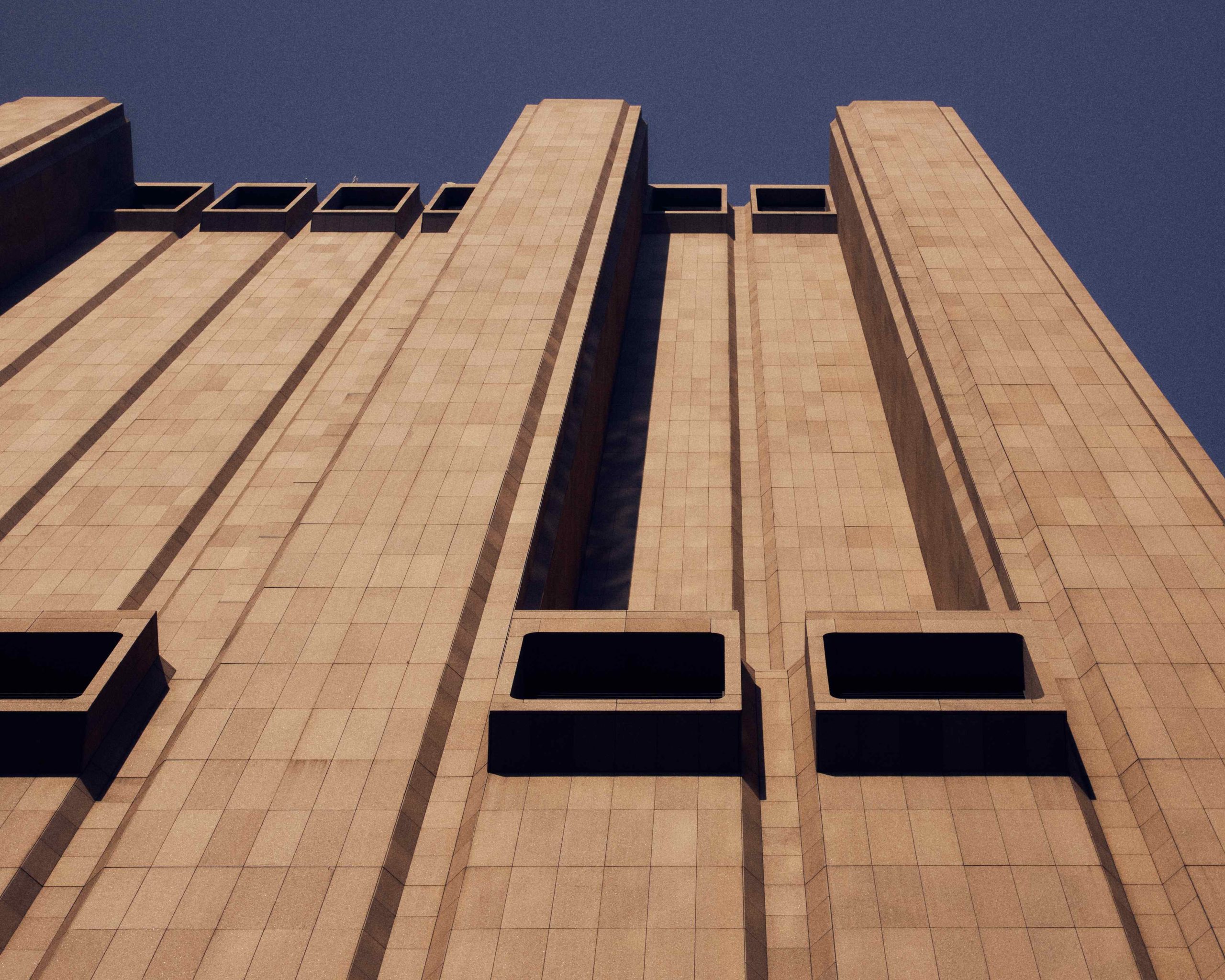
The Arimaston Building is a self-built project by the architect Keisuke Oka, located in Mita, a central area of Tokyo. Construction began about twenty years ago and was only recently brought close to completion. During this time, the site was incorporated into a redevelopment zone, and the building faced the threat of demolition. However, through persistent negotiations and efforts to raise public awareness, this crisis was ultimately averted.
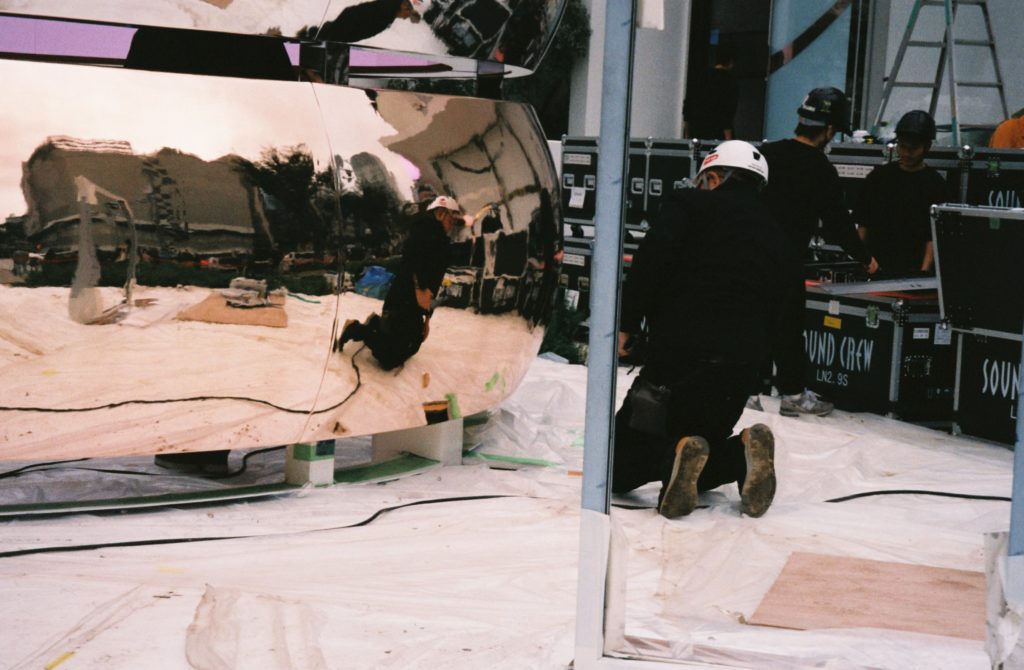
Oka is also a butoh dancer, and “building as if dancing” became a central theme of the project. Together with other participants, he developed construction methods specific to the project, allowing the design to evolve improvisationally during the building process. For instance, they poured concrete in smaller increments than usual, using vinyl-wrapped decorative formwork.
Musicians and artists also participated in the building process. Some participants were not directly involved in construction — for example, a cornet player regularly came simply to practice. Oka assigned participants specific tasks and provided verbal instructions about the specifications needed to meet building regulations and other constraints. However, he largely left design decisions to the discretion of each participant. Individuals crafted their portions while responding to what had already been built by others. This approach even gave expressive and decorative forms to elements usually hidden in conventional buildings, such as plumbing and electrical wiring.
Kappa Dimension
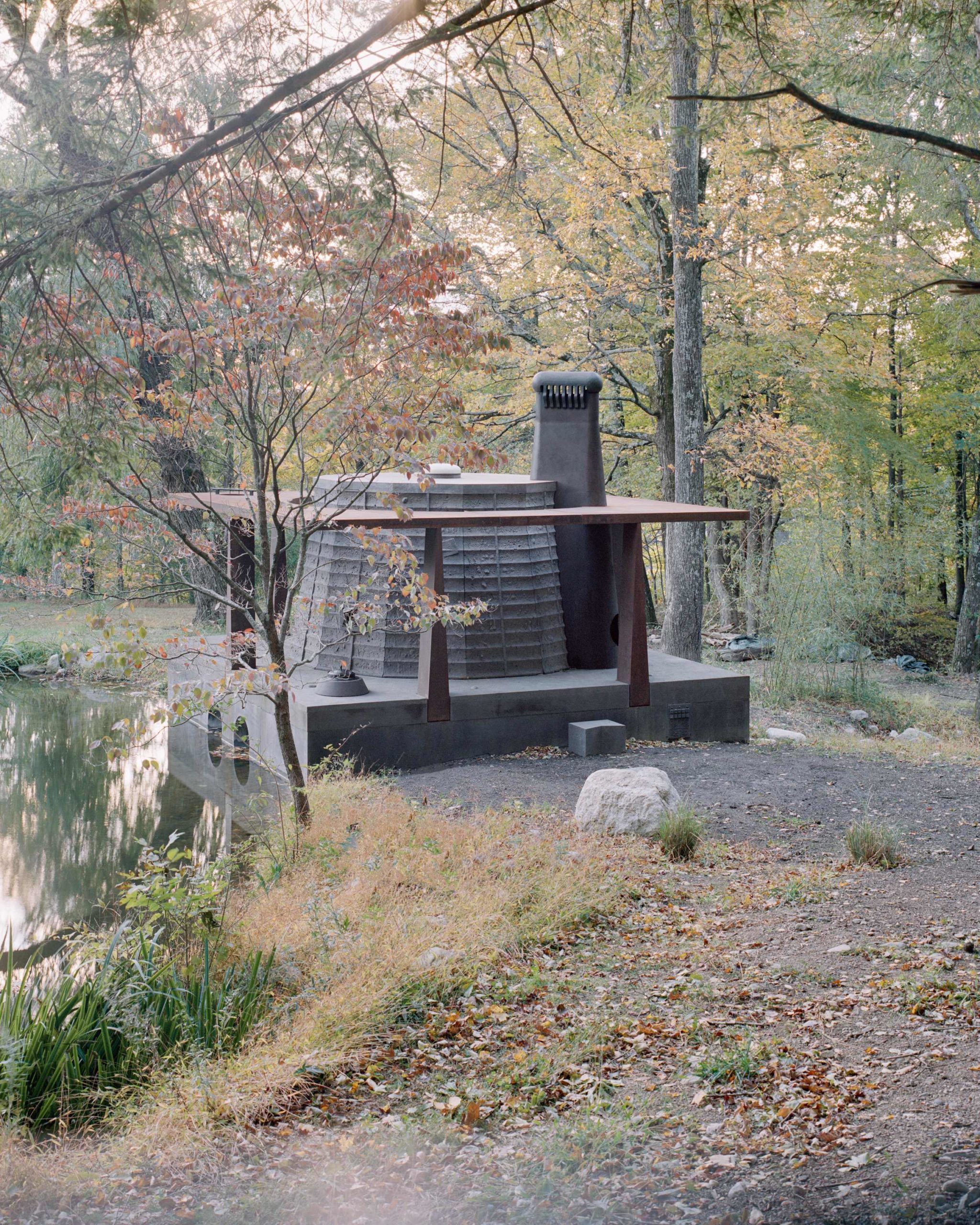
Kappa Dimension (KPD) is the residence of architect Kanji Wada (Lunch! Architects), created by renovating a nagaya — a traditional row house in Kyoto — once used as both a weaving workshop and a dwelling. Wada, a builder-architect, collaborated with carpenters and artists from diverse fields, blending traditional techniques like wood joinery and earthen walls with industrial materials such as aluminum and plastics.
Wada is also a kaidan-shi, a storyteller of yōkai tales, and the building takes the kappa as its theme. In Japanese folklore, the kappa is a water-dwelling creature known for challenging humans to sumo matches or helping with construction. It has also been associated with kawaramono — marginalized riverbank communities involved in occupations such as slaughtering animals, landscaping, and performing arts, who have historically faced discrimination. For Wada, adopting the kappa as a theme means creating architecture alongside those marginalized within the modern architectural industry and capitalist economy.
This approach is reflected in the playful use of discarded materials found on-site and in the reintroduction of festivity into the construction process. Wada and the participating artists perform “Self Jichinsai,” an improvisational art performance referencing jichinsai — a traditional Japanese ground-breaking ritual — as well as kappa-themed theater during construction, treating both as part of the architectural process. Through these performances, shared nonverbal atmospheres emerge, revealing the agency of spaces and materials that shape the design.
The Albertian Paradigm
In both cases, the architect participates directly in construction. While hierarchy is not entirely absent, these projects seek relatively egalitarian collaboration, rather than top-down control by the architect — an approach still somewhat unorthodox in modern architecture.
Historically, the architect was literally the head of the craftsmen, directing construction on-site. The separation of design from construction is commonly traced back to Renaissance architect Leon Battista Alberti, whose comprehensive drawings enabled architecture to be practiced primarily as design. This division — theorized as an “Albertian paradigm” by Mario Carpo[3] — became a foundation of modern industry, separating conception from execution and establishing a power dynamic between those who decide and those who follow.
In the ceramics industry, when Josiah Wedgwood introduced this separation in the eighteenth century, a letter of his included the phrase, “Preparing to make such Machines of the Men as cannot Err.”[4] Through discipline, workers were deprived of design autonomy, ensuring that objects were made exactly according to the design.
At the same time, the separation implies a mechanistic worldview in which materials are regarded as passive entities, lacking agency.

The Light of Reason
Alberti argued that architecture consists of forms made of lines and angles, rather than the material structures that are built, separating mental form from material substance.[5] This position is grounded in a Western archic paradigm: the idea that a governing principle precedes and orders what follows.[6] Spirit or intellect is imagined as light, while matter appears as its shadow — justifying the hierarchy between the architect who knows the principles and the craftsman who works with matter.
Since the Enlightenment, this universal light has been equated with reason, and transparency to it — being rational, demonstrable, and explainable — has become a widely accepted demand. In architecture, spatial forms are expected to clearly express social functions, and design processes must remain transparent to support stakeholder participation in democratic decision-making. Mario Carpo argued that recent developments in digital technology — such as algorithmic design and digital fabrication — indicate a post-Albertian paradigm by reconnecting design and construction through non-static, adaptable forms. However, to me, these developments seem to reinforce the paradigm, further demanding architecture’s transparency as a clarity of argumentation, and leaving little room for the unpredictable agencies of workers and materials.
Breakdown
Ontological design, as proposed by Fernando Flores and Terry Winograd, suggests that design shapes how we understand our place in the world.[7] This highlights the importance of opacity in design. Drawing on Martin Heidegger,[8] they note that in everyday life, things appear primarily as “in-order-to” something or ready-to-hand (Zuhandenheit), within a context of equipment. Only when this context breaks down does something appear as a present-at-hand (Vorhandenheit) object with determinate properties. We can say that the previously transparent tool becomes opaque at such moments of breakdown. Winograd and Flores argue that such breakdowns make ontological design possible because they provoke shifts in our understanding of the world.
Recent developments in neuroscience suggest a comparable mechanism. The Free Energy Principle, introduced by Karl Friston in neuroscience and now developed into a general theory of adaptive systems,[9] proposes that living beings perceive and act through predictions generated by internal models of the world. The context of equipment can be understood as a model, insofar as it encodes predictions about how things will appear and behave in relation to other things. Transparency corresponds to relative predictability and high confidence within the model, while opacity emerges when predictions fail or when the model proves incomplete, introducing uncertainty. Organisms cannot survive in conditions of overwhelming unpredictability; yet it is precisely such opacity that drives learning — the revision of our models and, consequently, of our ways of being.
Strategic Opacity
Since asymmetries of information often create power, transparency in decision-making may appear essential to democracy. Yet it’s important to distinguish between the transparency of rulers and that of the ruled. The postcolonial theorist Édouard Glissant argued for a “right to opacity”: demanding full transparency under the light of rationality can become a form of domination, subordinating other ways of being to the worldview of those in power.[10] Opacity, then, can be a strategy for autonomy.
In the two cases above, formal architectural drawings are rarely used as communication tools in the design–build process. Instead, participants rely on words and ad hoc sketches — not as complete design notations in the Albertian sense, but as media for response. In Kappa Dimension, Wada intentionally avoided conventional drawings in order to encourage participants to suggest ideas he had not imagined. Collaboration proceeds through mutual adjustment, acknowledging that participants cannot fully understand each another’s perspectives.
Because conventional drawings are absent, the overall form of these projects is hard to grasp from the outside. In the case of the Arimaston Building, this opacity may have helped shield it from the pressures of redevelopment; a transparently rational project might have been more easily absorbed into that logic.
Improvisational Pluralism
The two cases presented here exhibit a coexistence of diverse ways of being that cannot be reduced to one another. In the case of the Arimaston Building, this tendency is pushed in a particularly radical extreme, where expressive unity seems almost abandoned. Kappa Dimension, by contrast, maintains a certain unity of expression, limiting participants’ discretion, while its methodology — such as the introduction of theatrical performance — becomes more sharply articulated.
The coexistence of different worldviews is not a new theme. In his analysis of the novels of Fyodor Dostoevsky, Mikhail Bakhtin described this condition as polyphony.[11] The architectural theorist Colin Rowe used the term “phenomenal transparency” to describe a perceptual ambiguity produced by the coexistence of multiple spatial orders.[12] In some postmodern architecture — where the goal was to dismantle the universalism of modernism — the coexistence of multiple orders became a key theme.
However, because most mainstream architects have remained within the Albertian paradigm, even attempts to incorporate plurality into design tend to integrate it into a spatial form governed by a single framework. Such plurality remains largely epistemological — a multiplicity of interpretations of the same object.
By contrast, the plurality found in the two cases discussed here is ontological, involving heterogeneous practices and agencies that cannot be fully unified within a single conceptual framework.[13] It therefore cannot be completely planned in advance. Rather, it emerges from opacity — recognizing that no single viewpoint can foresee or plan everything. In other words, it is a plurality generated by improvisation, not by preordained design.
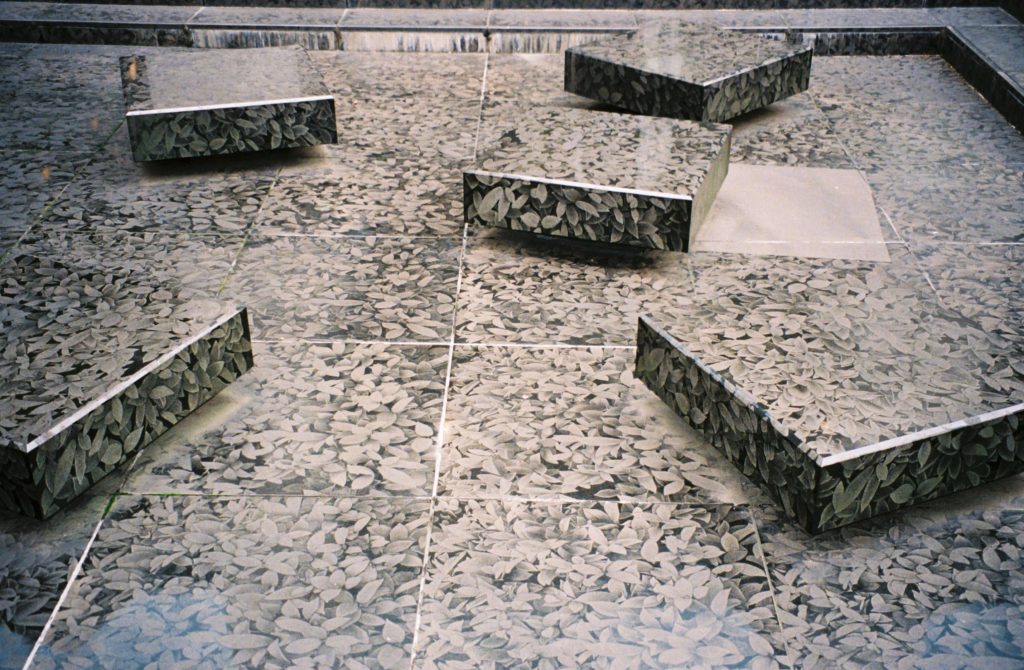
Singing, Dancing, and Building with Kappa
In both cases, participants include amateurs and semi-professionals without formal expertise, working for the joy of it. The universalization of the idea that architecture consists in rational spatial form has rendered invisible both the creativity and the joy of those who work with materials. Utai odori tateru: Arimasuton biru no tsukuri kata (Singing, Dancing, and Building: How to Make Arimaston Building”),[14] a collection of texts by the participants of Arimaston building construction, including me, published in 2025, imagines architecture as an extension of improvisational singing and dancing — arising from bodily and material responses rather than from abstract design intentions. This approach resonates with romantic socialist designers like William Morris, without idealizing the rigid hierarchies of the medieval past.
What the transparency of the Albertian paradigm has marginalized is not only the agency of workers but also that of non-humans. One folklore narrative about the kappa tells that humans once created dolls to make them work on construction projects. When the work was finished, they discarded the dolls by the riverbank, and these abandoned figures then became kappa that began to trouble humans. Similar stories exist in many cultures. Mary Shelley transformed this motif into literature with Frankenstein. In the 1818 novel, Dr. Victor Frankenstein creates an artificial human but then abandons it, and the creature rebels. Bruno Latour famously argued that Frankenstein’s crime was not that he created the creature, but that he abandoned it.[15] When technologies produce unintended consequences, the common response is to reject them. Latour, however, calls for responding to them while acknowledging that technological action inevitably generates unforeseen outcomes.
Kappa designates human and non-human agencies marginalized in modern frameworks. Instead of romanticizing or controlling them, I propose respecting them as opaque presences. Architecture could then emerge through singing and dancing with them — that is, through mutual bodily and material responses.
The cases introduced here are both private residences of architects, which allowed a relatively large degree of experimentation. Yet, precisely for that reason, they did not entirely eliminate hierarchy: a single architect ultimately made the final decisions. In these examples, design and construction were not divided into separate roles, and drawings did not play a major role. However, if we aim to create inclusive architecture — an architectural practice in which minorities, such as people with disabilities, can participate — it may become necessary to accept some degree of division of labor without reintroducing hierarchical relations. In such situations, architectural drawings may be used in ways that differ from their conventional role as transparent tools of instruction, instead encouraging improvisation alongside other more opaque media such as theater, dance, and song. While this approach may appear reactionary from the standpoint of industrialized architectural production, it does not advocate a return to a pre-industrial condition or to the Middle Ages, often retrospectively idealized as an era of harmonious order in interpretations of Morris. It shares with Morris a concern for reconnecting art, architecture, and everyday life, but departs from him in refusing to anchor this project in an idealized past. Instead, it explores how architecture might be re-embedded in everyday life as an experimental and prefigurative practice oriented toward alternative social and material arrangements and their associated aesthetics.
[1] It is widely associated with artist Gordon Matta- Clark but also used by others. Mark Wigley, Cutting Matta-Clark: The Anarchitecture Investigation (Lars Mueller: 2018).
[2] David Graeber and David Wengrow, The Dawn of Everything: A New History of Humanity (Farrar Straus & Giroux: 2021).
[3] Mario Carpo, The Alphabet and the Algorithm (MIT Press: 2011).
[4] Ann Finer and George Savage, The Selected Letters of Josiah Wedgwood (Cory, Adams & Mackay: 1965); Adrian Forty, Objects of Desire: Design and Society Since 1750 (Thames & Hudson: 1986).
[5] Leon Battista Alberti, Ten Books of Architecture (Tiranti: 1950).
[6] Terry Winograd, Understanding Computers and Cognition: A New Foundation for Design (Addison-Wesley: 1986).
[7] Terry Winograd, Understanding Computers and Cognition: A New Foundation for Design (Addison-Wesley: 1986).
[8] Martin Heidegger, Being and Time (Blackwell: 1962).
[9] Karl Friston, “The Free-Energy Principle: A Unified Brain Theory?” Nature Reviews Neuroscience 11 (2010): 127–138.
[10] Édouard Glissant, Poetics of Relation (University of Michigan Press: 1997).
[11] Mikhail Bakhtin, Problems of Dostoevsky’s Poetics (University of Minnesota Press: 1984).
[12] Colin Rowe, The Mathematics of the Ideal Villa and Other Essays (MIT Press: 1976).
[13] Although framed here as a distinction between epistemological and ontological opacity, this separation is provisional. Following Charles Sanders Peirce, one might instead understand being itself as semiosis, complicating any strict division between ontology and epistemology.
[14] Kimura Nao, Utai odori tateru: Arimasuton biru no tsukuri kata (うたい、おどり、建てる 蟻鱒鳶ル(ありますとんびる)のつくり方) (Seidosha: 2025).
[15] Bruno Latour, “Love Your Monster: Why We Must Care for our Technologies as We Do Our Children, Breakthrough Journal 2, no. 11 (2011).