Originally published in Flash Art International no. 188, May–June 1995.
Diller + Scofidio is a New York-based collaborative studio involved in cross-disciplinary work that incorporates architecture, performance, and visual arts. D+S was formed in 1979. Elizabeth Diller is an assistant professor at Princeton University. Ricardo Scofidio is a professor at Cooper Union.
Kyong Park: You were recently accused by a certain New York Times architecture critic of hiding out in the art world, aloof from architecture. Would you care to comment?
Ricardo Scofidio: We were praised and slapped on the hand all at the same time for Soft Sell (1993), a video installation in an abandoned porno theater. Evidently, our critique of the remarketing of 42nd Street was appreciated, though the medium we chose and the art context venue was deemed elitist. We were accused of avoiding architecture.
KP: Like building a building.
Elizabeth Diller: Yes, like building a building. Even the liberal thinkers in the architectural discipline insist on disciplinary control over its borders.
KP: Your work is largely dedicated to redefining architectural practice. For some, the notion of an “alternative practice” has been a means to adapt to the economic crisis, while for you crossing architecture with other media was an early choice. Why?
RS: Traditional architecture is too slow. Incidentally, when we began, during the building boom of the ’80s, hybrid strategies such as architectural installation and performance seemed like an expedient way of working through ideas while keeping our research in the public realm.
KP: Do you feel that change is not possible from within architecture? Can architecture only be challenged from outside its borders?
ED: If we paid too much attention to borders, we would be playing into the hands of the border patrol. We have always asserted ourselves as architects even though building buildings is just one strand of our production. Architecture is often a target of our critique and sometimes our most effective weapon. Broadly, our interest lies in interrogating spatial conventions of the everyday. The choice of medium is a matter of the right tool for the particular job.
RS: It’s not unusual for us to be involved in disparate projects — at the moment we are working on a prototype facade for a chain of pachinko parlors in Japan, a theater piece about jet lag, a media marquee for a Cineplex theater, one hundred units of social housing, a project on dissident housework, and an installation about the American lawn.
KP: Art practice at large has closely followed changing cultural concerns, engaging issues of multiculturalism, gender politics, etc., while architecture has been slow to respond. Do you think that architecture is merely in service to existing systems of authority? Is architecture fundamentally a discipline that reinforces permanence and stasis?
ED: No, but architecture is a victim of a self-imposed autonomy. It resists the notion that space is already constructed before the architect arrives on the scene — coded legally, economically, politically, and socially. It presumes a tabula rasa for formal experiments and, quite often, inadvertently, assumes a simple regulatory role, servicing the powers that employ it. It is possible, however, to accommodate those powers without falling into a complicit relation with them. We argue for an “architecture of entrapment.”
KP: It seems that architecture has not adequately rethought its heroic role since the ’80s when Johnson’s AT&T building, Pei’s Pyramid at the Louvre, and Canary Wharf were prominently featured on the front pages of magazines. Today, the media no longer features spectacular buildings by spectacular architects with international reputations, but anonymous, benign buildings caught in the mirror of world events.
ED: According to Herbert Muschamp, the new architectural monument serving mass cultural commemoration is the building under siege, under the bright lights of the media — the burning Waco compound, the bombed out floors of the World Trade Center, the Russian White House blackened by fire, the gouged federal building in Oklahoma City, the damaged high-rises of Beirut and Sarajevo… Injured buildings have become more poignant media symbols than injured bodies.
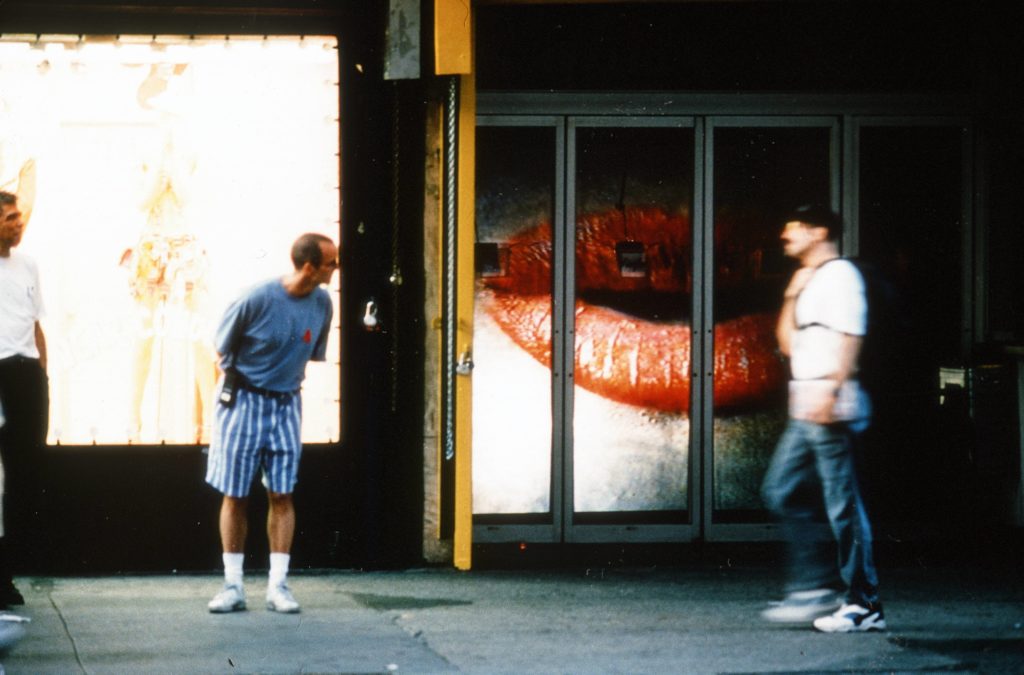
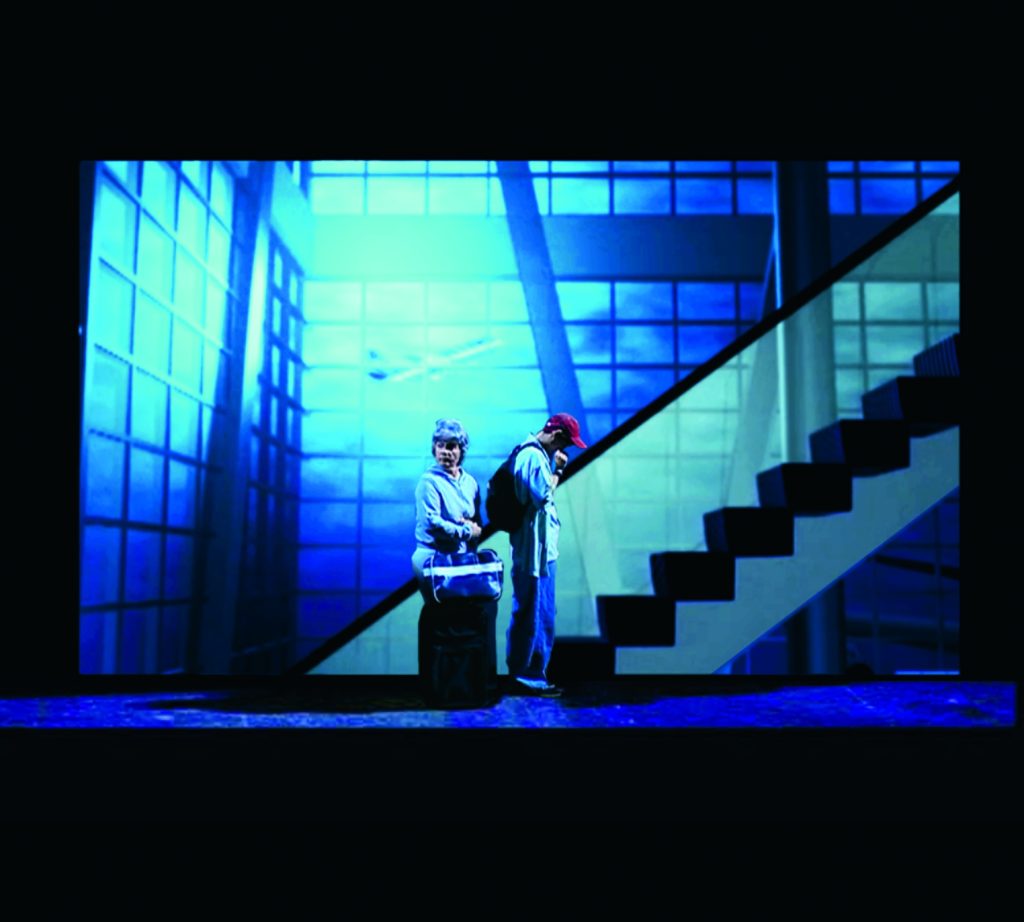
Elizabeth Diller, Ricardo Scofidio, Brendan Cotter, Calvert Wright, Joseph Cho, Jean-Philippe Lanoire, and Birgit Schlieps, “Soft Sell.” Installation view at Rialto Theater, New York, 1993. Photography by Michael Moran. Courtesy of Diller Scofidio + Renfro, New York.
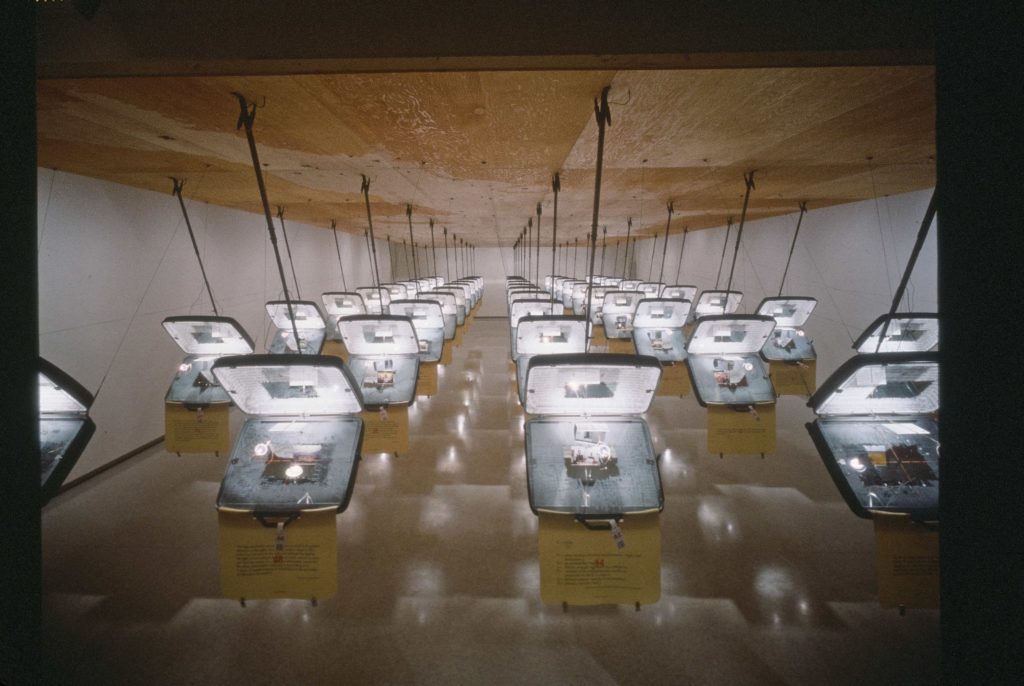
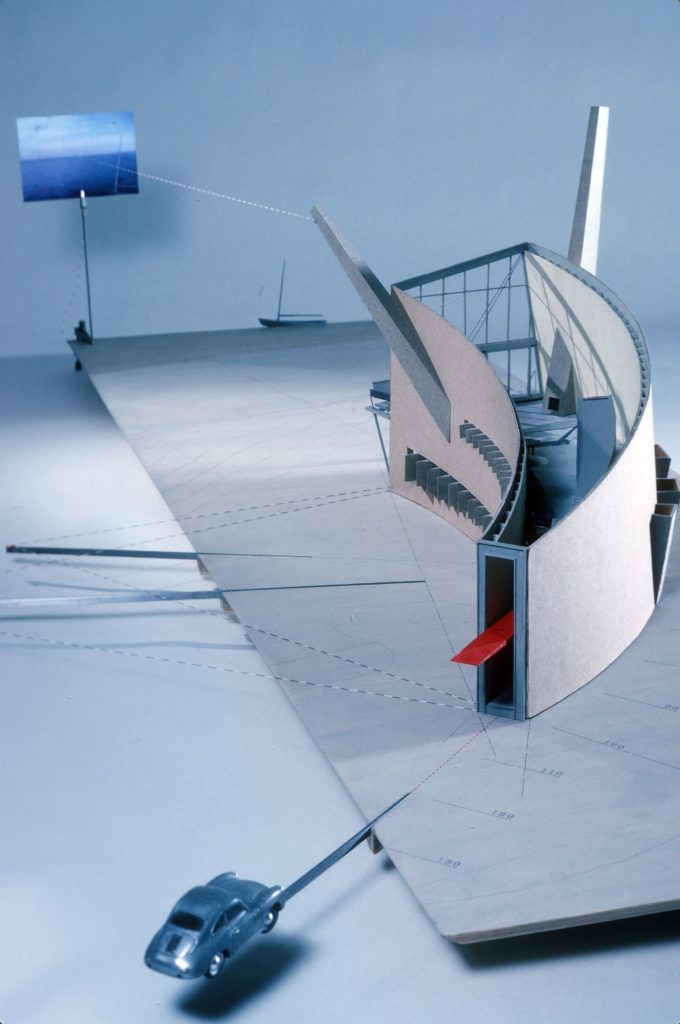
KP: Your work is thoroughly connected with media culture. Some of your recent projects are centered on today’s fastest growing industries, tourism and entertainment. Your installation Tourism: SuitCase Studies (1991), the vacation residence, the Slow House (1989–1991), your latest video projects, Overexposed and Indigestion (both 1995), address how current technologies and economies are absorbing the traditional space to which architecture has been bound.
ED: We are interested in rethinking the designations “high” and “low” culture and “high” and “low” technologies. For instance, in Tourisms, revealing the sophistication with which “sightmakers” manipulate space and vision for “sightseers” in the fabrication of authentic “sights” to enhance travel to a national past, or in the Slow House, collapsing the distinction between “mediated” and “unmediated” views. Our recent video installations arise out of the desire to find an opening between the technophilic narratives of progress and the technophobic narratives of decline. Specifically, our most recent work stems from a preoccupation with the rhetoric of freedom used both to describe the new spaces envisioned by the technology of glass at the turn of the century and the new spaces promised by emerging technologies today.
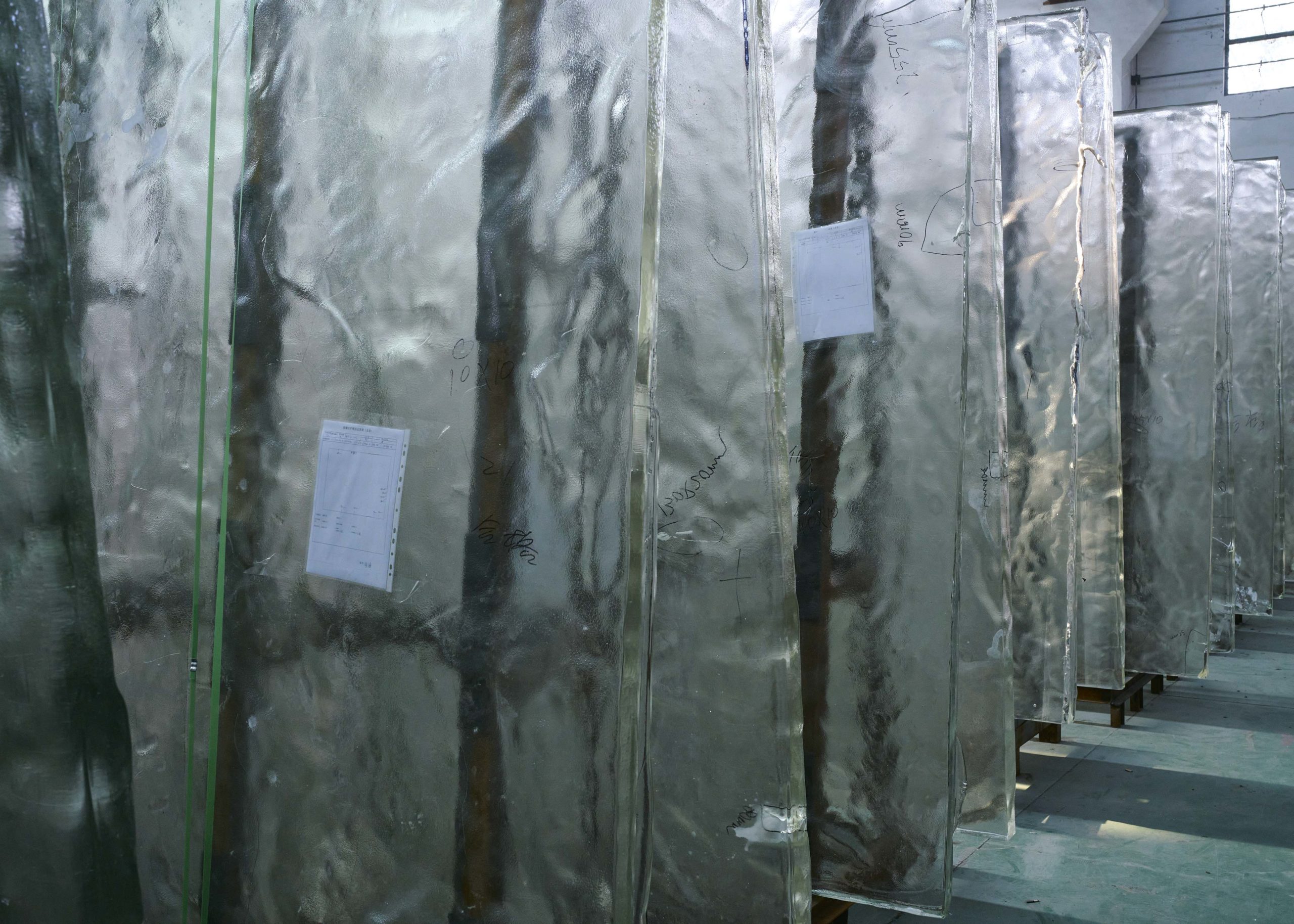
RS: In early modernism, glass was to liberate vision from the disciplinary confines of masonry. It was considered a material of “truth,” an instrument of disclosure. And like emerging electronic technologies today, it promised to democratize space and information in a world guaranteed to become transparent, available. While the curtain wall was becoming the dominant building technology of the twentieth century, it was becoming evident that the technology which permitted unlimited vision to the outside also exposed itself to observation from that very same outside. The gaze was, all of the sudden, a two-way system. Glass was becoming an anxious material of surveillance and control.
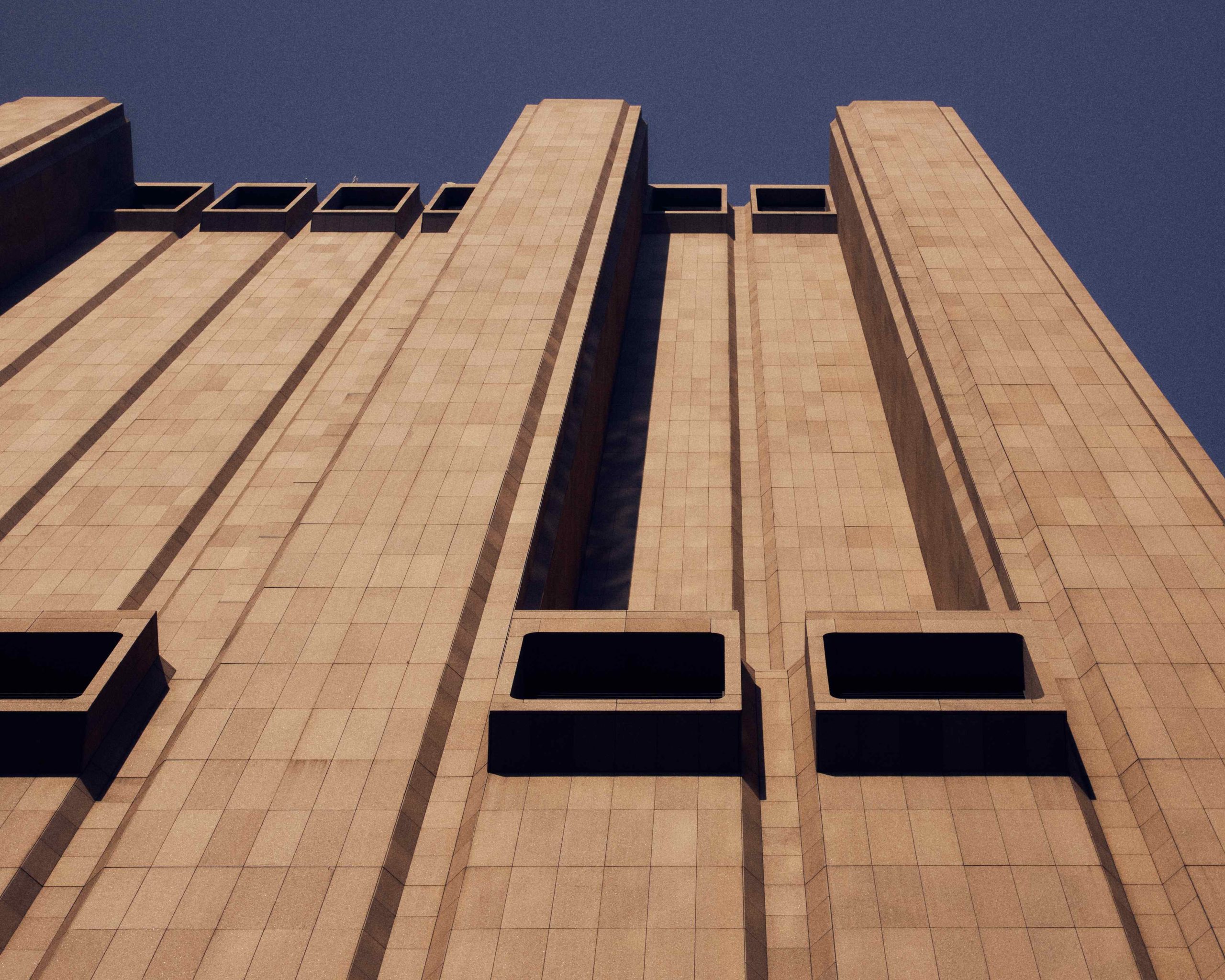
ED: The visual availability of everything all of the time led to a condition of overexposure, which led to a blindness, which has now been compensated by a new kind of hyper-sightedness. Our video Overexposed sidesteps utopic and dystopic arguments to look at glass from a postmodern perspective. In a continuous close-up pan across the facade of an iconic glass-and-steel building, the camera stops serially to describe the scene in micro-detail. Here, the tactics of secrecy are substituted by tactics of display, vision once motivated by hierarchies is replaced by a vision producing new taxonomies and inventories.
KP: If the once-democratic material of glass became a substance of surveillance and control, will new technology move to the same ends?
ED: New technologies are an extension of the modernist project — the continued promise of freedom and empowerment, the continued desire to dematerialize physical limits (like walls and bodies) for unrestricted movement, the assurance in progress, the guarantee of unrestricted vision and information. But just as the freedom promised by glass ultimately led to the question: “Whose freedom and on which side of the glass?,” the freedom promised by information technologies has raised the question: “Whose freedom and on which side of the interface?”
RS: The freedom of “choice,” guaranteed by interactive technologies, is assumed to challenge the conventions of authorship by turning the once passive subject into an active co-producer. Therefore, the control granted the subject corresponds with the control surrendered by the author. However, as all variables are scripted into interactive programs, choice becomes a kind of predetermined indeterminacy. This passive/interactive dualism, constructed by interactive media, assumes that subjects are “passive” if they are not pushing buttons and “active” even though they are playing out prescribed scripts.
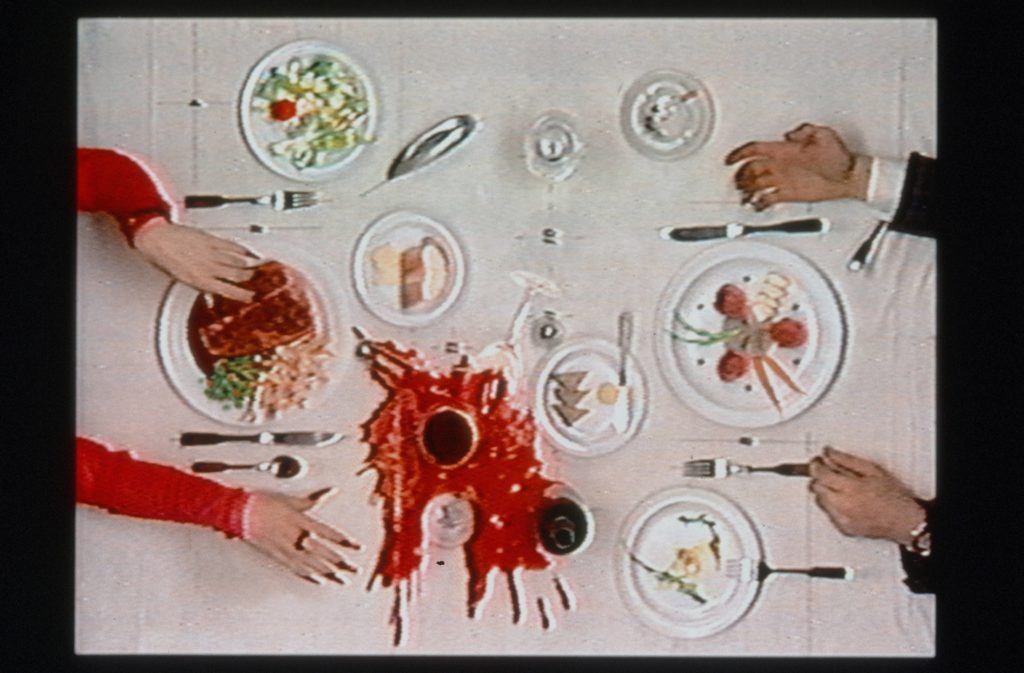
ED: “Choice” is often taken as an object in itself. In Indigestion, we tactically limited choice to foreground the denial of other choices. The interactive video features two characters of undesignated relation across a dinner table, projected onto a horizontal screen that corresponds precisely in size and shape and height to the table itself. The dialogue involves an archetypal blackmail scenario camouflaged within a repartee about food. A touch screen offers viewers a selection of replaceable characters, each a sexual and class stereotype. With any change of character and branching pathway, the narrative remains continuous though nuanced by the stereotype, emphasizing the surfaces of character construction.
RS: Indigestion was envisioned in two electronically linked modes. The second, which we will begin this year, is a virtual environment. It will offer one navigator a mobile and magnified viewpoint on top of the forensic surface of the table. Here, micro-dramas will be played out in micro-detail. The two modes — the interactive video and the virtual environment — are not intended to reinforce one another. They don’t add up. They’re “indigestible.” The subject’s critical observation of parallel representations of the same event is the subtext of the work.
KP: Is there room for a critical subject in the space of VR?
ED: In current VR literature, the subject is typically described as “entering” the virtual world, which presupposes exiting the actual one. This departure/arrival metaphor is the key to real-time, immersive environments because it sets up a fictive space distinct from the one in which it sets. The ecstasy of “disembodiment” strips the subject of identity and reinforces a separateness between the fictional “inside” and the actual “outside.” And this safeguards the distance between author and subject — the very distance the technology was originally meant to bridge. So long as the distinctions “real” and “fictive” are maintained, VR will present no real threat to the conventions of subjectivity.
RS: As I see it, the problem is that there is no accountability for actions within interactive environments. In video games, for example, if you lose, you die, you put another quarter in. The challenge for interactive art would be to offer the possibility of transgression with culpability.
ED: But maybe, because there is no culpability, VR can become the perfect vehicle for the interrogation of the everyday. The cult of disembodiment, however, would have to make way for a thinking, acting, geographically and culturally situated subject, looking at the familiar from the critical distance of semi-fictive space. There would have to be an active reciprocity between the virtual and operational worlds.
KP: Do advanced technologies a pose a threat to architecture?
RS: Architecture has to face up to the fact that it can no longer pretend to be the dominant instrument of cultural expression in the face of media technologies. Sometimes, however, architecture falsely becomes implicated as a player. Emerging technologies regularly return to the theme of “space” and its language is peppered with spatial references — electronic space, cyberspace, hyperspace, digital space, virtual space, informational space, proto-space… The concept of space is at odds with a mode that radically challenges it.
ED: Architecture often channels its techno-envy into representations of the tele-technological zeitgeist. But as architecture’s desire to represent technology intensifies, technology becomes progressively less representable. Advanced technology strives to dematerialize its hardware, to purge its object, leaving only interface and effects. An aesthetics of disappearance, however, in a discipline preeminently concerned with the visible, puts architecture at paradoxical odds with itself.
RS: Architecture simply has to come to terms with an expanded definition of technology — one in which it has always had a strong role to play. After all, is not architecture already a complex special effects technology mediating policies, economies, and social relations?