When you tell a local in New Mexico that you are headed to Los Alamos, they will remind you not to forget your passport. You will need it, they say, especially if you intend to explore the area. So, with this faintly political warning in mind, you embark on a journey through an eerie system of both control and openness.
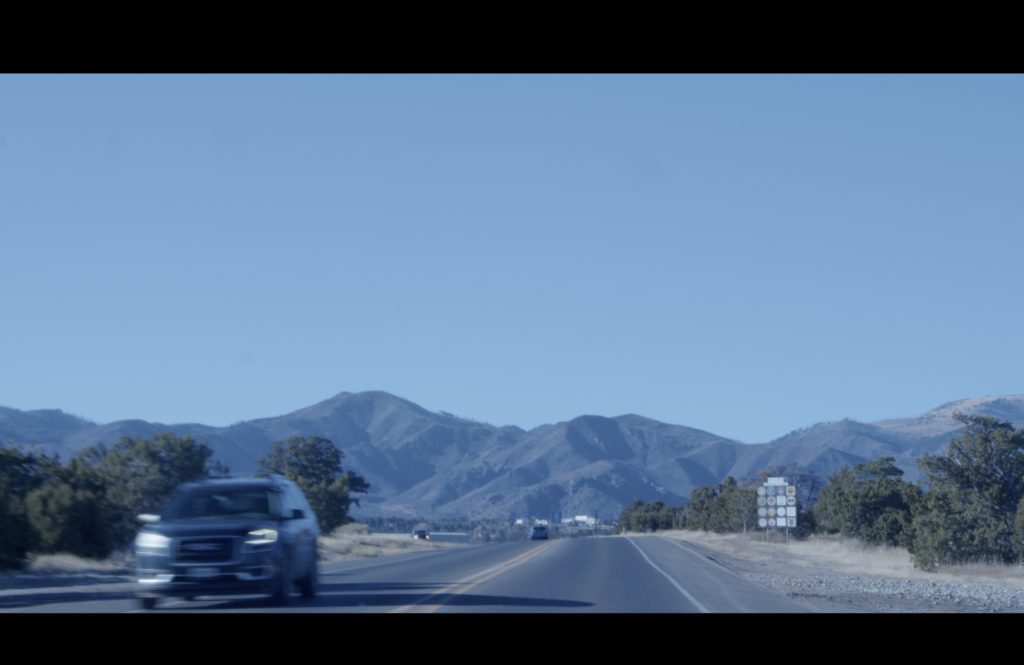
As you approach this place on a high- altitude mesa in northern New Mexico, you feel what I would describe as a low-grade self- consciousness, a sense that the town’s normality is somehow a test. You are aware that, of all secret military places in the world, this one must have had one of the most significant impacts. A handful of scientists were tucked away here from spring 1943 to late summer of 1945 to work on the Manhattan Project. Led by J. Robert Oppenheimer, the laboratory at Los Alamos (Project Y) designed and built the first atomic bombs, and in doing so established the nuclear age, perhaps unintentionally ushering the world into the conundrum we are still grappling with today.
The location of Los Alamos was chosen with the same colonial sensibility that still tends to treat vast landscapes as empty and easy to fence. New Mexico has historically been seen as a place where not much happens, Professor Christopher Mead, Emeritus Regents’ Professor of Architecture and Art History at the University of New Mexico, told me. “But precisely because of that,” he added, “so much seems to unfold in these landscapes.”
Before Project Y arrived on the Pajarito Plateau, the landscape was not empty. It was already embedded with older Indigenous geographies, with Pueblo sites across the plateau. alongside many Hispano homesteads — small family holdings established through late nineteenth- and early twentieth-century land regimes. People moved with the seasons, farming and grazing on the plateau in spring and summer and often returning to more permanent homes in the Rio Grande Valley in winter. Homesteads were among the first things to go as the site was cleared for the Manhattan Project. The Los Alamos Ranch School, founded in 1917, was closed and taken over, becoming part of the early fabric of a fenced and gated secret town.
Today, Los Alamos is “open.” The gates came down in 1957 in a moment of civic transition, when residents were told that the guarded entrances that had defined daily life since the town’s inception would be removed. I imagine that this produced a peculiar problem: the town had to learn to look normal. How do you teach visitors to read the surface while the interior remains a functioning scientific complex, structured through restricted zones, classified work, and carefully managed historical narratives?
The Bradbury Science Museum is a good place to start. It is almost aggressively ordinary. It sits on the high street as a mundane civic amenity that is neither pretentious nor seductive. As you approach the entrance, you pass a large glass window. Behind it, at full scale, sits a replica of Fat Man, the atomic bomb dropped on Nagasaki. Little Boy, the Hiroshima bomb, sits slightly hidden behind it.
Inside, two friendly volunteers greeted me. Their warmth was disarming, and it made me feel slightly ashamed of my own suspicion. One of them said something along the lines of, Welcome to Los Alamos. This is where peace was born. I smiled and thanked them sincerely, and as I walked away a strange confusion settled over me. Staring at the exhibit dedicated to high-precision timing and firing mechanisms, my nervous system was doing a kind of mental gymnastics, trying to understand what peace could possibly mean in this context.
Within weeks of the Trinity test on July 16, 1945, two bombs were dropped on Japan: on Hiroshima on August 6 and on Nagasaki on August 9. By the end of 1945, estimated deaths caused by the two objects presented in this Los Alamos shop window exceeded 200,000.
So if you hold that timeline and scale of atrocity in mind, a phrase like “peace was born here” becomes another unsettling device you encounter. Peace is clearly understood here as a technical and managerial process. It is a version of peace manufactured in Los Alamos. We are not speaking of harmony or reconciliation, but of an uneasy settlement: the regime of non- proliferation, the Cold War logic of a stalemate that keeps the world hovering near midnight on the Doomsday Clock without ever crossing it. The potential for total annihilation becomes a system designed to prevent the worst outcome. As of January 27, 2026, the Doomsday Clock is 85 seconds to midnight. This symbolic clock, used by the Bulletin of the Atomic Scientists, is a proxy for how close we are to self-inflicted global catastrophe. Peace, in that sense, is not the end of violence at all but the ongoing management of our proximity to it, an administrative achievement.
The unsettling part of entering the Bradbury Science Museum was the kindness, not the bomb. The bomb is easy to read as horror because it is already coded as such in our cultural memory. Kindness is what triggers the intellectual gymnastics. For many visitors, however, it simply suggests that they can now relax. To borrow Stanley Kubrick’s subtitle to his 1964 film Dr. Strangelove, you are invited to stop worrying and learn to love the bomb.
You become part of the unspoken agreement that this is an educational encounter, that your job is to indulge your noble curiosity. You learn the difference between uranium and plutonium bombs, triggering mechanisms, implosion types, and many other fun facts, which I will spare you on this occasion.
But there is the tint I’d like to describe. I am not speaking about concealment, but about calibrated visibility. A window, friendly staff, and lots of interactive facts produce a particular atmosphere: trust, relief, even admiration. You are allowed to see and understand. You are almost made to feel that you have entered Los Alamos National Laboratory itself.
Indeed, the narrative is not only historical. The section of the museum describing DARHT, the Dual-Axis Radiographic Hydrodynamic Test facility, is carefully designed to reassure. Sean J Patrick Carney, in his epic, ten- episode podcast series Time Zero, rejects the comforting geography in which the bomb is something that is detonated “elsewhere.” He reminds us not only that the first place to ever be nuked was the US itself, with the New Mexico test, but also that the US state of Nevada is officially the most nuked place in the world, with nine hundred and twenty-eight official detonations between 1951 and 1992.
Well, now everyone can relax because we have DARHT. Los Alamos describes it in strikingly straightforward terms: two large X-ray machines producing freeze- frame radiographs of materials imploding at extreme speed. This data is used to help ensure weapons in the stockpile are safe and effective without having to keep nuking Nevada.
The museum seemingly offers a civilized promise: We no longer need to see mushroom clouds to sustain deterrence or peace. That line, of course, is both true and deeply ideological. It is true in a technical sense and ideological in the way it instrumentalizes violence. DARHT sits several kilometers south of the museum in the mountainous landscape, unmarked unless you know what to look for on satellite imagery. So you can spend the morning in a family museum on the high street of Los Alamos, be welcomed into “peace,” while a few miles away an extraordinary diagnostic machine quietly performs its works.
Despite the eeriness of that idea, that facility fits into the peace narrative.
The proximity to similar processes is what makes the town even more eerie, especially when you remember that the laboratory spans almost forty square miles of Department of Energy-owned property, with almost nine hundred individual facilities and thirteen nuclear facilities. As you drive past neatly marked Technical Areas (TAs), you may later discover that TA-55 is the plutonium facility associated with pit production. TA-54, or Area G, is a well-known legacy waste area, while TA-53 is associated with LANSCE, a major linear accelerator complex.
The eeriness is an architectural quality of this place. Mark Fisher defines it through a particular disturbance: either something is missing where it should be, or something is operating where no operator can be found. In both cases the question is the same: who, or what, is at work here.[1] The eerie is agency without an agent. In Los Alamos, that invisible agency dominates the landscape.
There is no gloom or decay in Los Alamos. It is eerie because it is cheerful. The town offers walking tours, brochures, and heritage routes. It has a town center that behaves like a town center. You can buy coffee and move through it as if you were in any well-managed American mountain community.
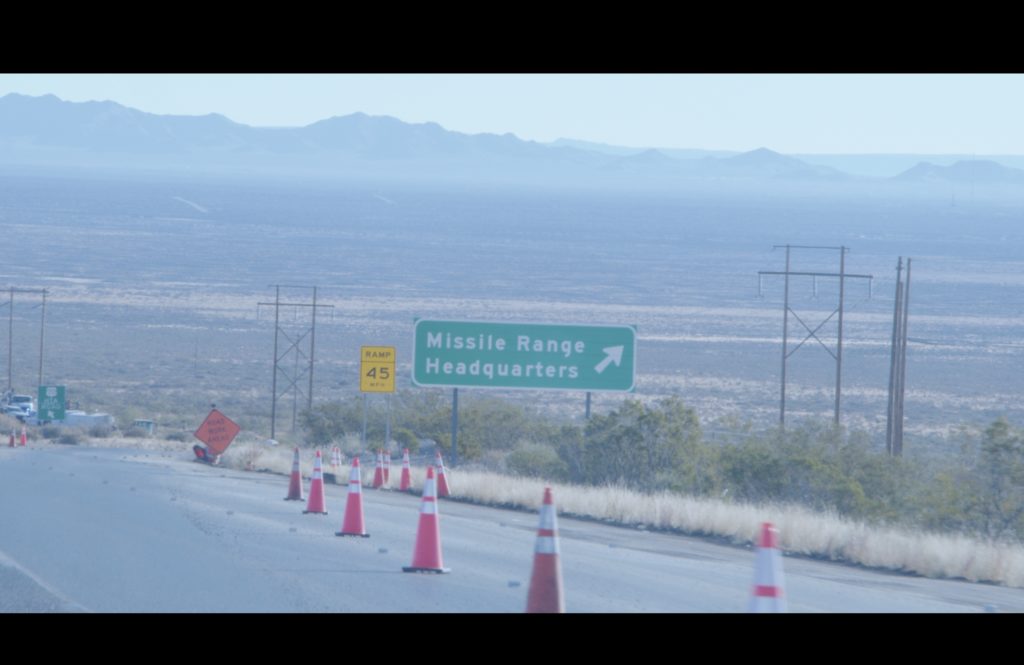
The heritage layer is part of this calm. The Hans Bethe House is a good example. It presents the Manhattan Project through the lens of domestic life. We are invited into the life of Dr. Hans Bethe, Nobel Prize winner in Physics in 1967, whose house you can walk through. It contains memorabilia that makes the Cold War feel oddly like a lifestyle — almost cool: canned food, fallout shelter signage.
Los Alamos is very Lynchian. It fits beautifully the definition given by David Foster Wallace, who described the term as referring to “a particular kind of irony where the very macabre and the very mundane combine in such a way as to reveal the former’s perpetual containment within the latter.”[2] That is what Los Alamos has perfected: a mundanity capable of containing lethality — a lethality that is proven to turn people into shadows.
But this project on the Pajarito Plateau has not only erased Hiroshima and Nagasaki. This containment of death within the everyday is also used to re-narrate the formation of the community itself.
As part of the museum exhibit, a side corner is dedicated to narrating the displacement of the original occupants of the landscape before the takeover by the military. The seemingly transparent acknowledgment reads:
“Homesteads on the Pajarito Plateau.
Of the more than 87,000 homesteaders in New Mexico, 36 families homesteaded on the Pajarito Plateau before the Army took over the land for the Manhattan Project.
Under the Homestead Act of 1862, adult US citizens could claim 160 acres of public land for a small fee. If they lived on or “improved” the land for five years, they received a patent, or legal title, and the land was theirs.”
So let’s look carefully at this small but revealing piece of propaganda. First, the numbers. The scale is collapsed — again — from 87,000 homesteaders to thirty-six families. We are not told how many individuals were in those families. We are not told what removal meant for seasonal patterns of life. Instead, we are given a ratio that renders the local story statistically trivial.
The second move uses the voice of law. The Homestead Act paragraph may look like a civics lesson, but it functions as moral mitigation. Law, of course, is often instrumentalized into injustice. Here it turns land into an entitlement granted through procedure — for a small fee. Only five years of occupation could lead to a legal title. It is not stated how long people had lived on the land before that framework existed. The law relativizes the relationship to the land while making it conditional, state-issued, temporary. Once framed in that way, the Army “taking over” appears almost procedural, a more urgent version of the same terms of reference.
Of course, this is a well-established technique of settler colonialism. A legal framework that distributes land, which later becomes the language by which dispossession appears orderly and legitimate. The panel doesn’t even need to say that the removals were necessary for a greater national purpose. It simply rearranges legitimacy.
The exhibit then moves into a story of care. You will discover that there exist laboratory archaeologists whose job is to document and safeguard history, “ensuring descendants and the public remember the stories of those who once lived here.” We even see pictures of the Hispano descendants returning as invited visitors to what is now “laboratory land.” The wound is acknowledged in a particular way that preserves the institution’s moral posture.
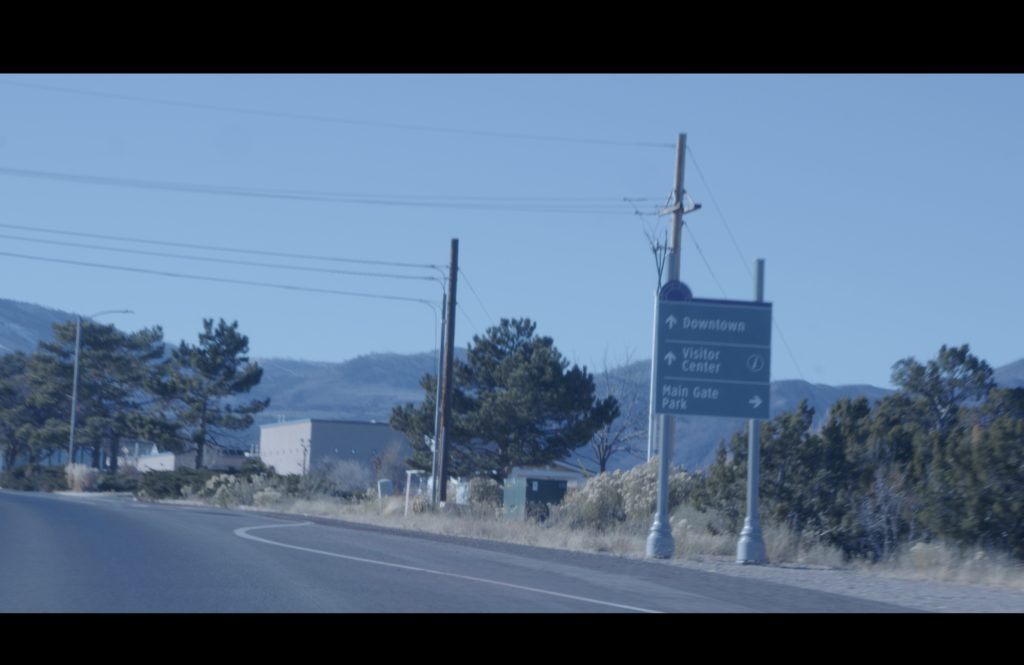
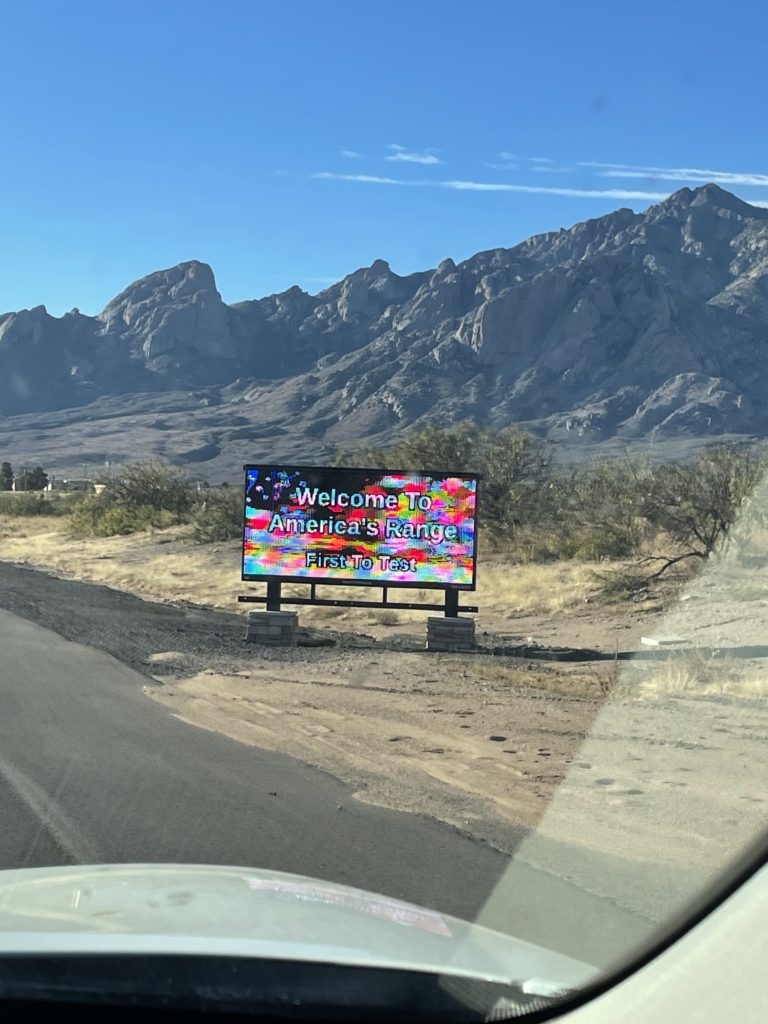
If you widen out from Los Alamos into the rest of New Mexico, the emptiness myth underpinning the entire region becomes harder to ignore. If you drive to White Sands in southern New Mexico, you encounter the access logic of an active missile range, where even the museum operates the town’s authority. As you approach the town, road signs proudly declare: “Welcome to America’s Range. First to Test.” When you arrive at a gate, it turns out that the museum is closed that day due to an “unforeseen family emergency.” No external visitors are allowed into the town until tomorrow. Transparency suddenly feels negotiable.
As you drive back to Albuquerque and decide to stop by the Trinity site road marker, your attention may be drawn to a new one installed in 2025. This open acknowledgement of downwinders challenges the older narrative that the test occurred in an empty site where no one lived.
But knowledge does not absolve us of responsibility.
One repeated myth claims that Los Alamos has the most PhDs per capita anywhere in the world. The town’s knowledge density is part of the same story. Despite that specific fact being hard to confirm, Los Alamos County’s educational attainment really is extreme, with Census QuickFacts reporting 69.7% of adults twenty-five and over holding a bachelor’s degree or higher between 2020 and 2024.
It is tempting to treat that as civic virtue, and the town’s self-story often leans on intelligence as kind of moral cover, subtly suggesting that this is serious work carried out by serious people. But the authority of expertise is also a classic institutional mechanism. Museums deploy it constantly. What Michel Foucault called power- knowledge allows institutions to narrate history in particular ways.
Institutions rarely need to lie. They need to select, arrange, sequence, and set the emotional temperature of the space. Once the emotional key is set, visitors begin to do the rest of the work themselves, smoothing contradictions and accepting the frame.
Beyond the museum and the heritage layer, Los Alamos National Laboratory remains a major national security institution with continuing weapons programs and expansions. The Government Accountability Office has criticized the National Nuclear Security Administration’s plans for re-establishing and scaling plutonium pit production, citing weaknesses in cost and schedule planning, with Los Alamos positioned as a central site in those efforts.
Environmental questions also remain. An independent review of the chromium remediation system in Mortandad Canyon documents ongoing disputes and a long timeline of groundwater contamination management. Area G, the legacy waste zone at TA-54, is described in Department of Energy material as a site for storing, characterizing, and remediating legacy waste before shipment off-site. The language sounds harmlessly bureaucratic until you remember what kind of waste is involved.
If we zoom out again, we return to peace as a carefully narrated surface, with dread operating underneath it, administered through a kind of tint.
On February 5, 2026, the New START treaty expired, removing the last legally binding limits on US and Russian strategic nuclear forces. Whatever one’s position on deterrence or arms control may be, the expiry itself reveals how fragile the formal architecture of restraint and “stability” is.
In that context, the volunteer’s line about peace becomes even more revealing, because peace is not a settled condition in the world that Los Alamos helped build. Peace is a regime: a series of negotiated limits and managed perceptions, supported by institutions, treaties, and technologies of seeing.
I was about to leave the museum when I encountered perhaps the most striking exhibit. A screen with a small wheel adjacent to it. As you turn the wheel you scrub through footage of nuclear explosions, frame by frame, speeding up and slowing down mushroom clouds as if editing a film.
Trinity, underwater tests, underground tests. The cloud becomes a visual object you can manipulate. It is mesmerizing and addictive. I watched others play the wheel too, kids, students, and older ladies. Our attention is captured by what feels like editorial control over apocalypse.
You can reverse the cloud. You can pause it. You can spin the wheel and run through twenty clouds in one second.
So when the volunteers suggested that peace was born here, it was not a provocation but a clue. It signaled an entire method of reframing, a tint applied to a transparent surface: make the violence legible as image, teach it as mechanism, describe it as responsibility, and allow everything else to recede into the categories of history, externalities, or unfortunate complexity.
Los Alamos is, of course, just a fascinating example of how many institutions operate. The gates are open and the entry is free, and when you leave you feel as if you have discovered something.
Then you realize that seeing was part of the arrangement. You were allowed to slow down the cloud, but not really to follow where it went.
Apocalypse became content.
[1] Mark Fisher, The Weird and the Eerie (London: Repeater Books, 2016).
[2] David Foster Wallace, “David Lynch: His Next Sick Flick,” Premiere Magazine, September 1996.