On the radio recently, I heard news of an Israeli bombing of an apartment building in Beirut that killed everyone inside. One man had been at the bomb site for days waiting for any sign of his sister until, at last, a disembodied hand was found amid the rubble. Desperate for answers, and to stave off the dark prospect of never knowing, the man set about determining if the hand was his sibling’s.
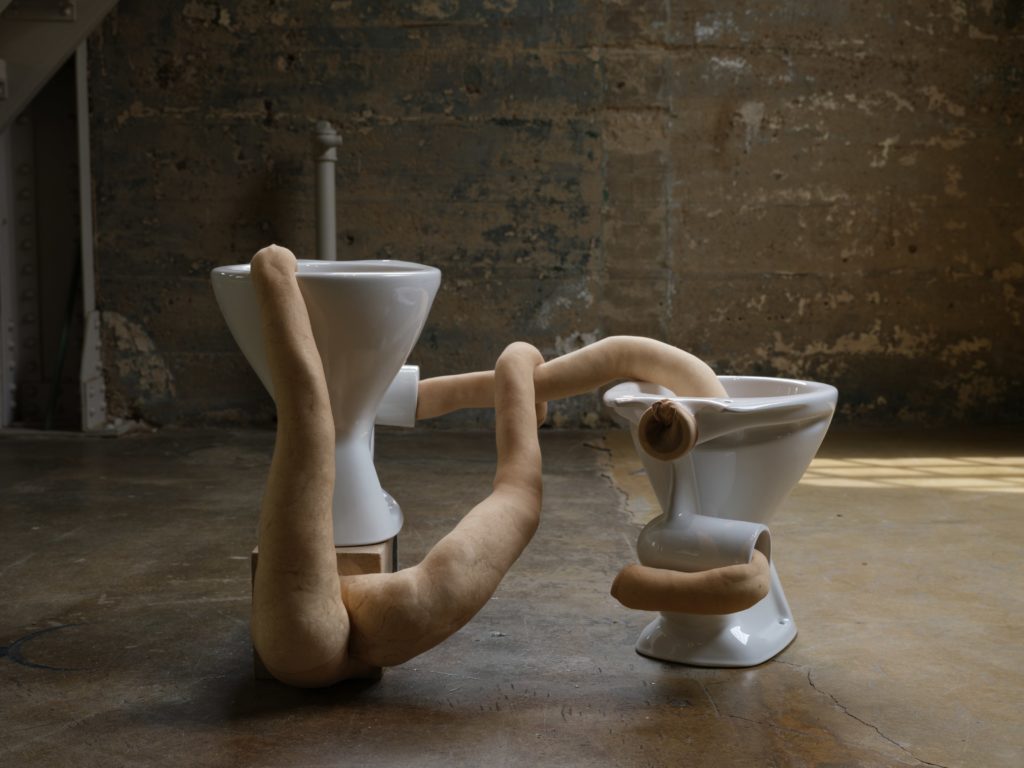
The unidentified hand came to mind when I made my way through “Body Fragment,” an elegiac group show at The Power Station in Dallas. Curated by the art space’s longtime artistic director, Rob Teeters, the exhibition takes cues from current global events like that in Beirut and brings together ancient figurative artifacts alongside works by contemporary artists to consider the historical and ever-current artistic motif of the body in pieces.
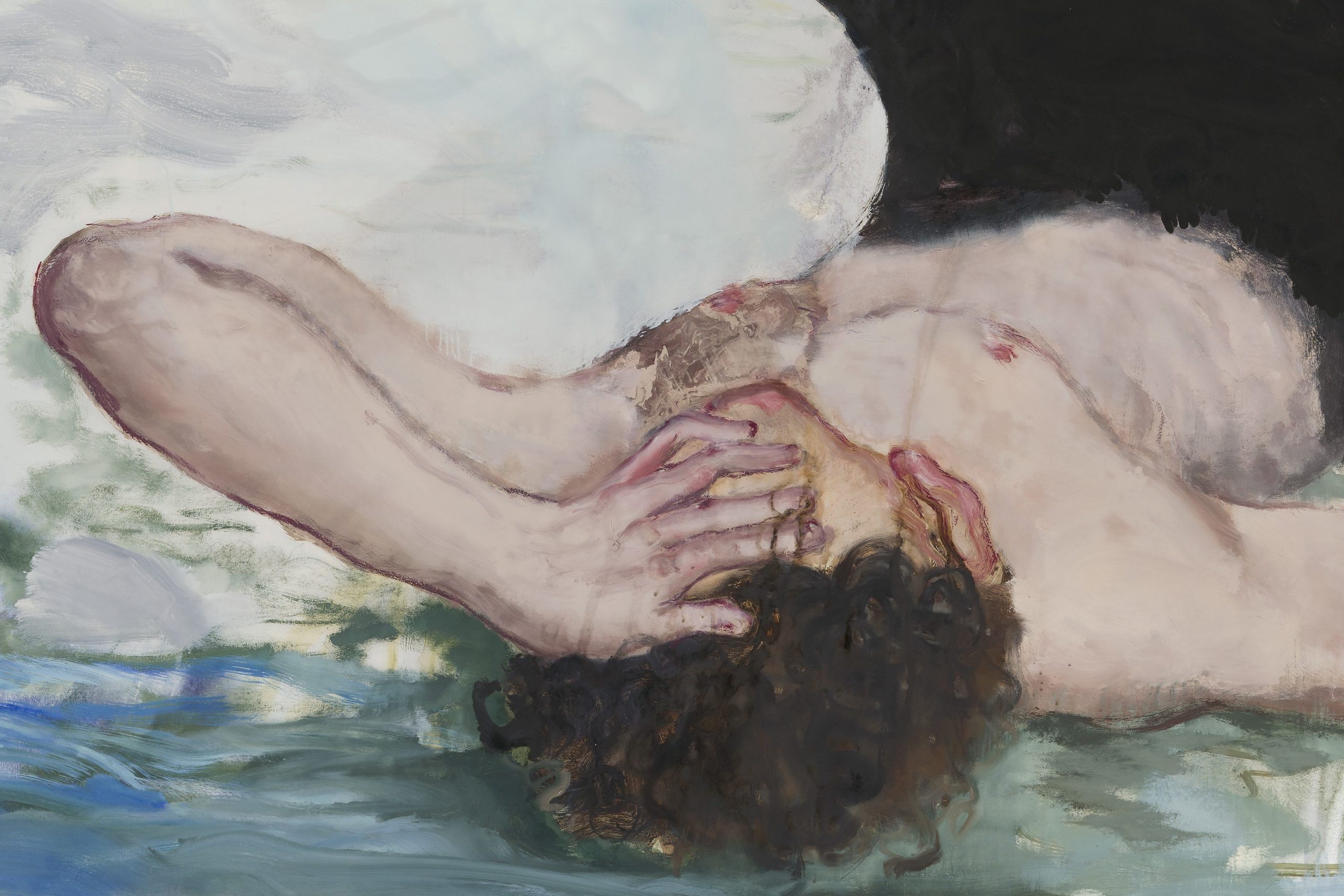
A quote from critic Linda Nochlin serves as an epigraph for the show, indicating a defining trait of modernity as fragmentation: “a loss of wholeness, a shattering of connection.” Joan Semmel’s painting Blue Back (1973), then, depicting a couple in the act of making love, is a surprise magnet on the far back wall. The majority of the picture is made up of a man’s back, with a glimpse of a woman’s knee making space for him between her unseen legs. Her hand is gripped between his buttocks, pulling him into her. Though an act of clear connection, the man’s body is an ice-cold blue, like one pulled from the freezer after weeks in the morgue, casting a ghostly pall over the erotic scene. One imagines the fantasized reunions of so many war widows and widowers. The aching left-behind.
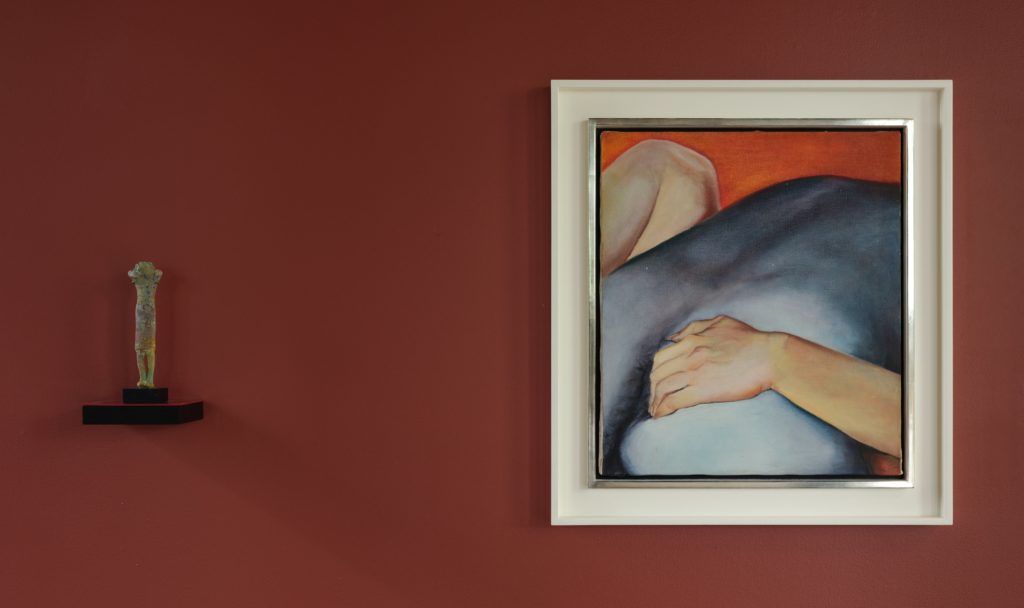
Nearby on a burnt-red wall, a small pencil drawing by nineteenth-century French painter Eugène Delacroix shows two views of the flayed muscles of a dead man. In one sketch, Delacroix has worked the cadaver into a posture of exhaustion and worry; the figure is prone on his back, with one hand clutched upon his forehead and the other a tight fist upon his chest. The muscles are flexed, telling the story of the dead man’s strife. On a small ledge between the Semmel and the Delacroix stands a small, three-thousand- year-old headless bronze figure, patinated green and making one wonder if the figure lost its head somehow in the millennia since it was made or if it was made to commemorate a head-losing death. Such are the pregnant ambiguities of fragments, in any age.
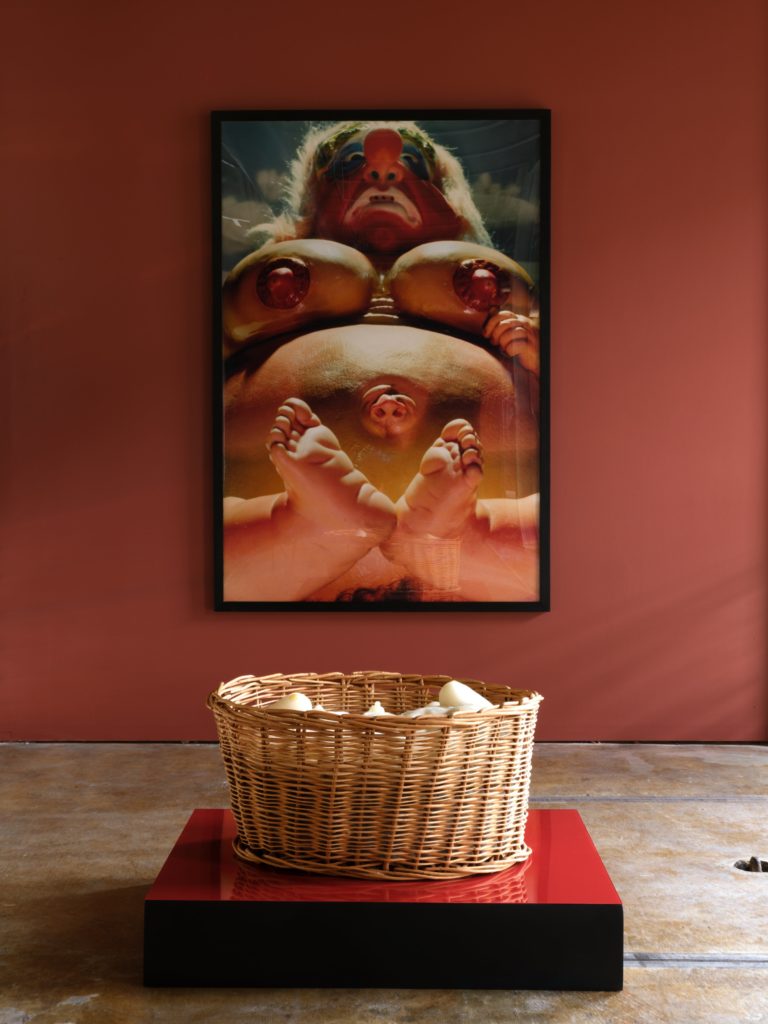
A cartoonish painting, Dead Soldier (2016), by Calvin Marcus of a uniformed figure punctured with bullet holes and surrounded by blood, his face contorted in a demonic grimace, underscores the implicit political violence in many of the works in “Body Fragment,” as does a gory Cindy Sherman photograph of a swollen pregnant body, another political arena, with the belly button protruding like a pig’s snout. At her feet is a basket carrying an ambiguous, pallid, and hairy form by Robert Gober that has a drain for a belly button.
A tremendous, complex piece by Mark Manders, Continuous Living Room Scene – Assignment – Chair (2007–08), occupies the right side of the lower level. In it, two of Manders’s signature nude, flat, gray- painted figures stand precariously atop separate rusty beams, each figure divided top-to-bottom by wooden planks. Beneath the beams, a thick plate covered in brass slopes in three descending diagonal planes, like some ancient topography, over which the nude figures rule, protect, or stand as sacrifice, the latter option suggested by the human hair that dangles against the floor from the back of the enormous configuration.
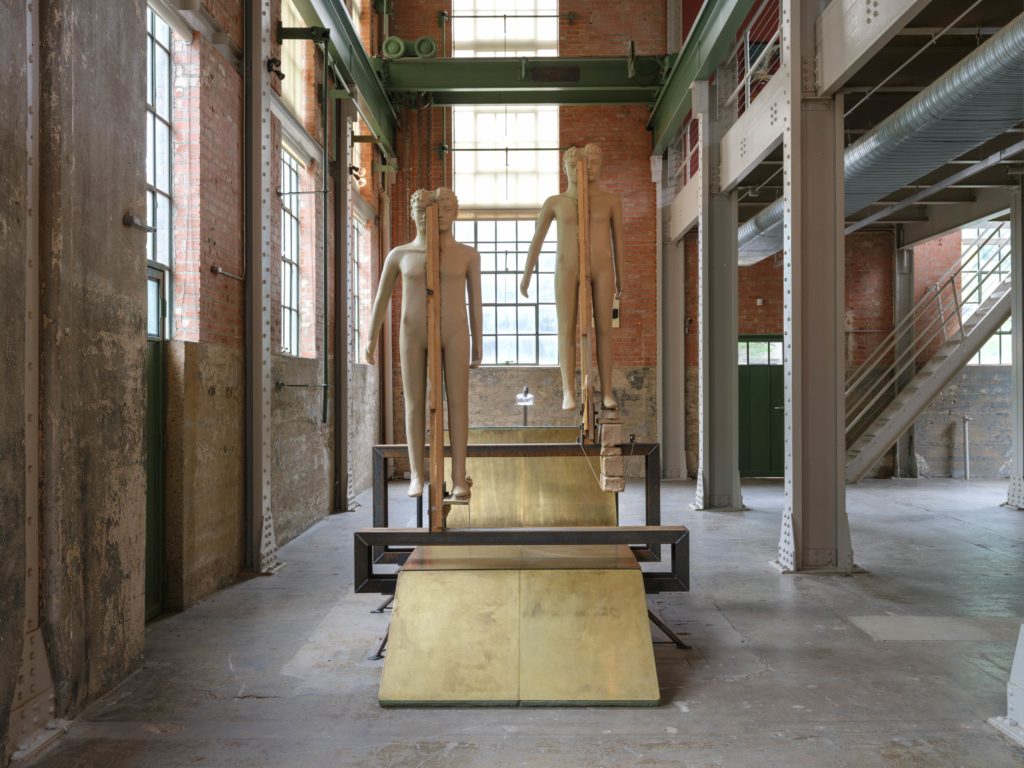
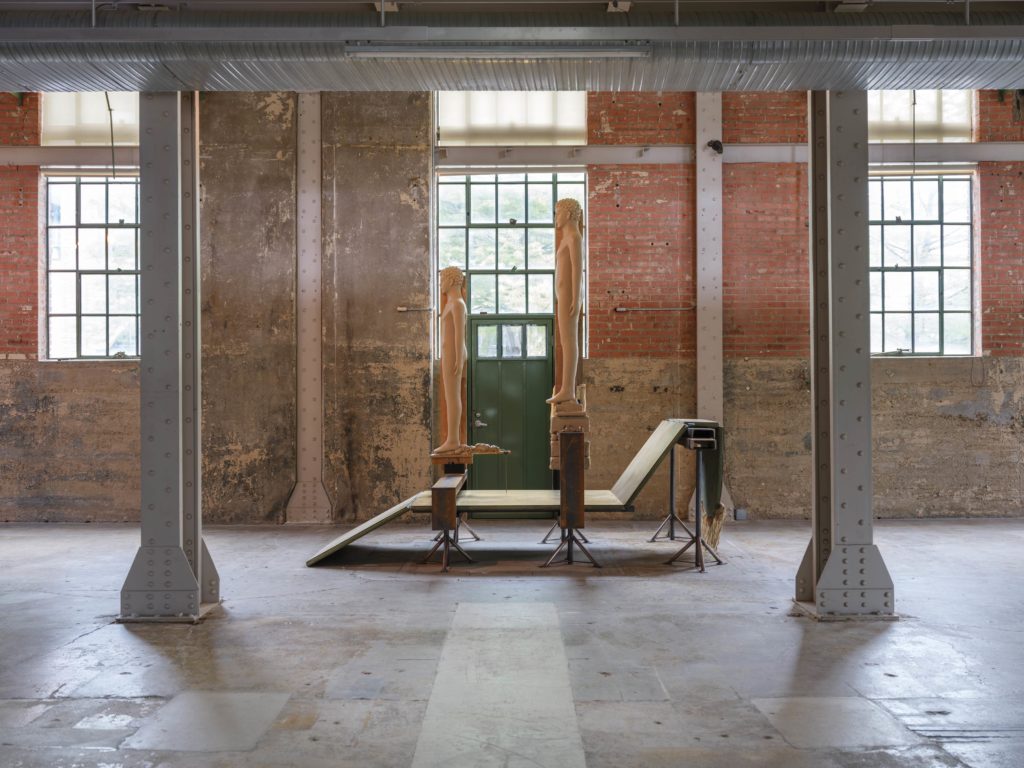
As much as this glorious Manders work recalls some ancient age of gilded might — Tenochtitlan, perhaps — it also conjures the not-so- distant age of ambitious, outsized sculptural practice that defined the art of the early 2000s and teens, a mode that now seems decadent and impossible for most artists and nonprofit art spaces like this one, as real estate, materials, and shipping costs have skyrocketed in the last decade, shrinking the scale of new work’s possibility, everything a symptom of global upheaval and failing systems.
“Body Fragment” as a whole points to those failing systems; it is actually the second group show in short order at The Power Station that brings artworks together under a theme, borrowed from private collections or on loan from galleries, a departure from the space’s previous program of large-scale, extraordinarily innovative solo exhibitions of new work. This show is culled from notable private Dallas collections, a tactic of making- do-and-getting-by to which many art spaces are resorting — no material costs, nominal shipping, but high quality work to show. So while “Body Fragment” is a beautiful, mournful acknowledgment of the fraught political and socio-economic state of the world, it also tacitly describes a contraction of new frontiers for artists and art institutions — a breaking down of curatorial and programmatic vision into more manageable parts.
“Body Fragment” is a dirge for the lives and dreams that have been or will be lost — by war and political violence, certainly, but also by the savagery of socio-economic systems that, in the wake of such turmoil and greed, diminish opportunity, curtail the ascent of talent, or adversely regulate the scale of artistic imagination, the very thing that defines civilization. Optimistically, though, like every fragment, a small piece encourages one to imagine things whole and complete — bodies, minds, and culture — as full, healthy, and alive again.