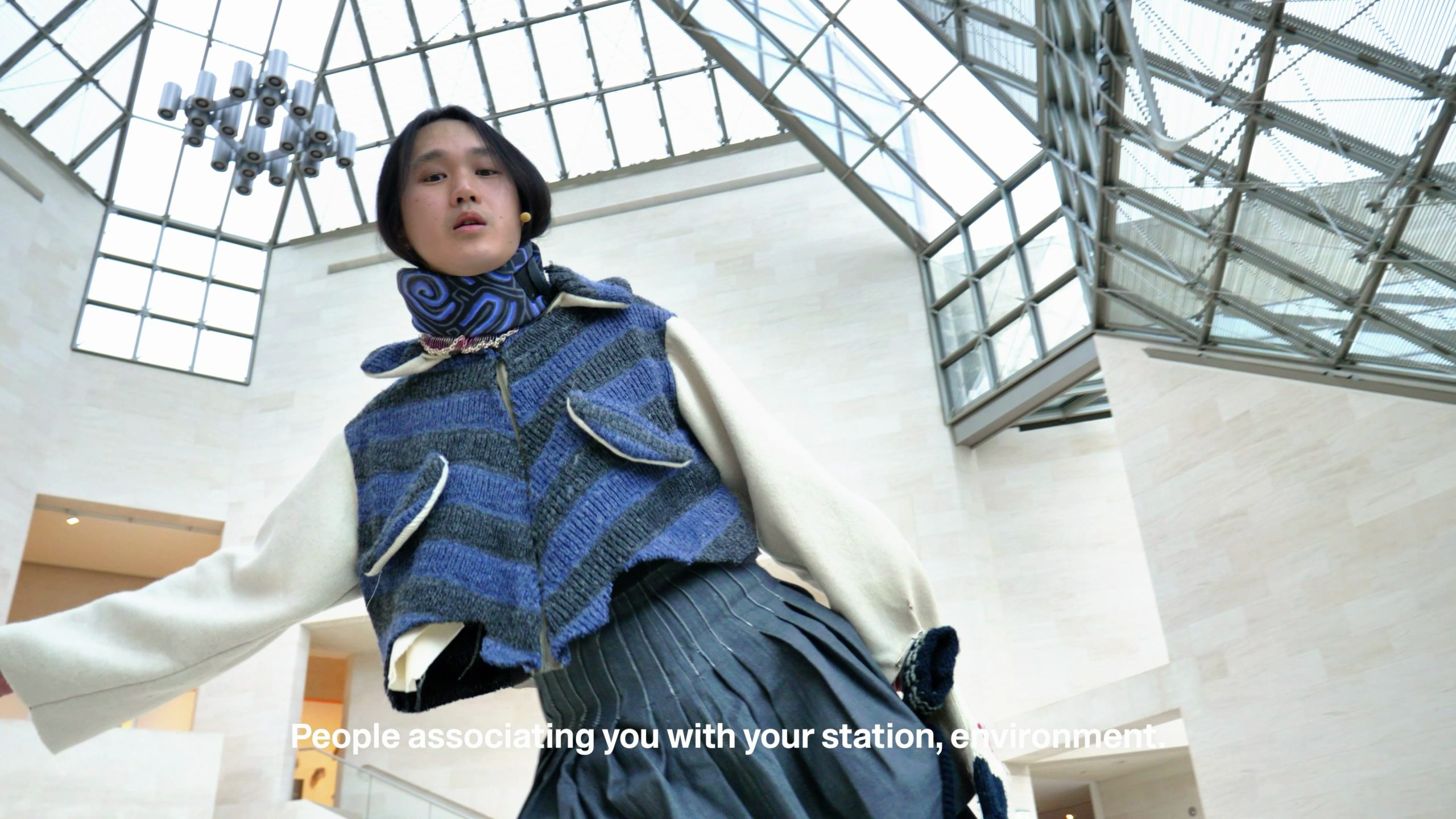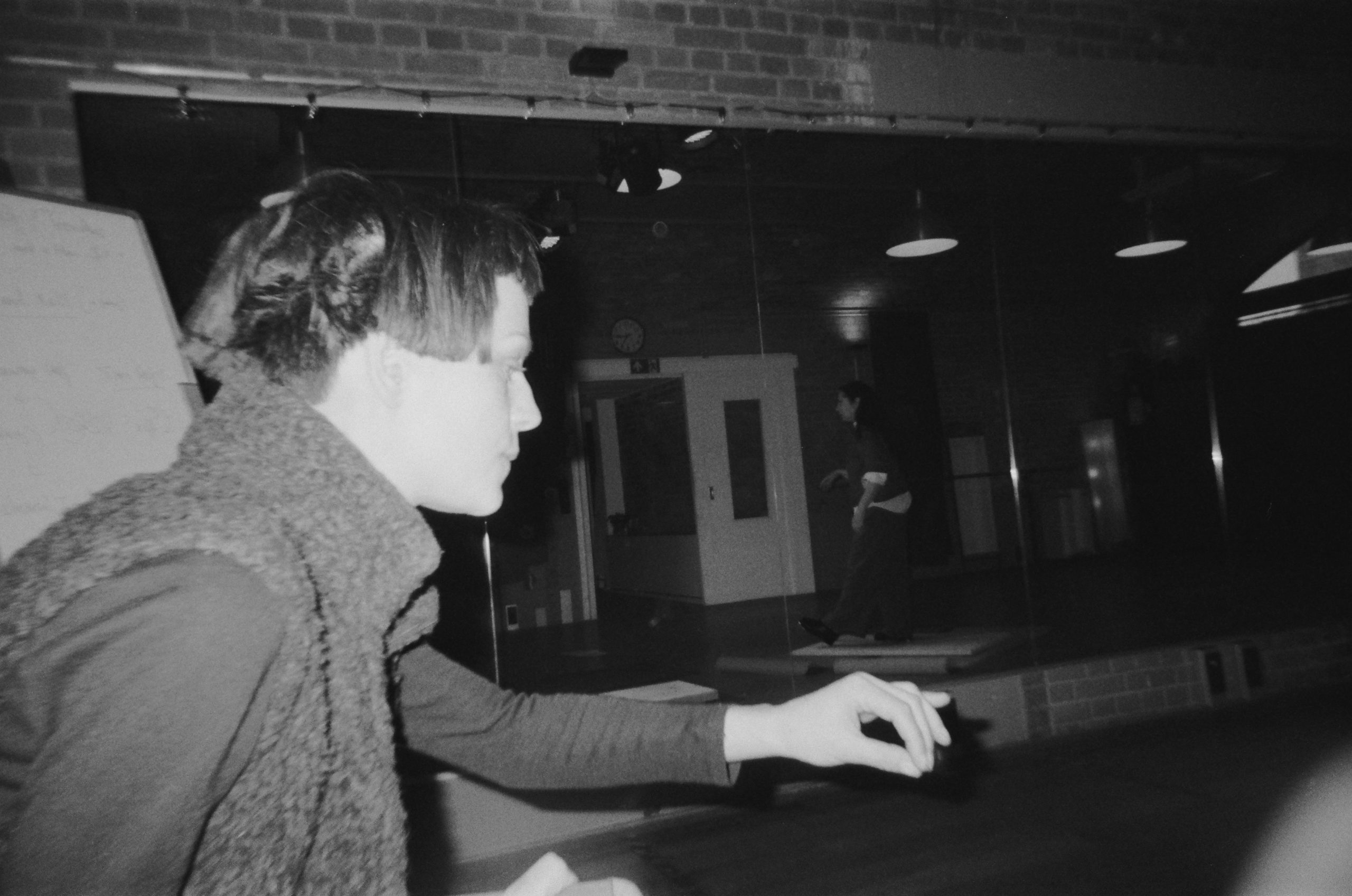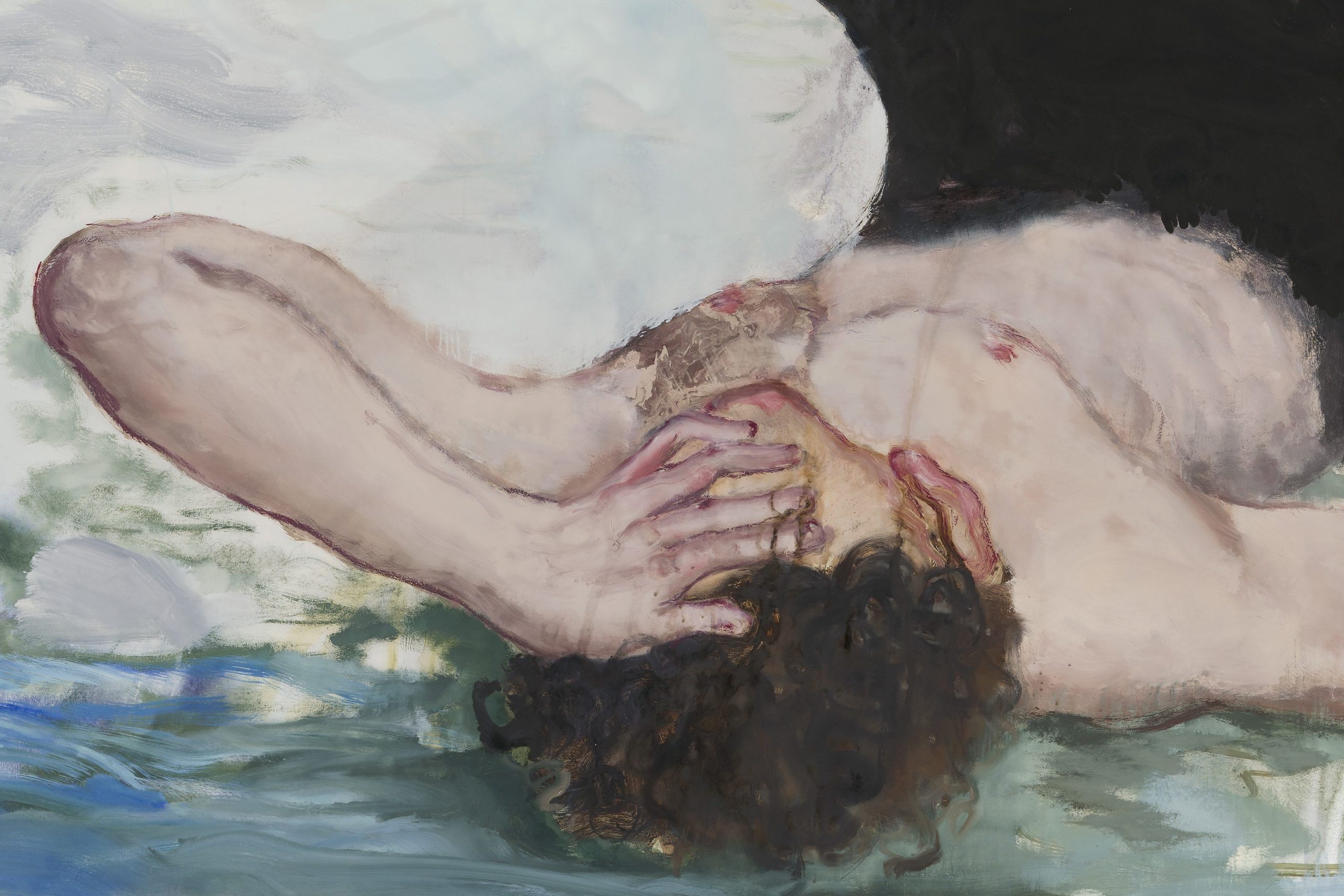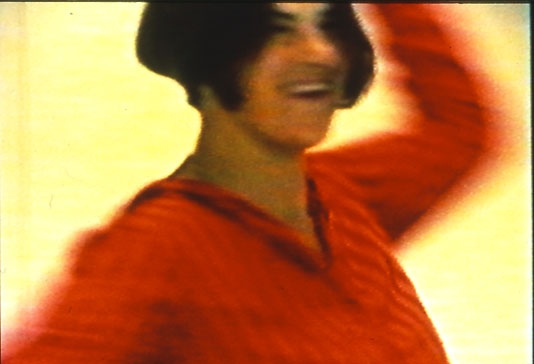
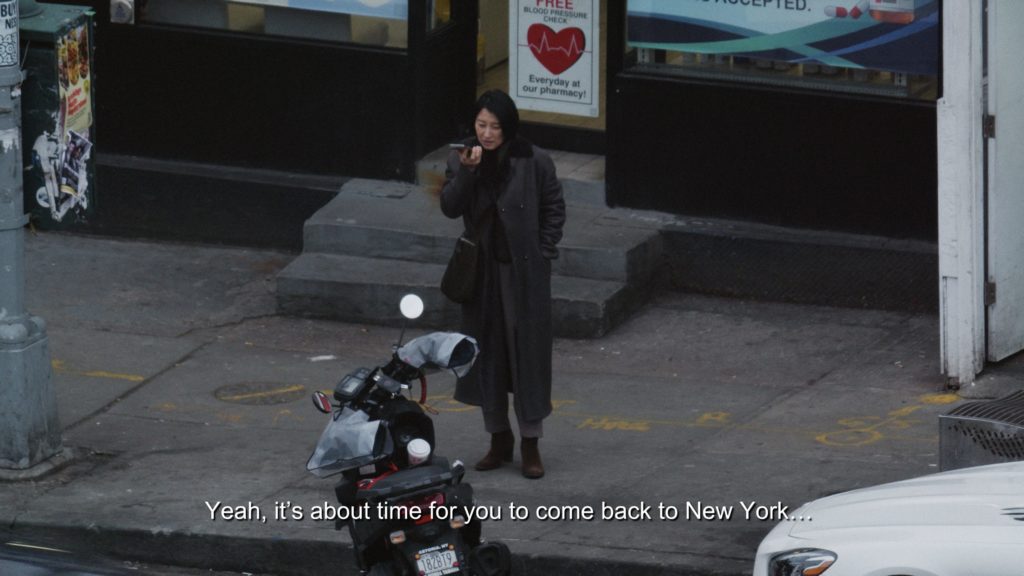
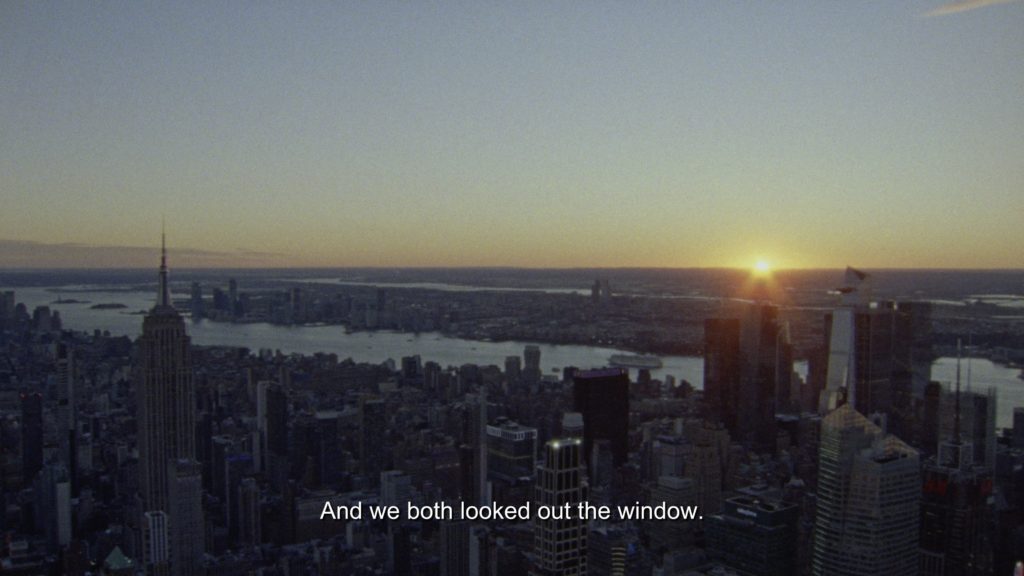
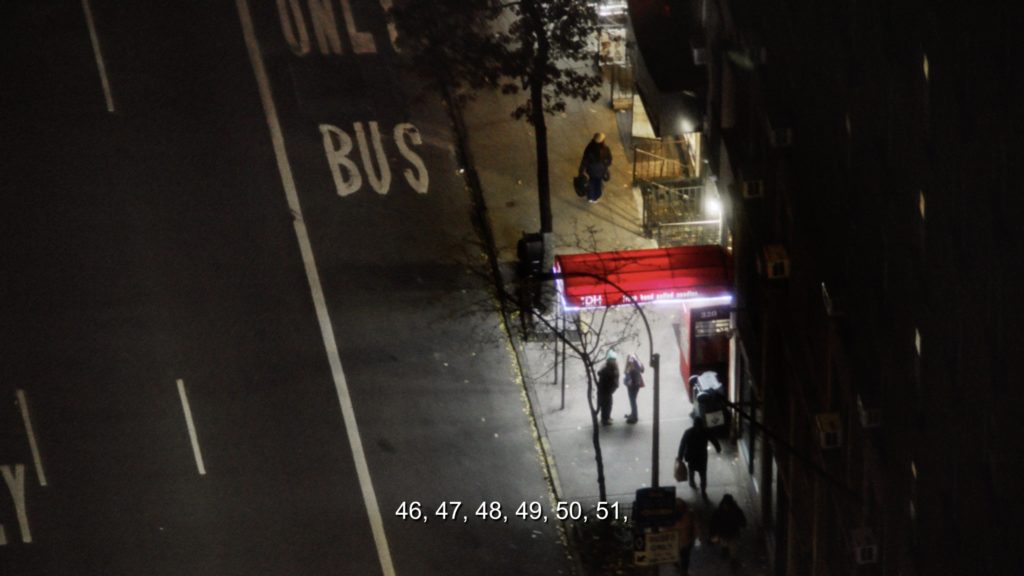
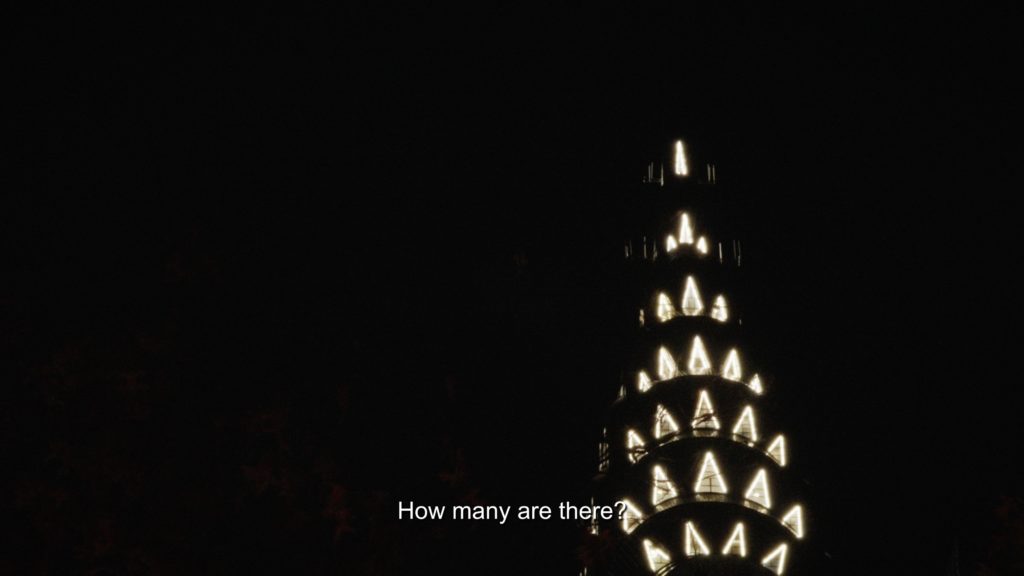
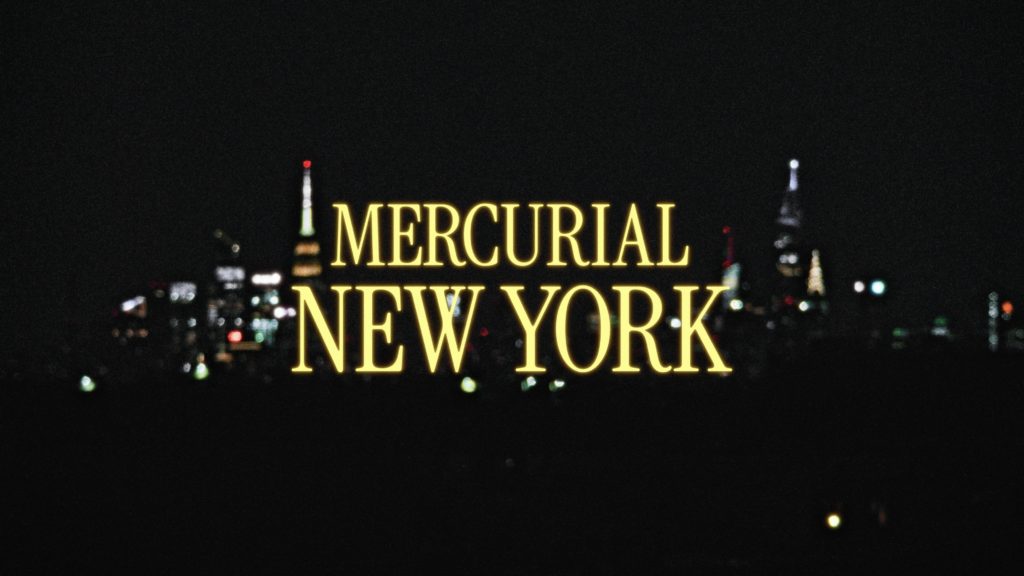
Rose Salane’s newly commissioned film Mercurial New York (2026), debuting at the 61st Venice Biennale, “In Minor Keys,” curated by the late Koyo Kouoh, asks us to consider the city and its inhabitants as a hypnotic symphony comprised of our shared relationships to memory, love, and time. Spanning the course of one day in New York, Salane constructs seemingly impossible voyeuristic perspectives of couples conversing in public in sixteen different languages. We peer into these lives long enough to recognize something familiar. In the opening scene, the camera is a static eyeball in the pavement looking up at an opera singer as she intones Ave Maria. The camera lens catches a coin from a passerby as if it were positioned inside a tip bucket. Throughout the film, the camera’s gaze looks across long distances, peeks into subway cars and parked car windows, and hovers through sidewalk scaffoldings. One long-distance shot follows two friends as they cross the Brooklyn Bridge. In another scene, the camera sits atop the Chrysler Building and slowly tilts down to highlight two high school girls counting the triangles that make up the building’s peak from blocks away. The viewer is always left wondering where the camera is.
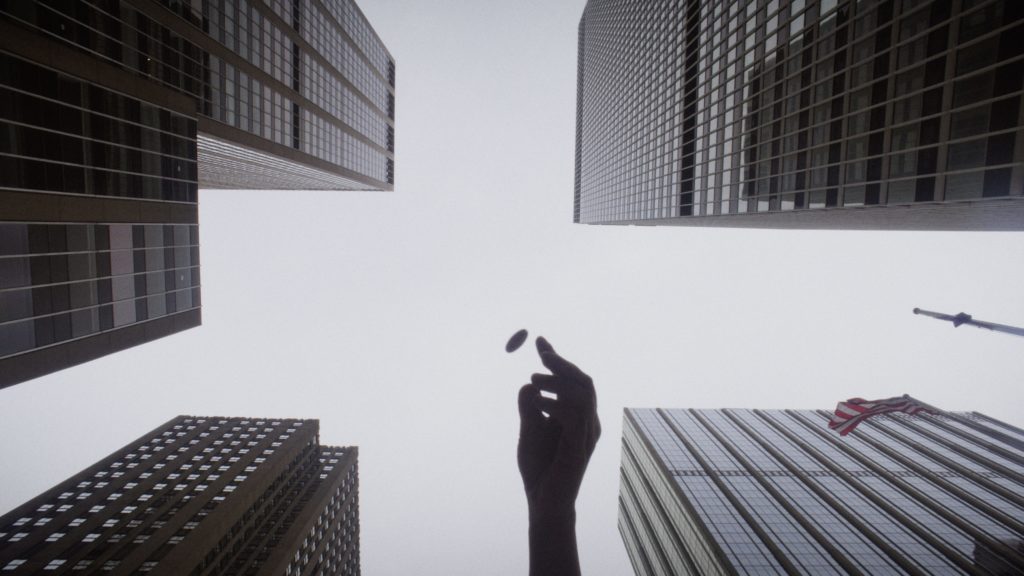
Chiara Siravo: In Mercurial New York, the viewer is inevitably shaped by New York City’s imposing spiritedness — a public yet intimate affair. Can you speak about your intentions behind closeness and distance in the film?
Rose Salane: I wanted to highlight that New York City exists omnidirectionally. Its power is held through its continuously personified activity, from office buildings that populate the skyline to ground-level transactions and the subterranean tunnels of its transit system. Each of these levels is composed of people, their movements, their labor, and their perspectives. For a year before we started filming, I would sketch out the film by taking notice of the conversations people were having while commuting. I paid close attention to all the activity surrounding them, from the moment I was observing them to when I lost sight of them. I wanted to relay the speed of the public in motion by making these fleeting fragments of overheard conversations audible and to show them through different vantage points, for example through overlapping train-car windows or from rooftops looking onto crowds at street level. A huge part of New York’s identity is its linguistic landscape. To capture the soul of the city I knew I had to include the many languages spoken in New York. I ended up creating a focused collection of encounters that I observed in public. I wanted to use cinema to help hold their synchronicity and serendipity.
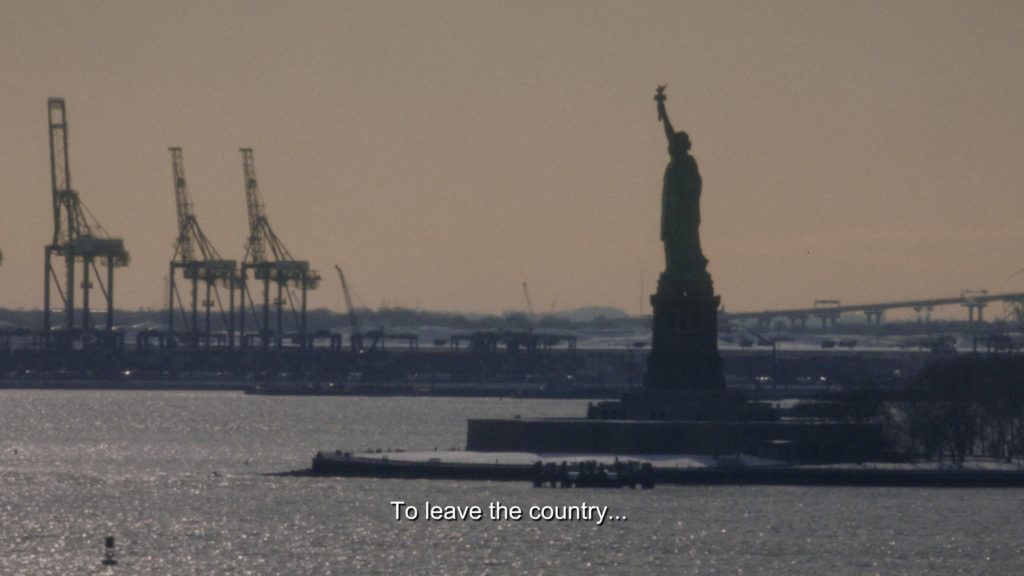
CS: This work, to me, shows the bigger picture of what you have always done in your urban archaeological practice. It’s as if with this work you went from collecting and isolating lost or discarded or dismissed objects to collecting shots, editing and arranging them to form a conceptual narrative just like you did with Panorama 94 (2019) and 64,000 Attempts at Circulation (2022). Has anything changed in your way of zooming in on overlooked power structures? Or on a familiar form of anonymity, which in the end is always about humans?
RS: Yes, definitely. I often find myself working with groups of objects that have come together through disparate forces. I call these collections “dynamic sets of object accumulations” because I’m interested in how loss, removal, repatriation, or donation cause objects to reappear in new environments. I found the repetition of loss and gain compelling in the group of lost rings that were found on the NYC subway and the invalid currency used by commuters to pay for bus fare in 64,000 Attempts at Circulation. Each “collection” was purchased at a public auction from the Metropolitan Transit Authority — another way of uncovering subjectivity from bureaucracy by engaging in a financial transaction. For Mercurial New York I wanted to work with a different vantage point, not from the objects’ description of a place but from the perspective of people and how they come to embody the many places they have lived in. Staging such intimate conversations in public with people felt like a complete change in the way I work with subjectivity. The dialogue in Mercurial New York is all improvisational. I would start out by asking people what is going on in their lives and about their time living in New York. This quickly led to conversations about sickness, health, children, love, birth, and mortality. I began to build the narrative for the film by collecting these stories in as many languages I could cast into the film. In the end, we have sixteen languages. The cast is a mix of friends, friends of friends, family, people I found on Craigslist, and local theater groups like the New York Deaf Theatre. I didn’t necessarily want actors; I was interested in casting everyday people that were open to speaking about their lives on camera. Through this film I somehow assembled another archive that emphasizes the many lives that the city hosts.
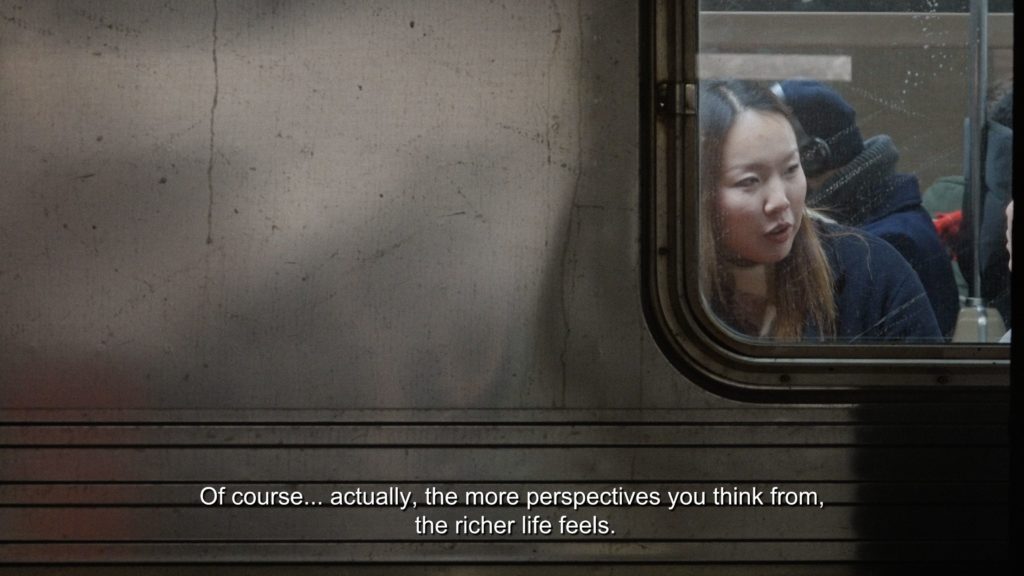
CS: In the works mentioned above, the project forms were somewhat dictated by what makes up the city, like what personal items they lose or what signs they produce within a system. In Mercurial New York you seem to have more agency as a “visual artist” because you are pretty much composing the images from scratch: rather than found, they are constructed — even though they originate in observation. How did this control over form feel in relation to the readymade / recontextualized part of your art practice?
RS: I learned so much about the possibilities in film and the impossibility of trying to control all the elements when we went out to film. Patience was the key, as was the trust placed in the film by my amazing team: Carlos Cardona, Justin Gold, Zach Bishop, Kirsten Nicholas, Oliva Strawn, Felipe Oliveira, Owen Smith-Clark, and Devlin Claro. Film is a new medium for me, and I used it like a telescope to peer into personal histories across New York and spin a spiderweb of kinetic viewpoints. Once I understood the visual rhythm required to open and close each shot, it felt like we were really tapping into something interesting. The actual filming consisted of a mix of guerrilla filming, using access to rooftops, buildings, and views that were sometimes kindly granted, while others involved gentle trespassing. I felt like I was always fighting to see my city in a certain way and pushing past so much bureaucracy to get the shots. However, this made the film even more thrilling to make and I was able to take this on because I know how to run across New York too well 🙂
CS: I remember we spoke before you set out to make this film, following the invitation to take part in “In Minor Keys,” soon after the announcement of Koyo Kouoh’s passing. You knew you wanted to make your first moving- image work, zooming in or eavesdropping on those things you might catch a fragmented glimpse of while moving through the city: a transaction, an economy (in the widest possible sense of the word). Can you tell me more about how the film evolved from there and became about personifying New York? How did you move from transactions of goods for money to reciprocity in the form of language as a driving force of a place or an economy?
RS: Before I knew what direction Mercurial New York would take, I would go film without a plan with a friend and collaborator, Devlin Claro. We would stand in one place in a busy area of the city, 34th street for example. On Valentine’s day we stayed out for an afternoon and documented countless transactions taking place on the street. We captured people buying gifts, writing letters in Grand Central, and embracing loved ones. I would ask people if it was okay to film them and here is where I began to understand the relationship to the camera’s presence. I wanted to try long zoom lenses and film these interactions from afar because the camera would not be as intimidating. This also made me realize that I could orchestrate contact amid the constant flow of the public’s movement. I still questioned how staged conversations could have a place within this visual. It was when I started to connect with the people I cast that I realized the fragments of overheard narrative would be best unscripted, if they were simply soundbites of what people were really dealing with in their lives living in New York.
I began working on the film after the announcement of Kouoh’s passing from cancer in May 2025. I knew that showing at this biennale would be significantly tender. But I also felt prepared. Having had an experience with cancer myself, I put all of this energy into the making of the work, which felt like the ultimate driving force. Mercurial New York was really driven by Kouoh and her Biennale. It probably would’ve taken me years to make it otherwise.
CS: Philosopher and anthropologist Ernesto de Martino thought that twentieth- century human existence was suspended between the fear of being lost in the world and the fear of losing the world itself.[1] And so everything we do, believe in, our rituals, everything we make, or make of things, addresses this angst in some way or another. Everything you record, collect, or even leave out as an artist feels like a form of orientation within this suspended state. How does this play out within a planned space like a city? But I also wonder how this also relates to one of the central themes of Mercurial New York, which is that the latter is an immigrant city, a place of displacement (loss of presence/self) and self-rediscovery (reorientation) within a new social fabric.
RS: I love this definition of existence as suspension — that it is a balance of the fundamental human desire to belong, to not be stripped of the inherent definition of oneself, and the need to be able to relate to one’s environment. This is a complicated feeling to navigate but that’s why I work with New York as a site where the performativity of culture manages to prevail. The negotiations that are required when one seeks to assimilate to a place happen through language, labor, and displacement. There is ultimately a loss of self and a development of community and therefore belonging. I saw these challenges in my experience growing up in New York with one parent who immigrated to the United States and another who was born in the US. Their experiences of opportunity and stability were of course not the same. But what makes cities like New York attractive are how the relationships to belonging are constantly redefined by strong diversity in its communities. Approximately eight hundred languages are spoken across NYC. It’s a radical idea that a city could host an opportunity for all of these cultures to share their identities, ultimately redefining New York itself. However, the cost of living and the struggle for immigration opportunities create a crisis in how we engage with belonging. I wanted to highlight these obstacles within Mercurial New York and the inclusion of sixteen languages begins to share these perspectives.
CS: In the Giardini exhibition, your work Summer 2006, American Stock Exchange, 86 Trinity Place (2022) consists of a screen print on archival paper of logbook notes taken by stock exchange maintenance workers in 2006. What I find interesting about this work, once again, is the scale — a small logbook made monumental. Can you explain more about it? Also, I love that it was placed next to Duchamp’s Box in a Valise (1935–41), a self-contained universe where he used the format of a box to enclose miniature replicas of his works. Is your box New York?
RS: This work was made from discarded documentation, found at the former American Stock Exchange on 86 Trinity Place in New York City, about the building’s heating, ventilation and air conditioning (HVAC) regulation during the summer of 2006. I created a screen print organizing the loose pieces of handwritten maintenance notes as monitored by on-site building engineers adjusting system changes over twenty-four-hour periods. Pressure and temperature levels are listed daily along with occasional mentions of outside weather conditions, for example, “7/13/06 3PM, CK MER & roof OK. #1 44/44°” or “6/17/06 4AM, Happy Father’s Day, all okay.” I was fascinated by how a completely abandoned site, that once hosted global trade, could be documented by the balancing of its airflow. I was surprised that this appeared next to a monumental work like Duchamp’s Box in a Valise, but I see it as these exponential iterations of how we can record a place. In this case, by having an entire season documented by way of the labor to create comfort for the flow of the workplace. In ways similar to Box in a Valise, the idea of New York is made from a continuous gathering of activity, people, and culture, that in their contributions to the city form a unique universe, not necessarily in a box but in its soul.
[1] Ernesto de Martino, The End of the World: Cultural Apocalypse and Transcendence, trans. by Dorothy Louise Zinn, (Chicago: University of Chicago Press, 2023), in particular 194–95.