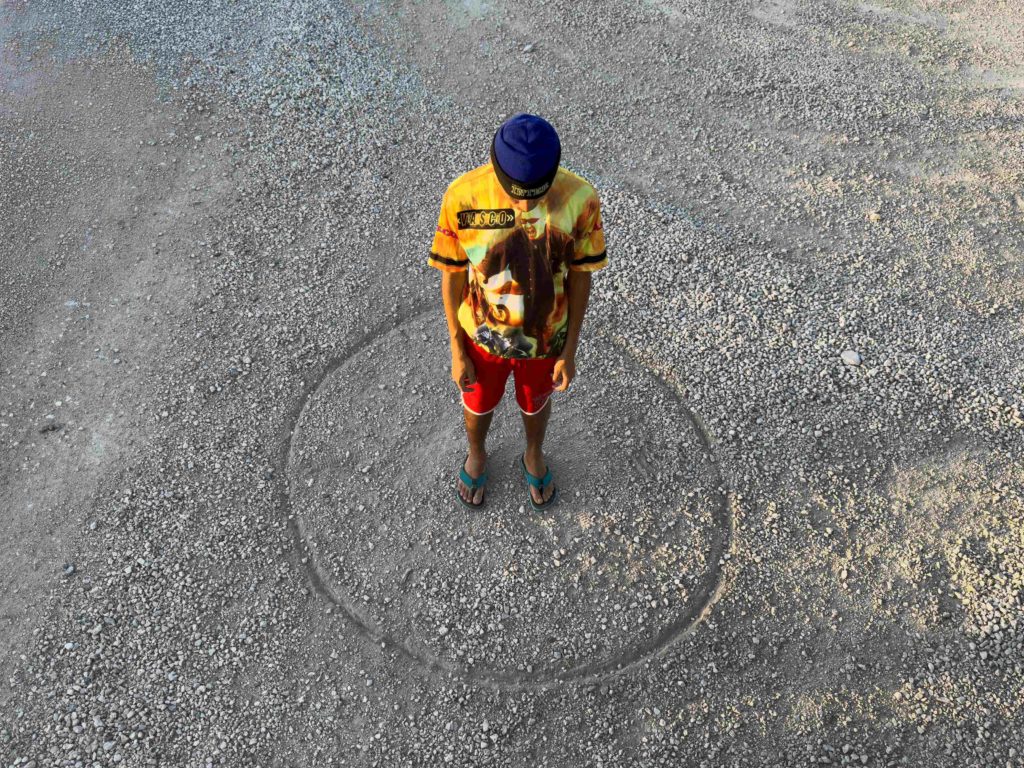
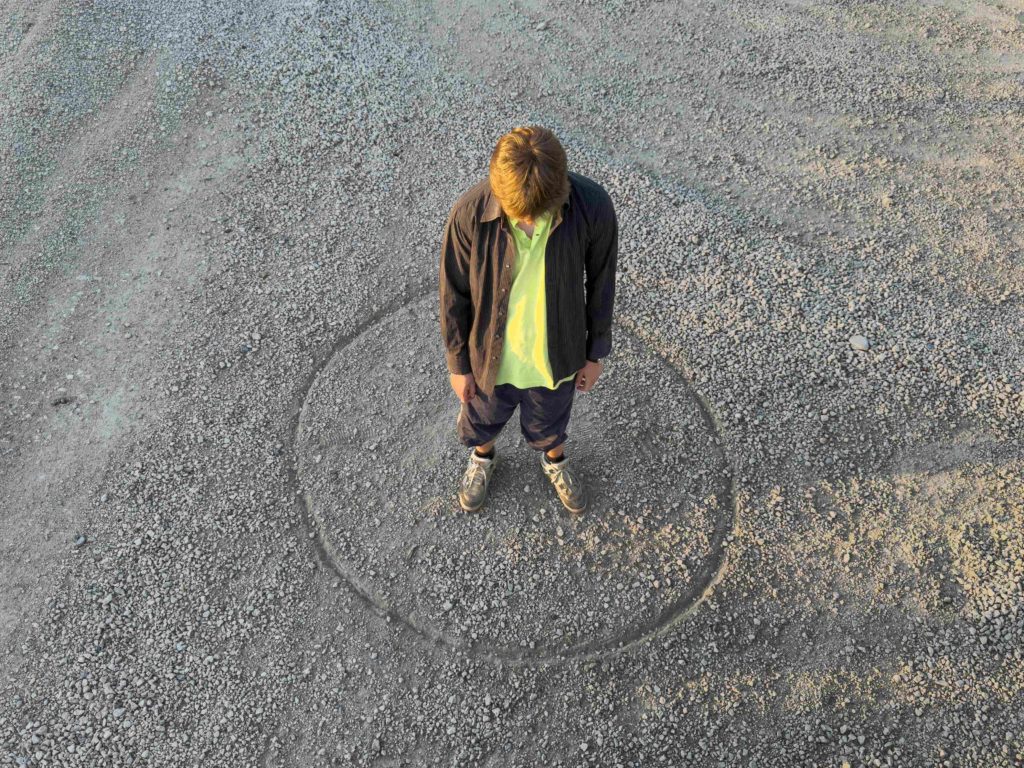
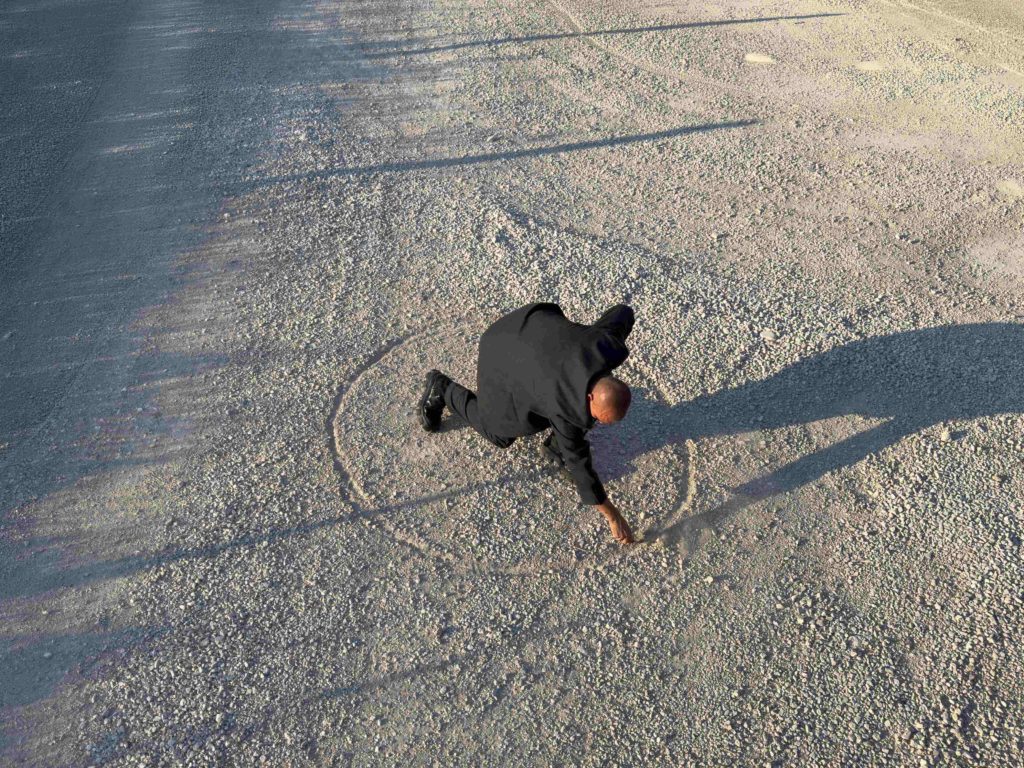
It takes at least three people to make a society. Three, then, are also enough to make a secession. The moment a trio is formed, questions of power and domination become impossible to avoid. So it is three teenagers whom Vladislav Markov has recruited to talk about all this, placing them in MASSIMODECARLO Pièce Unique in Paris — enclosed by three walls and a glass storefront — armed with a heap of dirt and knives. The heap itself, shaped into a disc, starts out divided into three equal wedges of territory, one per player. Their boundaries are destined to shift according to a rule that is deceptively simple: a knife, aimed at the enemy wedge — the one you covet — is thrown to the ground, and wherever it lands, so long as it sticks, it traces a still-imaginary line, soon to be drawn for real, extending the thrower’s territory by eating that of another player. Once a player’s territory is gone, they are eliminated. A game of conquest, then, fought with blades: a war game, a grown-up’s game.
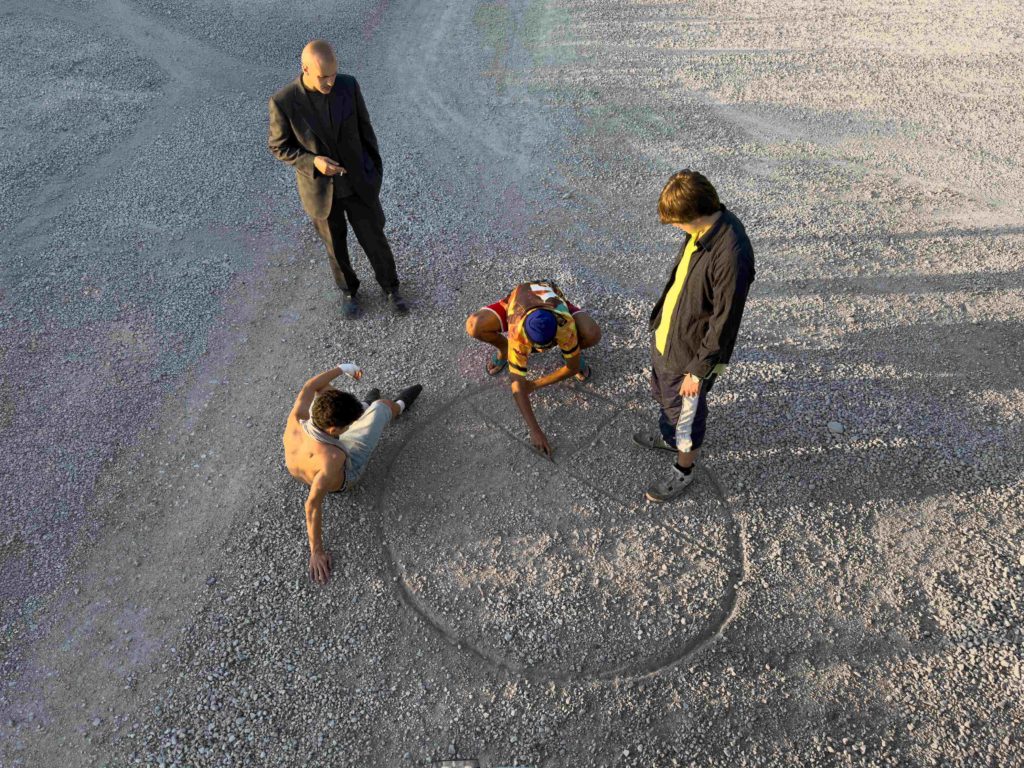
Everyone knows that, for a child, play is a way of laying claim both to oneself and to the surrounding world: gesture is learned through exercise, the symbolic through make-believe, and, eventually, society through rules, as Swiss psychologist Jean Piaget supposed.[1] The whole of cultural life takes shape there, rushing headlong into what D.W. Winnicott called a “potential space”[2]: an ambiguous space, suspended between pure inner fantasy and pure outer reality; between imagination, to put it simply, and the world. And it is in that same space that beliefs and conspiracies take shape too, along with desires — envy, more often than not — black magic, illegitimate rage, hallucinations that need no drugs, the simulacra we steer by, the vices of some becoming the virtues of others, and vice versa, and so on.
None of this is ever lost on Markov. A children’s game is never truly innocent, nor harmless, and it cannot be reduced to the sheer pleasure of play that later shapes our grown-up habits of amusement, as Walter Benjamin held. He himself was nonetheless well aware that a child’s play can rightly be called a miniaturization of the adult world,[3] and not merely its prototype. Violence, for instance, being contagious, travels down the hierarchy of ages from adults to the youngest of children. In turn, they go on to torment animals.
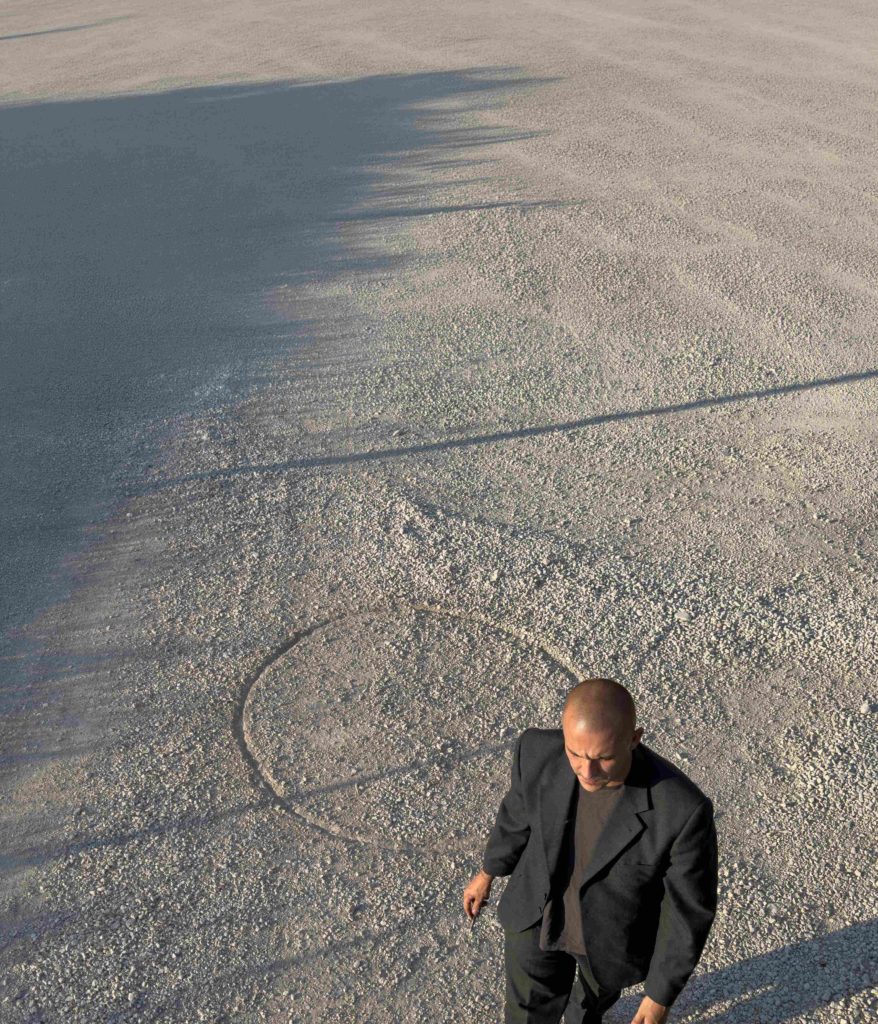
Three short façades and a single pane of glass, like those at MASSIMODECARLO Pièce Unique, which Markov occupies with his game of conquest, can in fact hold a fair amount of disaster — the kind of disasters only grown-ups have the knowledge and the technique to produce. Here again, adults pass down to their juniors the art of cruelty and contradiction.
Children watch the world and play it back, imitating it through their games. Later on, they too may have their turn to massacre it, as adults sometimes do. They can also mock the adult world and break its rules. Whether through unfiltered imitation or its critique, play always swings between opposite poles: frivolity and discipline, control and chance, projection and construction. It was with these tensions in mind that Guy Debord and Alice Becker-Ho conceived their book A Game of War (Jeu de la Guerre) in 1987, turning it into a project of emancipation.[4] Far from being mere amusement, a pastime and nothing more, their game was nothing less than strategic training for the battle to be waged against the society of the spectacle.[5]
And indeed, there’s good reason to speak of spectacle in relation to Markov’s project for MASSIMODECARLO Pièce Unique. Like spectacle itself, play produces an order distinct from ordinary life and invents a time and a space entirely its own. After all, it is a kind of theater — all the more so if we think of theater, after Antonin Artaud, as a visceral, cathartic site that acts like the plague, revealing by contagion a society’s darker temptations, whether toward violence, desire, or cruelty.[6]

Facing the window at MASSIMODECARLO Pièce Unique, where Markov’s piece unfolds, along a busy street in Paris’s historic Le Marais district, what we’re watching is a genuine act of performance: a piece of theater put on display, meant to be appreciated for its form and its timing. And yet we experience it fully — meaning we take part in it, drawn in precisely by the distance imposed by a pane of glass and by the prohibition against stepping inside. Our own subjectivity as spectators, and everything that entails, is called into question by it.
Watching Markov’s game of power — all the more unsettling for being played by three teenagers, exposed and shut inside a cramped space — we may well find ourselves subject to its rules too. Jonathan Crary, one of the first scholars to bring questions of the attention economy into the field of art history, argued that as far back as the nineteenth century, “spectacular culture is not founded on the necessity of making a subject see, but rather on strategies in which individuals are isolated, separated, and inhabit time as disempowered.” [7]

Some of the most recent devices Markov has constructed mobilize and recast this very logic in their own way. “OBJECTS IN MIRROR MAY BE CLOSER THAN THEY APPEAR” (2025), installed at Management in New York, presented itself as a hall of mirrors and a strip club at once, riddled with boredom and the leftover traces of suffering and vice. Narcissism and voyeurism, mirror and peep-show — a kind of schizophrenia, in other words — walked hand in hand there and clung to one another. Two mutilated bouncers occupied the space. Wearing prosthetics made by Markov, they pass the time on their phones, to the sound of a radio swinging between the extremes of American-style entertainment and the most radical forms of musical experimentation.
“Location. Location. Location” (2026), at Bernheim Gallery in Zurich, left the viewer face to face with a disarming, vaguely grubby kitchen, where the only thing playing was footage of some long conflict inside a car. Both installations thus fed, each in its own way, into the idea of “a continual crisis of attentiveness: a crisis in which the changing configurations of capitalism push distraction to new limits and thresholds, with the unending introduction of new organizations of sensory experience, new sources of stimulation and streams of information,” as Crary put it elsewhere.[8]

The attention economy freed itself, long ago now, from the sheer objectivity of optics to encompass the subjectivity of visual perception as well. With it comes the entry — into the visual field specifically — of everything that constitutes a soul, a mind, a heart, a personal experience, a given culture, as well as physical and psychological processes and timeframes, all of them necessarily singular. This is because nineteenth-century science discovered “the unreliability, the internal volatility, and the uncertain temporality of visual perception,” and ever since, our perception has never stopped being shaped and reshaped, again and again, by ever more numerous and ever more powerful devices.[9]
Perhaps this is why certain corners of the internet — the video-game industry, big-budget cinema, and social media — have built their success on courting our vices and amplifying them, making them impossible to ignore. What remains is the fear of blanket disinformation — total, undifferentiated — reshaping the old social forms that now feed on collective illusions and can no longer find their bearings in reality. We begin to wonder whether artificial intelligence ultimately has its counterpart in ordinary human stupidity. We start to understand why conspiracy theories — and conspiracy theorists — have multiplied dramatically in this atmosphere of seeming and deceit.
Fueled by this heightened visibility, the conspiratorial mode that has grown so vast over the last few decades has reasons that Reason itself knows nothing of. Fredric Jameson described it as “the poor person’s cognitive mapping in the postmodern age”[10] — that is, in an age of the fragmenting subject, of the hyper-commodification of society and culture, of a flattened-out world, where the search for truth has been traded away, at a loss, for the instant gratification of spectacle and seduction. For the individual, coherence itself has come apart, and the old idea of History as a continuous progression is now nothing more than an object of nostalgia confronted with the indescribable complexity of the world as it stands today — a world for which we can no longer tell whether it is genuinely fractured or the product of some superhuman design. Everything has become far too vast, far too tangled, for our minds ever to have been prepared for.[11] A lie is muttered under someone’s breath, and the echo chambers of social networks feed its false memories to entire crowds at once, producing something akin to the Mandela effect.
Across his most recent works, consolidating his practice in New York and Zurich, Markov may be establishing himself as a kind of model-maker. If his project for Pièce Unique, dealing with childhood and play, proceeds from what, per Benjamin, we have called a “miniaturization of the adult world,” it also belongs to a broader series of works that miniaturize the world itself. Benjamin, through his reflections on the reproducibility of artworks and the world through mechanical images — in ways that anticipate Jameson’s conclusions — already glimpsed the transformations brought about by the mass culture made possible through the reproduction of fragments of the world upon the surface of a photographic print. Markos is, however, a critical model-maker. His miniaturizations, which are also condensations, absorb the world’s aberrations as they exist, rather than merely presenting its most seductive image, as architects so often do with their grand urban visions.
Across a body of work where games of power, conspiracy, and spectacle intersect, Markov offers a third term — and possibly a way out of the sterile alternative into which contemporary society seems increasingly trapped: the multinational media conglomerate or the radical cult. Such a dilemma lies, for example, at the heart of David Cronenberg’s Videodrome (1983), about which Jameson argued, in his critique of postmodern culture, that these two dominant forms of conspiracy — these two great modes of exercising power through the production of a “truth” that claims to describe reality — are not opposites at all, but are deeply intertwined.[12] They are bound together as intimately as two sides of the same coin, belonging not to some grand collective illusion, but to a shared fantasy of orientation, of finding one’s bearing. By disorienting us instead, Markov lays bare the mechanisms through which illusions take hold and come to be so readily embraced. In doing so, he also shows us how they might be undone. Once an illusion has been recognized as such, it loses the power to be anything else.
With his project for Pièce Unique, Vladislav Markov gives us a glimpse of what Johan Huizinga, in his magnum opus on play,[13] called a “magic circle”: a bounded space of play, formally indistinguishable from a sacred or ritual space, understood from the outset to stand apart from ordinary life and to unfold within closed limits of time and place. Violence, illusion, and conspiracy are, then, only ever performed there — played out precisely in a spirit of disinterest and freely chosen freedom. Human beings may be homo sapiens or homo faber, but, before all else, they are homo ludens: creatures whose culture is defined not only by knowledge or labor, but also by their capacity to suspend the real world, to turn it into a stage for catharsis, and perhaps, in doing so, to free themselves from whatever it is they keep running up against, day after day.
Feature Development & Editorial Coordination by Estella Sirotta.
[1] Jean Piaget, La formation du symbole chez l’enfant:imitation, jeu et rêve, image et représentation (Paris: Delachaux et Niestlé, 1945).
[2] D.W. Winnicott, Playing and Reality (London/New York: Routledge, 1971/2005).
[3] Walter Benjamin, “Toys and Play: Marginal Notes on a Monumental Work,” in Selected Writings, Volume 2: 1927–1934 (Cambridge, MA: Harvard University Press, 1928/2005).
[4] Alice Becker-Ho and Guy Debord, A Game of War (London: Atlas Press: 1987/2007).
[5] Emmanuel H. Guy, Le jeu de la guerre de Guy Debord: l’émancipation comme projet (Paris: B42, 2020)
[6] Antonin Artaud, The Theatre and Its Double (New York: Grove Press, 1958).
[7] Jonathan Crary, Suspensions of Perception: Attention, Spectacle, and Modern Culture (Cambridge, MA: MIT Press, 1999/2001), 3
[8] Jonathan Crary, “Dr. Mabuse and Mr. Edison,” in Kerry Bougher (ed.), Art and Film Since 1945: Hall of Mirrors, exhibition catalogue (Los Angeles: The Museum of Contemporary Art, 1996), 256
[9] Jonathan Crary, “Dr. Mabuse and Mr. Edison,” 258
[10] Fredric Jameson, “Cognitive Mapping,” in Cary Nelson and Lawrence Grosserg, eds., Marxism and the Interpretation of Culture (Chicago: University of Illinois Press, 1988), 347–60, here 356.
[11] Fredric Jameson, Postmodernism, or, The Cultural Logic of Capitalism (Durham: Duke University Press, 1991).
[12] Fredric Jameson, “Totality as Conspiracy,” in Geopolitical Aesthetics: Cinema and Space in the World System (Bloomington: Indiana University Press: 1995), 8–84. See also Jonathan Crary’s analysis of Jameson’s essay in “Dr. Mabuse and Mr. Edison,” 256.
[13] Johan Hazuinga, Homo Ludens: A Study of the Play-Element in Culture (London: Routledge, 1938/1998).