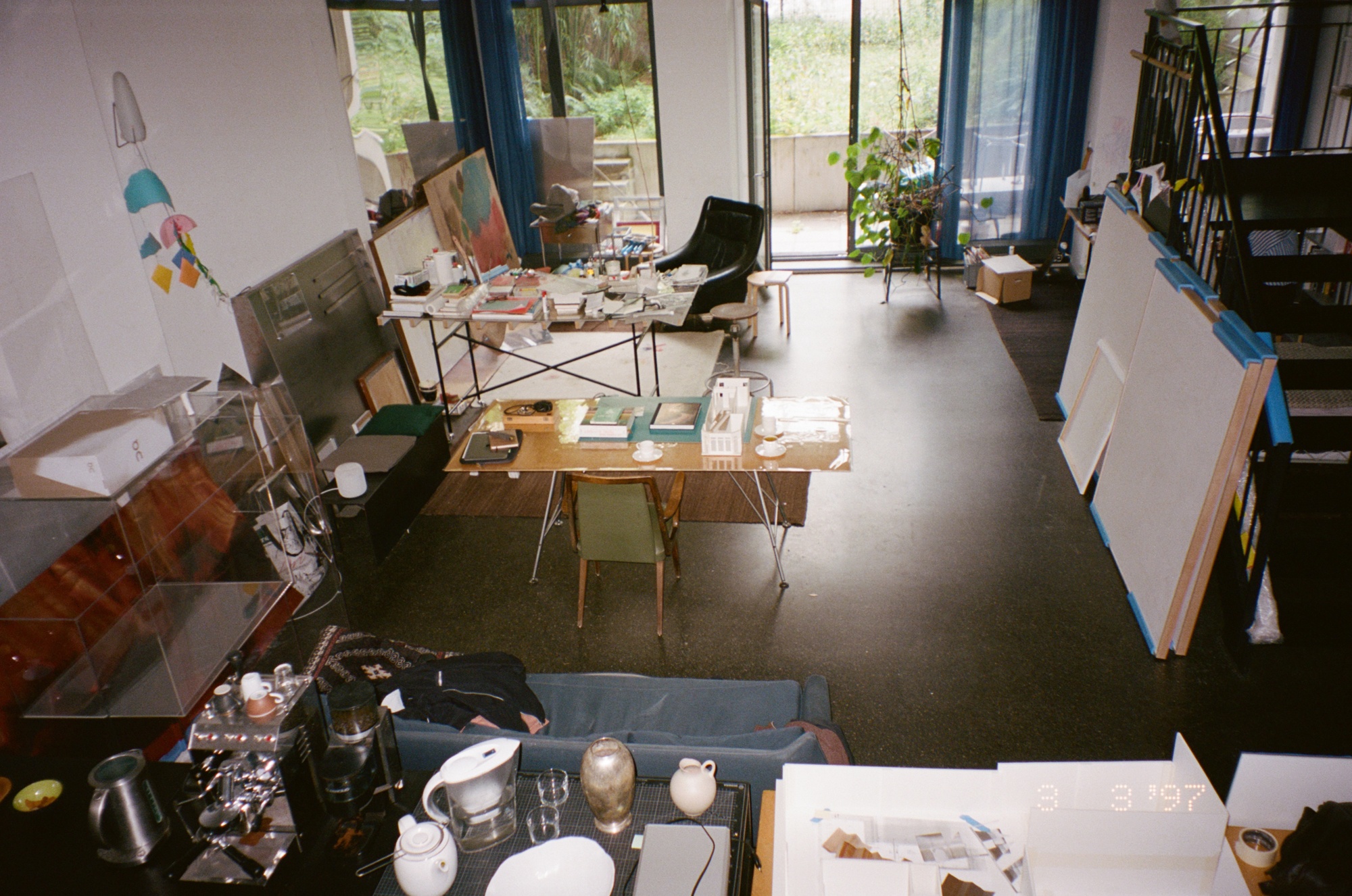
A few years ago, I stayed in Ewa Poniatowska’s bedroom in Stoke Newington. If London is like a polluted river, this room felt like clear water distilled from it: I saw traces of the city, but channeled in a secret, sleek and shiny logic. Concrete blocks and shattered mirrors, scavenged furniture of stainless steel and leather, clothes that propose luxury but are not luxurious, all lifted from their abandoned street posts, found their graceful, abstract new roles here. I witnessed Ewa gradually work this logic into her art – “sampling the city,” as she says – in sound, in performance, then painting, sculpture, and collage. I saw that the ephemeral sheen of Poniatowska’s works – like psychosis seen through the mist of a Muji diffuser, in an older performance we wrote together – sometimes tries to be contained by the straight-angled and ordered, like the paint patches that cover up graffiti, only to reveal, underneath, the psychoanalytical churn of mark-making. Underwriting any tasteful design surface here is a current of hysteria – Poniatowska’s research into medieval dancing manias, the paranoia of shopping malls, the psychosis of luxury and desire.
Tosia Leniarska: Hi Ewa, what are you up to today?
Ewa Poniatowska: Today I need to take my ferret to the vet. She’s been in pain and causing a lot of havoc. As a result, she damaged some of my drawings. But maybe they weren’t good.
TL I like your answer because I know you don’t own a ferret and never have. You’ve invented a slew of fictional characters in your work as Rat Section, the performance duo you’re part of. What role do these fictional biographies play in your work? Because it doesn’t feel like a “world-building” practice, either –the fiction is used for something else, something more tactically confusing.
EP Tosia!! Maybe I do have one now? You haven’t been over in some time.
But yes, I’m into layering realities, almost like collaging. It’s important for me to have fun with these structured formats.
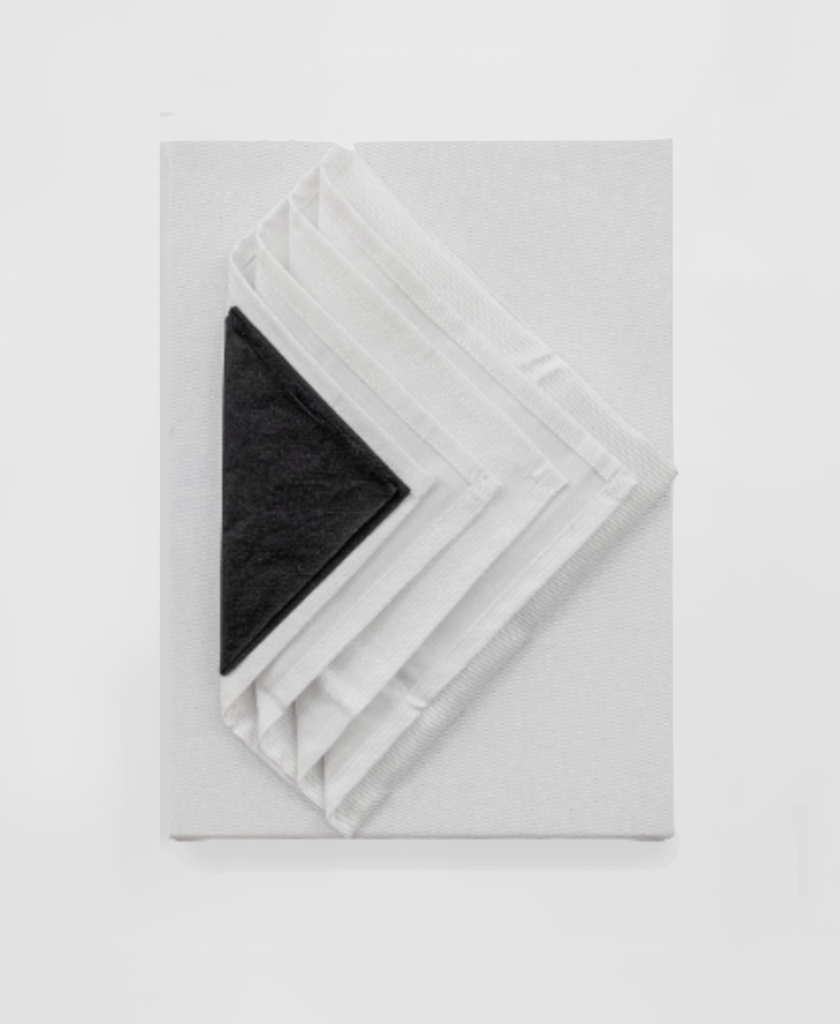
TL A work of yours that I look at most often is 75010 Paris + 4051 Basel (2025) a composition made of folded napkins. How did you start working with napkins? What do they represent to you?
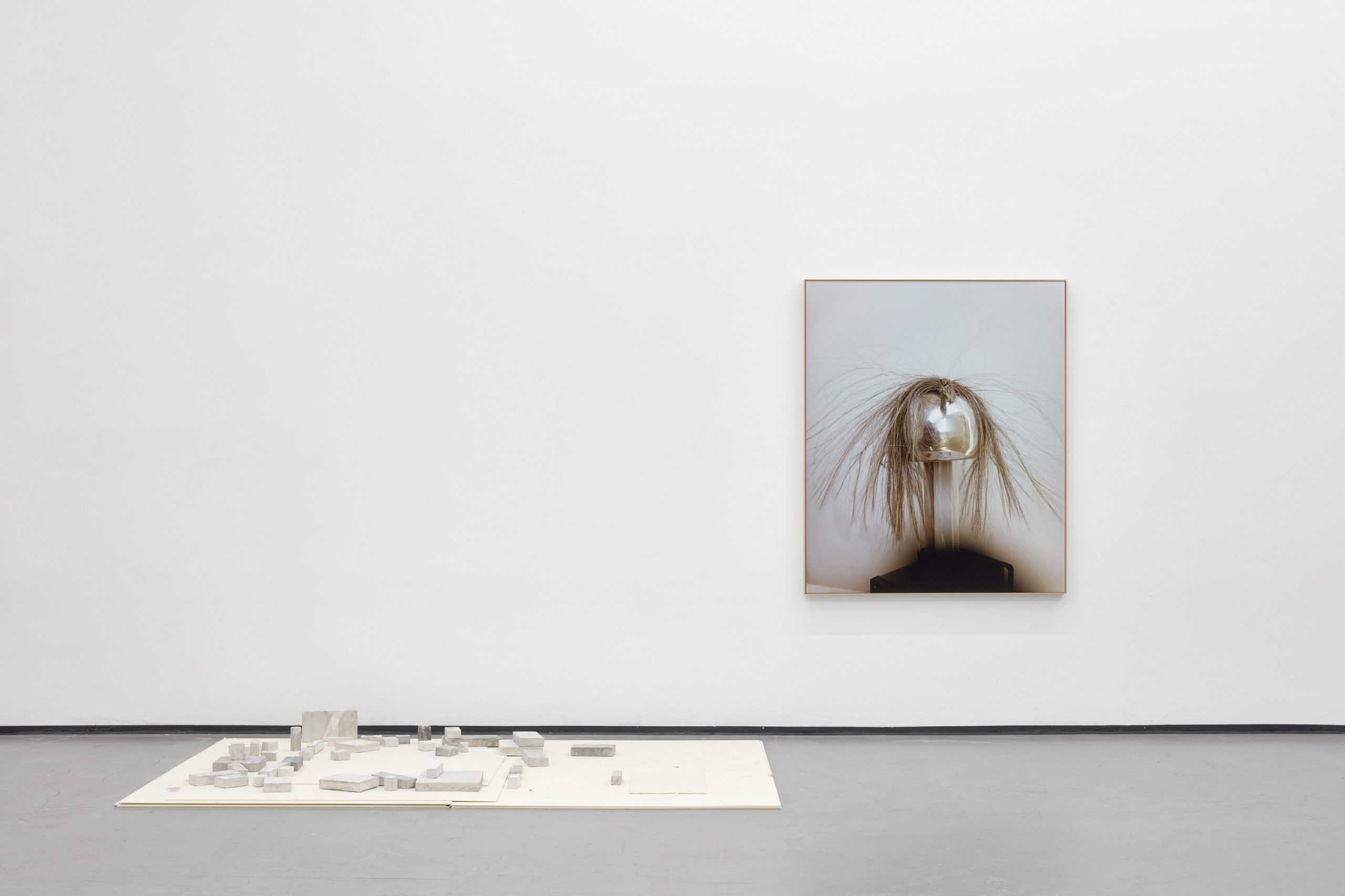
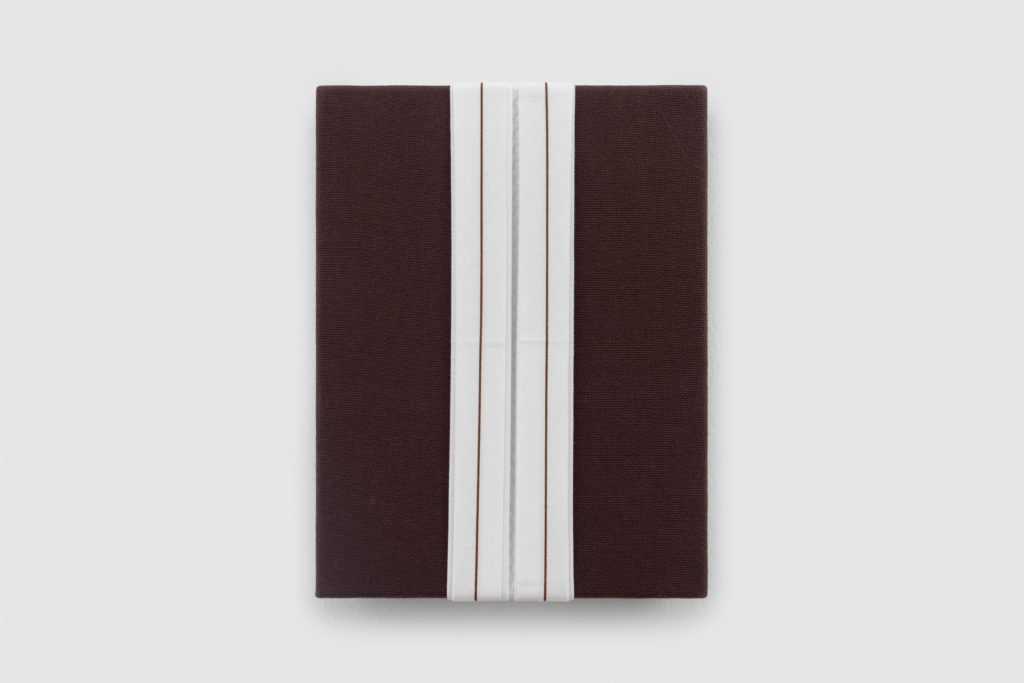
EP I started collecting napkins from hotels, bars, and restaurants while traveling. I think I came across a folded napkin that looked so beautiful on the table that my kleptomaniac impulse couldn’t be stopped. I’m really into accidental artworks that public spaces offer – I like collecting materials like that. It’s almost like sampling the city. I do that with my series of paintings too, by recreating walls of covered-up graffiti.
Napkins can be a basic symbol of luxury as part of the aesthetics of fine dining. Like perfumes, there’s something aspirational about them. But at the same time, they’re extremely accessible, mundane objects that you can grab for free when you walk into a café. For my first solo show at Galerina, I worked with “plating” (or, in other words, “sauce art”), which also sits in this realm for me.
TL These are, in some ways, folk arts, but for an urban and often commercial context – decorative arts used in hotels, conferences, or restaurants. What is it that interests you about sampling aesthetics from these spaces?
EP I think it’s the façade of luxury. I’m interested in the question of what gets collectively designated as a luxury selling point in the first place.
TL Speaking of luxury, do you know what you’ll show at Frieze London this autumn with Galerina?
EP It will be an architectural intervention that draws on my research into the black market and the movement of goods during the Communist era in Eastern Europe.
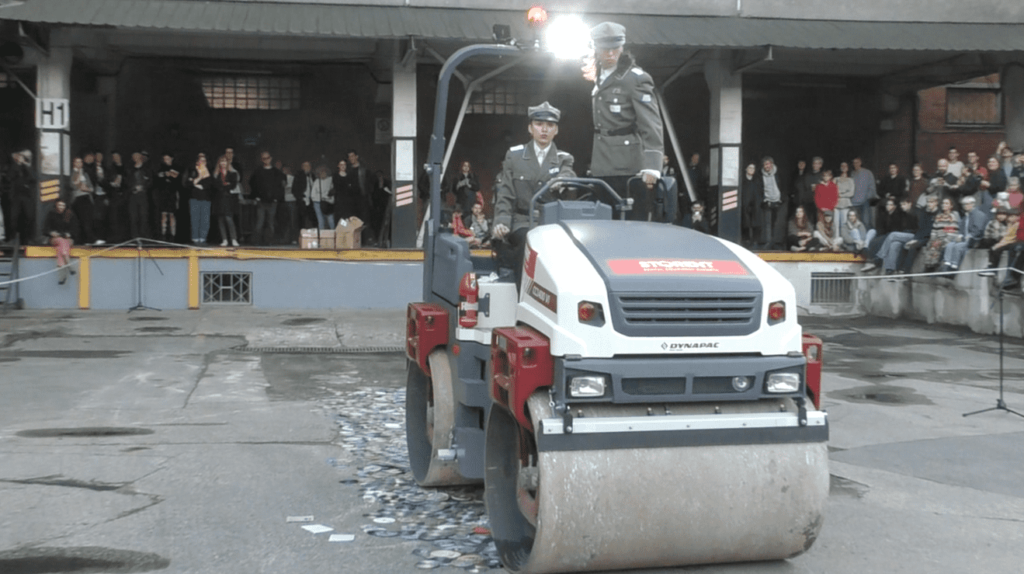
TL Ah, I remember this theme was part of Counterfeit (2025), a performance you did as Rat Section at the Kaunas Biennale opening: you ran over hundreds of pirated CDs with a road roller, wearing army-like uniforms. Can you talk about that performance and that kind of sinister-pop register you use? How has your research into this black-market economy evolved since then?
EP That was one of the most fun shows we’ve done. I loved driving that little machine. We decided to restage the crushing of bootleg CDs, posing as the fictional Audio Infringement Agency (AIA), performing a militarized choreography and hosting a press conference. The tone was quite serious, and a friend told us that her mum was worried about whether it was ethical that she still had some bootlegs at home.
We came across an article online about a CD destruction event from the 1980s, and then we found out that similar ceremonial crushes happen with luxury items – like watches, bags, or even bikes. It’s a crazy display of waste and power.
For the sound, we mashed up and chopped all sorts of pop songs from various eras, imagining how a crush could sound like – Justin Timberlake distorting into Prince or the Bee Gees.
My own research has recently been more about “commercial tourism” and objects of desire in Eastern Europe during Communism. For example, I came across the story of a man who was interned in 1982. He was detained by the militia, and during interrogation, he gave extensive explanations about his contacts, his trip abroad, a large number of pencils, and his possession of a German lamp.
In this absurd case, the lamp carried so much meaning – it was not only a cool and rare thing to have, but also a suspicious object that could land you in detention and put you under investigation for months.
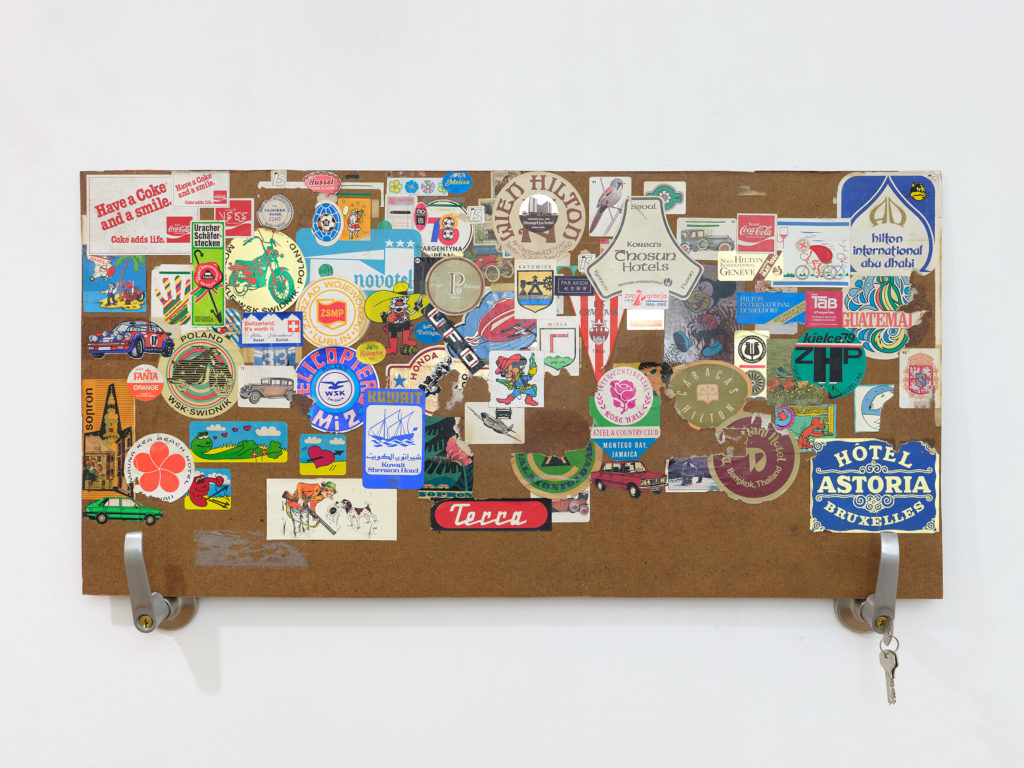
TL I know you draw some of these stories from your dad, who grew up in that system, and who also made one of your works, a collection of stickers from his childhood in 1970s Poland. How else does your background come up in your practice? What was it like growing up in Lublin?
EP Lately I’ve become more interested in working with the histories of Communist Poland / Soviet countries, which is an autobiographical turn that I rejected for a long time.
I think I grew up during an interesting, transitional time for the country – when the economy was improving, but it was still very much a post-communist place. I’m from the eastern part of Poland, which was always much more deprived, and the ideas of the mystical West, Western quality, or Chemia z Zachodu (“chemicals from the West,”cleaning products considered to be of superior quality), and so on, were everywhere. I remember when the first shopping mall opened in Lublin with the first H&M – it was a huge deal for me as a teenager. I could finally get skinny jeans! The first McDonald’s in Warsaw, which opened in 1992, had its ceremonial ribbon cut by the celebrated Polish social activist Jacek Kuroń, which is insane. I also like your Starbucks story, Tosia.
I don’t know if you remember, but when we were kids, the roads were totally fucked – giant holes everywhere. My childhood memory is that all that politicians talked about on TV was improving the roads. It was quite funny. Poland has developed so much that that period is almost unrecognizable.
TL Yes, my Starbucks story is that when the first Starbucks opened in Poland, when I was around thirteen years old, it was such a viciously novel and trendy place to go that I thought I wasn’t popular enough to enter. I didn’t go until I was older, once it had become uncool.
But for both you and me, Poland’s economic boom really took hold while we were living in the UK. It was still quite a difficult place to be from when we moved there, but I think the West-East power/fantasy dynamic has shifted since then. I often feel that the UK is more right-wing in some respects now, but without the same self-perception or sense of gravity. How does performing in Poland compare to the UK in your experience?
EP Yes, totally. I was recently reading Poor but Sexy by Agata Pyzik, a book about Poland and its relationship to the West. It was published in 2014, and pretty much everything it talks about is outdated now.
To be fair, I’ve only performed in Poland twice, both times in Warsaw at DIY artist-run spaces, and the energy was cool.
TL But the last solo performance of yours I saw was in London – can you describe Entertainment Tonight – Episode II (2025)? What’s the difference between your performances as Ewa and as Rat Section?
EP My last solo performance took place at House of Annetta, which is an important space for learning in London that works with ideas of spatial justice and land ownership.
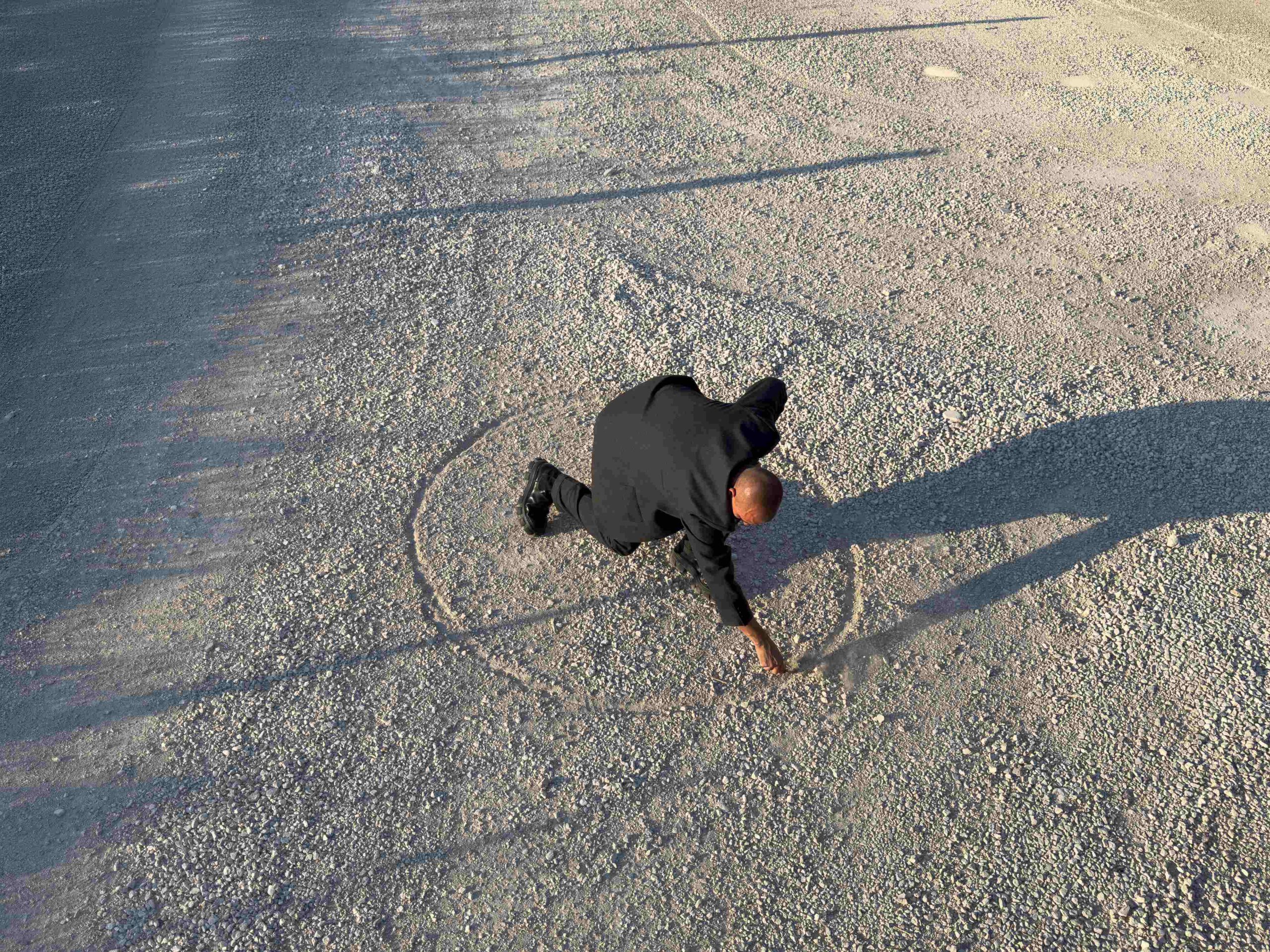
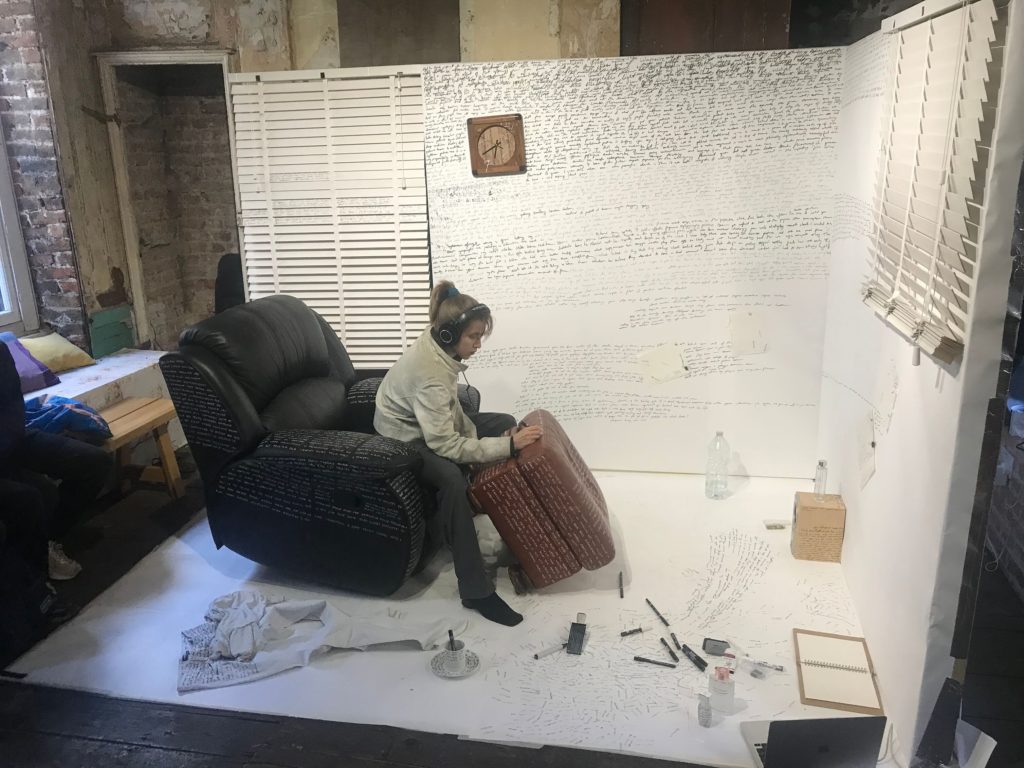
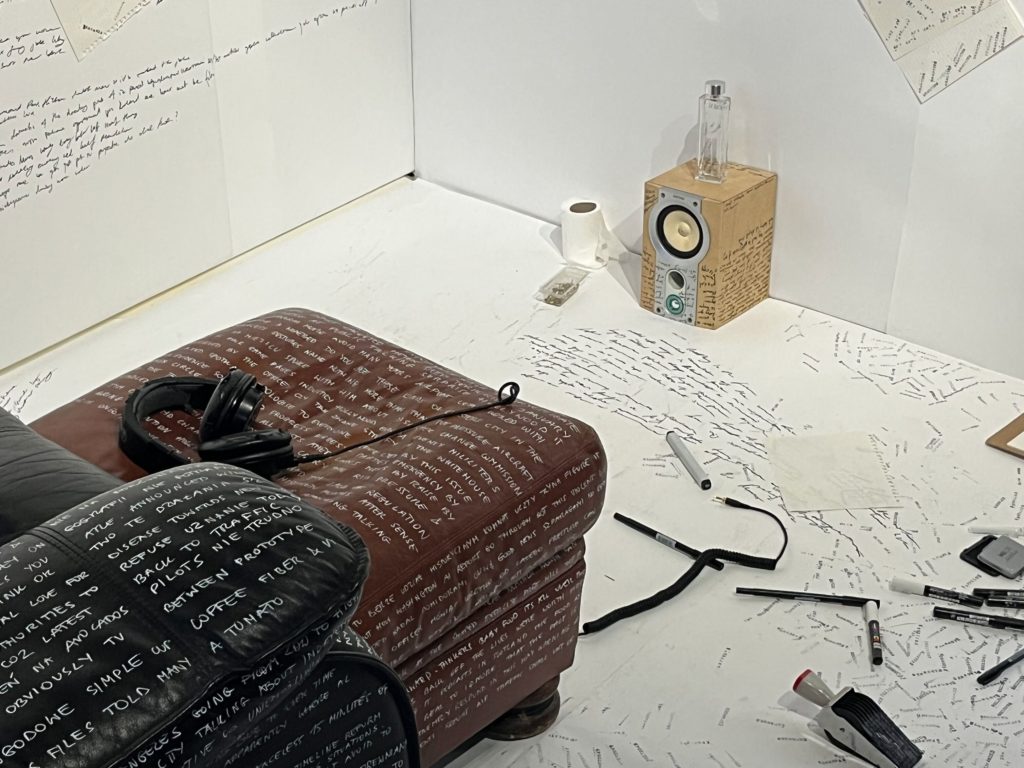
I built a small set – almost like a TV studio – that I occupied for seven hours (with toilet breaks allowed). My task was to continuously write on any possible surface, transcribing a sound piece that I had made. The track was a mash-up of various news programs in Polish and English, quite manic and disorientating. It was the longest performance I’ve ever done and structured in total opposition to all my other works – very long and anticlimactic. The audience was free to come in and out of the space at any time. It was the second chapter of a series of works titled “Entertainment Tonight,” (2025–ongoing) in which I look at endurance, the entertainment industry, and politics of spectatorship.
In my solo performance work, I tend to work in episodes, focusing on the same themes over longer periods of time. I would say that my solo performances have always touched on some sort of hysteria too, certain manic intensity. I’m not sure if there’s much difference between my solo work and Rat Section, other than that we often operate within a music context.
TL You mentioned drawing at the start of our conversation. The performance you describe at House of Annetta was focused on obsessive writing, also a repetitive mark made by the hand. What do you think your hands bring to the work?
EP In this work, I was mostly interested in the endurance aspect, but also the translation of speech into text. It formed an abstract piece of writing because my hand was slower than the sound piece and couldn’t catch up with it. The more tired I became, the less legible it got, almost like asemic writing, which means writing without any semantic content.
I also wanted to experiment with a new way of scripting a performance. There was no opening, no finale; it was like a flat line. And I was also curious to see what the act of continuously listening to an accelerated assault of news would do to the body.
TL What did it do?
EP I was exhausted and crashed out at 9 PM.