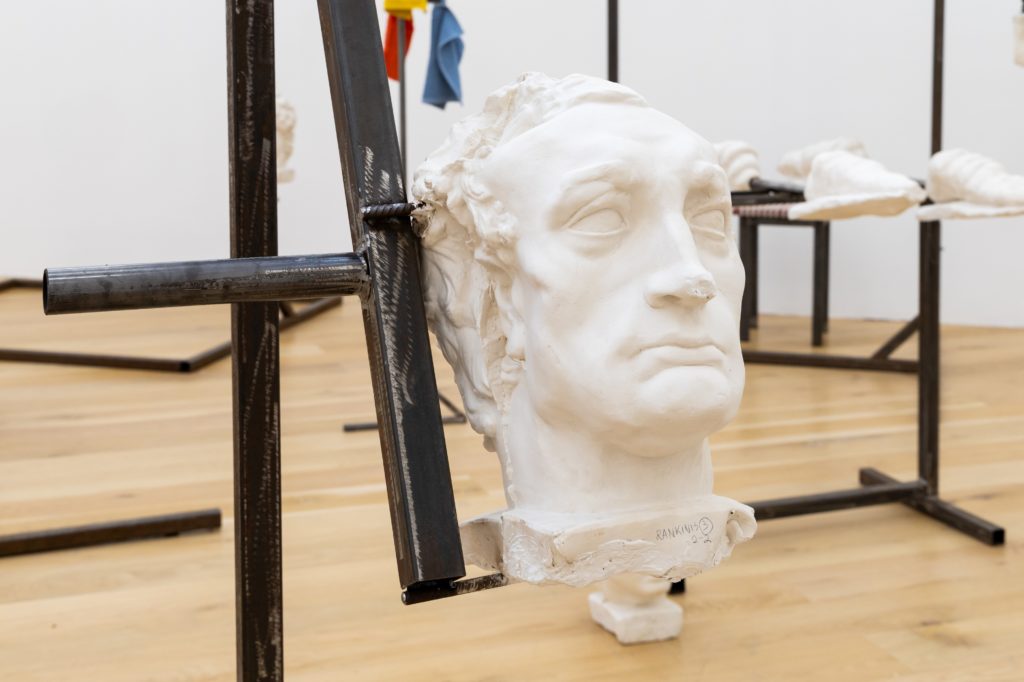
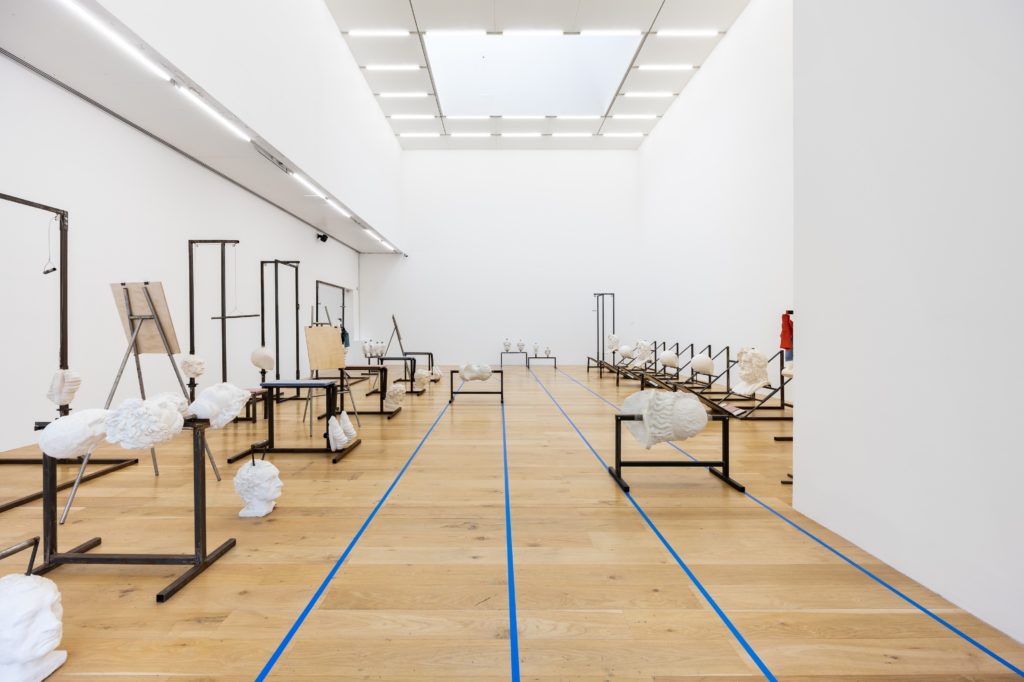
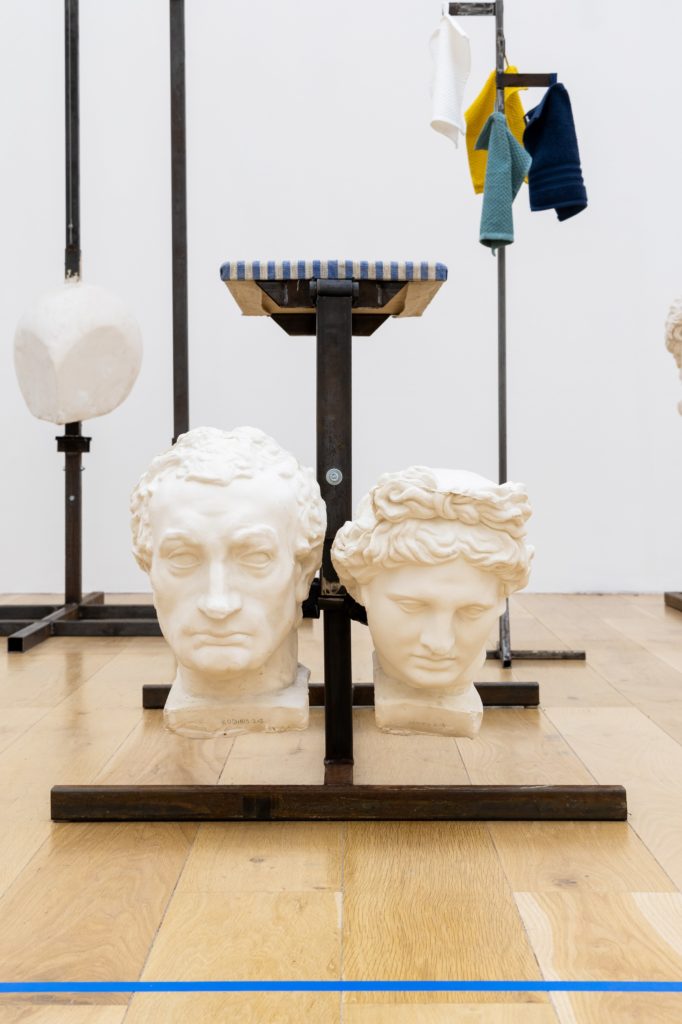
Euphoric, machinic Italo disco pulses through Nottingham Contemporary’s galleries, audible from the street, where passersby press against the wall- length glass windows trying to make sense of what is going on inside. The gallery has been converted into a gym. Long fluorescent strip lights flood the rooms with a cool brightness, and cobalt-blue court markings are outlined along the pinewood floorboards. The space has the unmistakable atmosphere of a school gymnasium. Black steel weight machines — ranging from chest presses, seated rowing machines, and leg curl and hip abductor presses — are crammed into the rooms, with hand weights lining the floor in a neat row. But, in place of conventional iron plates, cast heads drawn from classical antiquity sit atop the bars, their blank expressions level with yours as your body pushes and pulls against them. Scattered around the machines are sketch boards and easels, as though a life drawing class has just been finished. The effect is absurd, humorous, and slightly camp. This is Augustas Serapinas’s “Physical Culture,” first conceived in 2012 during the artist’s rigorous classical art education at the National M. K. Čiurlionis School of Art in Vilnius, and now given its first major institutional presentation in the United Kingdom.
The lightness of the exhibition sits alongside something heavier. Lithuania declared the restoration of its independence in March 1990 (the same year Serapinas was born), thereby triggering a standoff with Moscow that turned violent in January 1991 when Soviet troops seized the Vilnius TV tower, killing fourteen civilians. Since then, Lithuania has undertaken an extensive and ongoing process of decommunization, systematically removing Soviet-era monuments and public artworks, with statues dismantled and murals stripped from the sides of buildings. What was left behind were absences: blank walls, empty plinths, and the faint outlines of things that used to be there. “Physical Culture” is the work of a generation shaped by everything the Soviet Union left behind, as infrastructure is harder to dismantle than ideology.
That ideology had a very specific relationship to the body. In the Soviet Union, the disciplined physical form was a political technology, expressed through mass gymnastics displays, state-sponsored athletics programs, and public monuments in which the idealized body stood in for national virtue and ideological strength. Public art was produced on the same terms. Often the artists were anonymous, and often the works were created collectively. Soviet Socialist Realism drew upon the ideal body directly from the Western classical tradition. The heroic worker of the Soviet monument was modeled on the same proportions, the same posture, and the same fantasy of physical perfection as the ancient Greek statute, the Vatican’s Apollo Belvedere, and Michelangelo’s early sixteenth-century masterpiece, David. The classical body and the Soviet body are, it turns out, the same body: two different political projects modeled on the same ideal. Serapinas’s art school education was a formal training in copying these very objects, the founding reference points of the entire Western tradition of the idealized male form, upright, proportioned, physically perfect, and radiating disciplined virtue. These were the standards against which student work was measured, the standard to be aspired to.
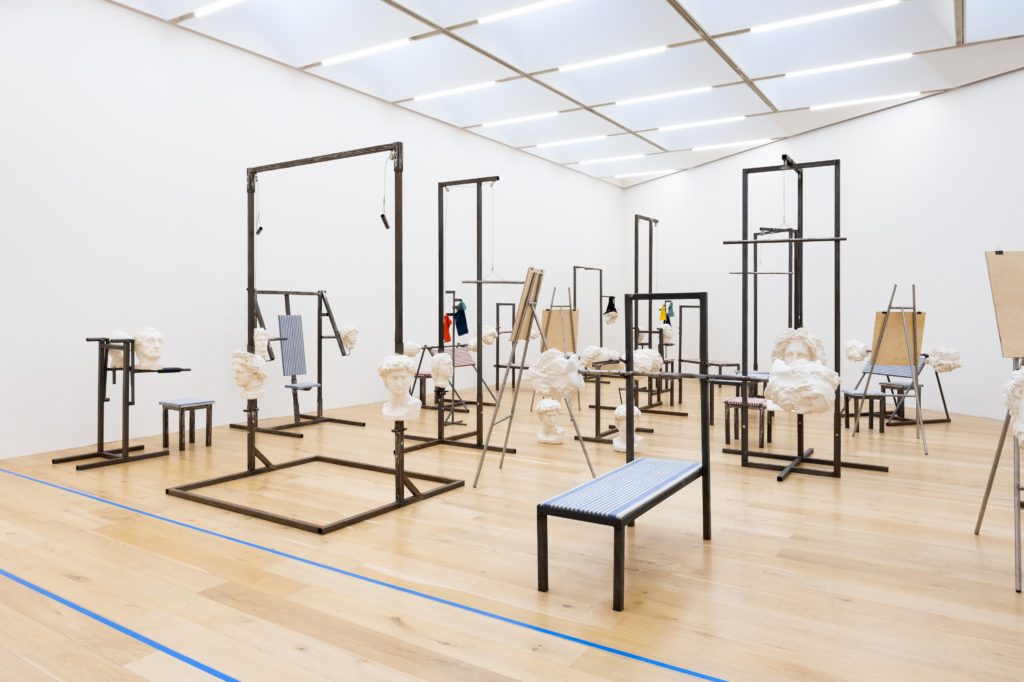
In the gallery, spaced along the blue floor markings are metal hurdles topped with heads drawn from the carved frieze on the façade of the Waverley Building, which previously housed the Nottingham School of Art & Design. Cast heads of Cellini, Raphael, and their contemporaries are repurposed as hurdles, as a physical obstacle. Here, art history has become something that the body must physically negotiate, clear, or fail to clear. But the hurdles are nearly impossible to clear without breaking them or physically harming oneself. Perhaps the function of the ideal was always to remain just out of reach, keeping the student, the athlete, or the citizen perpetually striving to reach perfection.
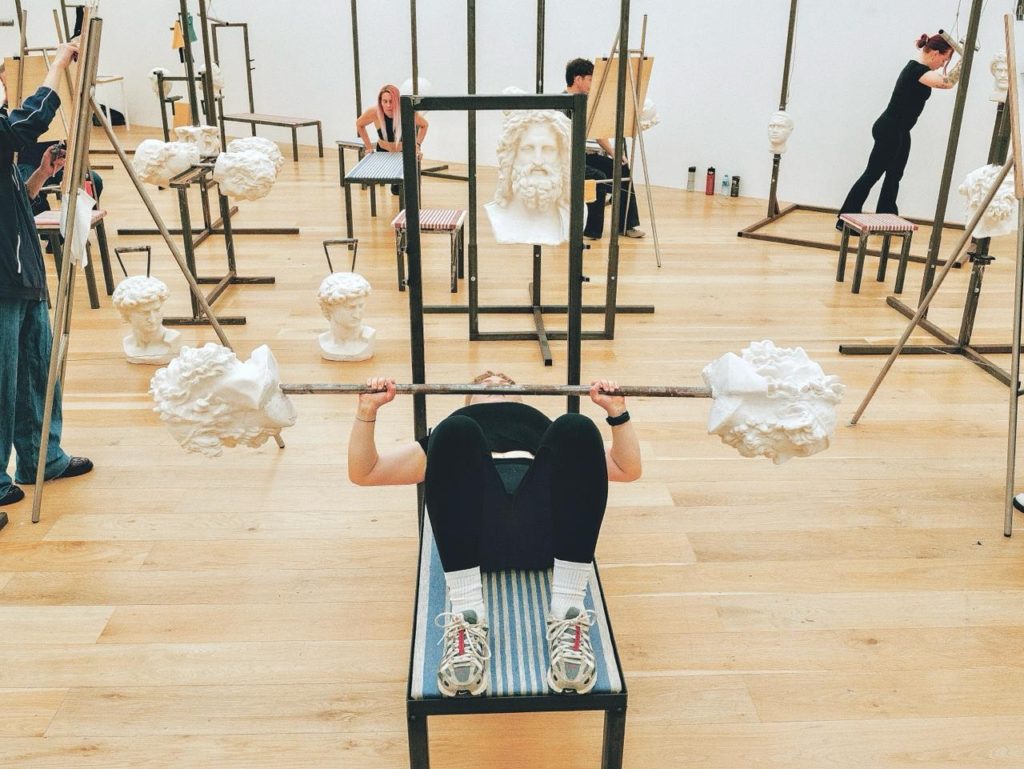
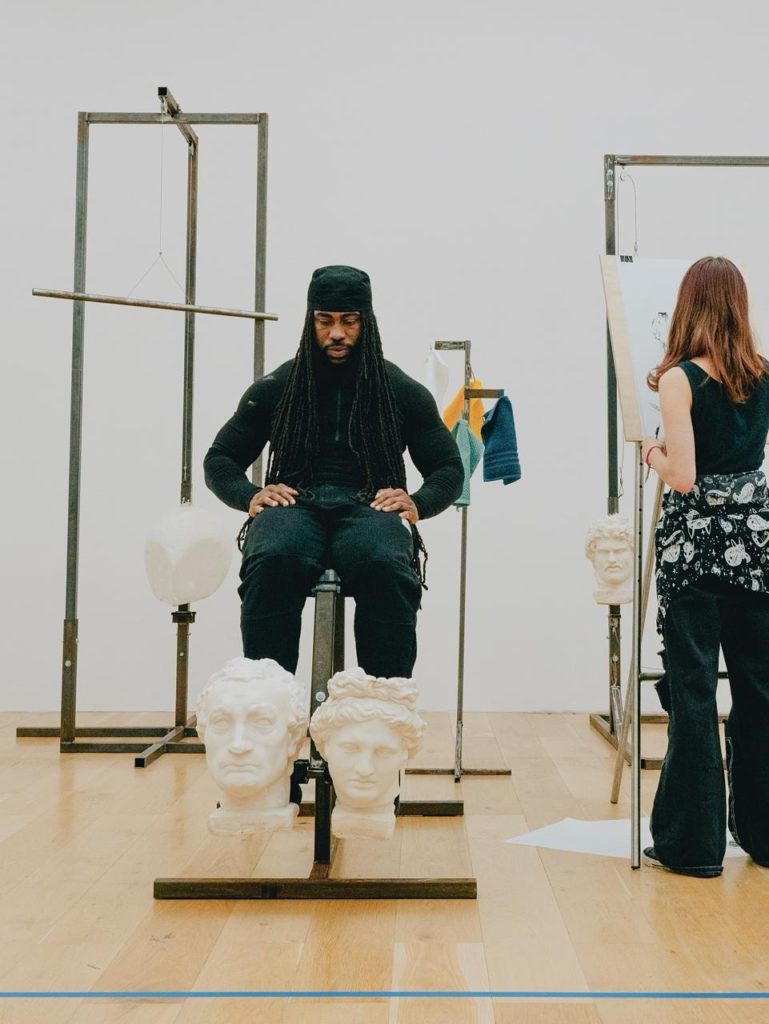
At first, it seems strange to position something that so clearly references the Soviet Union in a gallery in the Midlands of the UK. It begs the question of who the exhibition is for, and what purpose it serves. At one level, the answer is personal. This is an artist working through his own inheritance, returning to the objects and methods of his formation and subjecting them to relentless scrutiny. But the sketchboards set up around the room for life drawing, together with local fitness groups, community wellbeing sessions, and drawing classes held throughout the exhibition — in which participants observe gym-goers and statues via charcoal sketches — change this. The local community is actively engaged with the exhibition. The faces on the hurdles from the Waverley Building bring the city’s own classical aspirations into the room. What begins as one artist’s reckoning with a specifically Lithuanian inheritance opens outward into something more universal, raising the question of who defines the ideal, whether physical, aesthetic, or cultural. Will we submit willingly, or will we work against the ideal, against failure, and try again while the disco keeps on playing?