I’m afraid to admit the exact amount of debt I’m in.
Walking into the exhibition “Call me gravity” at WIELS in Brussels, I half-expected to find myself in the numbered world of credit, debit, and interest rates. Curator Pauline Hatzigeorgiou proves that assumption dead wrong. She has refracted the concept through a kaleidoscope, reconsidering it financially, generationally, socially, and karmically. Bringing together works by Niloufar Emamifar, Dora Budor & Noah Barker, Annaïk Lou Pitteloud, Georgia Sagri, Sung Tieu, and Gianna Surangkanjanajai, the results of this refraction are uneven: in some works, the conceptually rich frame sharpens the story the works are already telling. In others, the pieces fail to make a strong connection between the curator’s intent and the experience within the exhibition.
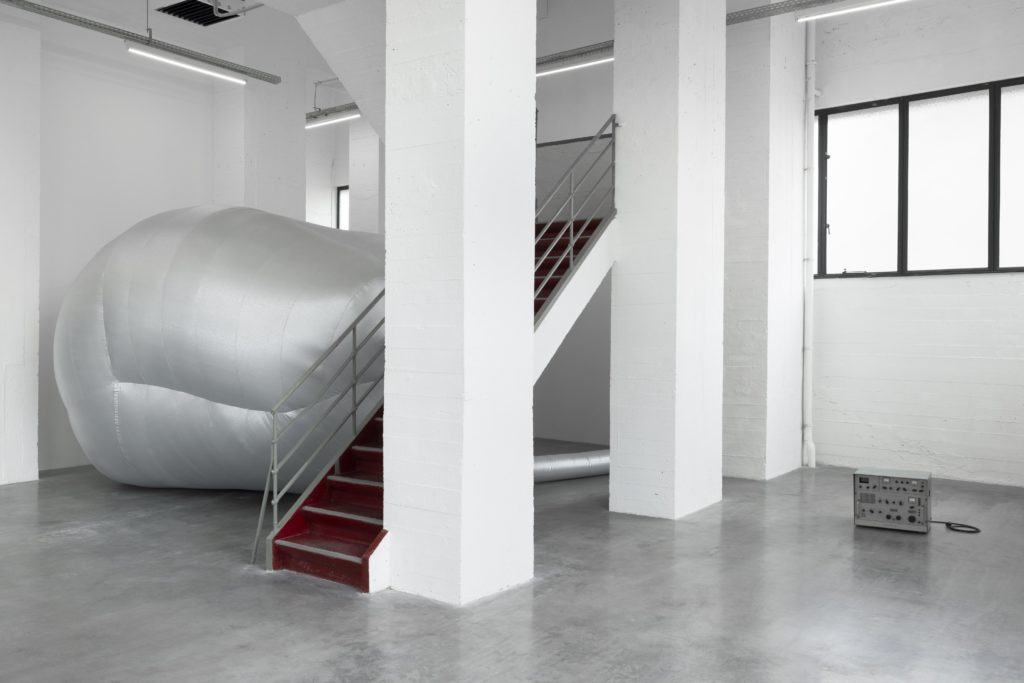
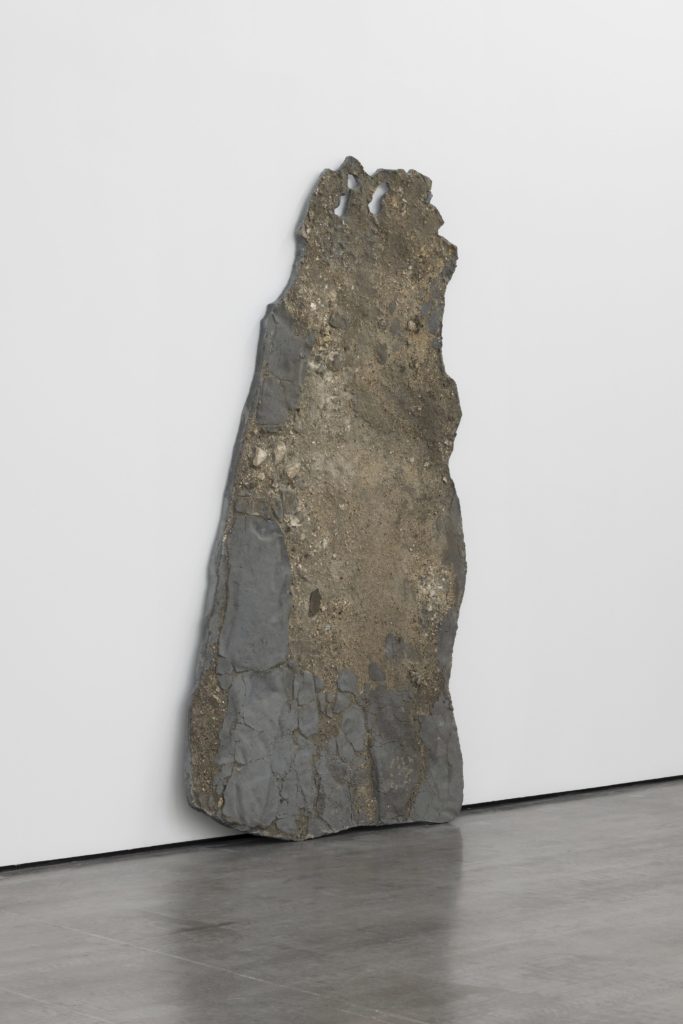
I’m greeted at the entrance by a slab of scorched earth by Niloufar Emamifar. Manduria (2025), a resin cast of a terrain in Lecce, Italy, stands almost three meters tall, its surface coated with dirt and debris gathered from the site itself. You’d be forgiven for thinking it had been cut directly from the ground. I learn that the work was born out of a curiosity in systems of property ownership, and that the cast reproduces a stretch of land that is unregistered and, legally speaking, owned by nobody (I knew the pamphlet would come in handy). Standing in front of it, however, that context fades away, and I latch onto what I see instead: a mountain peak that up close resolves into common dirt. Struggling to locate any trace of the discursive framing in the work itself, I’m left asking myself how necessary it actually is to the experience of the piece. Manduria is striking on its own terms, not because of the theoretical perspective offered somewhere in the exhibition’s reading material, but rather for its dizzying oscillation between the Matterhorn and an accidental face-plant into the earth.
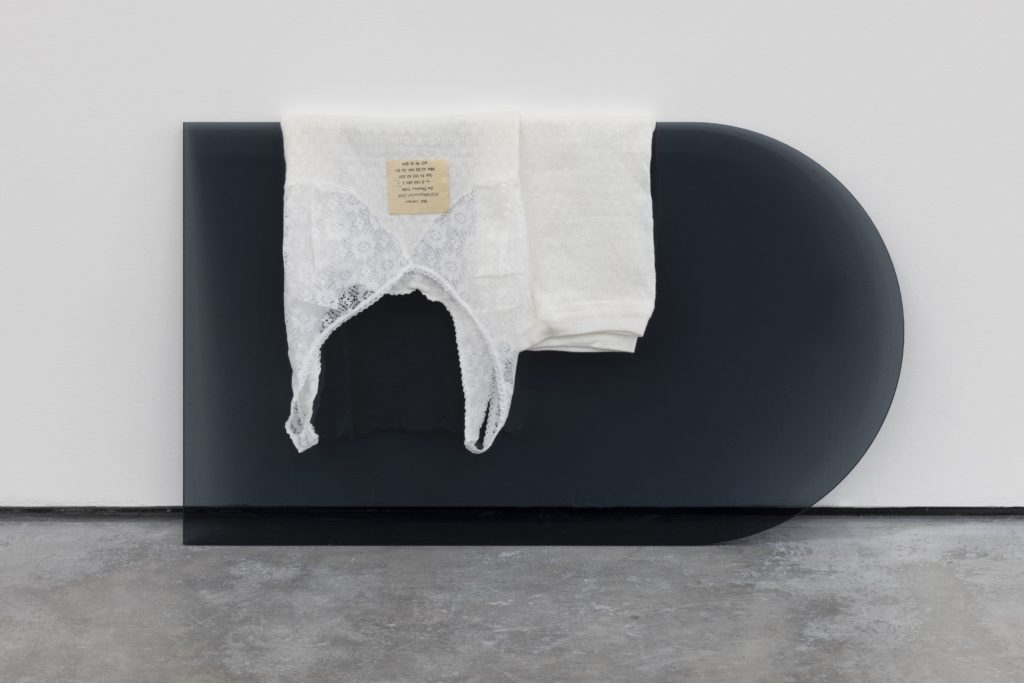
Turning to the left, I stumble across a breadcrumb trail of historical readymades left by Sung Tieu. Rest in Power (2022) presents white underwear and an aged, upside- down Post-it note arranged over a slate of black acrylic glass. The sparse but carefully calibrated arrangement seems to be just enough to crack open a line of contact between the present day and stories of the past. The underwear was produced in an East German state- owned factory that employed Vietnamese migrant workers under bilateral agreements between the two communist “brother countries.” The workers’ legal status was tied to that state-employment, and vanished with German reunification. Thus was an entire generation of Vietnamese diaspora in the GDR stranded in a bureaucratic gray zone, and in many cases unable to afford passage home. It would take years before a legal framework was built around them. It’s with this history in mind that Tieu asks: what are these individuals owed by the systems that failed them? It’s a considerable historical leap to ask of some underwear and a Post-it note, but I’m willing to do it. I’m less inclined to extend the same generosity to Tieu’s Frequency Receiver (2022), installed at the far end of the exhibition hall. Sharing the same historical context, the object embodies its title in perfectly literal terms, yet unlike Rest in Power, it remains untouched by the artist. With no trace of her hand, what’s left for me to chew on is a piece of technology that, while charmingly outdated, fails to assert its own relevance. Instead, it hands that responsibility over to the pamphlet, which supplies me with the justification the piece cannot.
Lodged in the exhibition hall’s Hintergrund, Gianna Surangkanjanajai’s untitled trio of ungainly, human- scale plexiglass prisms filled with clay appear to have slammed straight into the walls. As it turns out, a ramp was built during install, down which the prisms barrelled into the brick and mortar at WIELS, and where they landed is where they stayed. Their positioning thus becomes anti-curatorial, save perhaps for some attempt at aiming them in a certain direction. The clay inside the prisms is untreated, straight out of the packaging in clunky rectangles, alluding to a primordial state of sculpture. They are caught in the moment just before the stage of molding clay, the first step, classically, on the road to bronze monumentalism. The prisms counteract this monumentalism with real, crashing force. In spite of the work’s potency, my experience of it gets caught between two threads: the trajectory the prisms are pulling me in, and their relevance to the exhibition’s theme. Struggling to establish the connection, the latter does nothing more than haunt my attention like an intrusive footnote.
In “Call me gravity,” artworks endure the burden of being asked to carry an argument they didn’t choose; sometimes generative, sometimes not. In this way, the exhibition demonstrates a classic dilemma in themed group shows: whether the work exists to be experienced, or exists to prove a point. Still, the exhibition’s triumph, though occasionally existing around the works rather than within them, is its expansion of the viewer’s understanding of what it means to owe, or be owed. It’s forty degrees outside as I exit WIELS. Perhaps the sun is also a debt collector, one which we owe for humanity’s borrowed extravagance of the last one hundred years.