Henri McMaster spent her childhood in Canada, where she began building things out of feathers, sticks, and snow from an early age. “It’s such a cliché, but it’s a natural impulse to make stuff with my hands,” she smiles, a bit self-conscious of the admission, given how ubiquitous it is to hear this kind of anecdote. Her mother still has a photo of a sandcastle she made when she was three years old, its perimeter fortified with battlements of scavenged feathers: one of her earliest works, and perhaps an early precursor to the sculptures she produces today.
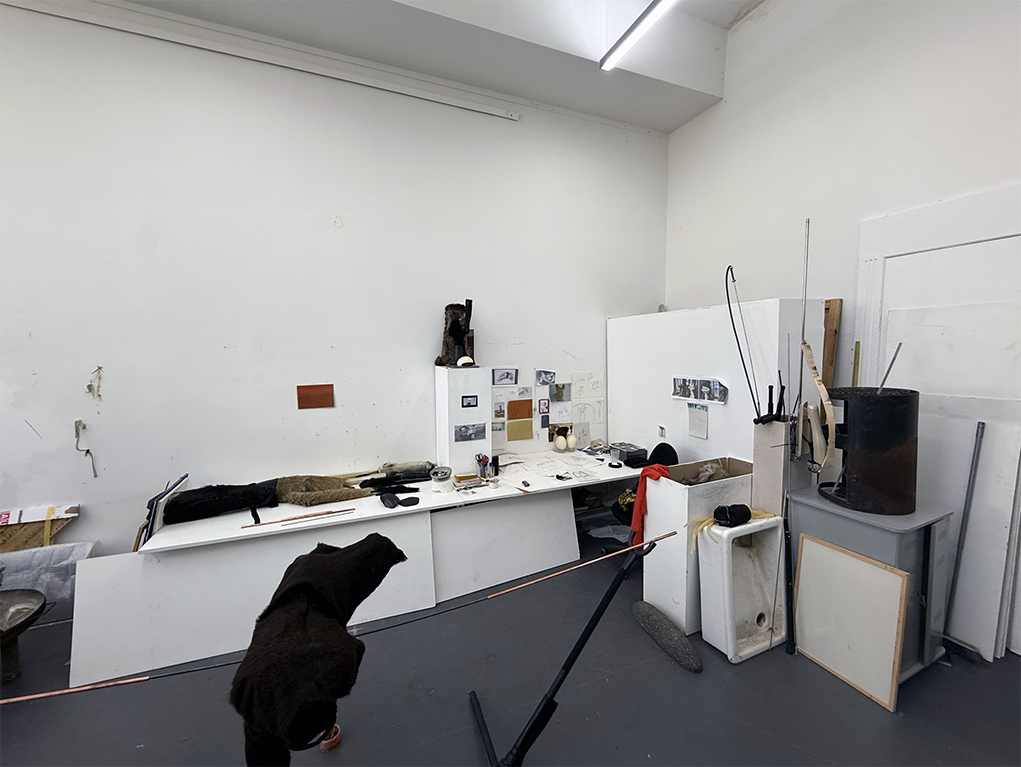
Now based in Berlin, where she was born and where she’s lived since the age of twelve, McMaster makes work that speaks a different language but shares an elemental architecture with those earlier, more naive experiments. Citing a long-term interest in archaeology and anatomy, she creates instinctual formations that echo natural, evolutionary design. Only, they’re slightly off. Like stumbling across roadkill at dusk, they are recognizable yet mutated forms — unnerving shapes that speak of something once animated.
“Baboon VII,” her show at No Tax, Paris, in September 2024, presented a series of works in which the shapes of these chimeric creatures were evoked in fur, hair, leather, metal, silk, silicone, resin, tape, and bone. The show’s titular work, Baboon VII (2024), takes on the form of an animal in a position of prostration, its head replaced with two dark silicone protrusions that look like an abnormally large hoof. Untitled III (2023) and Untitled V (2024) feature fur stitched and draped respectively on metal supports that give the inanimate textile the slightly unsettling feeling of former life. In Bucktoof (2024), two large resin spikes take the form of a bestial dental anomaly. Diptych (2025), from her 2025 show at Cherry Hill, Cologne, featured what appeared to be a shrouded figure atop a bench wrapped in leather and fabric with the skeletal form of a deer’s leg emerging from its side like an expired digit. Toad (2025) is a silicone round with cartilage-like, cranium-esque lumps framing what might be suggestive of a face; and Headpiece (2025) is a Styrofoam bulge covered in black nylon stockings decorated with silk ribbon, fur tufts, and a horsehair plait. Materials such as fur, leather, hair, and bone are often used in McMaster’s sculptural works, carefully positioned to give inanimate material the slightly unsettling feeling of former life. As a child, McMaster adored archaeology, an obsession we discovered we shared during a trip to Greece, in 2022, while staying round the corner from an active dig.
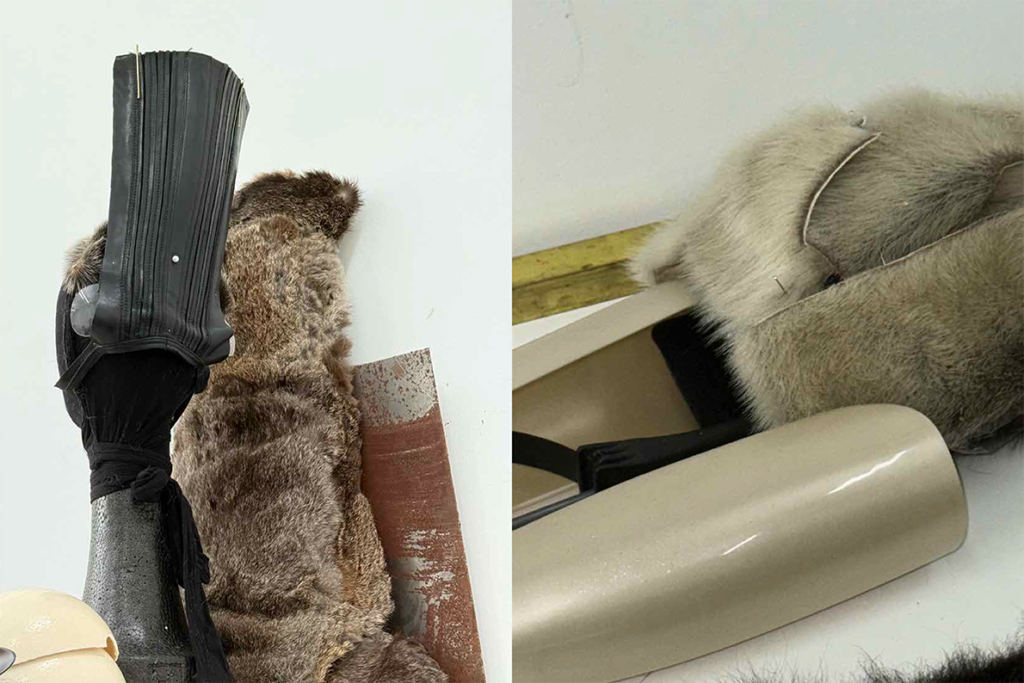
As she grew older, the study of anatomy — how bodies are formed and put together — became important. “Every anatomical structure has a function and a meaning — there’s a reason why it came to be,” she explains. “I try to fit this into my work, how everything loops back into each other, things get repeated in natural history, and an animal that existed five hundred million years ago will have the same anatomical functions as something that exists now.” Flesh and time, it seems, are key points of physical departure for McMaster. “I think I’m a bit scientifically minded,” she explains. “I’m using my knowledge of anatomy as a vessel to translate what I’m putting into a piece on an emotional level.” The body, in McMaster’s realm, is less about individuality than about expressing the complex feeling of being. As emotional tension comes to manifest itself in the body, there are physical signs of it doing so. McMaster is trying to locate that tension and render it in sculptural form.
“They are kind of loaded,” she begins to elaborate on her choice of materials and the effect they might have on the viewer, “but I think that can get a bit misconstrued, because it’s not like: ‘fur versus industrial,’ they’re incorporated into a whole.” She describes the positioning of these materials as “gestures” that “give the sculptures open-ended movement.” Fur, she explains, has that element of movement, too. Charged with associations of the living body, and the reanimation of the animal itself, it gives the work a sense of potential movement, of energy, even as it lies static on her studio floor. Animal skins have long been coveted by humans for their qualities, both physical and psychological, that connect the wearer to the behavior of such creatures. It’s believed that ancient Norse warriors called “berserkers” wore bearskins to channel the aggressive qualities of the animals they once protected. It’s this tension — between the animate and inanimate, the dead thing that channels something psychological pinned to its now extinguished life — that allows McMaster’s work to settle into a distinctive space of discomfort.
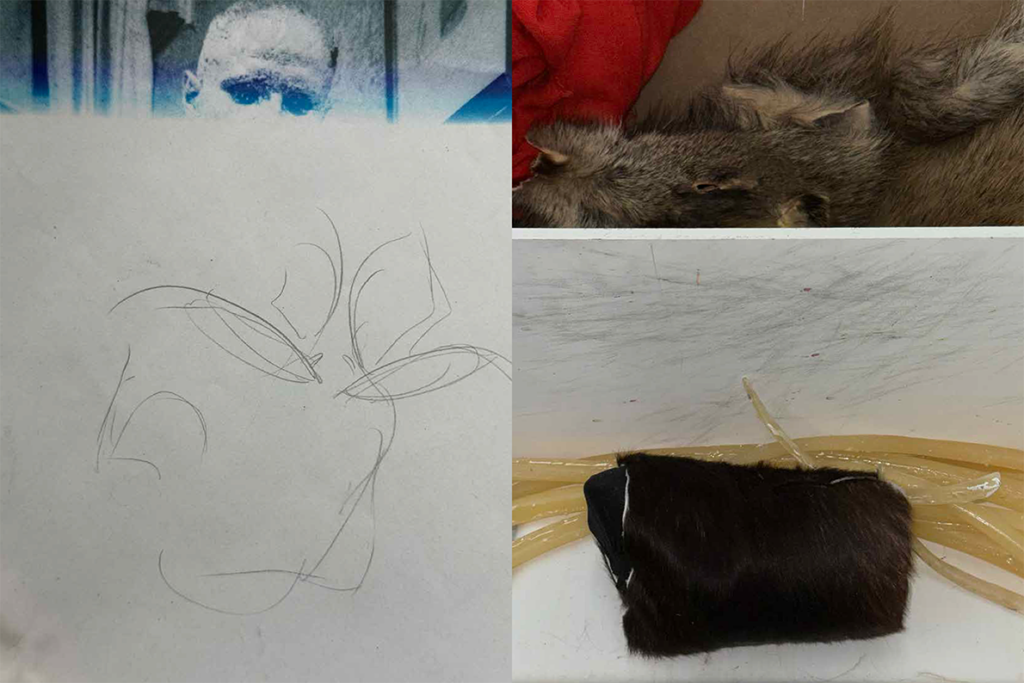
The texture of her work both physically and figuratively is augmented by the language that surrounds it. Medium descriptions are usually long and heavy with opulence: “leather, egg, pins, gold, seal skin” makes up the piece Fenula (2026); Figure (Perched) (2026) consists of “fur, metal, copper, plastic, glass, pins, silicone, silk”; and “bronze, leather, bone, hide, mixed material” are components of Study of a Bird I (2025). Within her writing practice, occasionally published alongside the work as a “press release,” language escapes from McMaster in long ribbons of description. “Often the writing puts into words what physical attributes I’m putting into the work in terms of what they impose,” McMaster explains.
Far from didactic descriptions, however, the language — disjointed, sparse, heady — sets the tone. A text published alongside her Cherry Hill show, for example, alludes to the psychological elements she was tapping into within the work, in which “how two or more bodies converge insatiably or politely is a reflection of the scattered ego.” Flickers of shape and body occupy her textual output; a description, perhaps, of what the experience is to make the work itself: “internally refracted, the experience of personhood is the sum of its parts, primal necessities fulfilled by two polar sources of need.” She cites Anne Carson as someone whose work she has been reading lately. “The way she’s nonsensically making so much sense, I get it — hardcore.”
“These sculptures are elements of the psyche,” she explains. “They are what I call ‘conditions,’ and, you know, I wouldn’t usually say this so openly, but they contain these elements of violence, of sexuality, and have a sense of oafishness, some stupidity, that I’m trying to condense all into one thing.” Speaking to McMaster about her work, the word “fetish” comes to mind. Rather than any Freudian conception of the term, it’s the older definition of “fetish” that is of interest in relation to her work. As historian William Pietz identified in the 1980s, the root of the term was intimately tied to the material world, and emerged from an attempt to arrive at an understanding of object relations outside the realm of commodity culture.[1] In the sixteenth and seventeenth centuries, the pidgin word fetisso emerged, used by Portuguese and West African traders, itself derived from the Portuguese fetiço, meaning “crude magic,” which comes from the Latin facticius, “to manufacture.” And here we arrive at the root of the term “fetish.”[2]
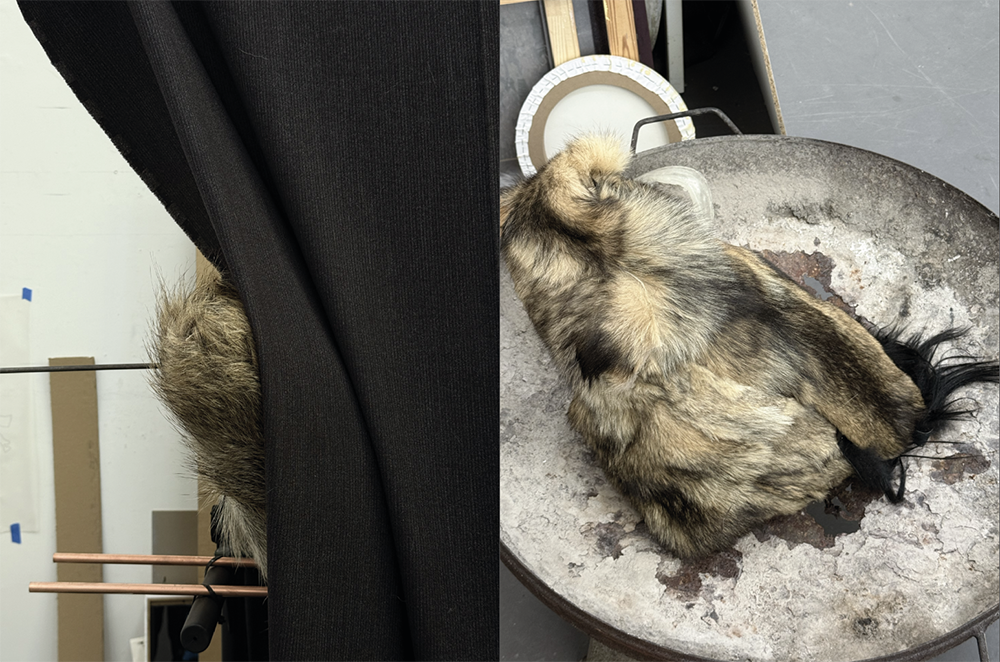
While there’s a near-irresistible temptation to begin to analyze McMaster’s sculptures through such a lens, the artist herself would rather resist such outside speculation. Aside from the occasional texts that she writes, she avoids the overly academic impulse to provide viewers with a stable conceptual framework through which to decode her work. McMaster refutes any allegorical or conceptual grounding for her sculptures, insisting that the viewer react in what she terms a “primal” fashion to her works. The way she makes work is guttural: “I want to hit something very, very core.”
The work itself begins with a feeling, which is what will come out in McMaster’s “gesture.” This will then be drafted onto paper as a sketch, offering the first inkling of physical form. “I might see the shape of a leg, and the shape of the leg starts to mean something, and then I’ll find stuff — I’m like a raccoon, I’m rummaging around finding stuff all the time — to replicate that shape.” This is when she begins to build. “I make a huge pigsty,” she laughs. The nature of the work will come out through this next process. As she makes, she is consistently reducing, eliminating surplus to boil the energy of the work down. “I need to make it into, like, a ball.” The most condensed, firm form it could possibly be.
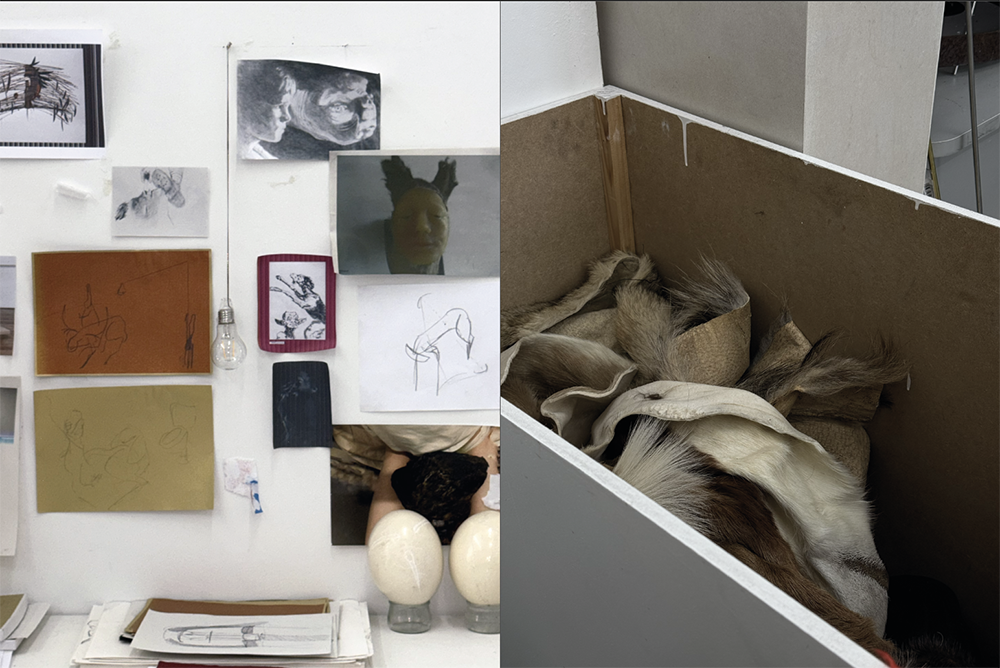
“In my work, I’m never trying to reach a resolution,” she explains. “I try to imply that what you’re seeing is perhaps an aftermath; that something has happened, but also that something could still happen.” As though the material might decide, at one moment, to unravel itself and transform into something entirely new. This sense of latent animation — the feeling that one of these pieces could abruptly stand up and walk out of the gallery door — is ultimately what the sculptures reflect back to us: that McMaster, like us all, is a multitude of contradictions, that the emotional life of a person can never truly be contained, and that sometimes the most terrifying thing you can do is put all of this out in the open, for all to see.
[1] William Pietz, “The Problem of the Fetish, I,” in RES: Anthropology and Aesthetics 9 (Spring, 1985), 5–17.
[2] Ibid., 7.