Living in the United States in the spring of 2026 is akin to living in the center of a hurricane influenced by individual and societal forces that are much larger than any given cultural zeitgeist presentation can address. The 2026 Whitney Biennial, this time presented without a title, raises an old question with renewed urgency: What can a biennial meaningfully do in a time of profound social and political fracture? In New York, it has become common to criticize this Biennial; such criticism signals one’s superior stance in aesthetics, political bipartisanship, and understanding of global politics. Within this context, what we see at the Whitney this year might be seen as an indulgent escapade into American isolationism, but this is not the case.
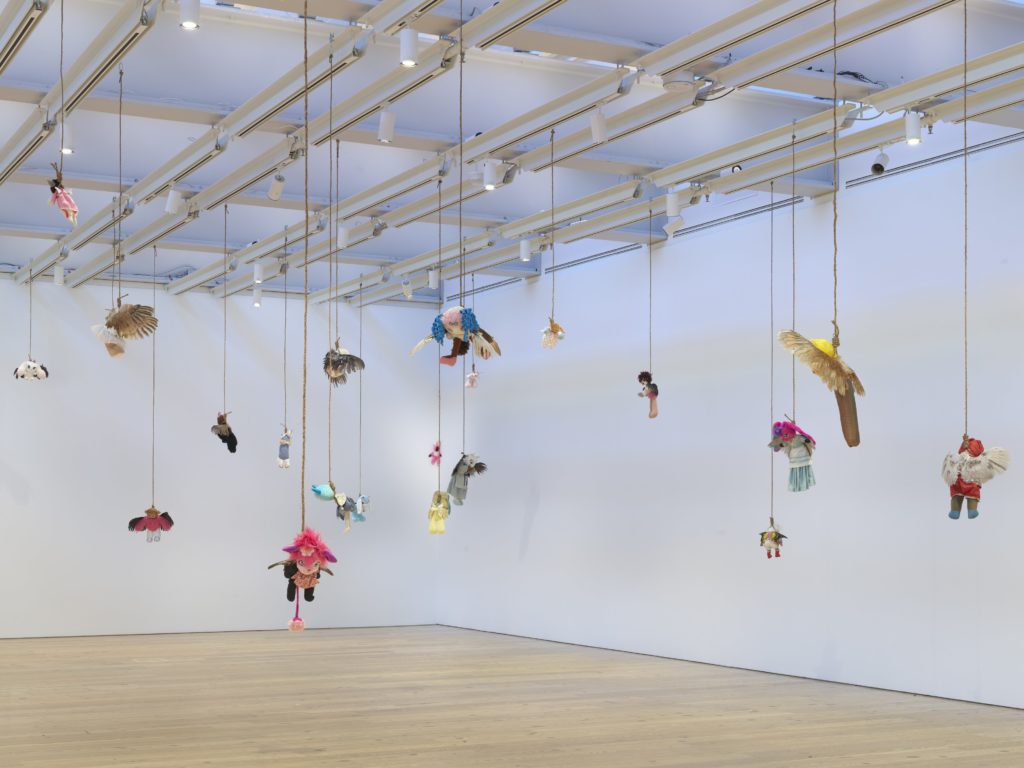
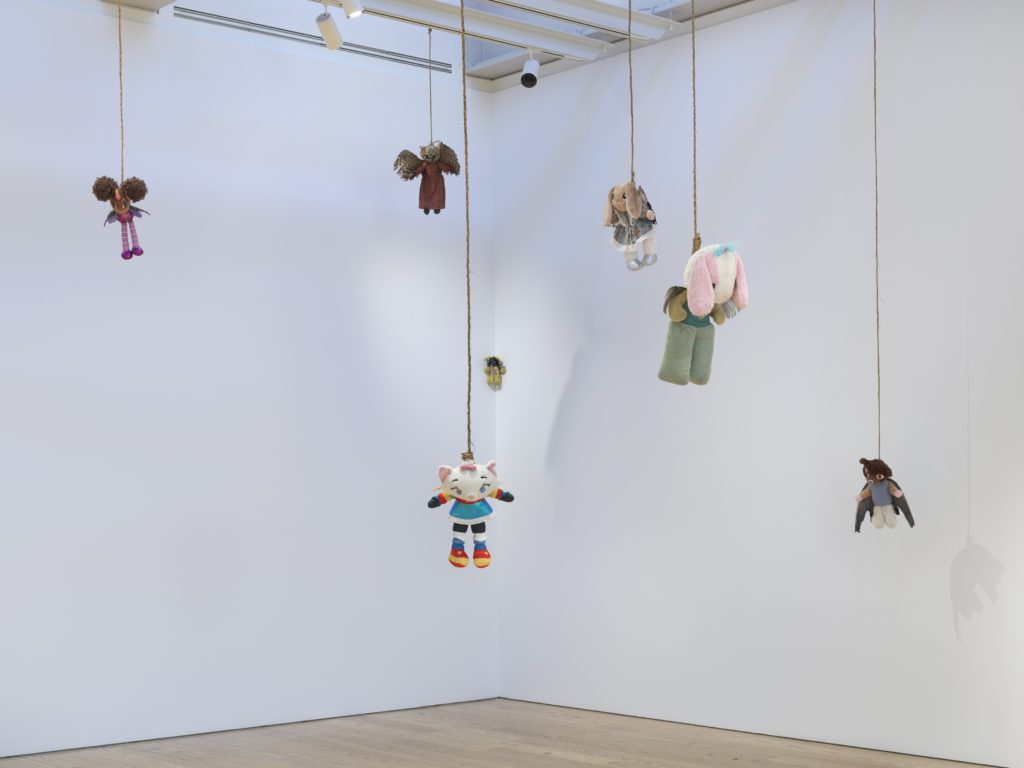
One work that seemingly speaks to this escapism is Everything wants to kill you and you should be afraid (2026), an expansive installation by Precious Okoyomon — a room filled with tiny plush toys hanging from ropes. Okoyomon, a Nigerian-American artist who seamlessly blends poetry, installations, and sculpture, creates a force field. The installation features winged plush bears, owls, and bunnies, among other animal forms, hanging helplessly. While there is an obvious reference to historical acts of violence and lynchings, the piece raises larger questions: Do we witness a universal image of suffering, or is this merely an American form of diminishing human dignity? Or, to reframe the question: Can one symbol of suffering stand for another? The problematic nature of signification is a central theme of this Biennial, which also reflects a larger cultural moment — a reconsideration of how art is created, viewed, and contextualized. This shift is fueled by the imminent disruption of the traditional consumer models of contemporary art, which, under market pressures, have become fast-producing, clinical utility belts of consumption. Artists, in turn, are experimenting with new methods of conveying their messages and visions, often turning to less explicit forms of investigation, employing non-direct engagement with subjects and forms that speak to larger issues. Discussing vulnerability rather than its direct socio-political or historical causes would be one example. It is not self-censorship, but rather more similar to a reservation for preservation’s sake, a silent accumulation of momentum.
Consider the history of socially engaged art: it has emerged during times of social upheaval — 1917, at the heyday of the European avant-garde; 1968, during a year of social unrest; and 1989, following the fall of communism. Each of these paradigm shifts was preceded by years of intellectual and artistic groundwork that paved the way for new developments. The Whitney Biennial reflects this silence turning into a whisper — a more implicit process — across its showing of fifty-six artists and art collectives reacting to acceleration.
The exhibition engages deeply with the theory of accelerationism, as eloquently discussed by Joshua Citarella, one of the Biennial’s participants, in his long- form podcast Doomscroll. Accelerationism posits that the destabilizing forces of society — such as technological advancement and the dismantling of traditional institutions — may ultimately become the forces that reconstruct society, if pushed further. In other words, capitalism will be broken if brought to its limit. This theory originates from Marxist theories, but more recently from Cybernetic Culture Research Unit, as well as Alex Williams and Nick Srnicek.[1] What we see on view at the Whitney Museum is a disruption of larger systems of understanding, in favor of a focus on systems of interconnection — body, identity, ecology, and community.
What we experience viewing these works is not a lack of understanding, but rather a heightened sense of engagement with critical issues, especially when existential threats, like the global rise of authoritarianism, are looming. Works like Okoyomon’s installation and Pat Oleszko’s oversized inflatable Blowhard (1995) question power structures by engaging directly with symbology and faces of power. In the context of these themes of violence and historical trauma, Isabelle Frances McGuire’s installation Satan in America and Other Invisible Evils: Experiments in Public Sculpture (2026) draws on mythologized scenes from American history, ranging from the witch trials in Salem to Abraham Lincoln’s birth near Hodgenville, Kentucky. The three witches are modeled from open-source medical 3D CT scans of human bodies. Though these scans offer high- resolution views of internal anatomy, they leave the body’s outward surface fragmentary and unresolved. Nearby, two Salem villagers hover in suspension, their forms assembled from character models taken from the video game Doom, an influential shooting game where the participants shoot all sorts of demons.
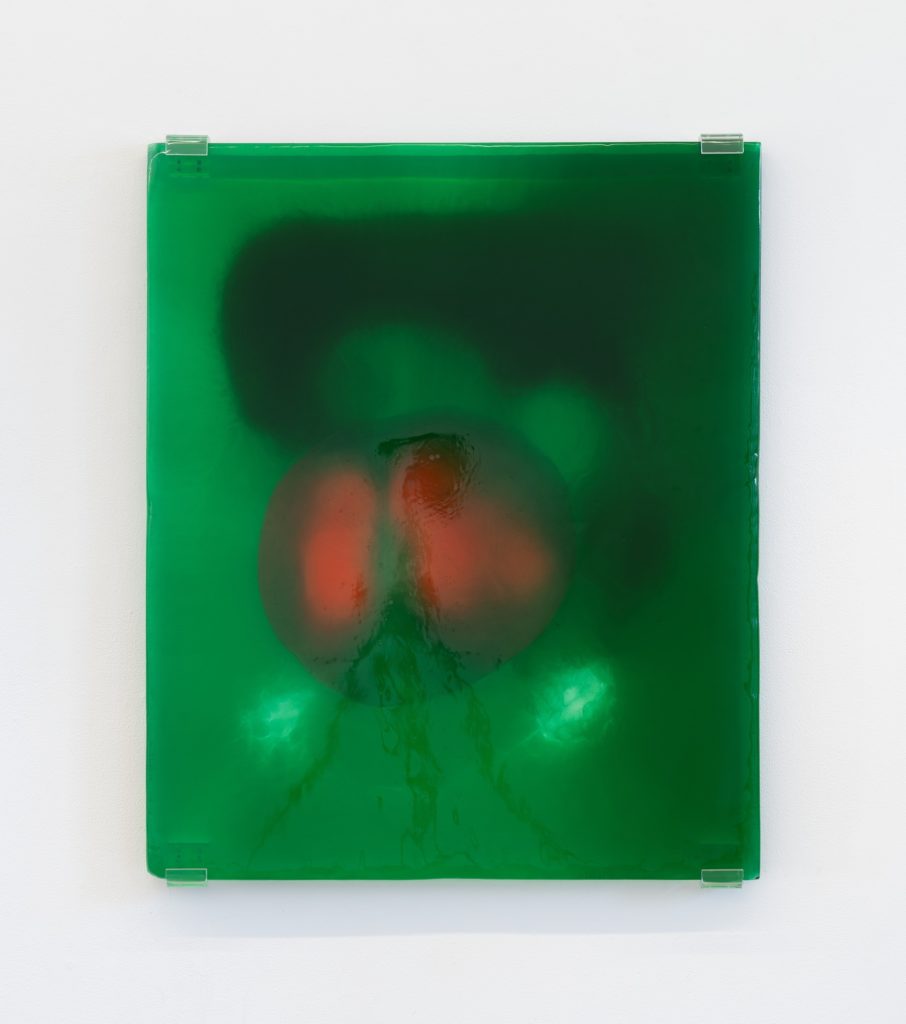
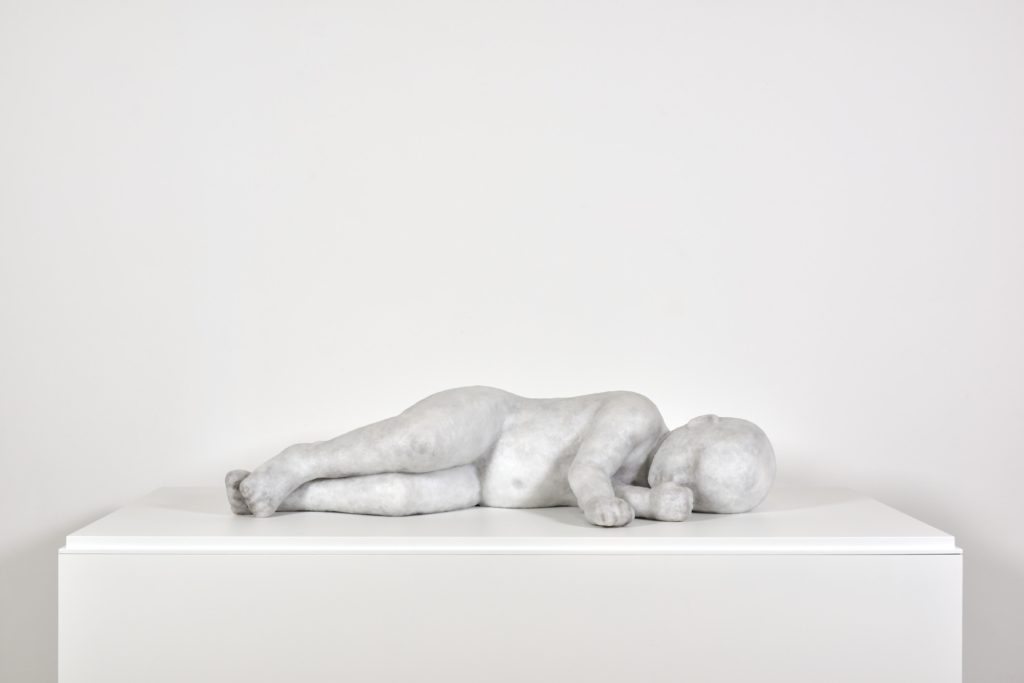
Yet, beyond these separate works, the shift toward socially engaged art, focused on human fragility and interconnectedness, is more pronounced than ever in this Biennial. Andrea Fraser, known for her institutional critique, presents sculptures of sleeping toddlers as allegories of the artwork itself — objects in need of care and protection. Four similar but not identical toddlers are depicted in various states of repose, hand-modeled from a wax that never hardens, encased in plexiglass containers that heighten the sense of vulnerability, not unlike our own. We all need these types of walls to protect us from calamities. A collection of Emilie Louise Gossiaux’s drawings and ceramic chew toys opens the Biennial, commemorating their late guide dog, London. Subtle, minimal drawings show Gossiaux and their dog as a kind of interdependent couple — close and intimate. By creating multiple versions of London’s favorite chew toys, Gossiaux sought to design a comfortable and affection-filled afterlife space for her companion.
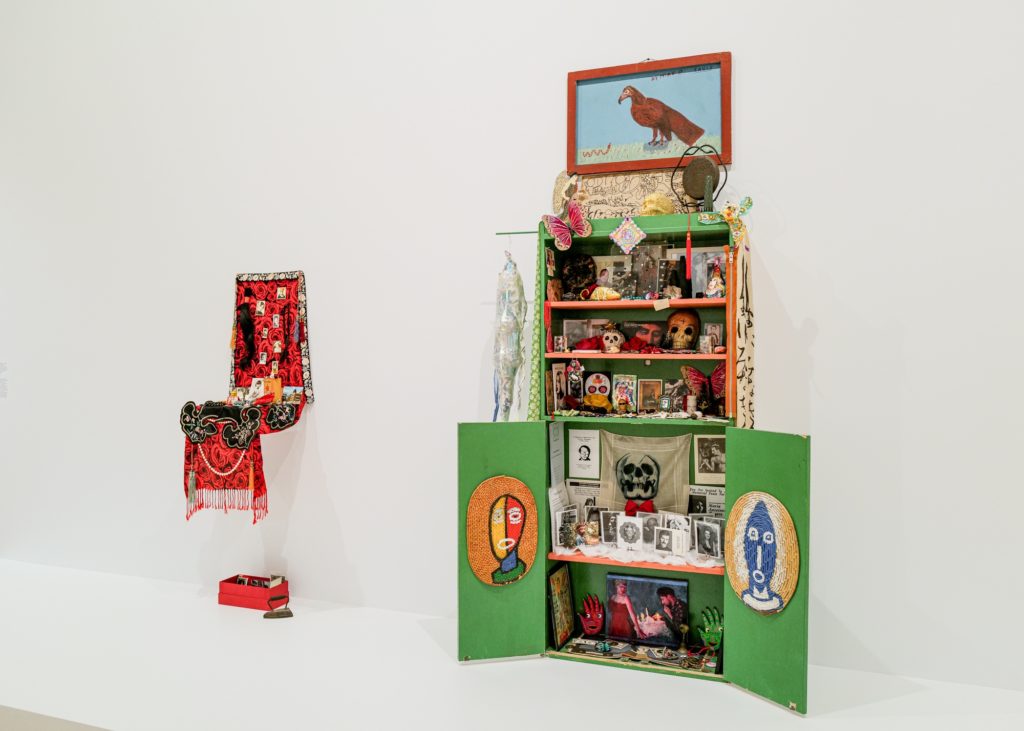
An amplified awareness of structural injustice brought about by disruptions of accelerating capitalism shapes several of the exhibition’s most powerful works. One poignant piece, Look Where I Took You (2026) by Baghdad- born Ali Eyal, depicts a Ferris wheel made of revolving black-haired heads, surrounded by a post-apocalyptic landscape. The scene is rooted in Eyal’s memory of visiting an amusement park in Baghdad with his mother and two sisters before they left the city, an example of systemic violence producing displacement and intergenerational trauma. The theme of systemic inequality that transforms people’s lives into an uninhabitable landscape also runs through Akira Ikezoe’s meticulously executed paintings. These pieces, almost slogan-like in style, could be straight out of an Elon Musk or Karl Marx cosmic mood board. People in repetitive, seemingly endless patterns are farming distant planets, wearing white space suits. Energy sources vary from nuclear plants to cow manure, yet the communities depicted — whether dining or working together — appear completely alienated, mechanical, and sterile. In contrast, Agosto Machado’s altars and shrines offer a more comforting element to this alienation. As a practicing caregiver, self-described “street queen,” and self-appointed archivist of the 1960s New York AIDS crisis, Machado creates vibrant and generous homages to his queer community. Anna May Wong (altar) (2025) is a small devotional assemblage consisting of pearls, a Chinese embroidered shawl, shoes, human hair, Mahjong tiles, Chinese fingernail guards, Empois Chinois starch, and other detritus of life that are equally important to understand fragility.
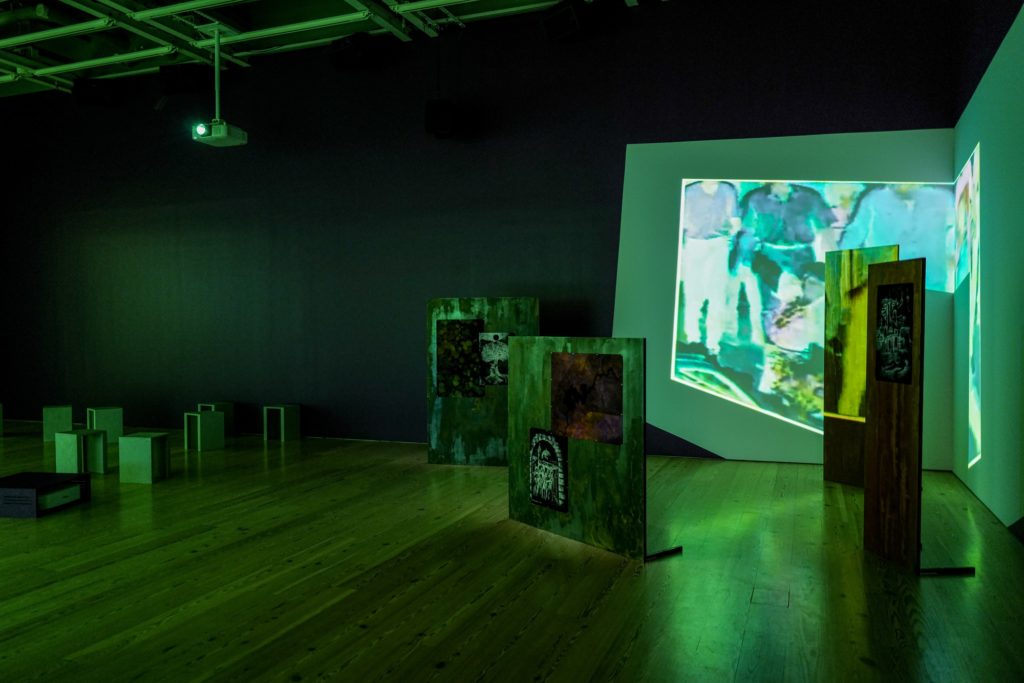
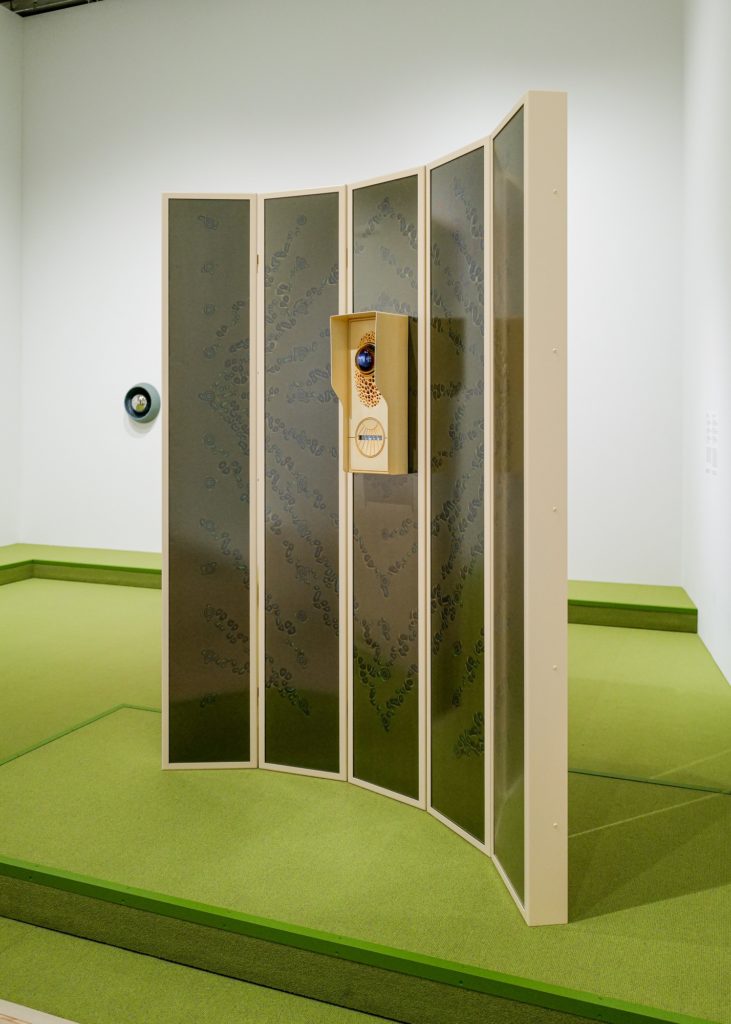
The overarching question posed in this and other biennials is how art responds when established systems lose their legitimacy and new systems have not yet emerged. The Whitney Biennial answers this by turning inward, questioning the premise of overt critique and virtue signaling. In this context, Samia Halaby’s kinetic paintings and CFGNY’s (Daniel Chew, Ten Izu, Kirsten Kilponen, and Tin Nguyen) subtle exploration of Asian identity and appropriation stand out. Halaby’s electronic and shape-shifting paintings, created using an Amiga computer, explore movement and how technology affects perception. CFGNY’s ambitious, translucent installation offers a precise, critical view of what Asian identity means, reflecting the shifting dynamics of global realities.
Finally, a work that encapsulate the essence of the Whitney Biennial 2026 can be found at the far end of the fifth floor. It is a sound piece consisting of twenty radios, composed by Filipino composer and ethnomusicologist José Maceda and revisited by Vancouver-based artist, composer, and curator Aki Onda. In 1974, Maceda composed a fifty-one- page score and recorded Filipino bamboo musicians in collaboration with radio stations across Manila so that the piece was transmitted simultaneously. The city was filled with the overlapping sounds of Ugnayan, Music for Twenty Radio Stations (1974/2026). As the idea of individual authorship and dissemination gradually gives way to more amorphous, open- ended, and radical modes of art-making, we are flooded with these waves too; rather than choosing which ones to listen, we might try to tune into atonal intersections instead.
[1] https://criticallegalthinking.com/2013/05/14/accelerate-manifesto-for-an-accelerationist-politics/