Like an owner that begins to resemble their dog, we humans have grown closer to our technologically saturated environments. What was once seen as mere background noise — microbes, atmospheric carbon compounds, the data flooding through algorithms — has been revealed as a central force that shapes not only our environment, but us.
Jenna Sutela has been observing this entanglement closely, creating work that amplifies these flows and transformations. Her living sculptures and audio-visual installations never fail to point us to the inherent unknowability of supposedly known processes. Although an adept reader of cutting-edge biotechnological and biomedical research, and well versed in astrobiological thinking, Sutela resists human-centered ideas of intelligence. For her, cognition does not stop at the human brain, but unfolds across interrelationships at all scales. This reconfiguration of cognition becomes operative in her artistic practice.
In Foreign Sequence / Birth Mantra (2020), a pandemic-era online commission, Sutela uses romanesco broccoli — a fractal vegetable, self-similar at every scale — to retell the story of mammalian origins: eons ago, a retrovirus inserted a foreign sequence into the human genome that allowed the placenta to fuse with the uterus and the immune system to accept a genetically distinct being. It enabled birth as we know it in mammals. If this hadn’t happened, humans would be laying eggs. This evolutionary scenario is framed in genetics through the concept of the “foreign sequence,” a retroviral insertion into the host genome. The foreign sequence is the birth mantra: nonhuman, viral, ancient, and utterly intimate. Time and again, Sutela finds kinship rather than threat in the nonhuman world. She establishes this by embracing interference and wetness as the conditions of meaning before it dries into language.
At the turn of the millennium, it was the literary critic and theorist N. Katherine Hayles who remarked that information couldn’t be separated from the material substrate that carries it. Cybernetics had made this illegitimate abstraction, she argued, producing the fantasy of signal without body, meaning without matter.[1] Sutela’s work could be understood as the revenge of the substrate. The concept of “wetware,” borrowed from biocomputing, where hardware and software find their biological counterpart in the body’s own processing architectures, is useful here, but Sutela pushes it further. For her, wetware is not only a metaphor for the brain. Meaning, cognition, and communication are not unique properties of the human mind but conditions of matter itself.
This shift resonates with Laura Tripaldi’s thinking on “soft technologies,” in which biological, chemical, and technical systems cannot be clearly separated, and where matter is understood as permeable and continuously in transformation.[2] From this perspective, even microbes can be understood as technological actors, inseparable from the instruments and interfaces through which they become perceptible. In nimiia cétiï (2018), Sutela produced a glyph set from the twists and turns of a bacterial culture dancing along the surface of a petri dish. On the accompanying 2019 LP nimiia vibié, she moves from language toward resonance; from the voice as a carrier of meaning toward sound as a condition of the world itself. A neural network trained on the movements of extremophilic bacteria and the glossolalic Martian language of the Swiss spiritualist Hélène Smith generates a form of speech that slips beyond articulation, producing a strange, post-linguistic vocality at the edge of sense.
Sonification is a central method in Sutela’s work, and she herself is wary of its tendency to short-circuit in meaning-making or to become illustrative or arbitrary. Through careful indexical mapping, she preserves the trace of a sound’s biological or nonhuman origin, allowing it to remain materially grounded in the processes that generate it. Her sound does not resolve into music or speech; instead, it retains texture and irregularity, without settling into clear form or meaning.
It is difficult to draw clear boundaries between body and environment, or between instrument and organism. HMO nutrix (2022) makes this tangible: a fountain of synthetic human milk bubbles and churns in sync with Arjopa’s biomimetic overtone singing. In the work, cognition, nourishment, and biological exchange are treated as a continuous feedback loop between human and more-than-human systems, rather than separate processes. The sculpture stands in relation to the video Milky Ways (2022), which develops ideas first articulated in Holobiont (2018), where cognition is no longer bound to the human body but distributed across microbial and cosmic scales. Wetness here is less a substance than a logic of continuity in which organism and environment remain indistinguishable, dissolving distinctions between inside and outside. Within this continuum, communication is no longer a human-centered transfer of meaning but an ongoing modulation of signals, affects, and material exchanges. Here, Sutela engages with therolinguistics, the study of nonhuman communication systems and forms of expression beyond linguistic structure that operate around and within us that we have barely begun to register.
Such systems can be found in the rhythms of glowworms, fireflies, bioluminescent algae, and other organisms that emit light to communicate, which Sutela captured in PALE FLUO DOT (2024), a collaboration with Amnesia Scanner. Attending, emitting, attuning: this immersive audio-visual work extends Pauline Oliveros’s notion of Deep Listening toward nonhuman, peripheral perception, where hearing becomes a bodily openness to subtle signals across species and environments. The sculpture 8–13 Hz (2024) continues this inquiry by linking pulsing light and electromagnetic frequencies that align perception with rhythmic, pre-linguistic forms of communication. It is titled after mu waves, brain oscillations in the 8–13 Hz range, an internal neural rhythm linked to bodily rest. Even planet Earth is said to resonate within a similar low-frequency range known as Schumann resonances. Both projects frame listening not as the interpretation of discrete signals but as attunement to continuous fields in which what appears as noise is never purely background; rather, it is a dense field of patterned activity that becomes legible through attention.
Listening, then, is a mode of pattern recognition. A way of sensing rhythm and frequency rather than extracting meaning from isolated events. This attention to shared material rhythms also underpins Sutela’s orientation toward “tech povera,” a term she uses in reference to Arte Povera’s investment in the raw, the low-tech, and the materially immediate. Rather than treating technology as something entirely artificial and opposed to nature, tech povera approaches technological and biological processes as fundamentally entangled. It foregrounds the material substrates of technological systems. In the terms developed here, this becomes a form of fidelity to wetness: a commitment to technologies that do not abstract themselves away from their material substrate. This critique extends to the social as much as the ecological. Thinking about ecological computation, Kei Kreutler has suggested that technological matter is itself a carrier of meaning, complicating distinctions between the inert and the animate. Reflecting on Sutela’s work and her idea of tech povera, she remarks that humans needed centuries to learn how to harness electricity, even though it was already hidden in something as ordinary as soil.[3]
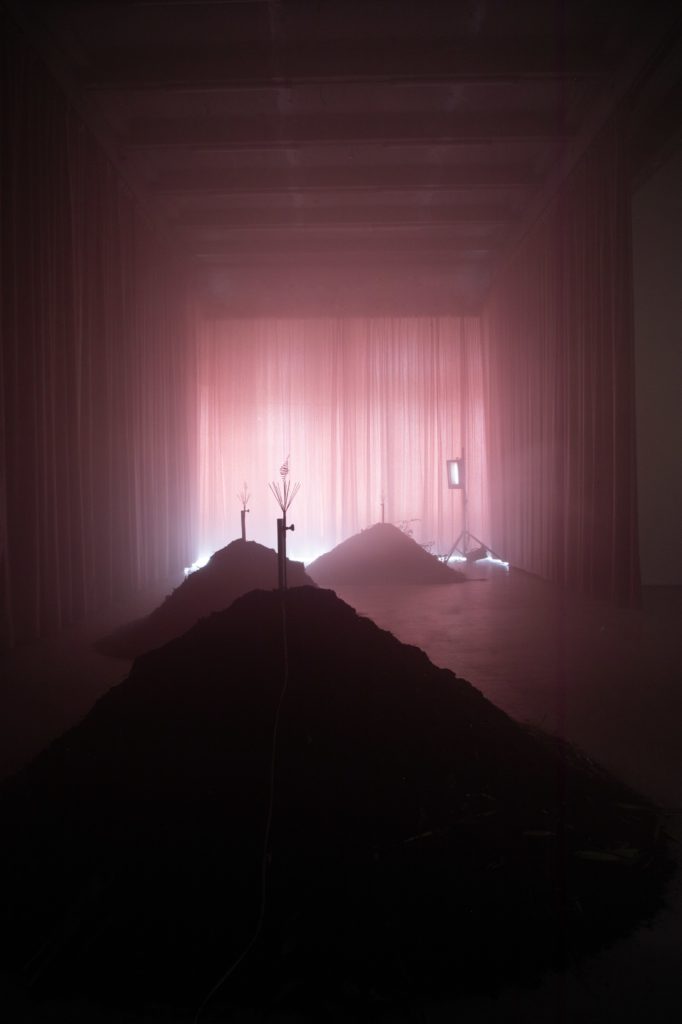
Sutela’s works with fermentation and composting make this logic tangible: in Vermi-Sibyl (2023) and Vermi-Cell (2023), an assemblage of soil, seedlings, and worms generates electricity through microbial processes, powering a sound system via conductive exchange. The work’s title consciously invokes the Sibyl, the ancient prophetess in Greek and Roman mythology, who wrote her prophecies on leaves scattered by the wind. It links this low-tech circuitry to forms of dispersed, material inscription in which energy, matter, and meaning are continuously co-produced.
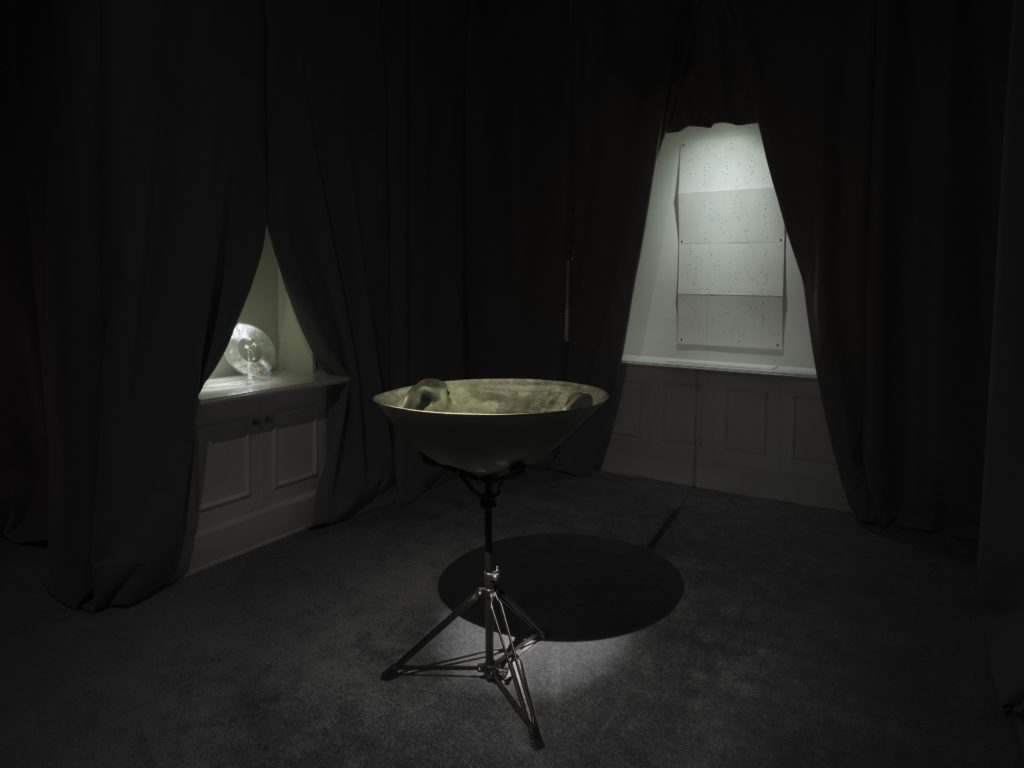
Continuing the focus on moist, wet material processes, Pond Brain (2023) takes the form of a water-filled bronze spouting bowl that can be played through touch and friction. It draws on “alt” cyberneticist Stafford Beer’s idea that a pond ecosystem could function as a distributed, self-regulating intelligence, reframing cognition as something ecological rather than centrally located. The work draws on oceanic and interplanetary audio libraries — star pulses, dolphin vocalizations — feeding them to a neural network that tunes into the sculpture’s sonic frequencies and plays back an array of what Sutela calls “otherworldly resonances.” In its media extension the work takes shape as a limited-edition resin record, made with Disc Archive and released on PAN’s “Entopia” series. It incorporates organic pond matter within its surface. Its mutable grooves ensure that each playback differs, while the record itself gradually degrades, making entropy part of the composition.
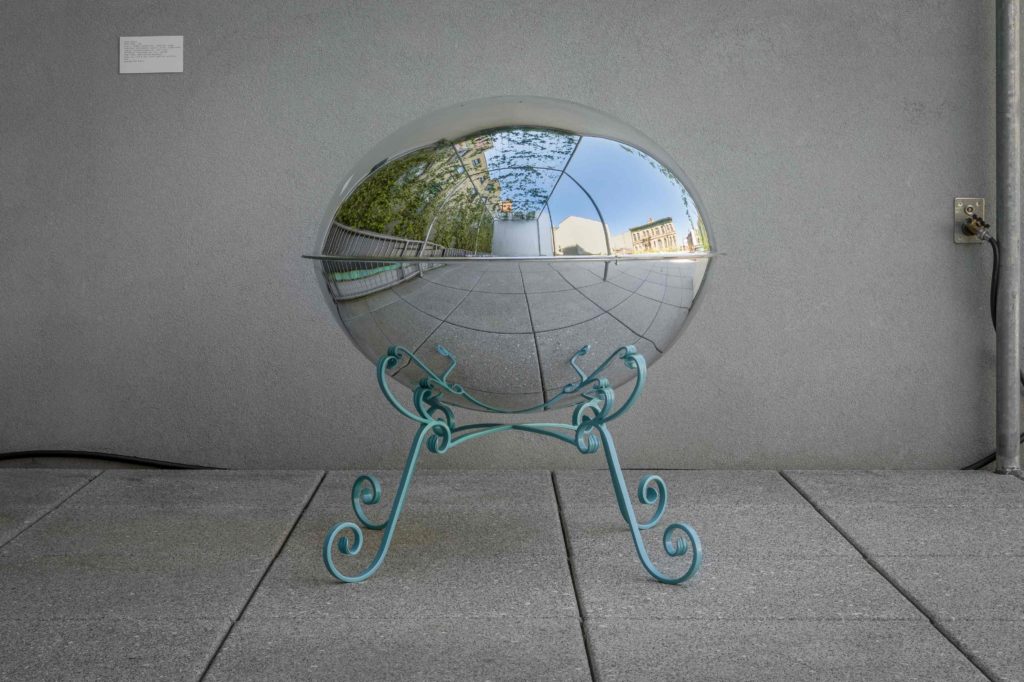
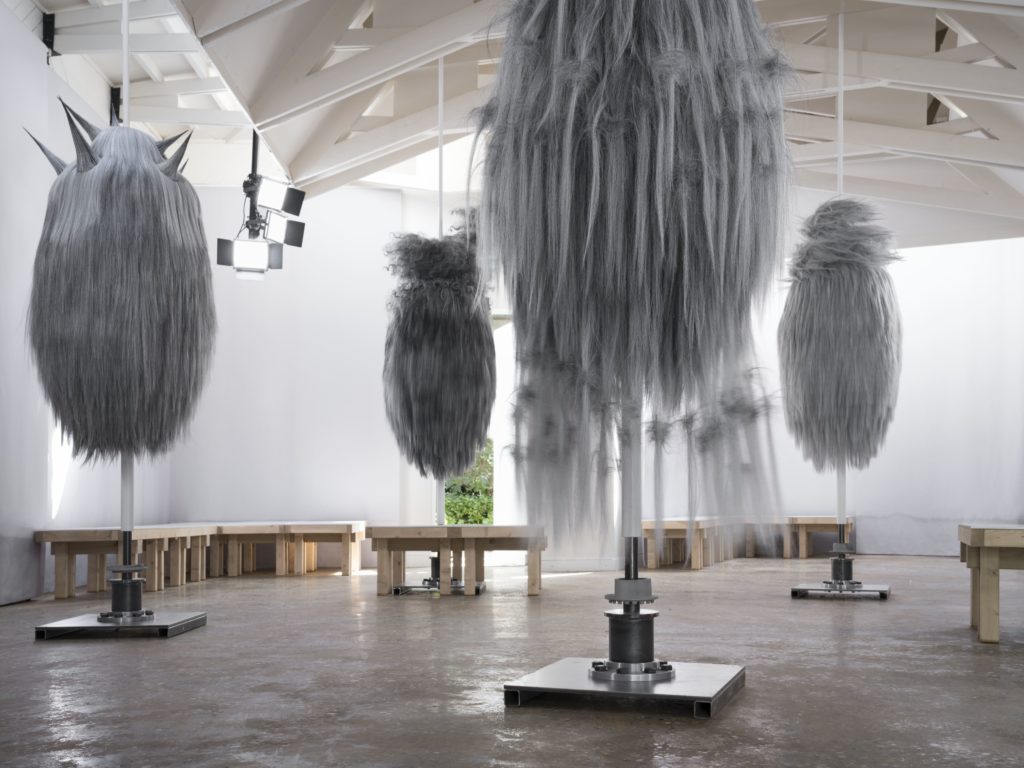
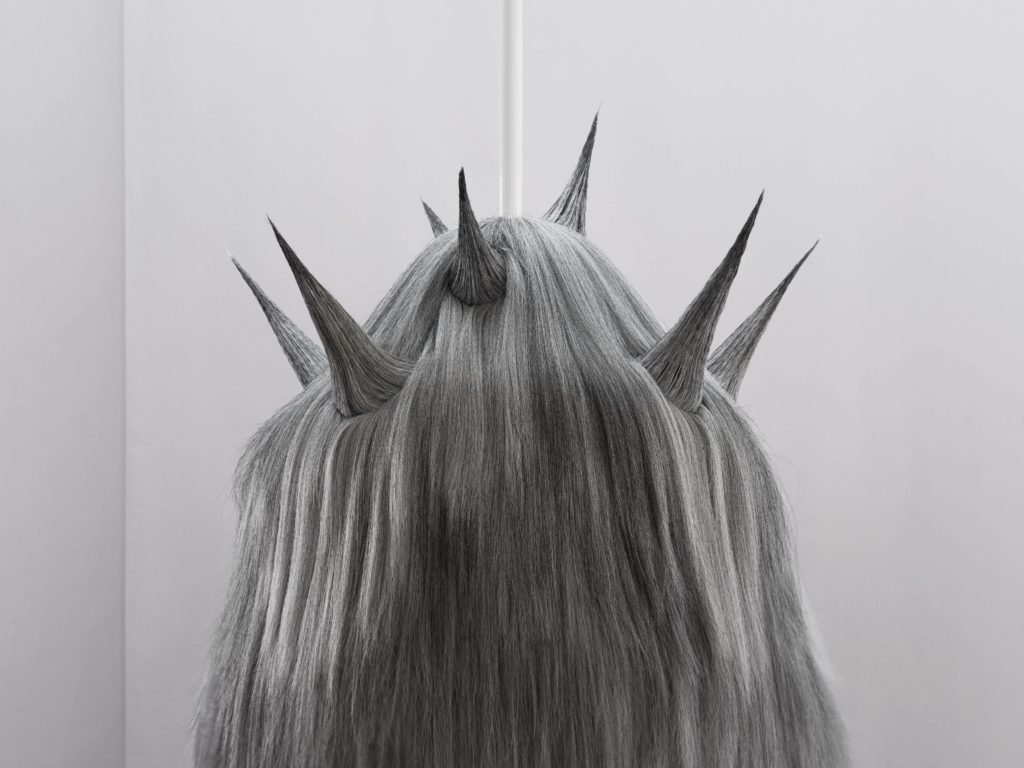
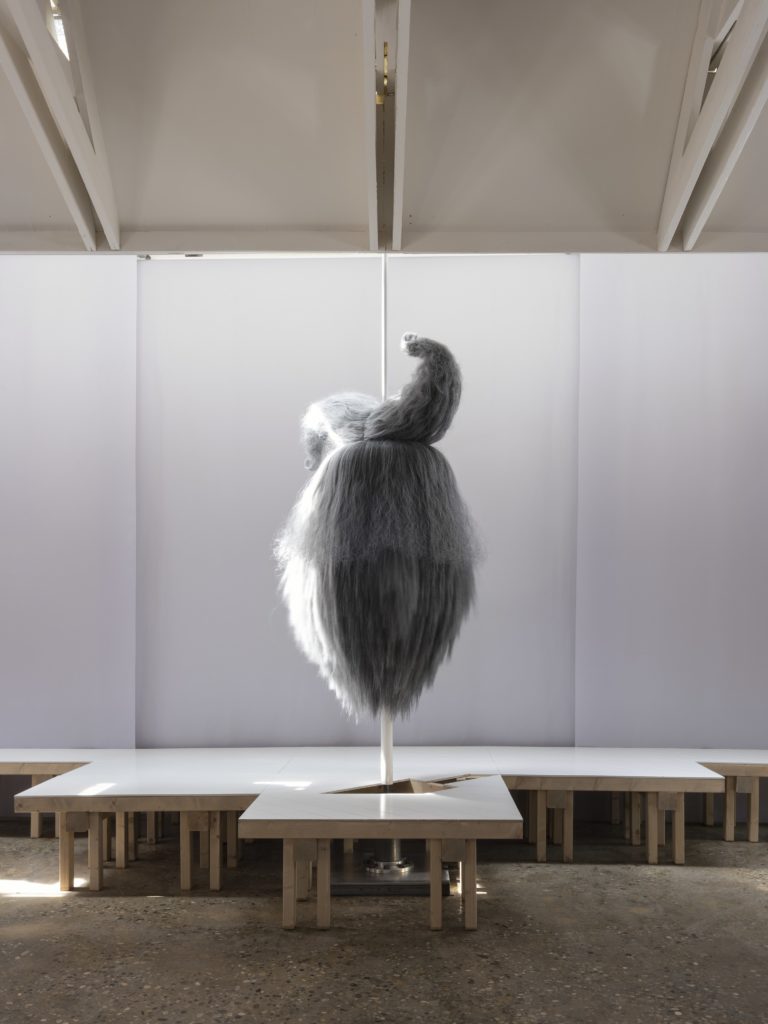
This concern with dispersed, environmentally co-produced sound continues in Aeolian Suite (2026), a windscape Sutela created for the Finnish Pavilion at the 61st Venice Biennale. The installation draws on grammelot, the “art of speaking without words” from commedia dell’arte. These traveling theater troupes moved across the Mediterranean and, in order to bypass language barriers, communicated through rhythm, tone, and gesture rather than fixed linguistic systems. The artist describes her installation as “a theater of sound sculptures.” Shaped like microphone wind muffs, they echo the wind’s own language.
Understood as an Aeolian instrument, this installation becomes a figure for music the world makes by itself, for itself. Musically speaking, a suite is also a sequence, less foreign than the retro-virus but perhaps a kindred form. The instrumentation brings together a children’s woodwind orchestra, meteorological data, field recordings, and wind machines. The human performers tune into nonhuman rhythms, neither fully in control nor fully given over to chance.
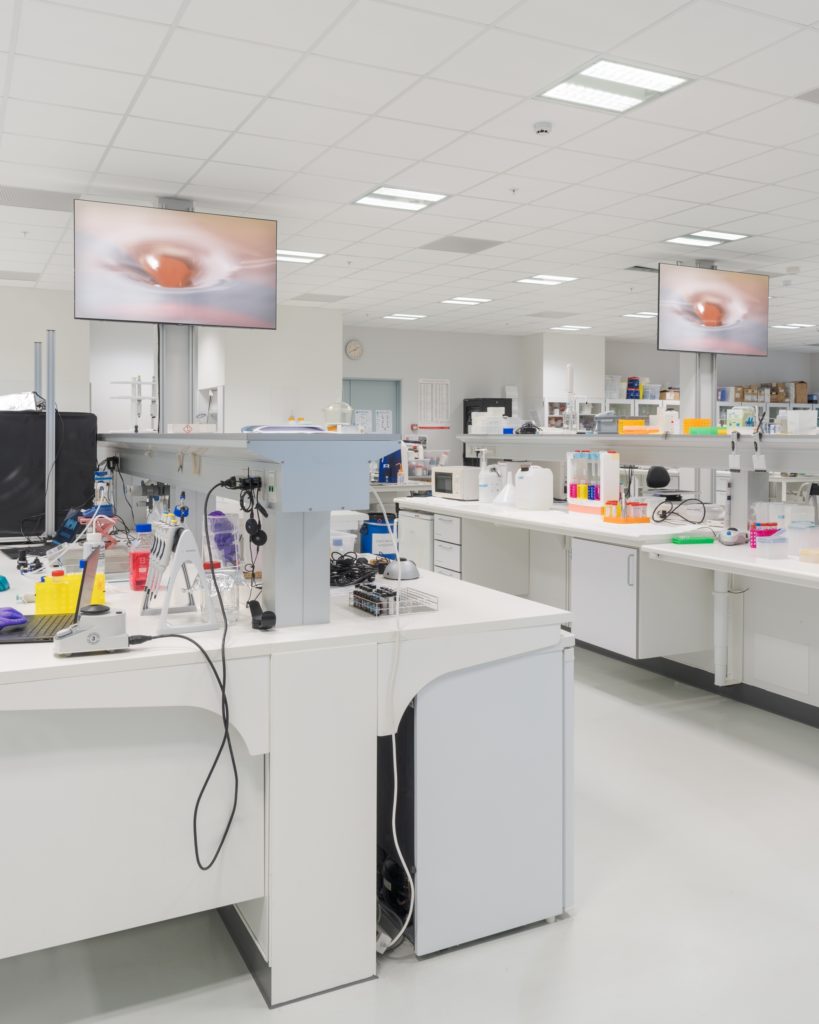
Listening to the wind creating noise on the microphone is to tune into interference, into what we perceive as wet flicks of sound — moments in which disturbance becomes a signal. The same wind that interferes with our recording is also what makes sound possible at all: in a vacuum, there is no sound. In an oversaturated world, information is so abundant that it becomes noise. The children in Sutela’s orchestra intuitively inhabit noise as a form of expression. It seems they know that to work in sound is to work in the shared medium of the world, the thing that passes through all bodies and does not belong to any one of them.
[1] See N. Katherine Hayles, How We Became Posthuman: Virtual Bodies in Cybernetics, Literature, and Informatics (Chicago: University of Chicago Press, 1999)
[2] See Laura Tripaldi, Parallel Minds: Discovering the Intelligence of Materials (London: Urbanomic/MIT Press, 2022).
[3] Kei Kreutler in the exhibition text for Jena Sutela: ave bossa, bow ole, exhibition at Stroom Den Haag, [2005].