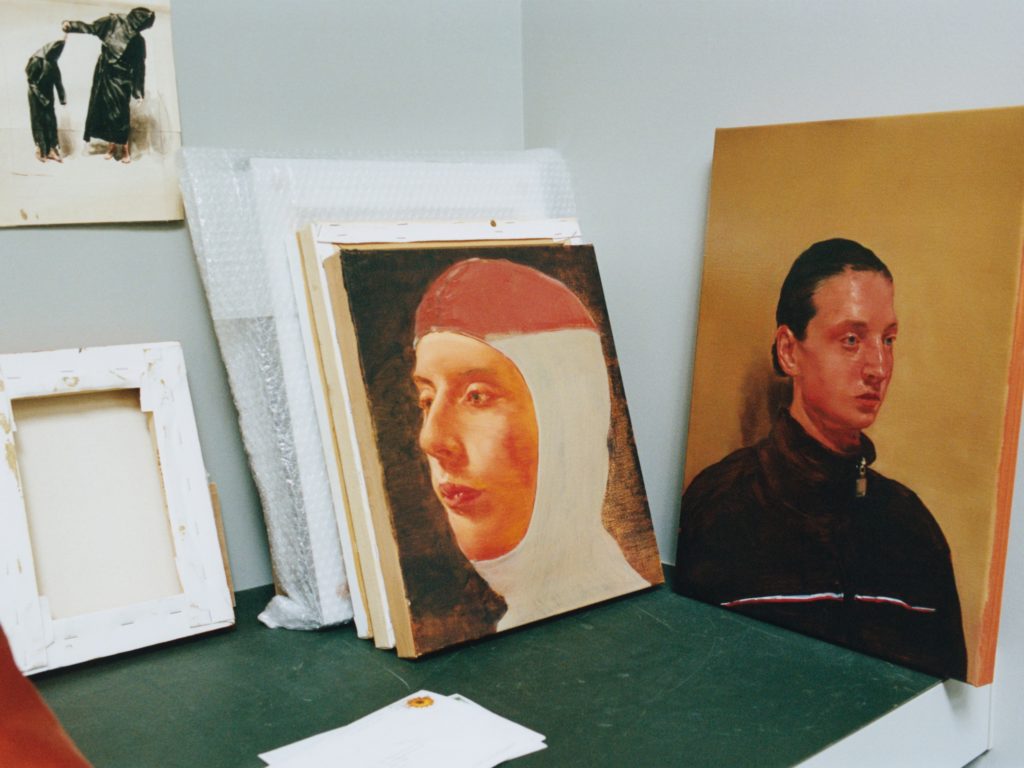
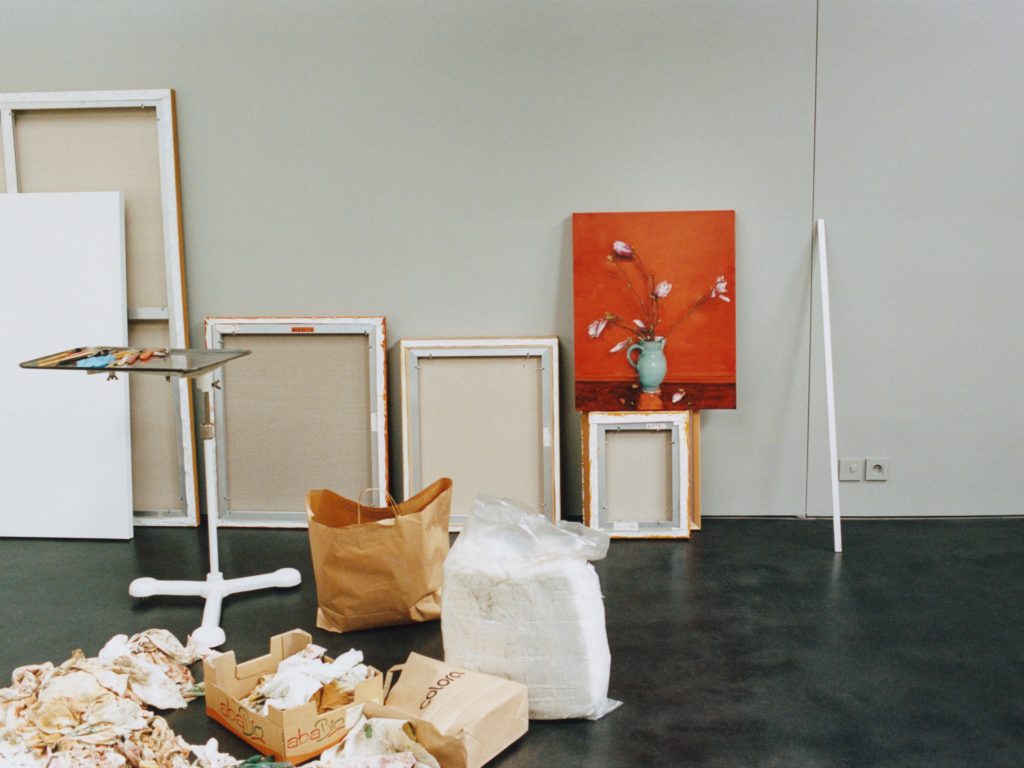
Seeing a painter’s studio always feels intimate. It’s impossible to keep your eyes from darting around. Soaking up the surround. Trying to piece together the puzzle of process, from pigment to binder to canvas. In the case of Michaël Borremans, paintbrushes of various sizes, density, and widths are lined up; bottles and jars of solvents are scattered over tables; paint-stained rags are gathered into a pile. There is a white plate with edges encrusted by sediments of beige and fleshy pinks, with dark greens and blues punctuated by bright flashes of cadmium red. Yet the center of the plate is so clean you could eat your dinner off it. Sparkling.
Known for his paintings that pristinely depict disquieting imagery, from people dressed as bullets to hooded figures ritualistically dancing around a badger to a woman whose face is pierced with feathers, Borremans’s figuration suggests an unreliable reality, one in which the line between representation and realism is indeterminate. The artist’s exhibition “French Painting” (2026) is currently on view at David Zwirner in Paris, where a new body of paintings explores how ideas of legacy and beauty intertwine with tenderness and nihilism. I spoke with Borremans about what drives his curiosity as an artist, his subversion of the French tradition, and whether or not beauty is still relevant to painting today.
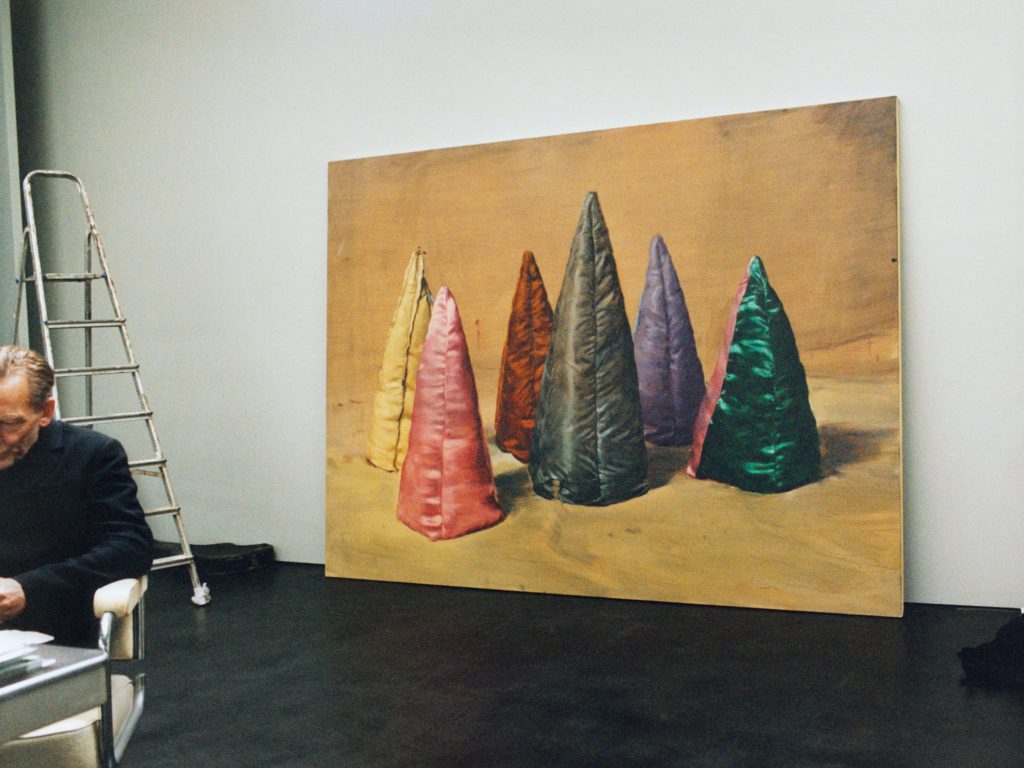
Louisa Elderton: As part of your exhibition at David Zwirner, you cite an ironic homage to the French pictorial tradition, and seek to subtly unsettle its legacy. In one painting, a caramel-colored, bomb-like form rests upon a small wooden panel against a sumptuous backdrop. It is at once threatening and intimate. The effect is strange and unnerving, in part because the object is both alluring and sinister. What informed this dual approach?
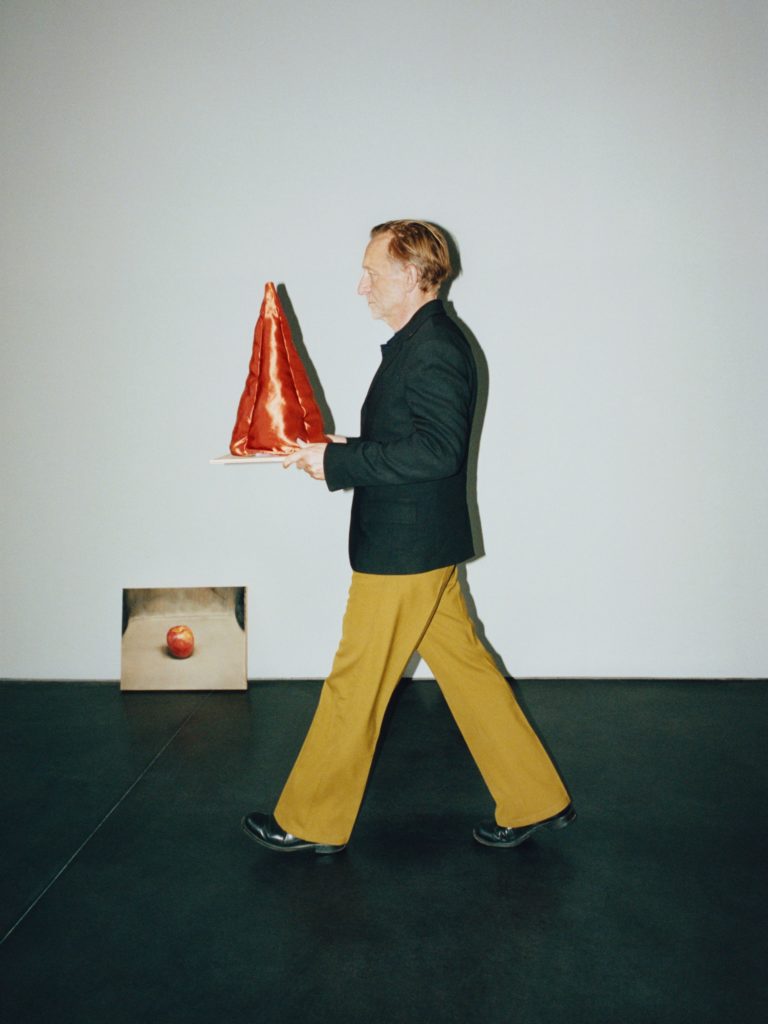
Michaël Borremans: Actually, it’s a missile, which is padded, like a padded coat. So when it falls, it lands softly. It’s ambiguous in its meaning. It’s meant to be aggressive, to be violent and destructive. And at the same time, the padded coat also refers to fashion, to consumerism, to desire. These are the two extremes on which the work reflects.
LE: It’s so formidable, that suggestion of violent destruction balanced — or working in tension — with the surface gloss of consumerism, which never quite lands and allows desire to be constantly on the move. With this body of work, as with most of your paintings, you seem to draw upon distinct tensions that have a haunting relevance in our time: Do you think quite specifically about the human condition and “individualism” in this moment, or are you more interested in the overarching structures and systems that shape us?
MB: Well, the large work in the exhibition is clearly the human being. He is a perpetrator and also the victim at the same time. He has no clear position anymore. The painting reflects on the state of humanity today, on the constant tension between the human impulse to dominate and control in a world where beauty and destruction are intertwined. It’s worrying.
LE: Can you expand on what worries you about it exactly? Your work often engages with timeless human concerns like power, vulnerability, ambiguity, and identity, and this can lead to a sense of the instability of meaning itself within your paintings. But from what I understand, you’re referring quite specifically to the state of the world as it stands, to the now; you’re grappling with questions of individual responsibility amid the frameworks or systems that bind us. Is that the case?
MB: Yes indeed, it is the case. Who is not worried about the state of the world right now, and especially our future? You can think you have principles and standards for yourself. Yet our education system is also starting to fail. If you don’t invest in education, in proper education, you will ruin your society. If politicians really want to invest in the future — and the question is whether they do really want to — and better society, you have to invest in education. It should be the first goal. Schools and education systems have to be ahead of things. They have to be much more progressive. If you want a better world, it’s the first urgent thing we have to do.
LE: Yes, we’re seeing governments around the world slashing funding for the arts and cultural institutions, as well as for arts education more generally. What do you think the role of art can be in all of this? In — as you put it — looking at the state of the world?
MB: I can only speak for myself as an artist. It’s a cliché, of course, but I try holding up a mirror. The mirror might be dark, but it’s a mirror nonetheless. An artist is someone who stands outside and looks inside and comments. That could be an artist, it could be a writer, it could be a filmmaker, it doesn’t matter what medium you use: even fashion designers, some of them are truly great artists and they reflect society just as well. But you only see it with time. It’s very hard to see today. That’s why Goya is such a great artist. He was so far ahead of his time, he was a true romantic and also deeply concerned about society, about his fellow humans. He’s always been a great example. That is why his work still stands out today; it is still very modern.
LE: The wonder of Goya is in his stark reflections on contemporary historical upheavals, and many art historians have written about how he felt alienated from social and political trends. Of course, he was also tormented by a dread of old age and fear of madness, and this mental and physical despair influenced his Black Paintings 1820–23), which he painted directly onto the walls of his home. He never spoke of them and never intended for them to be exhibited. They’re ultimately a private call of despair, but we can’t be sure of their reason or meaning.
MB: There’s no point in painting something without a reason, not for me. I cannot always point out what that reason is exactly, but I feel it. It’s an intuitive process. What I’m telling you now all comes from later analysis. My vision of the world is limited. I realize that. However, it’s the only perspective I can have.
LE: You’re able to channel a certain oscillation between beauty, uncertainty, and discomfort in your paintings, so that beauty is at once disturbing, sensitive, but also seemingly destructive. What is the role of beauty in painting today? Does beauty even matter in painting now?
MB: To me, it does. I use classical formats in my paintings — my technique is classical, as well as [the genres of] the portrait, the still life. I do this very deliberately to refer to painting from before. Figurative painting feels familiar in our common cultural background. If you see a portrait, you recognize it as a portrait, although, in my case, oftentimes it’s not really a portrait or a specific individual. But it’s a language that people can read. A common language. That’s why I use it. And then this element of beauty is also an important part in that. The aesthetics of a subject matter — as in, the technique and the approach of the artist — can be admirable or enjoyable in and of itself. I like my work to have different reasons to be enjoyed or appreciated. If someone is not interested in the content, you can still enjoy how the paint is laying, or how romantic or how poetic it is. The imagery, the color, the light, it can have poetry in it, but also, the way the paint is brushed upon the canvas can be, in itself, something very intriguing and beautiful. I like this richness that the work can have, that it can have a strong conceptual core, but at the same time, it can also just be a beautiful painting. It’s not impossible. That’s what I’m trying to achieve.
LE: So content and technique are very much of equal importance to you?
MB: Technique is relative: an artist with few means or possibilities can still create great art and the opposite is true as well. For myself, I try to create a synthesis in my work. We come out of a time in the twentieth century where art was totally analyzed through all the different tendencies and fashions. Today, I think we’re coming back to this more integrated approach to painting. We live in times where every medium, every approach is tolerated and is acceptable. This is also unique to these times. But I am not a fan of contemporary painting. Most contemporary painting or contemporary figure painting is horrible. Only few are very good.
LE: You’re going to avoid the damning roll call…?!
MB: There’s so much painting produced today. It’s a bit overwhelming. That’s why I don’t go to fairs or to Venice because I get a migraine. It’s too much. Too many beautiful things on one heap. I like to see a work of art in silence and by itself, somewhere by accident, preferably. You enter somewhere without expectations and all of a sudden you see a great work of art by surprise. Art is an experience first, I think. Imagine you enter a chapel in Italy in a small deserted village and there’s a Rothko hanging there. As an experience, that’s much stronger than when you go to big exhibitions. I try to look for the most minimal way that art gets to me. Its most powerful.
LE: In terms of your own process, you often work from a photograph or even, more recently, made-to-order sculpture. What’s your starting point in terms of imagery or experiences that then translate into a painting? Do you also try to keep this input as minimal and focused as possible? How does it guide the vision of where to begin?
MB: That’s a difficult question and the answer is very complex. The idea for work sometimes comes along in the process. It just comes to mind and you go on. When I’m traveling, sometimes I don’t work for two or three or four months, and when I have to start up again, I question everything: if it’s interesting to make a painting; why I should paint it; how should I paint it? And it takes a long time before I decide what I’m going to do. I make a lot of bad paintings. For this show, I started to work last summer and it took me until the end of the year before I made anything that I was happy with. From June, July, August until Christmas, I didn’t make anything good, which is tough, you know? Because then you think, “Oh, I lost it,” or something. But the main reason was that I couldn’t motivate myself enough because I didn’t think I had a strong concept. And then you’re just fooling yourself. It was a necessary time to do that because you need to practice, you need to experiment. I see this all as experimentation.
LE: So having a strong concept is really the absolute key starting point for you?
MB: I can understand different ways to do painting for painting. That’s fine. But for me, it’s impossible to do that. I want one work to combine with another because they reflect on each other. They are in their own dialogue.
LE: Do you always think in the round, so to speak, about how a body of work comes together, and about how the individual works speak to each other?
MB: The closer I come to an exhibition, the more I think, “Oh, I still need this, or this.” Two weeks ago, I said, “Oh, I have to paint an apple.” I don’t know why. I painted it just there on the table, very minimal, on a very cold surface. A very juicy apple. It made me think of the first time I had painting classes when I was fifteen, in art school. We had to paint an apple, and it’s the most difficult thing in the world to do. If someone starts painting, let them paint an apple, and then they have to paint an egg, which is even more difficult.
LE: My god, all of these highly symbolic forms!
MB: I like the symbol of an apple.
LE: Is there anything more symbolic?
MB: There are many apples that made history, so I had to paint an apple for the context. The context needed it.
LE: Would you say narrative is an important mechanism within your painting practice?
MB: Yes, but it’s very implicit. I don’t want you to be able to put your finger on what the expression is exactly, but rather, that you feel it.
LE: You’re never overt in the work; everything is implied, unspoken, or oblique, even.
MB: I don’t want to make an illustration because I want the work to vibrate by itself. An artwork is a presence in the room. It’s not just an illustration of an idea. It has to be more than that.
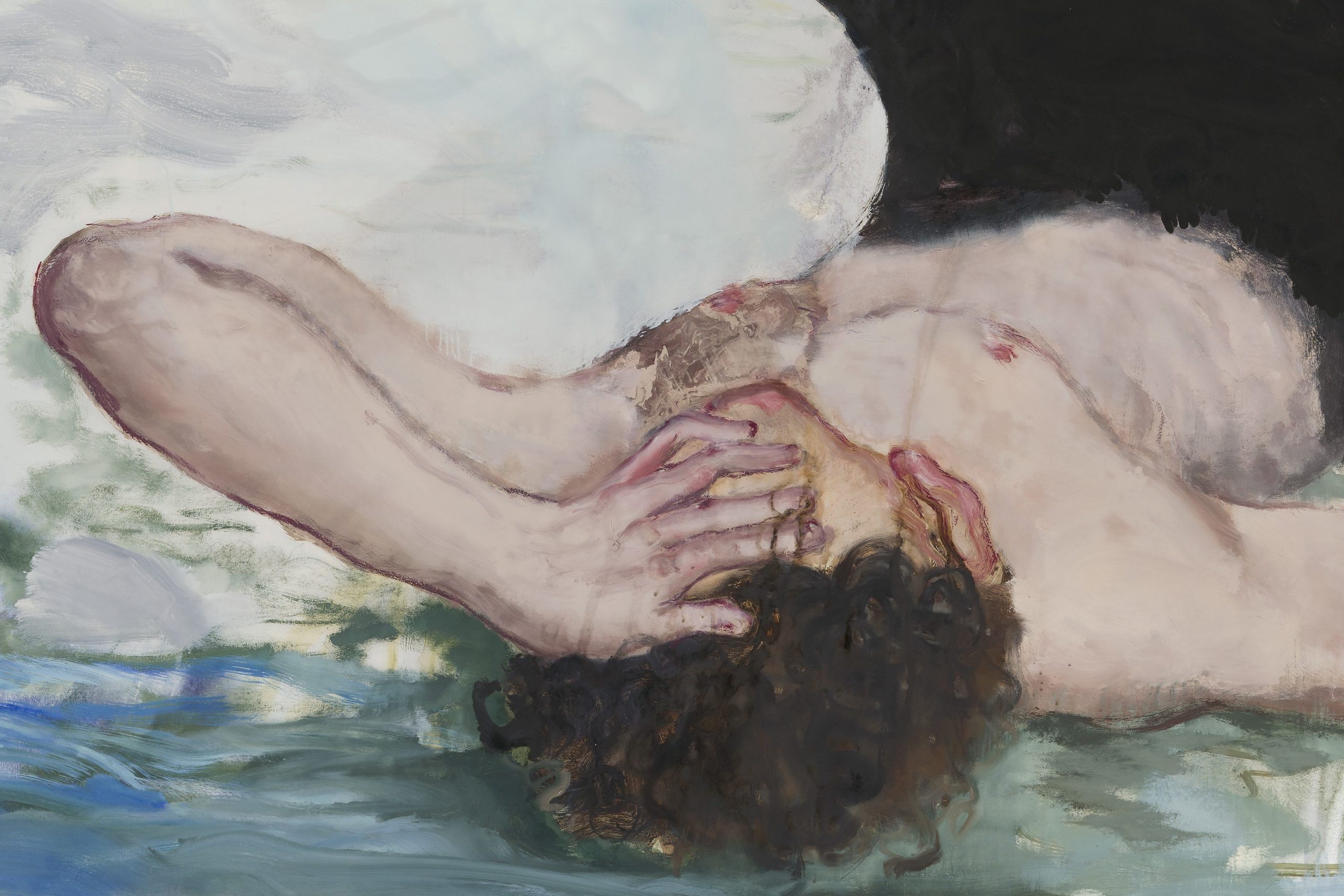
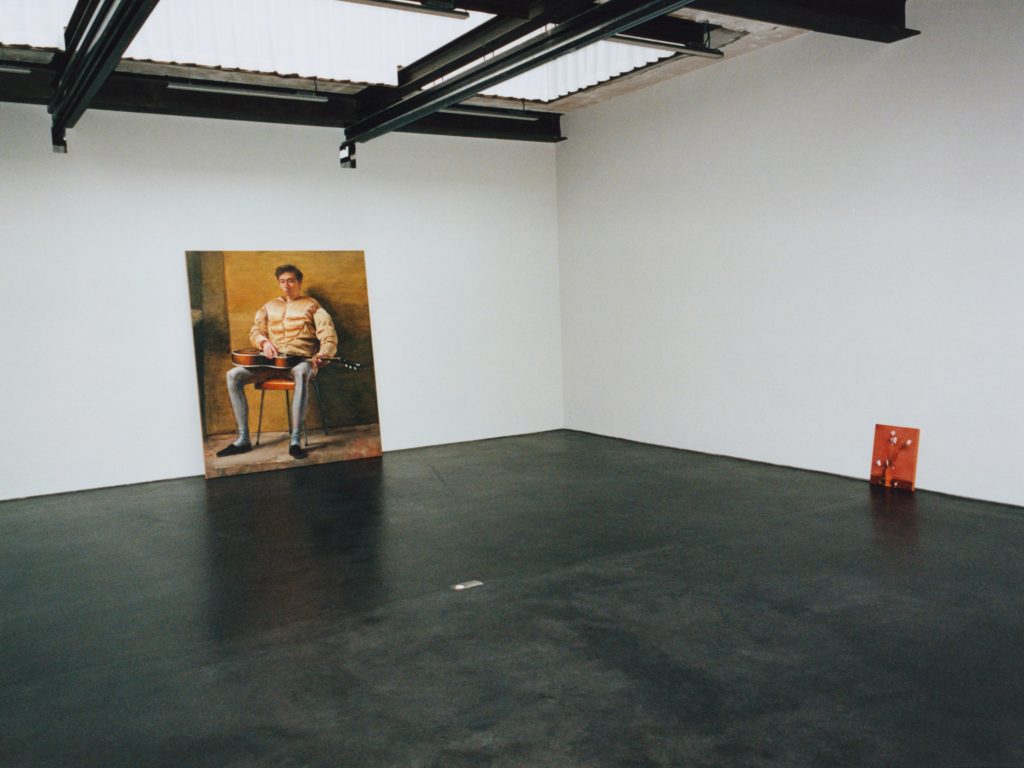
LE: One of the works in the exhibition depicts a young man wearing a padded suit of bulging muscles.
MB: That’s the French Painting (2026).
LE: I’m particularly interested in this painting in relation to constructions and performances of masculinity, especially amid the current crisis of masculinity and the manosphere with its normalization of misogyny, which we are very much preoccupied with in contemporary discourse. You seem to have painted a vulnerable, thinking, beautiful person in a muscled coat of armor. There is a strange ambiguity to their expression. Were you interested in delving into specific expressions of masculinity here?
MB: I’m very happy that the work made you think of that. For me, when I was painting it, I wasn’t thinking of that. I was thinking of a human being, because I don’t make a sexual difference between people. I quit that a long time ago. But I’m happy with your remark, because it is in there, truly. I think a good artwork is like a vessel you can fill with many meanings. Maybe I edit it subconsciously, I don’t know. It comes from my attitude: I can only express my own attitude, sometimes without even knowing it.
Artist: Michaël Borremans
Photographer: Osma Harvilahti
Creative Direction: Alessio Avventuroso
Production: Flash Art Studios
Location: Artist’s studio, Ghent