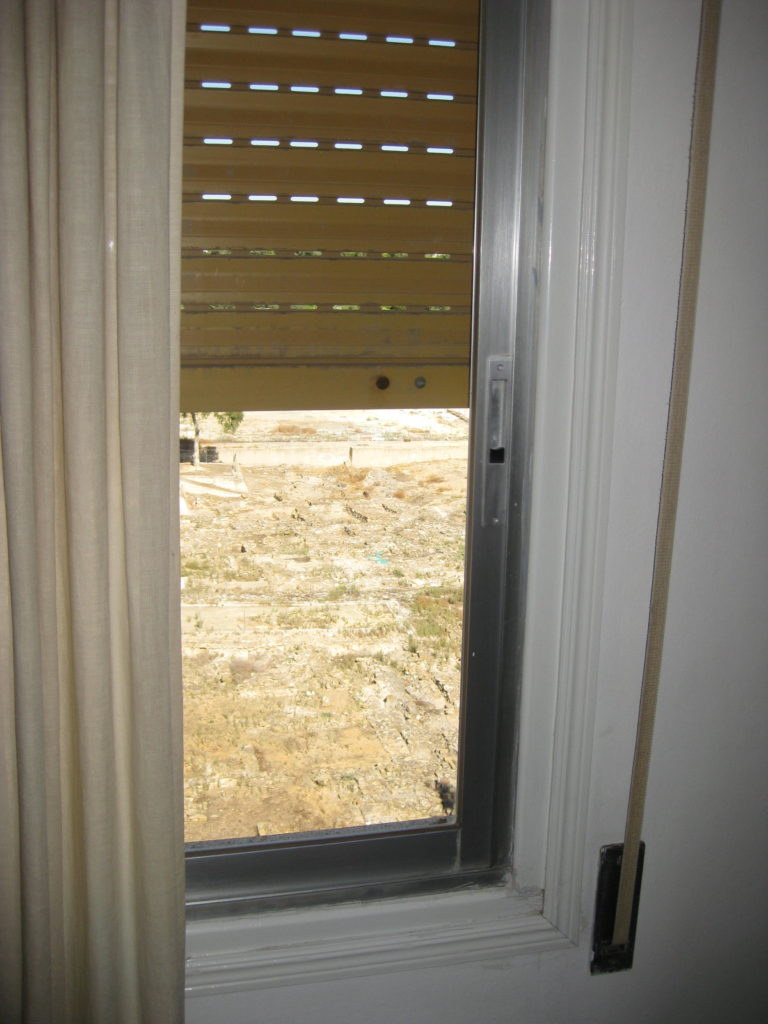
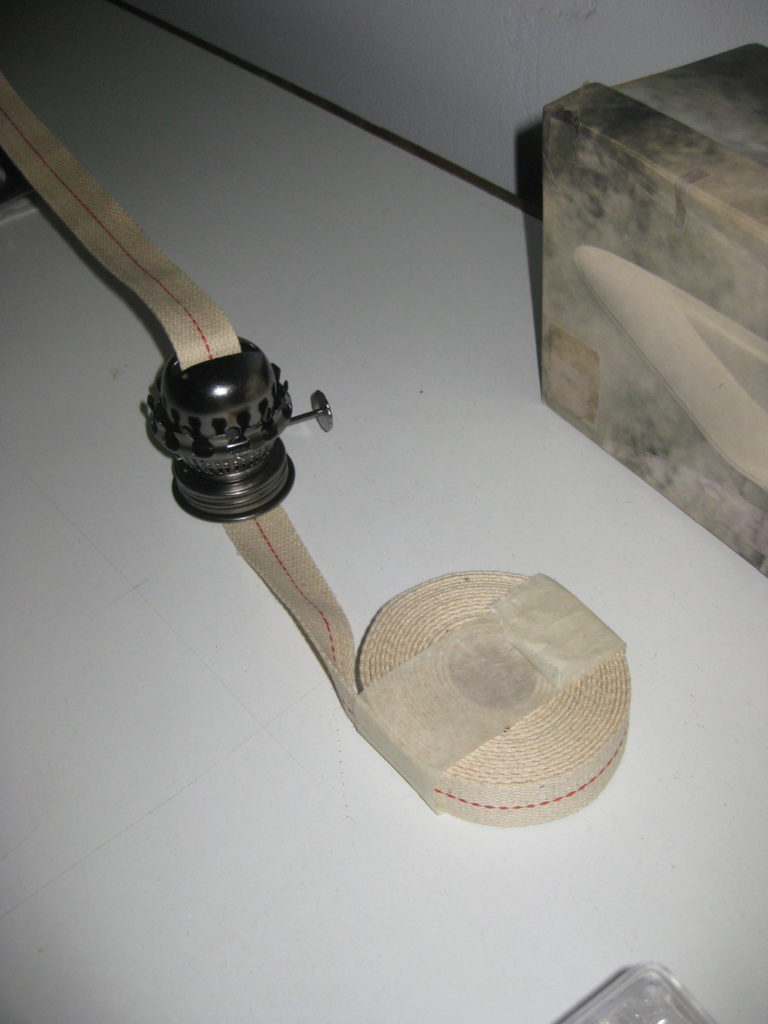
When I first call Maria Toumazou to discuss this feature, it is late on a Friday morning and she is at the office of the mayor of Lapithos, Cyprus, who also happens to be an importer of kerosene heaters. She is there looking for a specific kind of wick, one used both in oil lamps and for window shutter straps. Like her process of sourcing materials, a kind of self-devised fieldwork conducted through workshops, local manufacturers, and small enterprises, the notion that an object is never simply one thing, that it can move between functions, contexts, and meanings, is central to Toumazou’s practice.
Before we hang up, she sends me a picture of a detail from the mayor’s desk. Two business cards sit side by side: one identifies him as the mayor of Lapithos; the other as an “Importer — Distributor of Kerosene Heaters and Parts.” The juxtaposition could almost be one of Toumazou’s sculptural pieces. Rather than presenting contradictory identities, it reveals the layered realities of everyday life where community roles, trades, and informal economies frequently overlap. It is precisely these overlooked intersections that her work repeatedly returns to.
From my first encounter with Toumazou’s work at Apotheke Contemporary Arts in Nicosia (2010), and later through her collaborative project Neoterismoi Toumazou (2013–18), an artist-run space established in her grandfather’s former novelty shop in the center of Nicosia, her practice has been defined by a meticulous attention to the previous lives of the materials she works with. As she constructs hinges and networks between objects, texts, images, social encounters, and stories, the continuous transfer between one condition and another becomes a focal point. Through the arrangement of materials in space, collaboration, or the mobilization of found objects, her practice remains attentive to processes of translation and transformation.
Underlying this attention is a broader reflection on what is seen and what is erased, one possibly informed by growing up in a country repeatedly framed as “developing,” where buildings are enthusiastically demolished and rebuilt, and where political and economic fluctuations produce landscapes of perpetual material instability. Toumazou’s practice asks which forms of labor, knowledge, and material culture are preserved, and which are erased in the name of progress, modernity, and collective cultural imaginaries. Resisting the structure of such narratives, her sculptures seem to exist in (and also produce) interstitial places, as they insist that materials, like people, carry multiple histories at once, allowing previous lives and uses to remain visible alongside new ones.
These sculptural strategies are deeply rooted in the surrounding material culture and the stories that hold it in place, or question it. Toumazou turns attention toward overlooked infrastructures, labor cultures, and skilled practices acknowledging the many layers of dexterity embedded within everyday forms. The discreet intelligence of these borrowed skills is brought by the artist to exist together in enigmatic and playful shapes.
While authorship is often shared across relationships, conversations, and shared forms of making, an intersectional community of collaborators, friends, and skilled practitioners is often referenced in her titles, hinting at a hybrid production environment. There is a term used in music, “counterpoint,” that seems to me relevant to Toumazou’s sculptural thinking. Counterpoint is the technique of combining melodies, revealing the independence of each melodic line while maintaining the unity of the whole. When Glenn Gould first recorded Bach’s Goldberg Variations in 1955, the Canadian pianist was described as treating Bach’s counterpoint almost like a set of conversations happening in the same room — as if he were playing several people at once. In the recording, he can sometimes be heard humming one melodic line while his hands play another. This, to me, offers a way of thinking about Toumazou’s works: as they sit still in the gallery space they contain multiple voices, histories, and traces of the many exchanges, decisions, and relationships that have shaped them. Sometimes, they also watch you back.
In most works, the materials have already traveled. They are gathered during walks through the cities where she lives and works, sourced from workshops and novelty shops in the industrial areas of Nicosia, carried to the studio, and transported again to the spaces where they are assembled and re-assembled into sculptural installations. For “0” (2024), presented as part of the 15th Baltic Triennial in Vilnius, she fabricated a blue box from the cover of a 2002 calendar she found in a bookshop in Larnaca, made to measure to the dimensions of the cover, its gold-embossed numerals playfully destabilizing any sense of permanence and order. She bought the shop’s remaining stock, drawn to what she describes as “a strange and uncanny” year: a palindromic number that sits quietly next to 2001, the year that globally marked a before and after. Neither historically monumental nor entirely insignificant, 2002 becomes a residue of time, a forgotten moment preserved in obsolete objects. The title, “0,” evokes an opening, like a little hole through which you can look at something, or like the aperture that transforms the discarded calendar box into a pinhole camera. Like other sculptures in the space that similarly repurpose found materials (“Helios”, 2023; Last “Fay” prototype, 2024), “0” is a camouflaged pinhole camera actively registering long exposures on the resin-coated Ilford photographic multigrade paper contained inside the box.
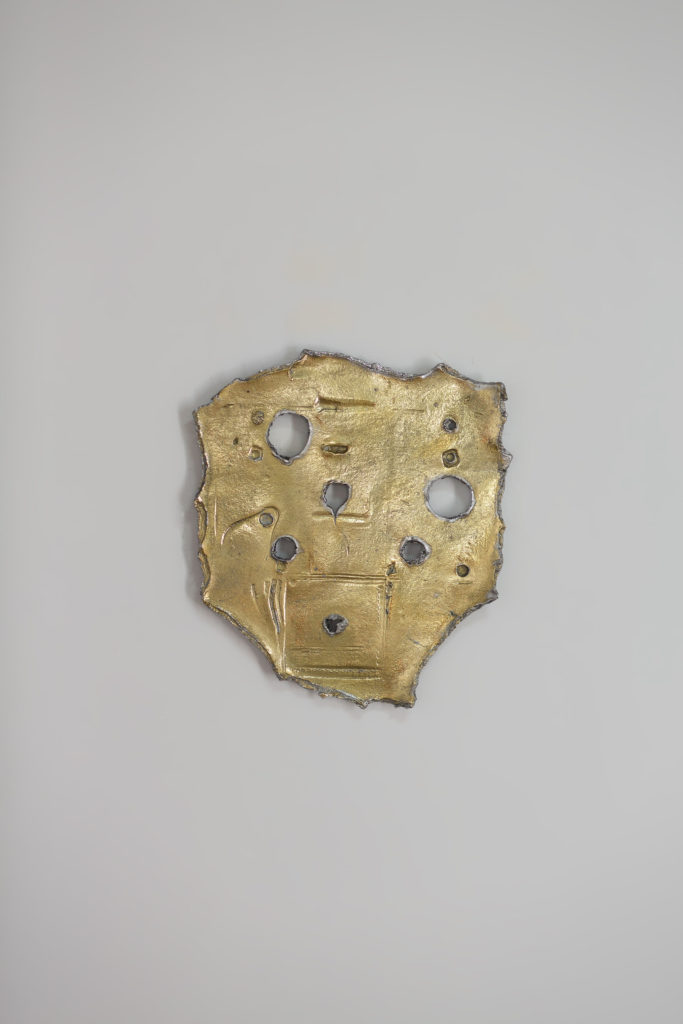
As the pinhole camera sculptures transform the observed into observers, Maria’s practice is driven by a constant movement between interiorities and the multiplicity of contexts through which she moves. This logic of translation is evident in Leather (2022). The work began with the form of a camera case: by opening the case and flattening it from its original three dimensional form, she traced its outline onto clay and then cast the resulting form in metal. Through this sequence of material transformations, the functional elements of the camera case — its buttons, seams, and contours — were reconfigured into a sculptural object that retained traces of its original body while becoming something altogether different. The camera case was approached as a body in itself, with the title Leather referring both to the material of the original case and to its bodily associations.
Throughout her work, the boundaries between interior and exterior spaces become porous and open to encounters with surrounding materials, systems of labor, and communities. Her bronze sculpture canons (2025) presented in “Half Frame ” (2025), her first institutional solo exhibition in Germany, at the Overbeck Gesellschaft – Kunstverein Lübeck, takes the form of the eponymous part of a church bell, enlarged and cast in bronze until its structural logic becomes sculpturally autonomous. The sculpture is based on a photograph of the church bell in the historic old town of Ayios Kassianos, which sits right next to the buffer zone, in Nicosia, not far from Neoterismoi Toumazou. Cast from the crown (the structural element that suspends the bell rather than the sounding body itself), the work isolates and magnifies a component that usually remains unseen. Resting directly on the floor of the nave of St. Petri Church, the form of the sculpture appears both mechanical and organic, evoking a spider, a skeletal framework, or the roots of a plant. By enlarging this overlooked architectural detail, Toumazou transforms an invisible support into the work’s central protagonist, lending material presence to a structure that ordinarily exists only in service of sound.
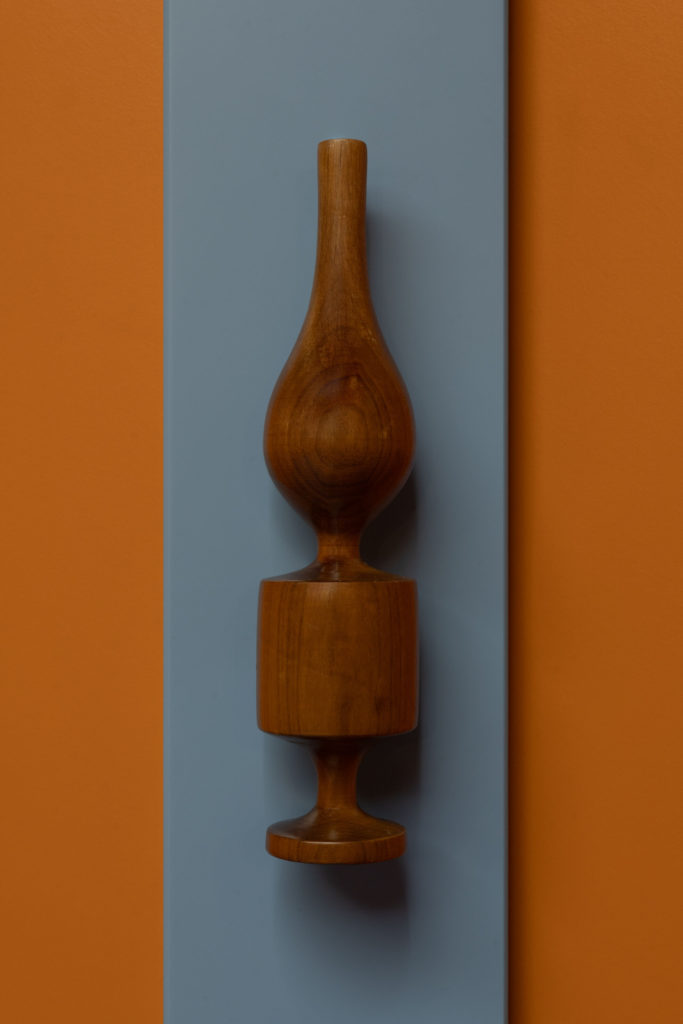
If canons reveals the hidden structures that support an object, her lightbased works extend this investigation into the invisible systems that shape perception itself. Her exhibition “Light industry” (2025) at Museum Abteiberg, conceived during her residency in Mönchengladbach, brought together a series of sculptural works and light-based installations that engaged with the architectural conditions of the museum’s working spaces. Merging contexts and incorporating the institutional architecture into the work, light becomes a sculptural medium that shapes our perception of objects and spaces. It also becomes a reference to the manufacturing workshops — the “light industries” scattered throughout the industrial zones of Nicosia — where much of her material research begins.
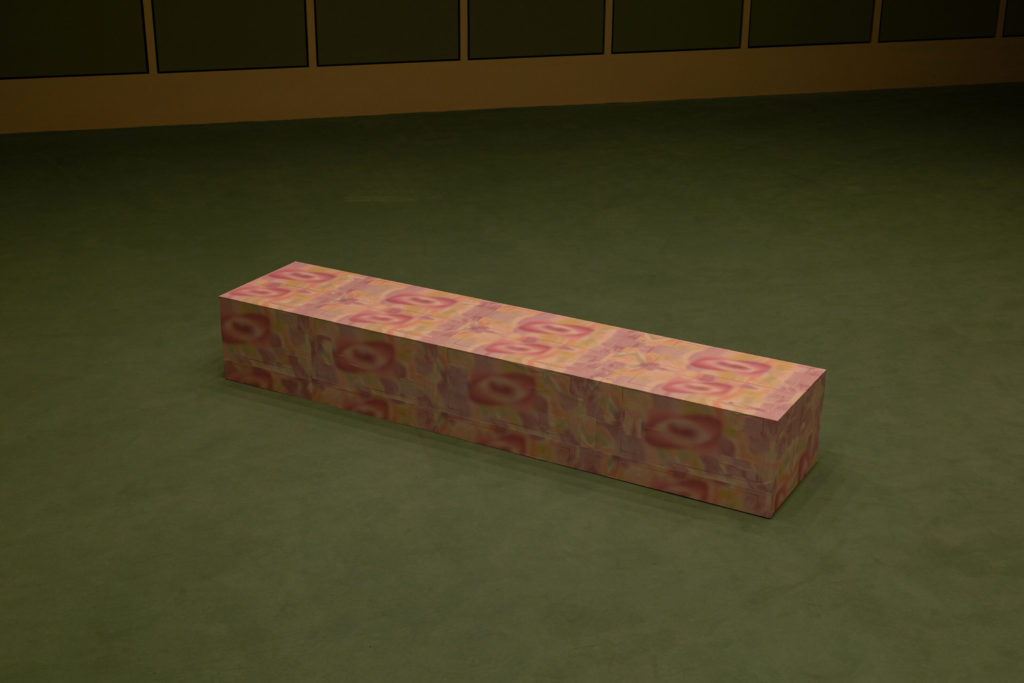
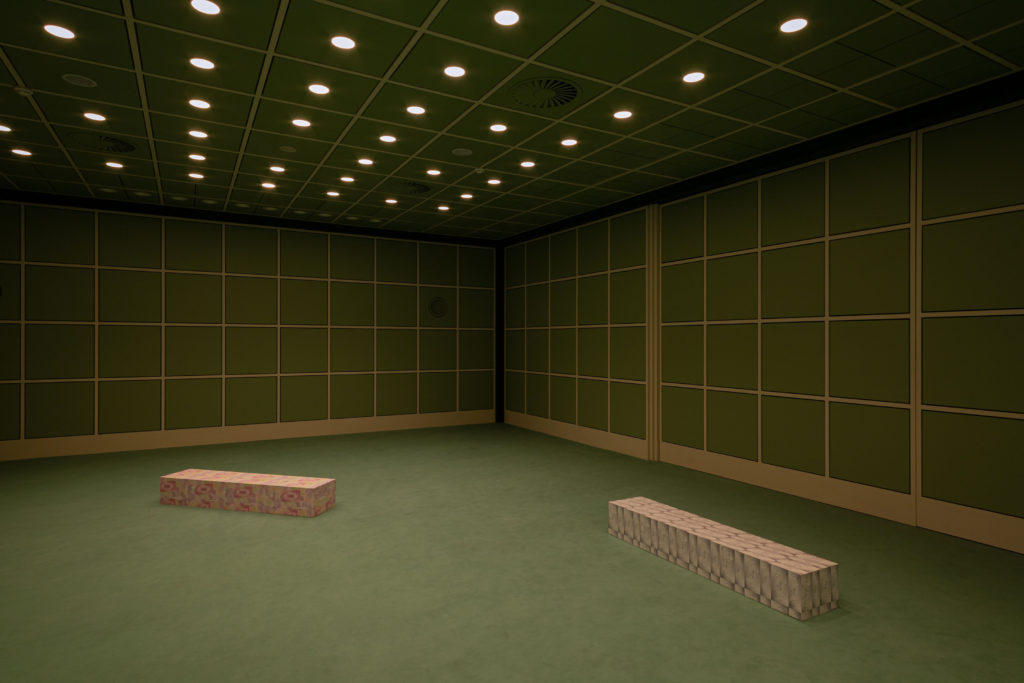
Lily and Rolly (both 2025) are the titles of two long horizontal sculptures positioned on the floor of the large, empty space of the Lecture Hall. Their titles also refer to two tissue paper brands commonly found in Cyprus, creating the kind of linguistic and material slippage that characterizes Toumazou’s practice. The long box-shaped sculptures are placed in a way that interrupts the strict geometric logic of the green, square-patterned room, as their low horizontal presence shifts the viewer’s attention toward the floor. The sculptures initially recall industrial packaging, but Toumazou complicates this reading through a process of collage and concealment. She incorporates industrial prints derived from the original packaging, covering or concealing the sections that bear information with smaller pieces of scanned reprints of the same pattern. In this way, she creates a visual loop in which the surface reproduces itself, simultaneously revealing and obscuring the information it originally carried.
This act of covering, masking, and repeating transforms the printed surface into a site of tension between visibility and disappearance. The familiar codes of branding and commercial circulation remain present, yet their function is disrupted as text and information become absorbed into the sculptural image.
For “Half Frame” she developed a conceptual framework drawing on the mechanics of photography. The exhibition title refers to the half-frame camera, a photographic format introduced in the 1960s that doubled the number of exposures on a roll of 35mm film and, coincidentally, resembled the scale of the window strips running through the skyline of the Kunstverein Lübeck. She explains that while preparing the exhibition, “a defining moment was during dusk, when the gold color of Renée Sintenis’s Daphne (1930) shared the same hue with the light emitted outwards from the institution‘s windows.” A precise scoring of the respective sites and their interiorities brought together camera obscura, projections, sculptures, and assembled found objects. Her proposal disarms photography’s conventional role as an instrument of knowledge and conquest, proposing instead partial, shifting, and ephemeral images.
This attention to the production of space extends to Toumazou’s photographic practice, where light is investigated as both image and physical process. The “Dimco capture” (2022) series, produced for the artist’s solo presentation at Liste Art Fair Basel, exemplifies this material approach. The sculptures Dimco [1] and Dimco [2] (both 2022) function as pinhole cameras and expose photographic paper directly to light. Collapsing distinctions between sculpture, camera, and image, the works reference photography’s earliest manual procedures.
In her persistent interest in the shaping of space, light is used as both material and medium, drawing attention to the spaces between objects as much as to the objects themselves. For her participation in the fifth Phenomenon biennial (2024) on the island of Anafi, sunlight activated the various sculptural interventions in and around the house so that each work registered a different duration through reflections, shadows, and changing intensities of daylight.
Instruments for the production of knowledge, such as cameras and clocks, are repeatedly taken apart in Toumazou’s practice. Unsettling fixed systems of meaning, she constructs an infrastructure that is personal, at times biographical, and intentionally elusive. Her sculptures evoke a counterintuitive sense of comfort: they appear familiar yet remain fundamentally unknowable, producing encounters that are at once intimate and estranging, much like human relationships themselves.
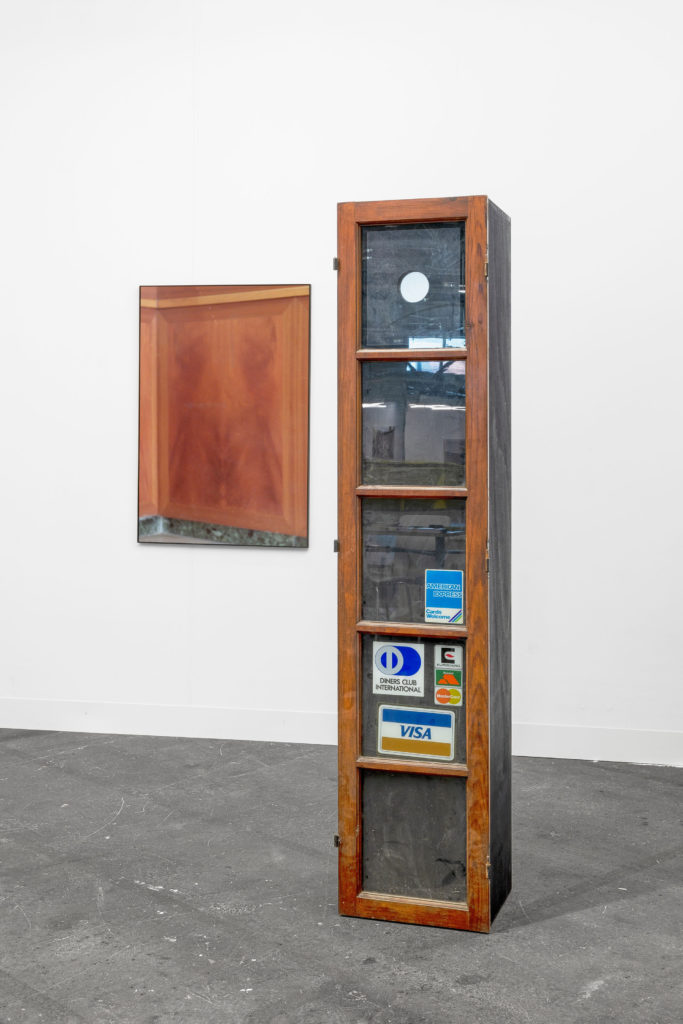
Clues, traces, and partial encounters are built into the structures of the works as understanding remains provisional and shifting within the viewer’s position. Through oblique methodologies, unstable narratives, and an attentiveness to the heritage of the unconscious, her work occupies what Donald Winnicott, in “The Place Where We Live” (1971), describes as an intermediate or potential space. Like the world we enter when we listen to music, it is both intimate and external, a space where inner and outer realities meet through play, projection, and imagination.
Making, like seeing, becomes a process of discovery rather than execution, where knowledge is continuously questioned. Toumazou says: “Sometimes the sculptures are more clever than you… I often look forward to seeing the final piece in order to understand what I wanted, or what I wanted at the time… there is something there for me in the articulation and the actual learning through making it.”