Space is never neutral. It is saturated with intention, shaped by the broader political and socioeconomic structures that produce it. It is within this understanding of space that the work of New York-based Croatian artist Dora Budor is situated. Trained as an architect at the Faculty of Architecture, University of Zagreb, Budor has developed a practice that examines the sites where the built environment and subjectivity shape one another. Her work engages space at multiple scales — from institutional exhibitions to the urban environment as sites of circulation, regulation, and control — using them as prisms through which the systemic social and political pressures of late capitalism come into view.
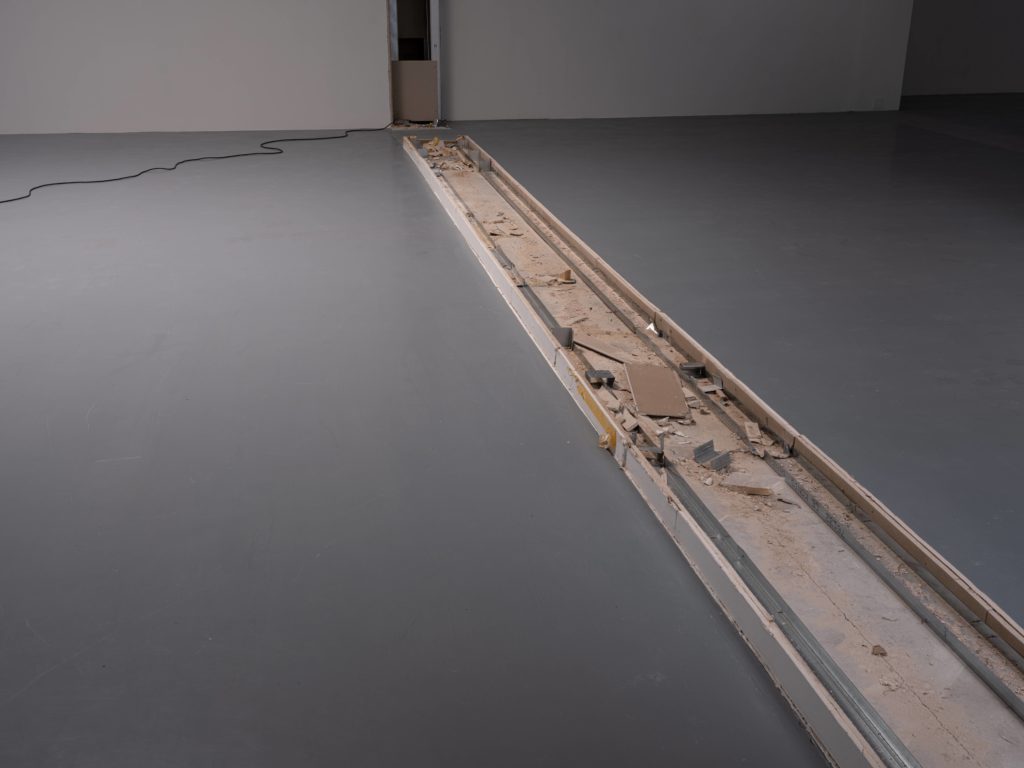
Working across sculpture, video, sound, and installation, Budor grounds her practice in a meticulous process of research and material inquiry. She frequently begins with found objects and materials steeped in specific histories, often the by-products, remnants, or residues of capitalist production, which she gathers, reconfigures, and reanimates. Dislodged from their original functions and cast into new constellations, these materials become charged with alternative meaning, entering into new relations of value, authority, and use, while exposing the latent ideologies embedded within the systems and conditions that produced them.
Her process resonates with the Situationist International’s concept of détournement — the appropriation and rerouting of existing elements in ways that subvert their established functions.[1] In Budor’s work, such acts of recontextualization become a means of working critically from within existing materials and ideological structures, redirecting their remnants toward alternative concepts and uses through which familiar systems acquire an uncanny, and at times surreal, quality.
Within the expanded context of the exhibition, Budor brings these ideas into relation through the choreography of individual works into complex installations, often conceived in direct response to the sites they inhabit. In this way, Budor approaches the exhibition itself as both medium and subject: a spatial apparatus through which broader systems of meaning, power, and representation can be staged, examined, and reconfigured. Displaced from their habitual modes of operation, the conventions that ordinarily govern these spaces are destabilized.
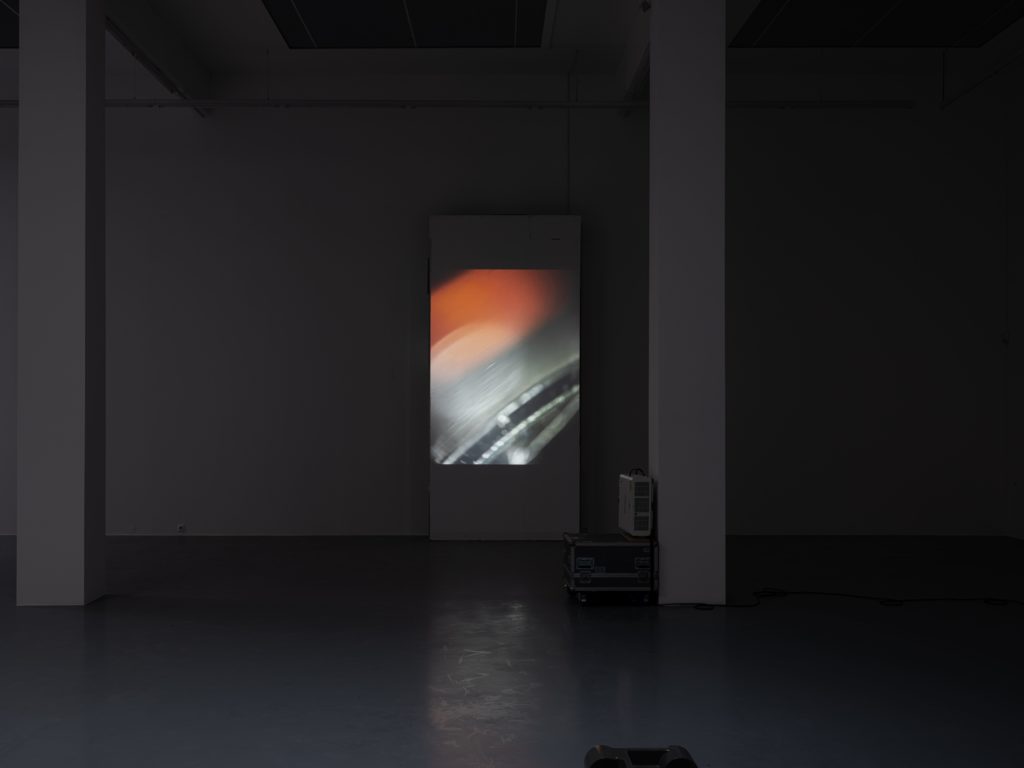
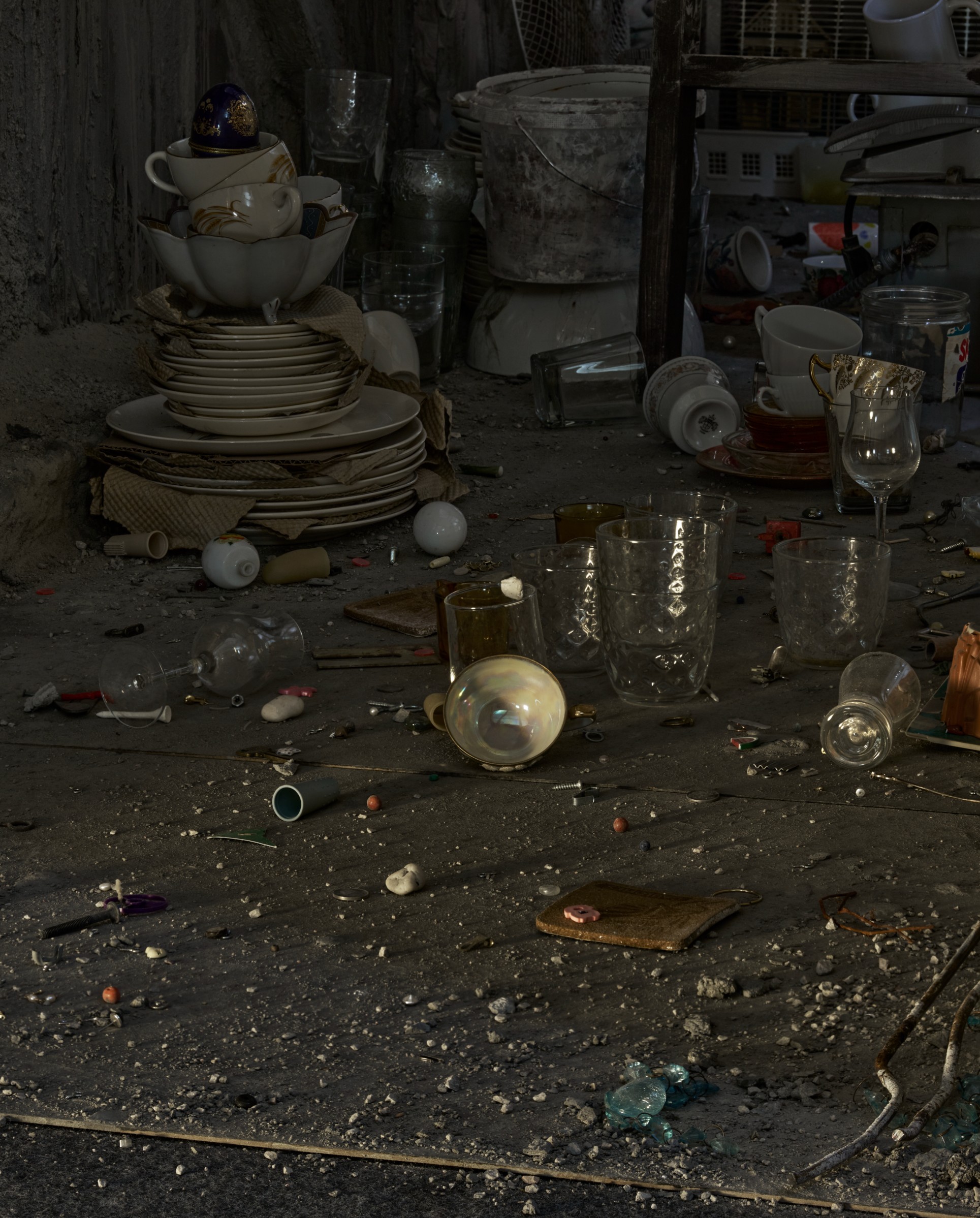
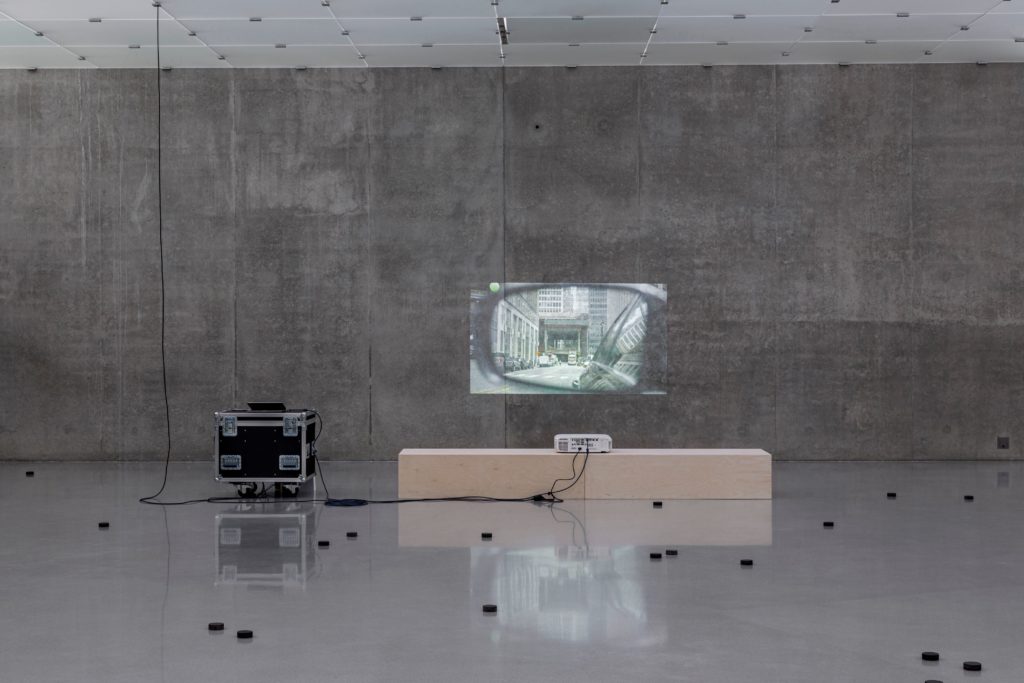
Installation view of ”My energy comes from Freedom,” at Bonner Kunstverein, 2026.
Photography by Oskar Lee. © Dora Budor, Bonner Kunstverein.
Budor’s most recent exhibition, “My energy comes from freedom” at Bonner Kunstverein (2026) synthesizes many of the concerns that have shaped her practice to date. As in her past exhibitions at “I am Gong” at Kunsthalle Basel (2019) and “Continent” at Kunsthaus Bregenz (2022), the architecture of the institution, and its psychosocial armature, are understood not as a passive backdrop, but as structures that conceal and sustain systems of power and labour. At Bonner Kunstverein, the mid-1980s architecture designed by the utopian architecture collective Haus-Rucker-Co becomes both the material and conceptual infrastructure through which the conventions of exhibition-making, and the institution, are unsettled.
This destabilization begins before Budor’s own works are fully encountered, where videos by Camilla Wills, Eleanor Ivory Weber, Henrik Olesen, and Yvo Cho function as a preamble to the exhibition, complicating the presumed singularity of authorship conventionally associated with the solo show. Devices from earlier works, such as the series “Autophones” (2022–26) that acts against the stability of the visual space, are brought into dialogue with new works. Most significantly, Budor returns to an excavatory mode of working, previously developed at Kunsthalle Basel and, most emphatically, at Kunsthaus Bregenz, that inhabits and usurps the physical fabric of the building itself. At Bonner Kunstverein, Budor chops up a historical black-box framework, conventionally used to present and contain moving-image works and which had been situated at the centre of the exhibition hall for the last three decades. Hoisted and carried across the exhibition space, this architecture of display becomes an object in its own right, while simultaneously providing the infrastructure for two recent moving image works.
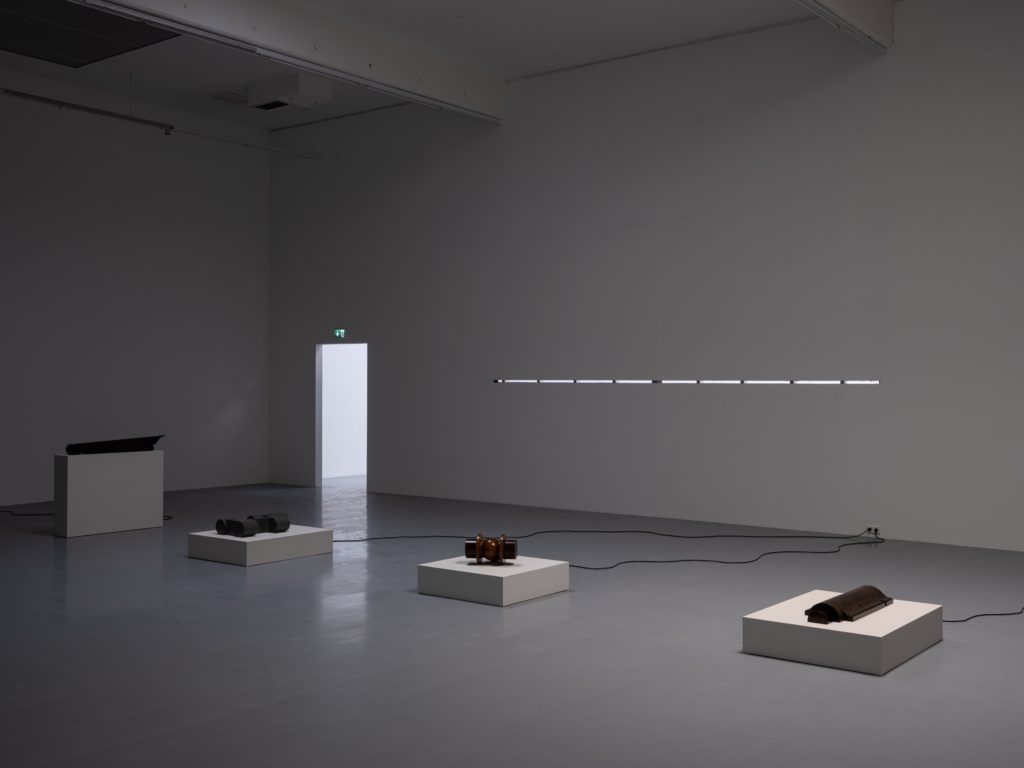
In the video Medium (2025), spy cameras placed during rush hour within holes in the tarmac produce a disorienting, upward-facing view of the city, capturing the undersides of passing vehicles while largely excluding the sky and surrounding architecture from view. A sense of tension emerges as the urban environment and its visual codes become abstracted, rendering the familiar increasingly difficult to decipher and allowing the urban landscape to slip into a space suggestive of the unconscious. The work Atomizer: Everything is here. (2026) operates in a similar way to Medium, presenting a continuous stream of images. These consist of photomicrographs taken by the artist of disposable vapes collected from strangers in and around New York, accompanied by a soundscape created from recordings of a digital mini projector. Through magnification and accumulation, these discarded objects become fragmented traces of the city, dissolving into abstract forms that evoke a dream-like, semi-conscious encounter. Moving between the vastness of the metropolis and the minute material residues it leaves behind, the two works render urban space as fragmented, where dissociation becomes a condition embedded across its shifting scales, collapsing into Jonathan Crary’s notion of a perpetual, instantaneous present.[2]
The exhibition distills Budor’s central preoccupations, using appropriation, displacement, and inversion to interrogate the contradictions that shape psychological and institutional spaces. Distraction and circulation become central principles, drawing form from the psychic energies of social and economic life.
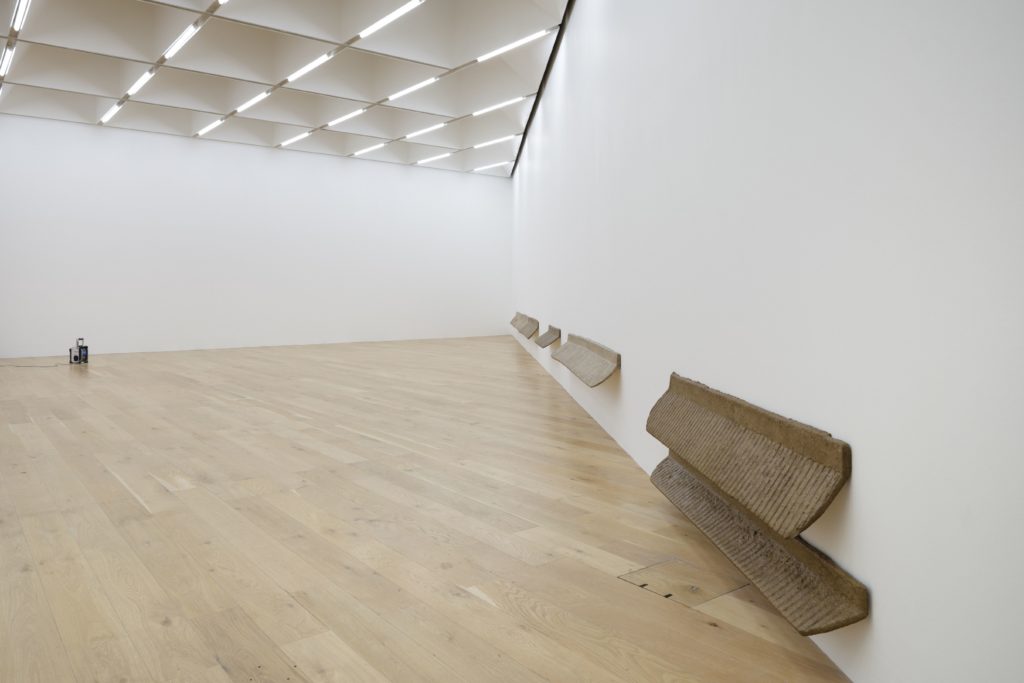
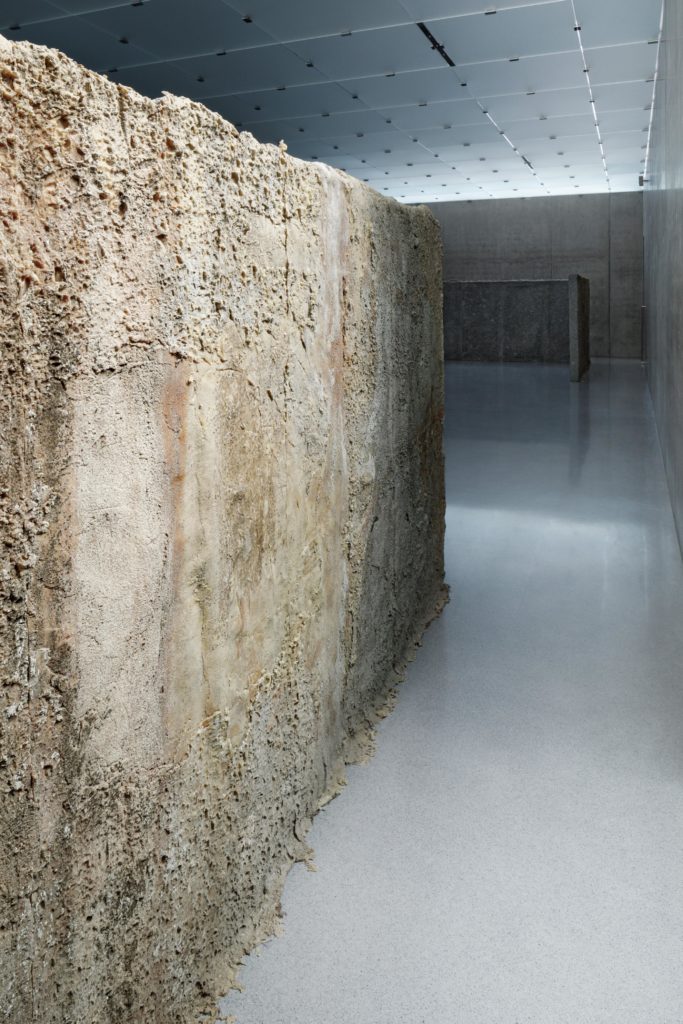
Such gestures were further developed in Budor’s exhibition “Continent” at Kunsthaus Bregenz four years prior. Rather than simply occupying Peter Zumthor’s stark concrete architecture, Budor excavated its hidden infrastructure, rendering the building’s unconscious visible. Obstructing the entrance to the galleries, the three-part sculpture “Kollektorgang (I–XXIX)” (2021) casts sections of the Kunsthaus’ vast subterranean foundation, the so-called “diaphragm wall,” designed to stabilize the building while diverting seeping mud and water. By casting spaces ordinarily inaccessible to the public, the work transformed architectural voids into sculptural form, unsettling distinctions between original and copy, molding and casting, in a generative use of negative space that recurs in other works such as Something to remind me (2020), 27 Male Molds (2021), and “Autophones.” Cast on site in latex and later erected in papercrete in the exhibition space, the work inverted the polished image of institutional architecture, exposing instead its hidden systems of support and the residues of bureaucratic labour. The tripartite work stands as an anti-monument, caught between permanence and dissolution, exposing the unstable foundations upon which the institution depends.
The installation Termites (2022) intervened in the building’s concealed infrastructure in a similar way. Remote-controlled sex toys inserted into ventilation ducts transmitted vibrations that reverberated through the galleries, rendering the building’s hidden systems perceptible as sound and sensation. The work introduced desire and eroticism into the supposedly neutral fabric of institutional architecture. The building no longer appeared as a stable container, but as a porous, animate body, its concealed cavities, circulatory systems, and internal tensions made perceptible from within. Budor would later extend many of the strategies explored in these works in “Autophones.” Replicated in tonewood, these sculptures take the form of “male” molds of rotating components used to cast parts for industrial and military machinery. Their forms contain sex toys that reverberate across the exhibition space. Through the tension between mechanized production and libidinal force, the instruments of power are made to resonate against the very logics of violence and control they embody.
Many of the interventionist gestures in these works may be traced back to Budor’s exhibition “I am Gong” at Kunsthalle Basel (2019), which marked a significant turning point in her practice, reflecting her growing interest in the institutional framework and the exhibition as a medium in itself. Here, she transformed the Kunsthalle into a musical instrument, using the construction work at the Musiksaal, or concert hall, across the street as a living motor, whose sounds acted as a score for the exhibition, bringing seemingly inanimate forms to life.
Throughout “Continent,” gender emerged as a loose thread, one that can be traced across Budor’s wider practice and, in particular, through her engagement with the city as a broader social and political space. This connection between the urban environment and gender resonates with the work of Leslie Kern, who, drawing on the history of feminist architectural theory and geography, describes urban space in her book Feminist City (2021) as a spatial expression of systemic structures of gender and power. [3]
This understanding of the city as an inscription of gendered power relations forms a backdrop to Chase Manhattan (2021–22), a video work made by Budor in collaboration with Noah Barker. Referencing the Situationist International’s concept of the dérive — a form of psychogeographic wandering through the urban space— the work presents a hurried flow of images set to music by Stubborn and KVANTUM (Stefan Tcherepin and Paul Sigerhall), tracing the demolition of New York’s Union Carbide Building. With its design led by Natalie de Blois while at Skidmore, Owings & Merrill (SOM), the building was considered to be one of the tallest towers designed by a woman in the United States at the onset of its destruction in 2019, when it also became the largest voluntary demolition project in the world. Its subsequent replacement by a substantially larger JPMorgan Chase skyscraper designed by Foster + Partners, registers the city as a space of continual erasure and reconstruction, shaped by the expanding forces of corporate capital. At the same time, the disappearance of de Blois’s building points to another form of erasure; the historically precarious visibility of women’s contributions to architecture and society more broadly.
Something to Remind Me (2020) presents itself as a subtle yet poignant intervention that marked the entrance to the exhibition space. Here, Budor took a rented bicycle in Berlin, an object that complicates conventional notions of possession and ownership, which she then smelted and recast using a mould taken from the original artwork by Elsa von Freytag-Loringhoven, Enduring Ornament (1913). Created in the same year as Marcel Duchamp’s Bicycle Wheel, Freytag-Loringhoven’s work has been cited as an early, even foundational, example of the readymade, yet both the work and its author have remained comparatively marginal within the history through which the form has been canonized. Just as Budor retrieves materials from circulation in the contemporary city, she also recovers a marginalized figure from art history, drawing a parallel between material and historical forms of dispossession. More broadly, this logic of retrieval and reversal extends across “Continent” as a whole, where established hierarchies inherent in visual space are unsettled through a process of reappropriation, recirculation, and revaluation.
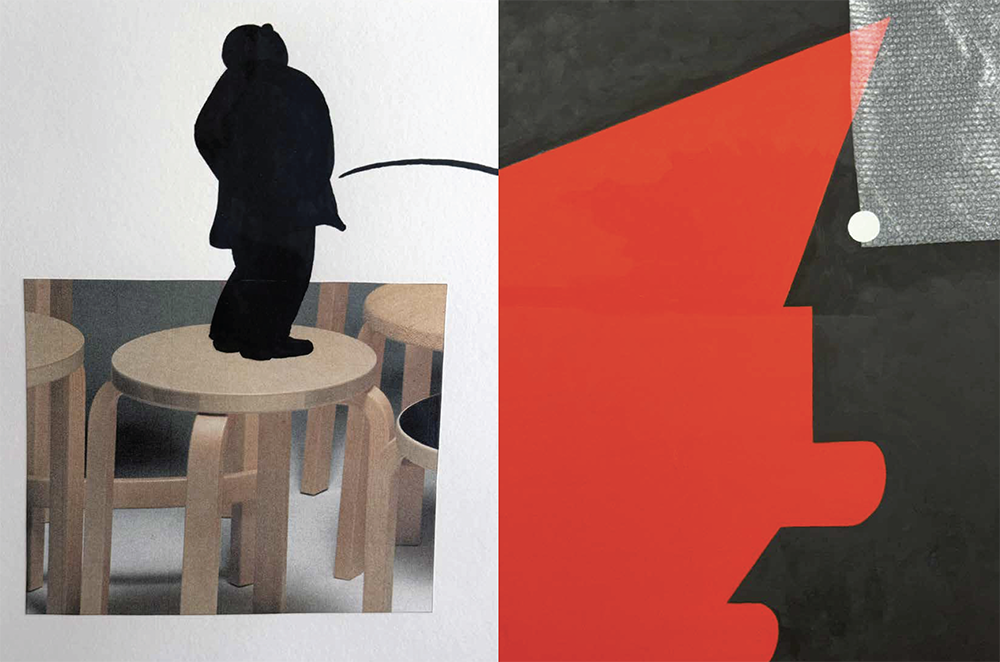
These concerns also hold a central place in earlier exhibitions such as “Again” (2024) at Nottingham Contemporary, where works across video and sculpture engage with gentrification, privatization, and the growing regulation of public life. Here, a later iteration of Something to Remind Me, titled Always Something to Remind Me (2023), extends her interrogation of urban space. It is placed in dialogue with a series of sculptures, “A.U.D. (I–IV)” (2023). Recalling Nils Norman’s photographic investigations into hostile urban architecture, which he began in the mid-1990s, the series turns to an earlier manifestation of such mechanisms of spatial control, reproducing nineteenth-century anti-urination devices once installed across London. Made from boiled cardboard, polyvinyl acetate, and shellac, their fragile, almost permeable materiality sits in tension with the disciplinary function of the objects they replicate. Removed from the street and installed across the gallery walls as sculptural elements, these works reveal how architecture quietly regulates bodies, behavior, and access to public space.
A related transformation of urban space underpins Passive Recreation (2024), a video work presented in the exhibition space that centers on Little Island, the privately funded park designed by Thomas Heatherwick on the Hudson River in New York. Situated adjacent to the former Chelsea piers, an area historically associated with queer sociality and cruising during the 1970s and 1980s, the park embodies a radically different conception of public life, one in which art, nature, and leisure are carefully designed and packaged for consumption. In this work, and across the exhibition, the city comes to be understood as a contested terrain to be read against itself; a site whose apparently benign surfaces can be deconstructed.
Budor’s work more broadly gives rise to new spatial formations; mutable landscapes that recall Bernard Cache’s conception of the architectural image as, like the Earth itself, being in constant motion.[4] These landscapes open onto new forms of meaning that are continually reorganized, always slipping beyond the structures that seek to define and contain them.
[1] “A User’s Guide to Détournement,” Guy Debord & Gil J. Wolman, Les Lèvres Nues #8 (May 1956), Translated by Ken Knabb
[2] Jonathan Crary, Suspensions of Perception: Attention, Spectacle, and Modern Culture, (Cambridge, Masssachussets: The MIT Press, 2001)
[3] Leslie Kern, The Feminist City, (London: Verso, 2021)
[4] Bernard Cache, Earth Moves: The Furnishing of Territories, (Cambridge, Massachusetts: The MIT Press, 1995)