Seamus Heaney begins his “Elegy (For Robert Lowell)” (1977) [1] with an observation that seems pretty self-evident: “The way we’re living, timorous or bold, will have been our lives” — and yet, it is the devastatingly accidental finality of its retrospective will have been that I, for one, have long considered to be one of the most crushingly insightful turns in the history of English verse. Much like the art of Felix Gonzalez-Torres, it speaks of the inexorable advancement of our most immediate present’s future past-ness, as well as the notion of the remainder: What is left in division’s wake after all of its action has come to pass? Is loss itself subject to loss? The vast majority of Gonzalez-Torres’s work may itself be seen as a type of elegy-in-progress, both preemptive and actual: for his partner, Ross Laycock, who passed away in 1991 from complications related to AIDS; for his own disappearing body, slowly ravaged by HIV throughout most of Gonzalez-Torres’s active artistic years (ultimately leading to his early death at the age of thirty-eight); and for the lives and loves of many others lost to civil rights causes, wars, and unequal struggles.

Spurred on by the twin contexts of poststructuralist conceptualism’s interrogation of Minimalism’s formal neutrality and the AIDS epidemic, the concept of the remainder is where Gonzalez-Torres’s work meets our present moment in its host of concerns and queries. It echoes Leif Weatherby’s notion of “remainder humanism”: human quintessence defined structurally by its negative, as a core remainder not yet chiseled away by the advancement of technology’s own intelligence, personified by AI’s inexorable progress.[2] “Sweet Revenge,” Museo Reina Sofia’s comprehensive exhibition of Felix Gonzalez-Torres’s oeuvre, a first on Spanish soil, arrives at an especially acute historical moment for this anguished grasping for a remainder for human dignity. In Gonzalez-Torres’s time, the consideration was instead what remained of humanity after the indignities of warfare, AIDS, and homophobia each chipped off their piece — yet his formal devices remain acutely relevant. Two of Gonzalez-Torres’s most well-known bodies of work are the stacks of neatly arranged identical sheets of paper, Untitled (Passport) (1991), (printed with laconic phrases and/or images; lists of historical events significant to civil rights movements; or subtly and minimally tinted) and mounds or spreads of uniform, variously colored, plastic-wrapped hard candy, Untitled (Revenge) (1991), both conceived as “endless supplies,” as specified in their technical descriptions. Both embody this reflection on the nature of the remainder especially clearly: constantly chipped away at, yet also constantly replenished. Everything and everyone is replaceable, but the totality is never fully depleted: the final remainder is never found, nor allowed to appear.
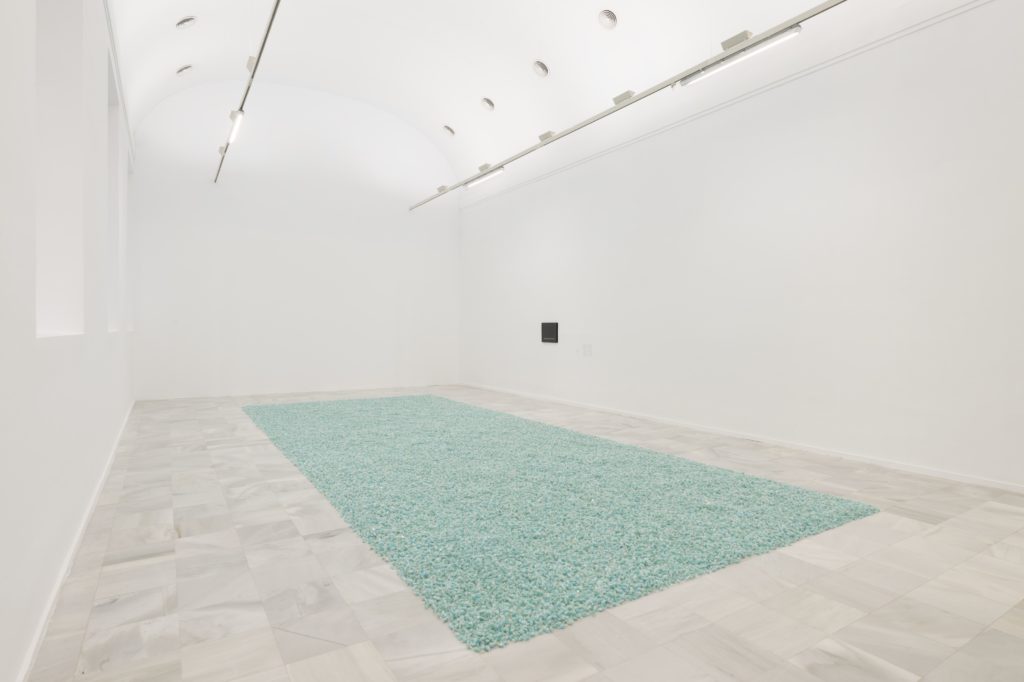

By Gonzalez-Torres’s custom, both the paper stacks and the candy installations come with specifications of “ideal height” and “ideal weight,” respectively — an embedded allegory within the very structure of the works, condemned to destruction by the consumptive impulse of their public, whose presence is nevertheless integral to the pieces’ status as proper art. Perhaps the most elegiac facet of Gonzalez-Torres’s output, then, is the way in which it interpellates its lyrical personification through a provocation aimed at its audience’s most unthinking and reflexively detached reactions: Free stuff? For me?! There is an irony to the fact that, by the works’ definition, once taken outside the bounds of the gallery, the individual particles of the sculptures picked up by a visitor cease to be art at all, becoming mere Xeroxed sheets of paper and cheap bulk candy, devoid of value or authorship. That is also why Gonzalez-Torres’s billboards and public installations — which for the Madrid retrospective have been placed inside busy passageways at several of the city’s metro stations — make for perfect companions to the candy and paper pieces: in their blank-faced ambiguity, occupying the space where brightly colored calls to “Buy!” and “Consume!” are expected to appear, they reverse the advertisement’s attention-grabbing operation in order to halt the habitual automatism of one’s subliminal media consumption.
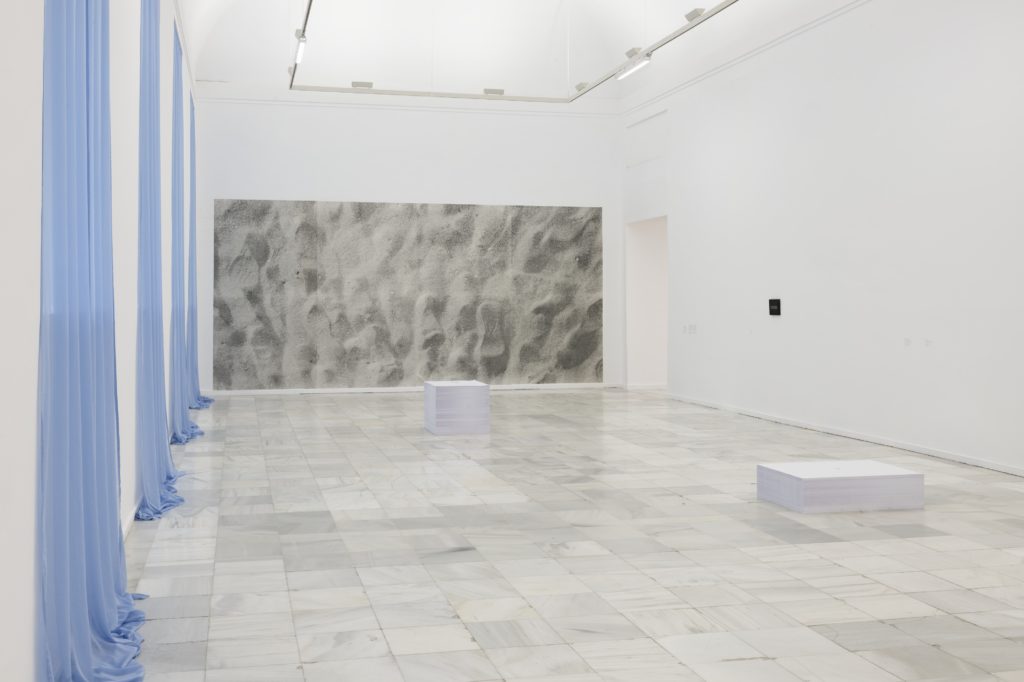
An integral part of his project to desanitize Minimalism, curtains of different kinds are another consistent presence within Gonzalez- Torres’s oeuvre. They are constructed from either sheer, pastel-colored fabric that filters the site’s light through a muted lens, or from chunky beads suspended in floor- to-ceiling rows across passageways and door frames between galleries. Not only freely touchable but, in many cases, unavoidably intrusive upon a visitor’s person, these substitute a tactile and multi-sensorial experience for Minimalism’s purely retinal relating-at-a-remove. In a kindred key with a cohort of Gonzalez-Torres’s Post- Minimalist peers like Zoe Leonard, Mona Hatoum, or Robert Gober, the curtains participate in an emphatic project of reminding that the aesthetic is rarely fully apolitical. They add a crucial point that may matter even more today than it did in his time: that the political is also always bodily and never purely cognitive — something we are especially prone to forget nowadays, when so much of everything has been removed to a purely cognitive sphere divorced from physicality’s messy realities. Gonzalez- Torres’s insistence on naming all of his pieces Untitled while adding to them parenthetical allusions to the deeply personal circumstances of his own life is another device in service of that overarching goal. In his own words: “Someone’s agenda has been enacted to define ‘public’ and ‘private.’ We’re really talking about private property because there is no private space anymore. Our intimate desires, fantasies, dreams are ruled and intercepted by the public sphere [while] ‘meaning’ is created once something can be related to personal experience. ”[3]
[1] Seamus Heaney, Field Work, Farrar, Straus, Giroux, 1979, p.31.
[2] Most extensively developed in Weatherby’s Language Machines: Cultural AI and the End of Remainder Humanism (University of Minnesota Press, 2025), “remainder humanism” criticizes the most widely currently accepted notion of “humanity” as defined negatively, i.e., as what is left after a machine’s own abilities have developed the independent capacity to generate everything else, “a humanism without a theory or doctrine of what is human, in which humanity is remaindered, like a book past salability,” in a way that is reactive instead of generative: the remainder shrinks, but the human is never given positive content, only the residue of subtraction. González-Torres’s stipulated weights and counts for the “endless supply” pieces invert this logic: the ideal figure is not a defended core to be scavenged from depletion but a structural set-point the work is deliberately conceived to deviate from and be endlessly restored to. This echoes a distinction Weatherby draws between treating an individual instance as the essence of a system and treating the system itself, in its differential and processual totality, as essential.
[3] Felix Gonzalez-Torres and Robert Nickas, “Felix Gonzalez-Torres: All the Time in the World,” Flash Art International, November–December 1991, 86–89.