I am made and remade continually. Different people draw different words from me.
— Virginia Woolf, The Waves[1]
Last Christmas, during Boxing Day, Sarah Brahim had just returned to Milan from Paris. We walked the streets together, quiet and giggly after the holiday crowds, and she mentioned her frustration with a half-laugh. She had wanted to find a physical copy of Emily Dickinson’s Envelope Poems, which the American poet began writing in 1864, to give to me — but the book was nowhere to be found. Some of these poems are available online. One line, in particular, caught my attention.
In this short Life that only lasts an hour
How much — how little — is within our power. [2]
It is easy to see why such lines resonate with Brahim’s work. Her practice occupies a similar space: attentive, careful, aware of what can be held and what must be released. She constantly moves between thought and material, between reflection and form, with a sensitivity that makes the space between them feel significant.
That day, we spoke about the book only briefly. It did not matter that it had not been found. The gesture of looking for it, of carrying the idea of it across cities, seemed already complete. Something had been set in motion and did not require a resolution. In this way, the absent object began to resemble one of Brahim’s works: precise in intention yet resistant to closure.
There is a peculiar kind of intimacy produced by things that remain unfinished or partially out of reach. Dickinson understood this well; her poems feel withheld more than written, hovering somewhere between thought and gesture. Brahim’s work moves through a similar register. Meaning rarely arrives all at once; it accumulates slowly, through fragments and repetitions and gestures so subtle they might pass unnoticed. What returns, again and again and again, is the body as a porous site through which memory passes, grief settles, and the world becomes legible for a brief luminous moment.
Her works do not attempt to represent emotion so much as inhabit it. Experiencing them, one often has the sensation that feelings arrive atmospherically, dispersed across gestures, fragments of sound, pauses extending longer than expected. Nothing is ever overstated. Emotion settles gradually, almost on tiptoe, until one realizes the works entered the body before arriving intellectually.
Perhaps this particular sensitivity unfolds from dance. Brahim began training as a child, and one can still sense in her work the discipline of repetition: the understanding that meaning is rarely produced through spectacle, but through returning to the same gesture until it begins to change texture. Dance taught Brahim endurance before expression. It taught her that the body carries thought long before language catches up. There is something profoundly moving about showing up daily, rehearsing presence even when nothing immediately reveals itself.
Brahim’s practice seems to echo Clarice Lispector, one of her favorite authors, and her invitation in Água Viva (1973): “You must not be afraid of what you are.”[3] In remaining still enough to hear what the body already knows, her work often feels more choreographed than listened to. The body becomes a tuning device, registering emotional and environmental frequencies otherwise drowned out by the velocity of everyday life.
Loss, too, exists inside this listening. Not theatrically, not confessed outright, but as atmosphere. In “Sometimes we are eternal,” her 2023 solo exhibition at Bally Foundation in Lugano, curated by Vittoria Matarrese, grief appeared less as a subject than a condition — something tidal and recursive shaping the rhythm of perception itself. Borrowing its title from Alain Badiou’s reformulation of Spinoza — sometimes, we are eternal — the exhibition proposed eternity not as transcendence but as an interruption, brief moments in which time thickens and opens into something immeasurably larger than the self.
The works gathered in the show seemed to orbit around the experience of personal loss that altered the trajectory of Brahim’s life over the past decade. Yet the exhibition resisted any narrative of healing or conclusion. Instead, the body emerged as a site of continual negotiation between absence and continuation, resistance and surrender. One sensed throughout the rooms of Villa Heleneum what Brahim described as the “intrabody”: an interior landscape where sensation, memory, and physical experience collapse into one another. Watching her videos there, one becomes acutely aware of breathing, balance, weight shifting almost imperceptibly between feet. Consciousness appears to constantly reorganize itself in relation to invisible pressures.
This concern places Brahim within a lineage of artists and thinkers who approached movement not as a performance but as a heightened experience of life itself. Anna Halprin’s task-based choreographies come to mind, as does Thomas Hanna’s notion of “soma”[4]: the body perceived from within, where mental and physiological events become inseparable. Brahim’s work, however, never feels didactic or overtly theoretical. Her gestures remain startlingly simple: walking, breathing, lying down, waiting. Repetition, then, becomes less a formal strategy than a way of surviving time.
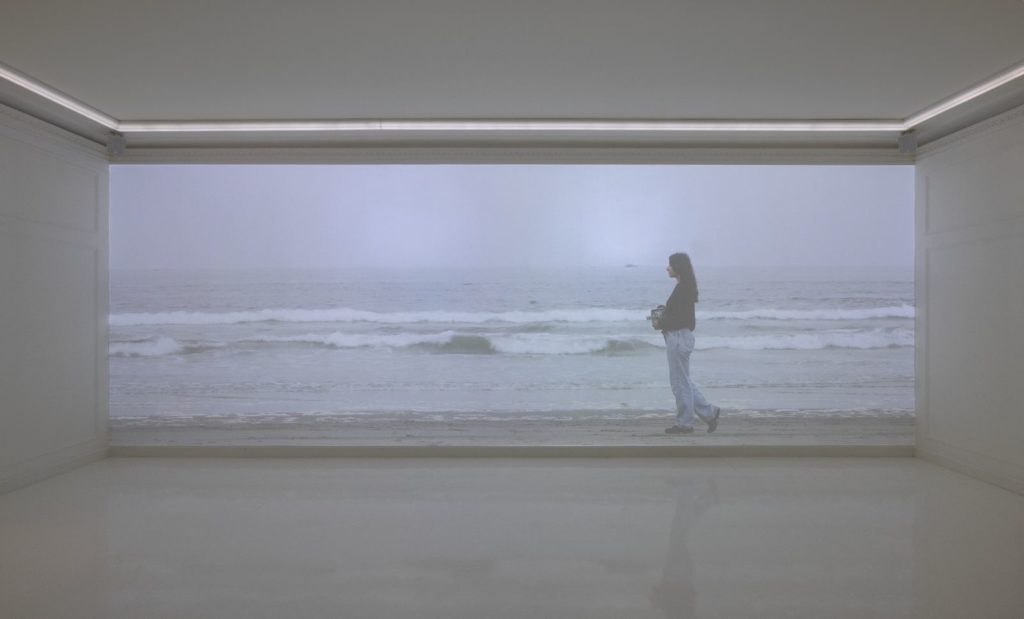
Slowness recurs throughout her practice not as aesthetic choice, but as a method for remaining inside attention. In one work, filmed in Watermill, New York, the body moves so gradually across the shoreline that perception itself begins to loosen from chronology. Following Pauline Oliveros’s “extreme slow walk,”[5] Brahim traverses the beach carrying a camera as though it were another limb, an extension of the body rather than an external recording device. The resulting work, Adagio (2023), unfolds with such restraint that at first almost nothing appears to happen. Yet gradually another temporality emerges. The eye, accustomed to acceleration, begins to recalibrate itself around breath, weight, duration.
What is radical about the work is not its slowness alone, but its refusal of productivity. The body, here, is not performing for visibility. It is simply attempting to remain present to itself. The camera trembles slightly with each step, reminding us that perception is always tethered to flesh. One thinks of Virginia Woolf’s understanding of consciousness as wave-like, constantly dissolving and reforming at the edges. Brahim’s movements possess something similar: they drift toward awareness rather than certainty.
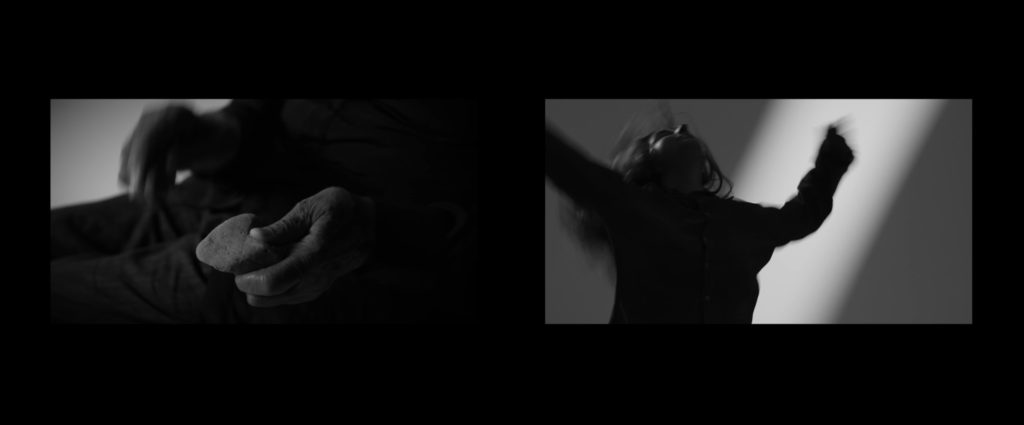
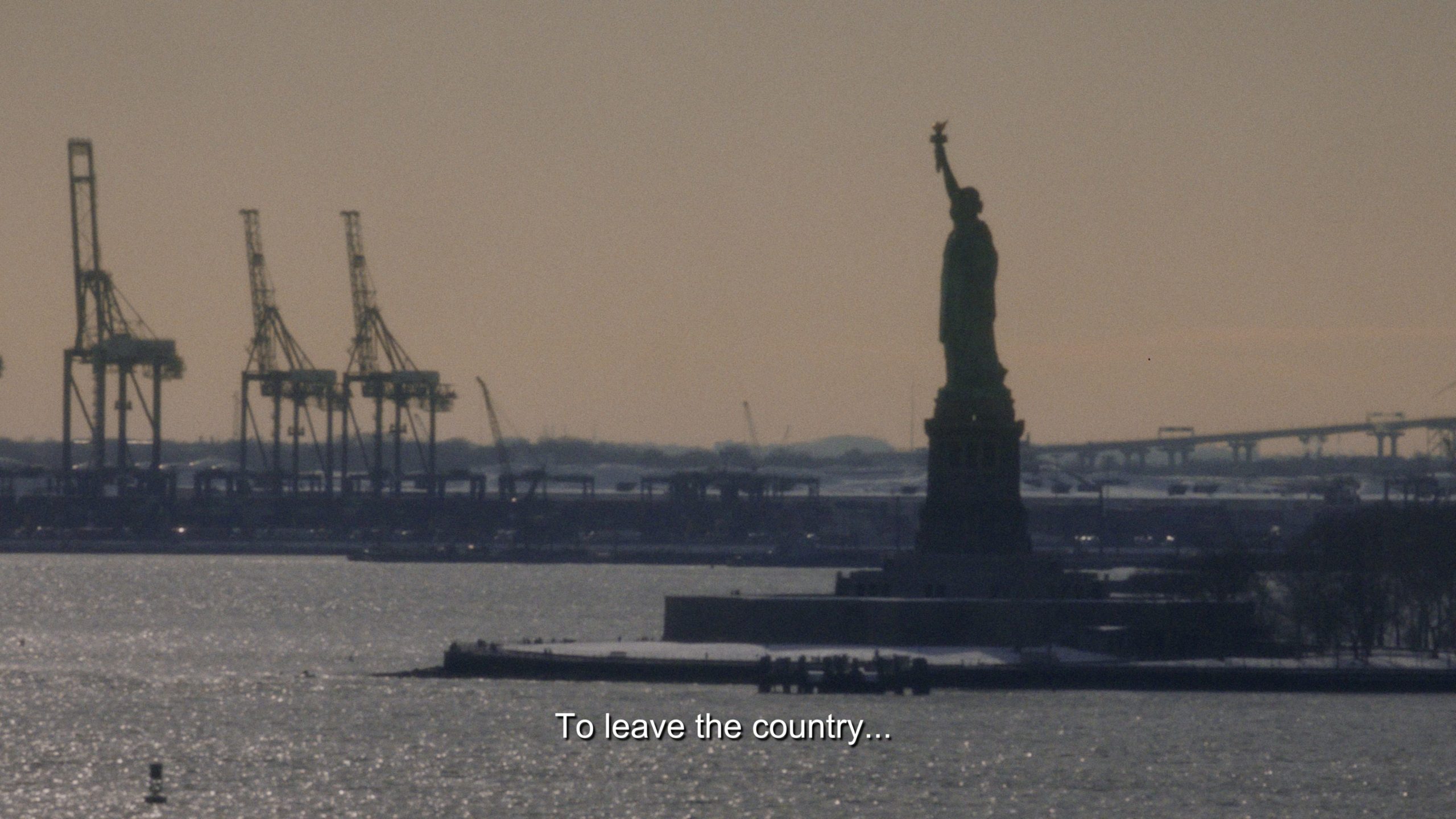
Memory, in her work, rarely arrives intact. Images surface partially, then recede before they can stabilize. Fragments overlap until recollection becomes indistinguishable from invention. In the two-channel film He said, we must forget (2023), footage gathered across seasons and cities — Milan, Lugano, New York — folds repeatedly into itself, appearing and disappearing through hand-painted interventions that obscure as much as they reveal. One image undoes another. Certain scenes emerge only momentarily before dissolving again, as though memory itself were resisting fixation.
The work seems concerned with the body’s involuntarily relationship to forgetting: the way certain experiences become inaccessible precisely because they remain too deeply embedded within us. Grief behaves similarly. It does not move linearly but accumulates in gestures, postures, unconscious repetitions. Watching the work, one senses that Brahim is less interested in recovering memory than in observing how memory mutates though time. How do we separate imagination from recollection? How does the body continue carrying what the mind can no longer fully access?
A phrase associated with the work lingers insistently: “To be born is to be nothing other than a reconfiguration, a metamorphosis, of something other.”[6] This idea of the self as continual recomposition runs quietly throughout Brahim’s practice. Identity is never stable. The body remains in constant negotiation with landscape, memory, language, and loss. Even pain becomes material through which one reorganizes a relationship to the world.
Perhaps this is why landscape enters her work so naturally, almost inevitably, or perhaps it had always been there, waiting at the edge of the frame. The desert, especially, recurs not as a backdrop but as a collaborator, a place Brahim returns to repeatedly, not to master it but to listen to it. In recent works filmed in AlUla, the body appears increasingly porous to its surroundings, shaped by heat, wind, silence, exhaustion. The vastness of the landscape seems to reduce the self while clarifying it at the same time.
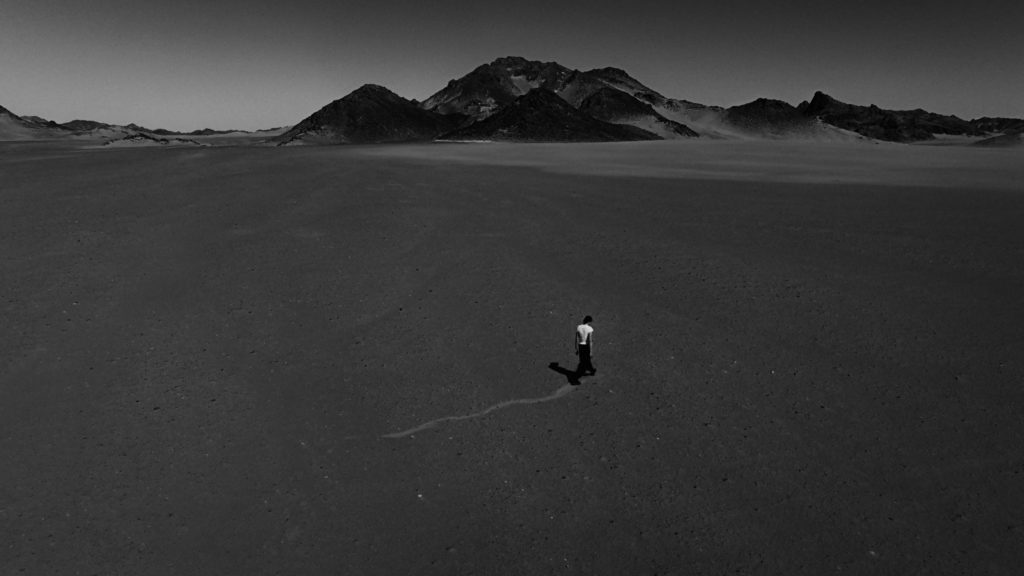
In In Search of an Honest Map (2025), presented in “Cartographies of Presence,” alongside Shirin Neshat, at Albion Jeune, London, Brahim traverses the Saudi Arabian desert under searing heat, dragging her feet across the sand to create circular traces before lying within them, fashioning temporary refuges with her own body. The gesture couldn’t be more simple. Nothing monumental occurs. But the work carries an extraordinary emotional weight precisely because of its restraint. The body does not impose itself upon the landscape but receives it. Presence emerges through listening, not through domination.
What remains so moving about these gestures is their impermanence. The marks Brahim leaves in the sand are destined to disappear almost immediately. Wind will erase them. Time will flatten them back into the landscape. This ephemerality, however, seems essential to the work’s emotional logic. It asks what it means to inhabit a place without possessing it, how one might leave a trace without insisting on permanence.
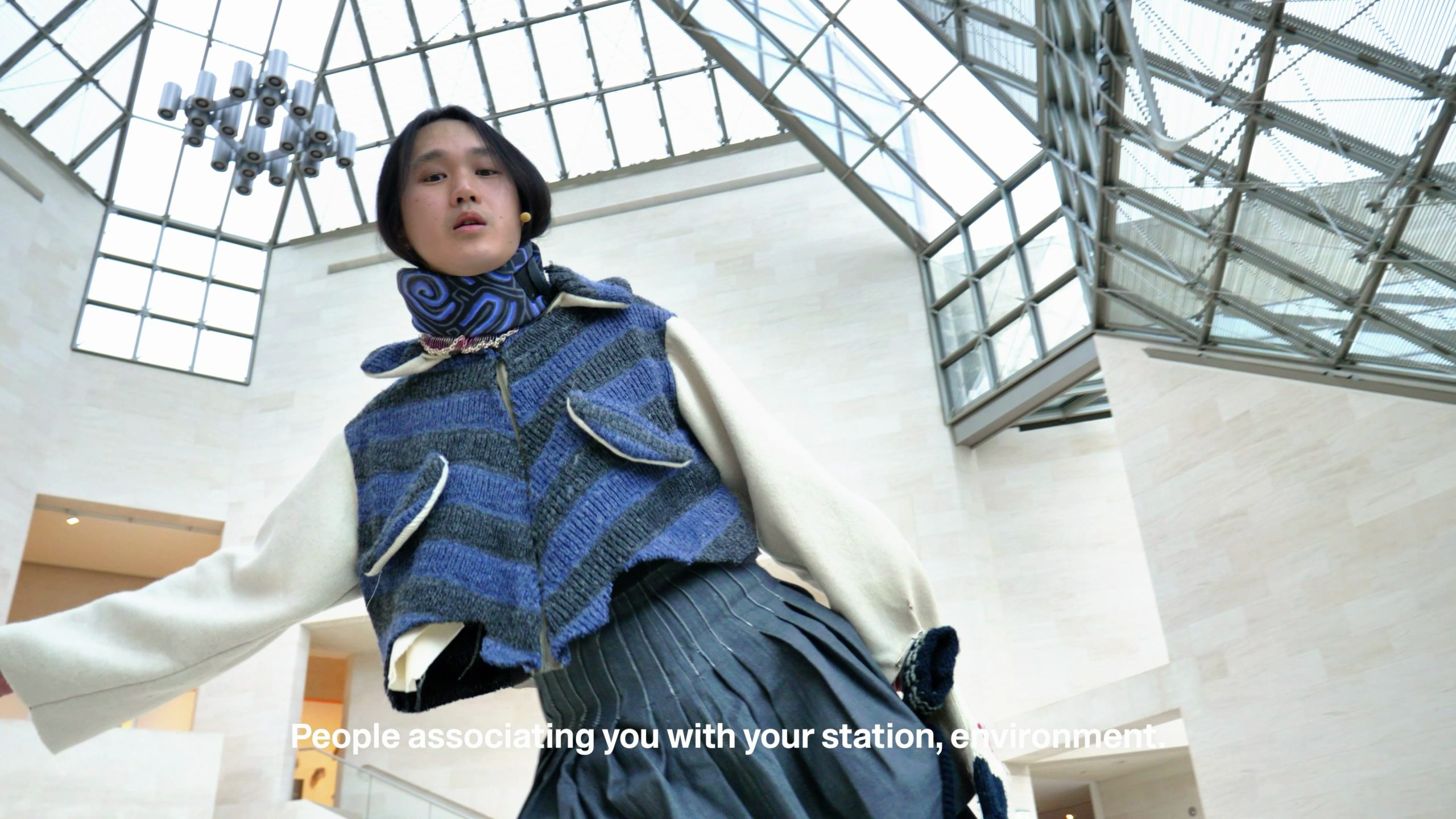
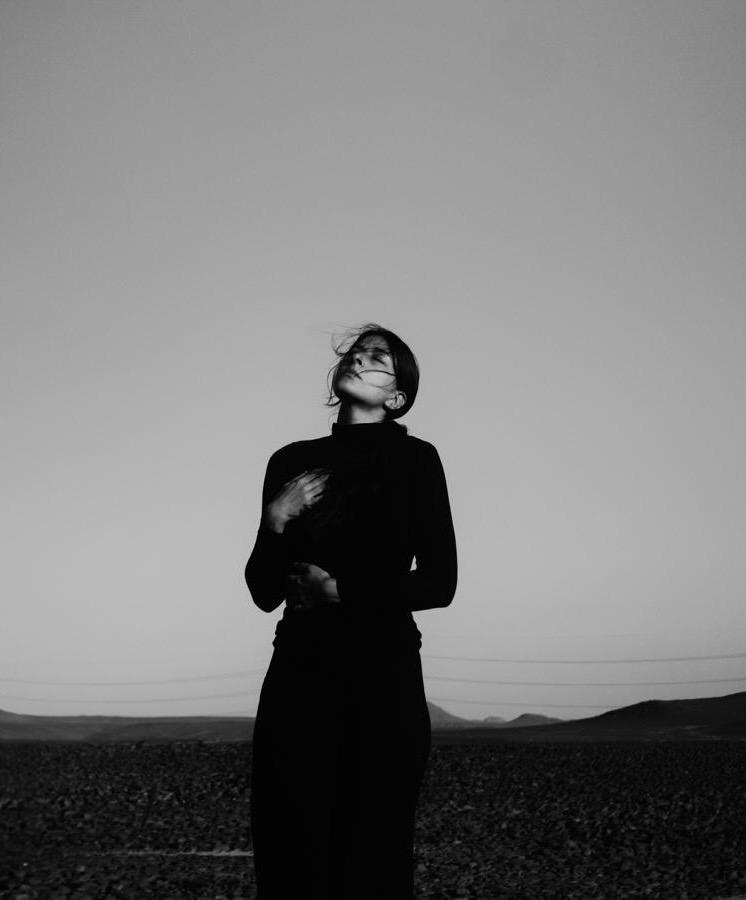
There is something so deeply humbling in the way Brahim approaches the desert. She often speaks of it as a place that gives information — not metaphorically but physically. A site capable of teaching the body how to listen differently. In many traditions, deserts function as spaces of revelation, emptied landscapes where one encounters both terror and clarity. For Brahim, revelation arrives not through transcendence but through attention. She once described teaching herself how to pray there with her eyes open — I shut my eyes to feel; I open them to pray, we hear her voice say in There Will Come Soft Rains (2025). That detail feels central to understanding the work. Presence, for her, is never withdrawing from the world. It is radical exposure to it.
Mary Oliver, another author beloved by Brahim, wrote that “attention is the beginning of devotion,”[7] and Brahim’s works seem built precisely from this form of devotion. They ask viewers to slow down enough to perceive what usually escapes visibility: wind passing across fabric, breath altering posture, silence reshaping a room. In There Will Come Soft Rains, filmed in the early morning hours on the Harrat Uwayrid, a volcanic mountain in AlUla, choreography almost disappears entirely. The body no longer directs movement so much as allows itself to be moved by atmospheric forces. Wind becomes visible only through contact — against skin, fabric, hair, the shifting balance of a standing figure (the artist herself). After years of returning to this landscape, Brahim approaches the desert as a collaborator that determines rhythm and form. Presence appears not autonomous but relational, produced through permeability.
The texts she writes to accompany these works often resemble poetic instructions more than explanations. Through somatic descriptions and small tasks, she invites viewers back into their own bodies, encouraging attentiveness to one’s breath and orientation in space. This pedagogical dimension feels important. Her work does not seek passive spectatorship; it asks for bodily participation, however subtle. Watching her films often produces an involuntarily physical response: slower breathing, sharpened listening, increased awareness of one’s own posture and surroundings. Art becomes less an object to interpret than a condition to inhabit.
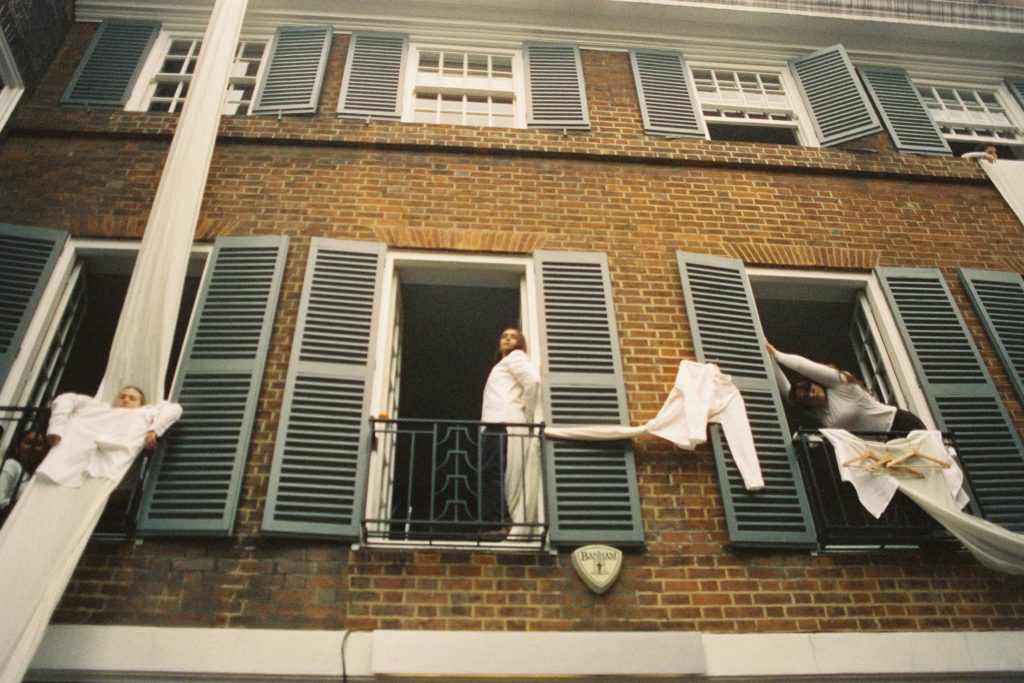
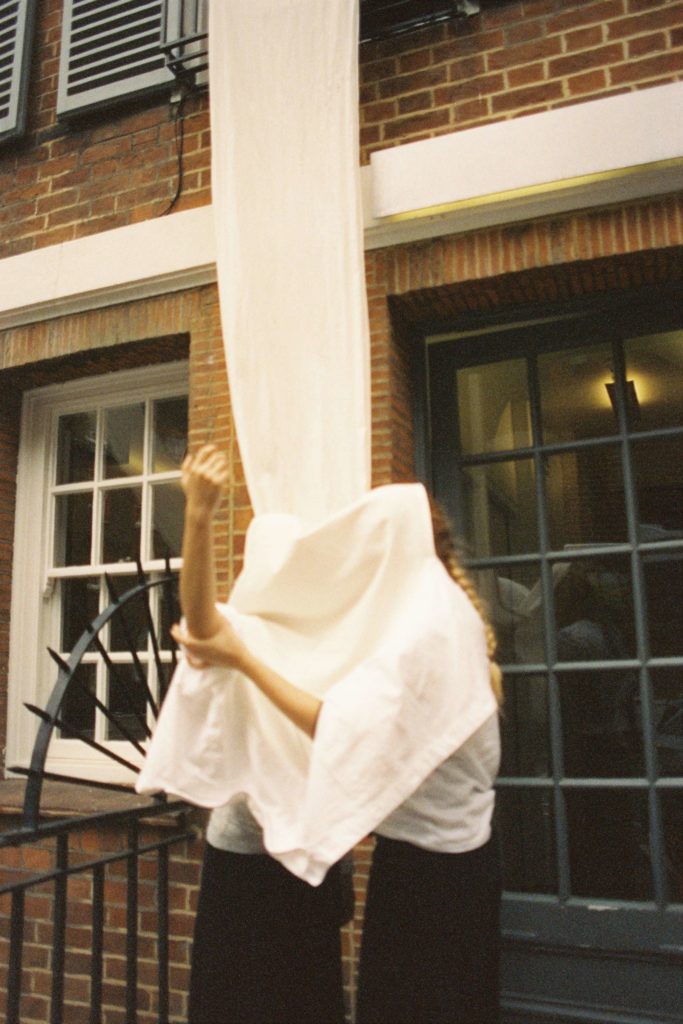
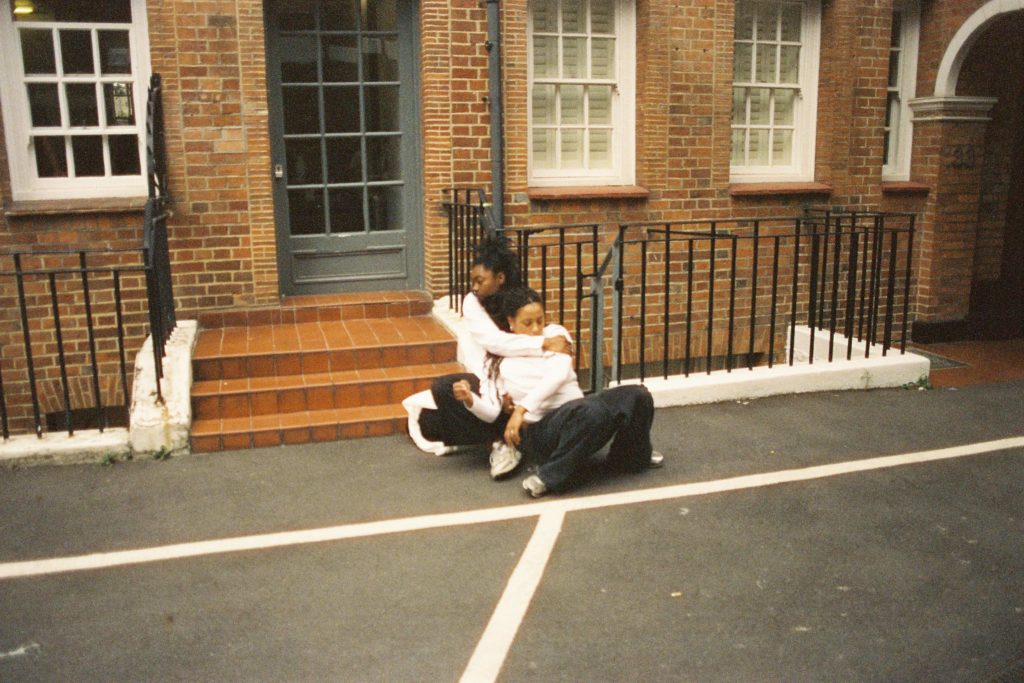
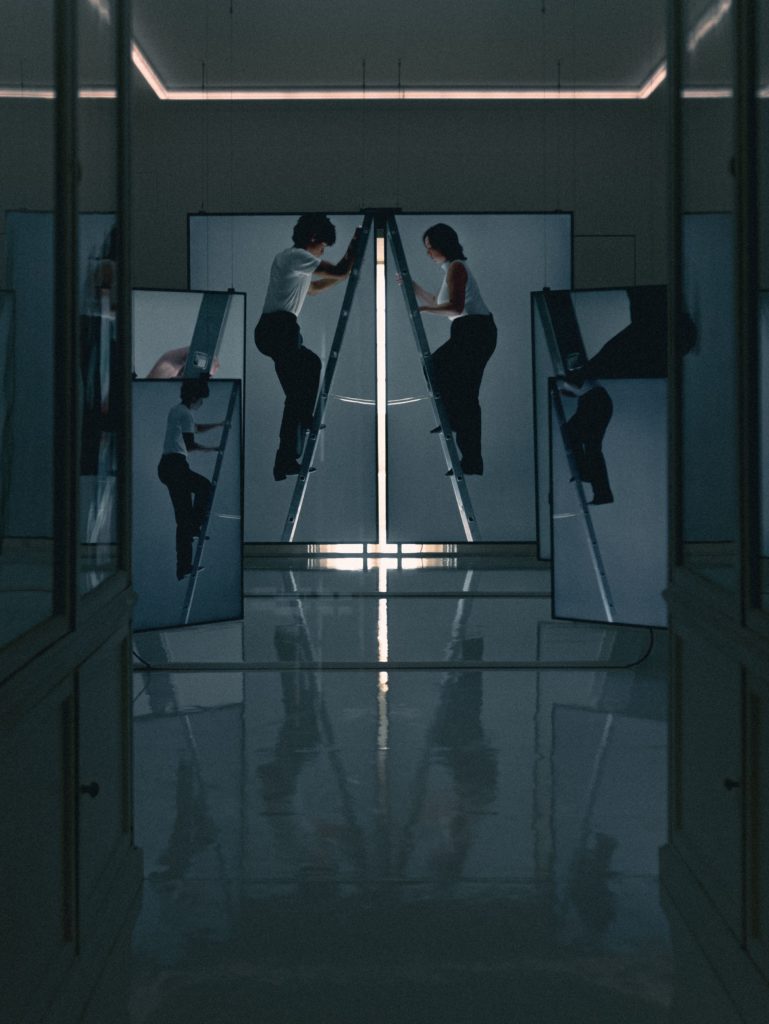
This concern with shared presence extends naturally into her performances. During Frieze London in 2025, a durational work unfolded slowly across the facade of the Delfina Foundation: bodies, connected through elongated white garments, measured distances between one another, folding, climbing, wrapping, reaching. How can I reach you? (2025) transformed architecture into something tender, a structure to be felt through movement. Two white shirts linked by draped fabric became mobile measures of proximity and dependency, allowing bodies to negotiate intimacy physically, in real time.
Nothing happened dramatically, and yet this refusal of spectacle was precisely the point. The gestures themselves were ordinary, but Brahim rendered them newly visible through duration and attentiveness. The windows of the building became frames through which everyday gestures acquired an almost unbearable intimacy. What lingered afterward was not image but sensation: the fragile labor of remaining connected to one another, even briefly, within the conditions of contemporary life.
This subtlety distinguishes her from much contemporary discourse surrounding performance and embodiment. Brahim does not instrumentalize the body into statement or slogan, though her work inevitably carries the weight of being a woman artist working through vulnerability, intimacy, and presence. Instead of treating identity as fixed declaration, she approaches subjectivity as a continual balancing of inner truth and external reality. “You can’t fake pain,” she once told me. What she means, perhaps, is that the body always betrays abstraction. It insists on lived experience.
And yet, there is nothing confessional about her work. Even at its most intimate, it resists any closure. The personal opens up outward into something shared, almost anonymous. Grief becomes less an individual condition than a common language of endurance. This is perhaps why her works feel so emotionally expansive despite their restraint. They leave space for viewers to enter them with their own memories and their own losses.
In a cultural moment organized around immediacy and declaration, Brahim’s practice feels radical. It refuses spectacle without retreating into opacity. It remains politically resonant without becoming polemical. There is no propaganda in these works, no attempt to instruct viewers what to think or feel. Instead, they create conditions under which attention itself becomes transformative.
Returning now to that afternoon in Milan, I realize the missing Dickinson book mattered because it mirrored something essential about Brahim’s work itself. The poems had not been found, yet their absence produced its own form of intimacy. So much of her practice concerns precisely this tension between presence and disappearance, between what can be held and what inevitably slips away. Her works do not attempt to resolve loss, but they ask how we might remain present within its aftermath.
Sylvia Plath once wrote, “I am inhabited by a cry.”[8] Brahim’s work seems to begin where such cries quiet into listening. Not silence exactly, but another register of attention capable of holding contradiction without collapsing into certainty. In her hands, the body becomes both archive and instrument: a place where grief accumulates, where memory fractures, where landscapes impress themselves onto skin, where transformation remains possible.
Sometimes we are eternal. Never permanently, nor completely, but briefly. In certain moments of profound attention — walking slowly enough to feel the earth shifting beneath the feet, listening hard enough for the wind to acquire shape, remaining still enough for another person’s presence to alter the atmosphere around us — something opens. Brahim’s work inhabits that opening.
[1] Virginia Woolf, The Waves (London: Hogarth Press, 1931), 32.
[2] Emily Dickinson, The Gorgeous Nothings: Emily Dickinson’s Envelope Poems, ed. Marta Werner and Jen Bervin (New York: New Directions, 2013), 68.
[3] Clarice Lispector, Água Viva (London: Penguin Modern Classics, 2014), 31.
[4] Anna Halprin developed experimental “task-based” choreographies in the 1960s and 1970s, replacing formal dance vocabulary with everyday actions, improvisation, and embodied awareness. Thomas Hanna later coined the term “soma” to describe the body as perceived from within; a lived sensorial body in which physical and mental processes remain inseparable.
[5] Pauline Oliveros’s “extreme slow walk” formed part of her broader practice of “Deep Listening,” a meditative approach to sound and movement based on heightened bodily harness, sustained attention, and radically slowed perception.
[6] Emanuele Coccia, Metamorphoses, trans. Robin Mackay (Cambridge: Polity Press, 2021), 20.
[7] Mary Oliver, Upstream: Selected Essays (New York: Penguin Press, 2016), 14.
[8] Sylvia Plath, “Tulips,” in Ariel (London: Faber and Faber, 1965), 18.