It’s the first official pre-opening day of the 61st Venice Biennale and we, a group of eager art tourists, are huddling together on a pier. While the rain slowly falls down on us, we pile into several boats. We’re on our way to the much anticipated and highly exclusive Opening Étude of Florentina Holzinger’s SEAWORLD VENICE (2026). For those in the know, the choreographer and performance artist Holzinger started staging one-offs under the title of Études in 2020 as a way to experiment outside the black box theaters where she’s been staging her works since 2012. Taking her choreographies into public space has offered the artist a chance to create much more complex compositions in dialogue with architecture and natural elements.
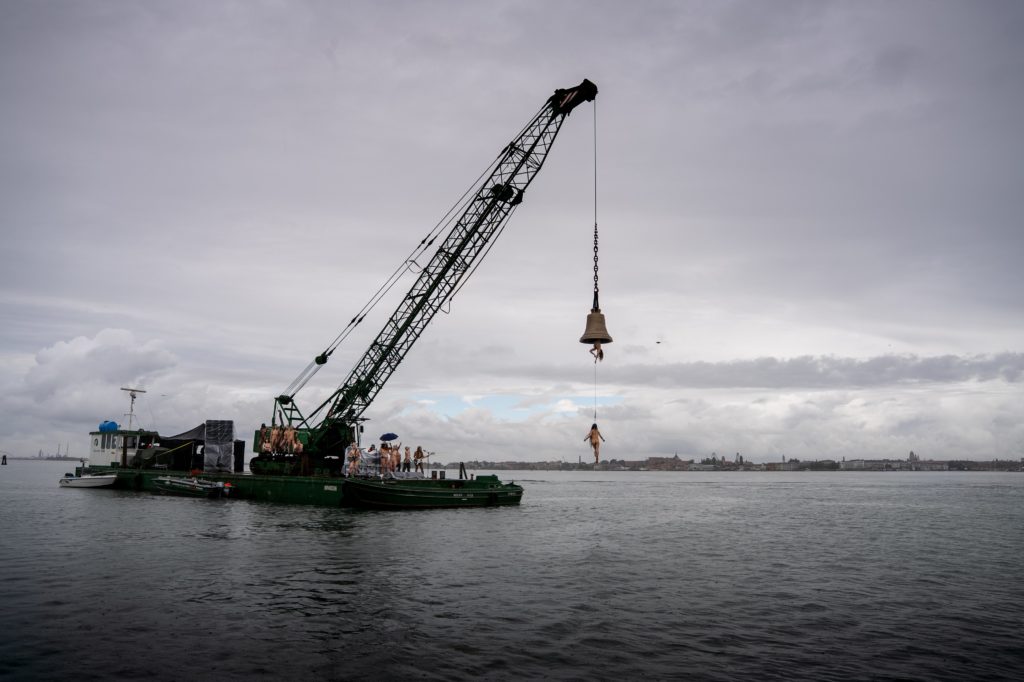
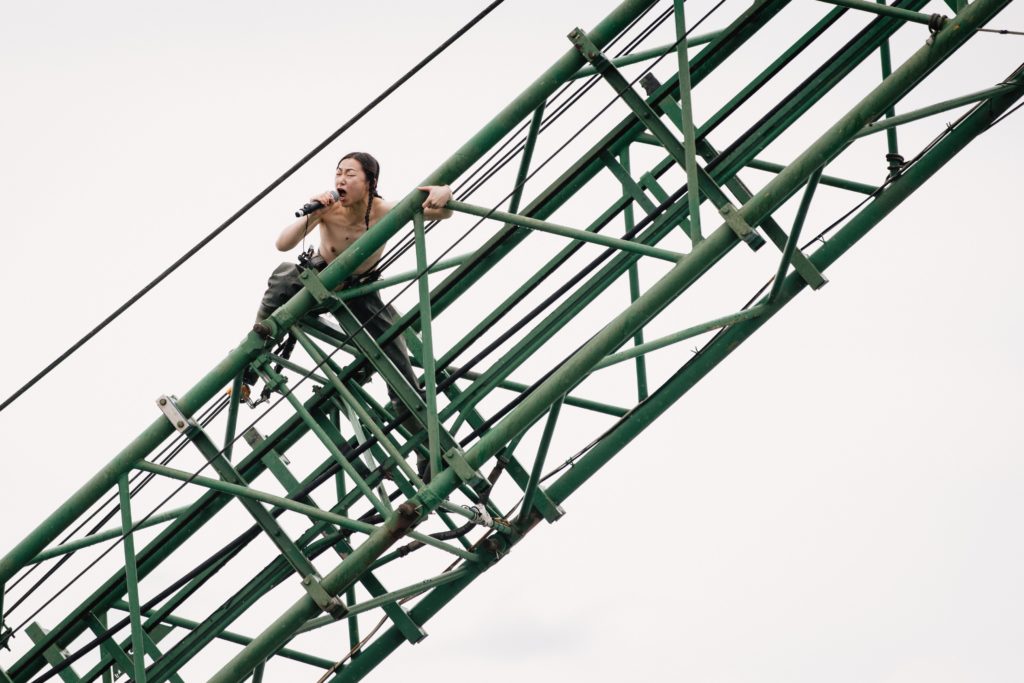
Our boats are driven to an undisclosed location out on the water, dropping us off on floating bleachers. We rush to find a wet seat with the best view of the water while hiding under our umbrellas. While we wait, several unclothed women hang out on another platform. One group blatantly stares at us across the water, another forms a band, playing peaceful string drone music out onto the lagoon. A large industrial crane looms above them. A conductor, whom I recognize from an earlier Étude in Bergen, walks out between the musicians and the music picks up in intensity, transforming into noise metal. A guitarist starts climbing all the way up to the top of the crane, followed by a singer belting out screams across the water, a long-haired siren luring us in. They’re both safely secured, yet the stark contrast between their flesh and the cold imposing metal of the crane feels visceral, reinforced by the gray clouds and the pounding rain. Then, slowly, the crane dredges something heavy from the water, revealing a metal bell, from which a dripping wet Holzinger emerges, hanging upside down. How long had she been down there? Slowly she starts moving her body from side to side, banging her lower body against the metal, turning herself into a bell clapper, before being joined by another performer lifted on flesh hooks between her shoulder blades, slowly and serenely dancing in the air below her. This same bell ends up hanging at the Austrian pavilion, where a performer climbs inside and rings it every hour, instantly creating one of the most eidetic images of the Biennale.
That Holzinger was to become the darling of the 61st Venice Biennale was not a given. Since Anne Imhof won the Golden Lion for her work Faust in 2017, and was quickly followed by the “beach opera” Sun & Sea (Marina) by Rugilė Barzdžiukaitė, Vaiva Grainytė, and Lina Lapelytė in 2019, an important shift toward including performance in the traditionally sculpture- and painting-heavy setting of the Venice Biennale had been signaled. Holzinger, however, has mostly been visible in the dance and theater world. Part of a broader wave of theater-makers, from Miet Warlop to Dries Verhoeven, who are increasingly finding their way to Venice, for many in the visual arts this may well be a first encounter with her work. Often lauded as the superstar of contemporary European dance, she only slowly began to venture into the visual art world after her collaboration with German curator Nora-Swantje Almes at Bergen Kunsthall, where she staged Harbour Étude (2024), a high-stakes, open-air choreography commanding dance, stunts, heavy machinery, and natural elements.
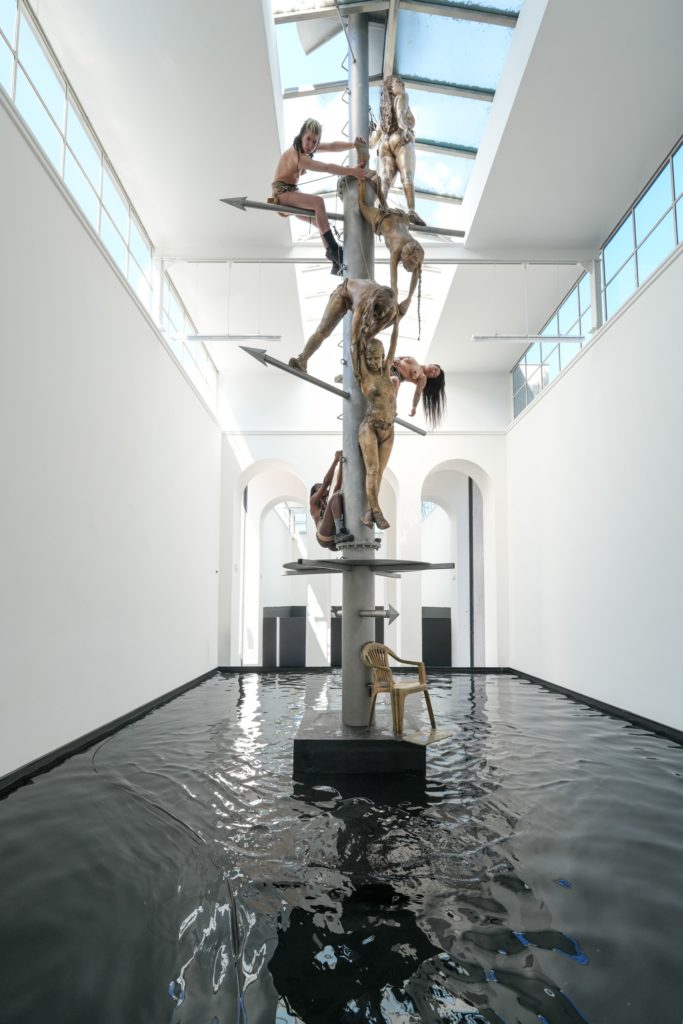
Her audience seems polarized as always, but responds overwhelmingly positively toward the newcomer. At the inauguration, Holzinger’s athletic frame is clad in baggy sportswear rather than full designer swag, ready to plunge herself into the flooded pavilion. She speaks about failing systems, the political pressures bearing down on the Biennale, and the tensions causing the prize jury to resign. In the days after, people kept quoting her back to me. Holzinger’s SEAWORLD VENICE feels like an acknowledgement that individualism isn’t working anymore. When the Art Not Genocide Alliance (ANGA), in collaboration with Italian unions, calls a strike during the Biennale, every single one of Holzinger’s performers joins, bringing the pavilion to a standstill. In an art world that too often mistakes critique for action, people are responding to someone who simply shows up and builds something real.
Since around 2017, Holzinger has worked almost exclusively with bodies that read as feminine, and they are almost always naked. Much has been made about the shock value of her choreographies — skating nuns, women pooping or orgasming on stage, suspended or crucified by flesh hooks — and the inevitable comparisons to the visceral and bloody rituals of the Viennese Actionists. Audience members have been known to require medical attention for severe nausea. But where the Viennese artist Valie Export used nudity as resistance, and the Actionists were deliberately shocking, Holzinger’s performers push past their constraints to expand their own physical boundaries. The religious and humorous imagery accrues. Hers is a demonstration of sovereignty, a display of what the body is capable of when it refuses the script of weakness that is usually projected onto the female form.
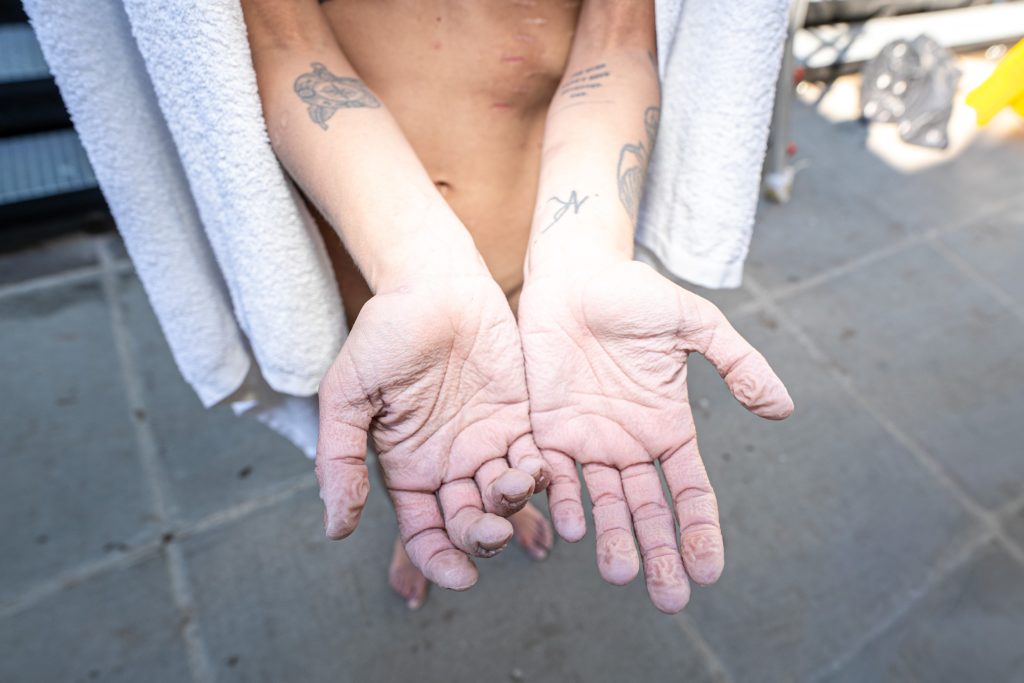
Holzinger uses spectacle as an access point, utilizing shock as a vehicle to bypass the viewer’s logical mind, a tactic informed by Antonin Artaud’s Theater of Cruelty, a theater concept that rejects traditional theater’s reliance on the rationality of text-based performance in favor of raw sensation, where sound, light, and physical spectacle act directly on the body rather than the intellect. But behind the initial shock, one finds layers of technical rigor and daily practice that accumulate into something closer to a habitus, a way of life, a ritual built in the body over time.
The refusal of Holzinger’s performers to be decoratively naked is particularly pointed at a time when her own digital presence is actively being censored; her Instagram account was temporarily suspended by Meta a few days after the pavilion opened. Her work offers an inversion of this digital gaze, as over time, the nudity becomes less of a spectacle and more of a given. She trains the viewer to cease projecting eroticism or shame, and instead to see the full extent of what the body is capable of.
In Ophelia’s Got Talent (2022), a two-and-a-half-hour performance created at the Berliner Volksbühne, a penisless cast moves from a drowning sailor’s dance to a synchronized swimming choreography before climbing a full-scale rescue helicopter, all grand gestures undercut by camp and deliberate clumsiness. Threading through Shakespearean and Greek mythology, water is both a natural force that overwhelms and a medium for collective pleasure. She doesn’t drown Ophelia in it but reveals it as a possibility to train the body. Harbour Étude gave her the chance to work with the intense forces of the sea and with the architecture, heavy machinery, and natural elements that would define her subsequent work. The collaboration with Almes, who was tasked with orchestrating the choreography of heavy machinery such as forklifts and boats together with Holzinger and her team, cemented a relationship that proved significant in continuing her journey into the visual arts. Almes, who has built her practice around performance-based exhibitions, is the ideal curator-collaborator. Where a traditionally trained curator knows how to handle traditionally static art, they often don’t know how to accommodate live art — let alone, in Holzinger’s case, a team of up to thirty performers, producers, technical directors, dramaturgs, and designers, and the crowds of visitors who become part of the work the moment they arrive. To hear Almes tell it, the Austrian pavilion this year won’t be a gallery so much as a metabolic process: a living organism that fluctuates with the weather and the crowd. It is, as Holzinger notes, a process of transformation until the very end.
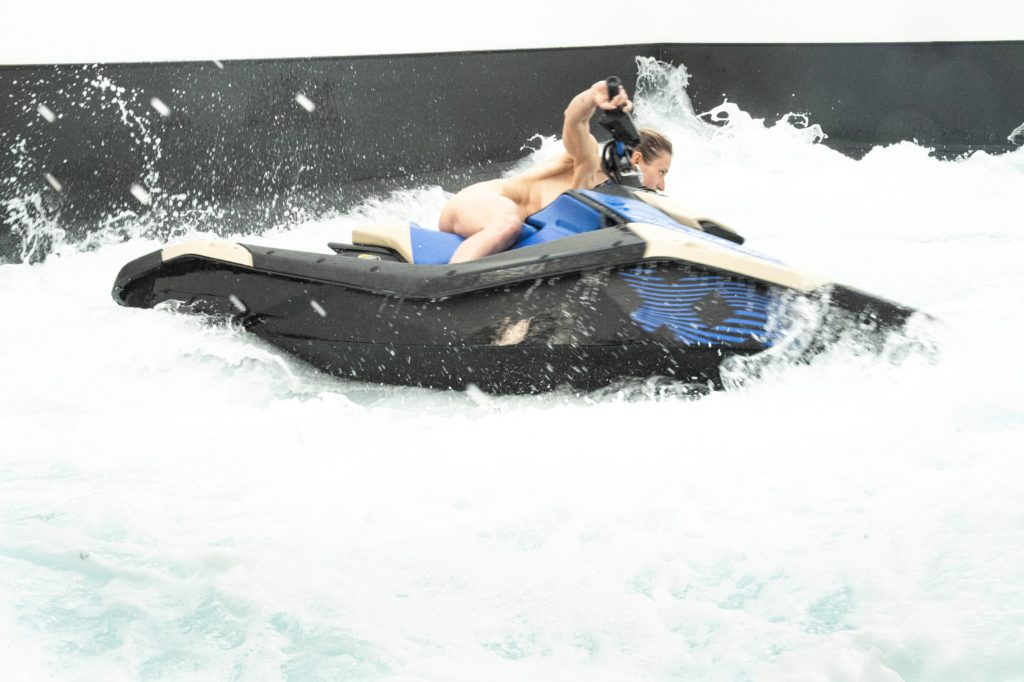
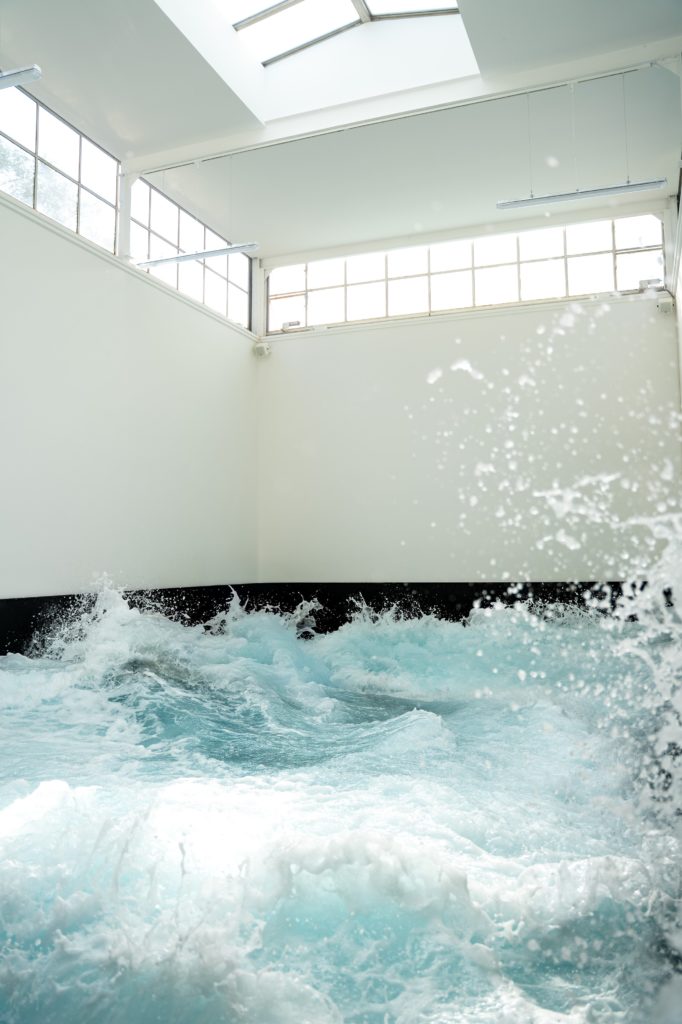
It’s a “hustle like a motherfucker” ethos she’s bringing into the Giardini of the Biennale, a defiant response to a world where political, ecological, and artistic systems are failing us all. SEAWORLD VENICE is an overly familiar setting made urgent again. A sinking city, flooded by the waste of mass tourism. By building their own infrastructure, including a water tank fueled by filtered piss from their visitors, where a performer lives for at least four hours a day breathing through a scuba regulator, Holzinger and her performer-sisters have moved into the Austrian pavilion for the next seven months. Inside, a performer occasionally circles a flooded room on a Jet Ski, in another, they ride a monumental rotating weathervane. In their own bombastic and humorous way, they offer a way to live in other people’s waste.
Holzinger didn’t set out to be the provocateur du jour; she initially wanted to be an athletic dancer, a body for hire, someone “satisfied to sweat for somebody else.”[1] But the gatekeepers of the traditional dance world demurred. When she eventually landed at SNDO (School for New Dance Development) in Amsterdam, she was presented with a curriculum that traded traditional dance classes for concept development, a holistic approach she describes as lying on floors and “sensing” the self, something she initially loathed. They started making pieces from the get-go, she says, without even knowing what they needed to make new work. After she finished in 2012, the idea of “making something out of nothing” remained, a skill she clearly carried into the productional complexity of building an entire alternative system in the bare-bones Hoffmann pavilion.[2]
Through Recovery (2015), Apollon (2018), and Tanz (2020), she addressed her initial desire for dance, reckoning with the disciplinary codes of classical dance and the body as object of spectacle. While Apollon dismantled Balanchine’s neoclassical ballet, Tanz explored the grueling rigor of ballet in general, inviting the legendary dancer Beatrice “Trixie” Cordua (who recently passed away at eighty-three) and a cohort of performers, dancers, and stunt women, to govern their bodies and ultimately set them free: flying on motorcycles, lifted by their hair and flesh. Holzinger, as always, veers from classical movement to stunt work, pushing our ideas of what is seemingly unhealthy or violent for a body. As she puts it: “Ultimately what we do is not more extreme than what many other people do. It’s just not normalized. We are very much questioning what type of pain is normalized in our society, and what type is not. And why is that?” While her work certainly plays with tropes such as the witch, the porn star, and the siren, it would be reductive to label it simply feminist. Caroline Lillian Schopp calls it feminist decadence, saying the work “luxuriates in the violence that so-called high art and its histories conceal.”[3] What looks like self-destruction is in fact self-determination.
Over the years, Holzinger has continued to insert her own body into her work while building close ties with her community. What isn’t immediately visible in the work is the depth of care behind it — for the performers, for the infrastructure, for the city of Venice itself. This type of high-stakes exploration is only possible through a high level of care and trust, something she has built and maintained over more than a decade with her group of collaborators. In SEAWORLD VENICE, her work has become more rigorous and more sincere. The 2026 Austrian Pavilion is thus not a stand-alone concept or just a self-described theme park where each performer does their trick, but a continuation of a training camp of sorts, for a life in the trenches. As Holzinger herself described it at the inauguration: “a way of life practiced in the waste of others.”
[1] Florentina Holzinger, in conversation with the author via WhatsApp, May 3, 2026.
[2] Holzinger, conversation.
[3] Caroline Lillian Schopp, “Florentina Holzinger Corrupts the Female Nude,” Artforum, May 13, 2026, https://www.artforum.com/features/florentina-holzinger-feature-caroline-lillian-schopp-1234750191/