“Conspiracies,” curated by Larne Abse Gogarty (author of What We Do Is Secret: Contemporary Art and the Antinomies of Conspiracy (2023), approaches conspiracy as a recurring structure of interpretation, collaboration, and political feeling. The exhibition brings together works by Hannah Black, Caspar Heinemann, Sam Keogh, and Shenece Oretha, alongside selected panels from Aby Warburg’s Bilderatlas Mnemosyne. Across sculpture, drawing, collage, installation, and sound, the show resists any expectation that conspiracy might be “solved” through exposure or critique. Instead, the works in this exhibition (and to a large extent the practices of these artists) tend to construct a field in which historical images, speculative narratives, psychoanalytical associations, and material processes are placed in unstable relation.
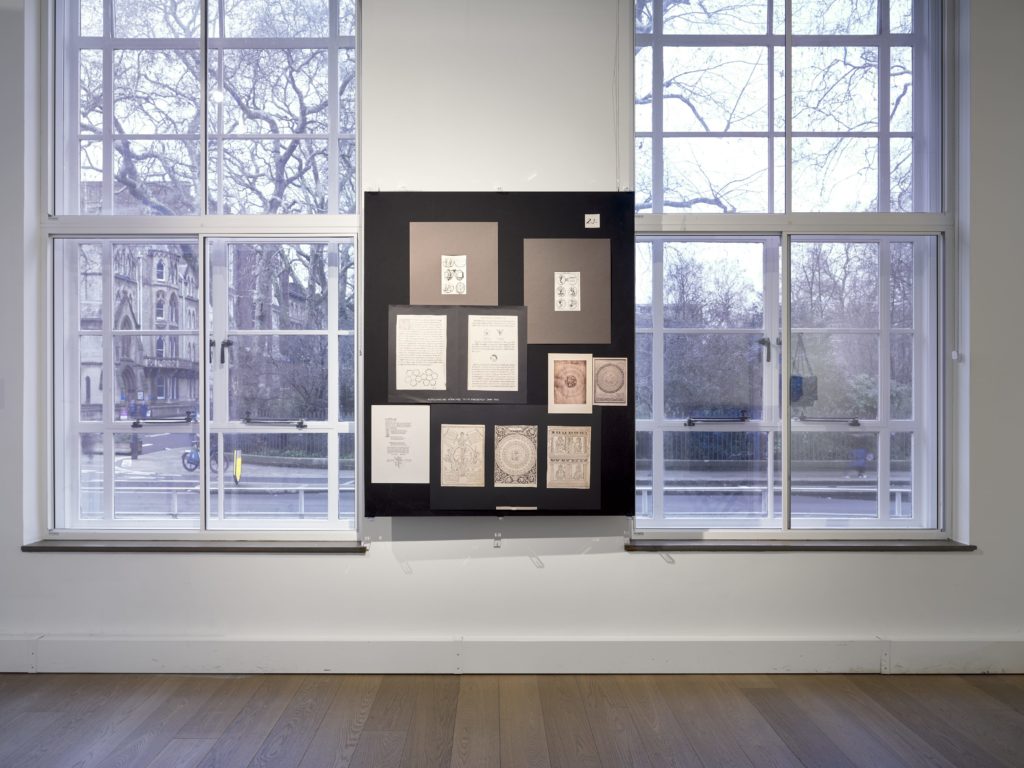
Bruno Latour argued that critical practices which rely on uncovering hidden structures risk reproducing the same logic that animates conspiracy thinking, insofar as both assume that power is coherent, concealed, and recoverable.1 Read in this light, conspiracy is an exaggerated extension of its potential for interpretive habits. The exhibition’s dense installation and refusal to resolve suggest a deliberate resistance to the idea that social and political relations can be reduced to a single hidden mechanism awaiting exposure.
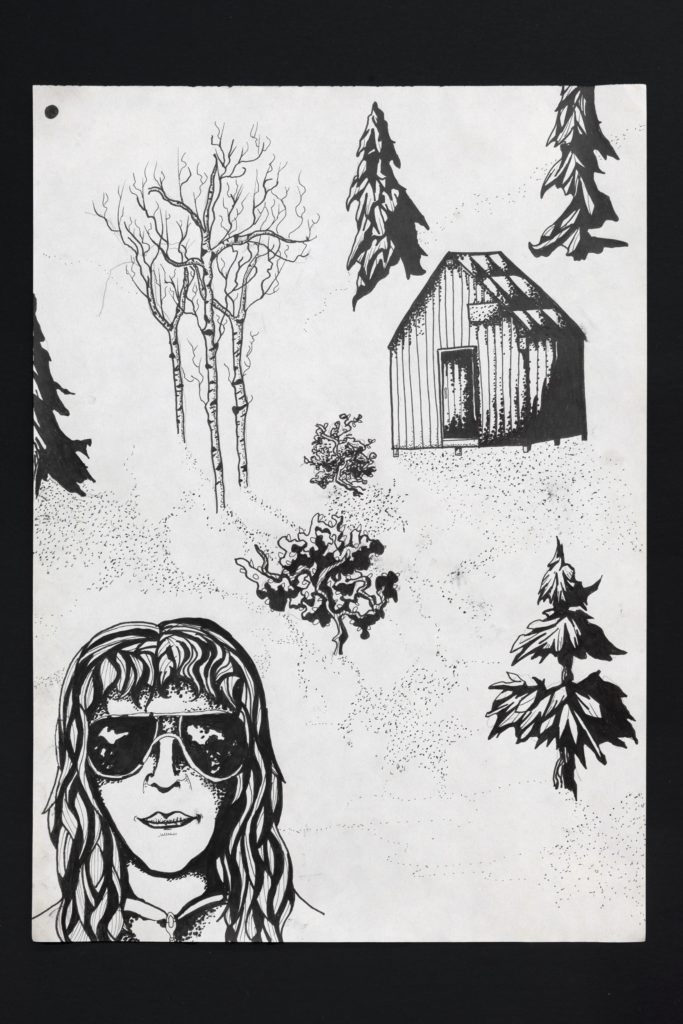
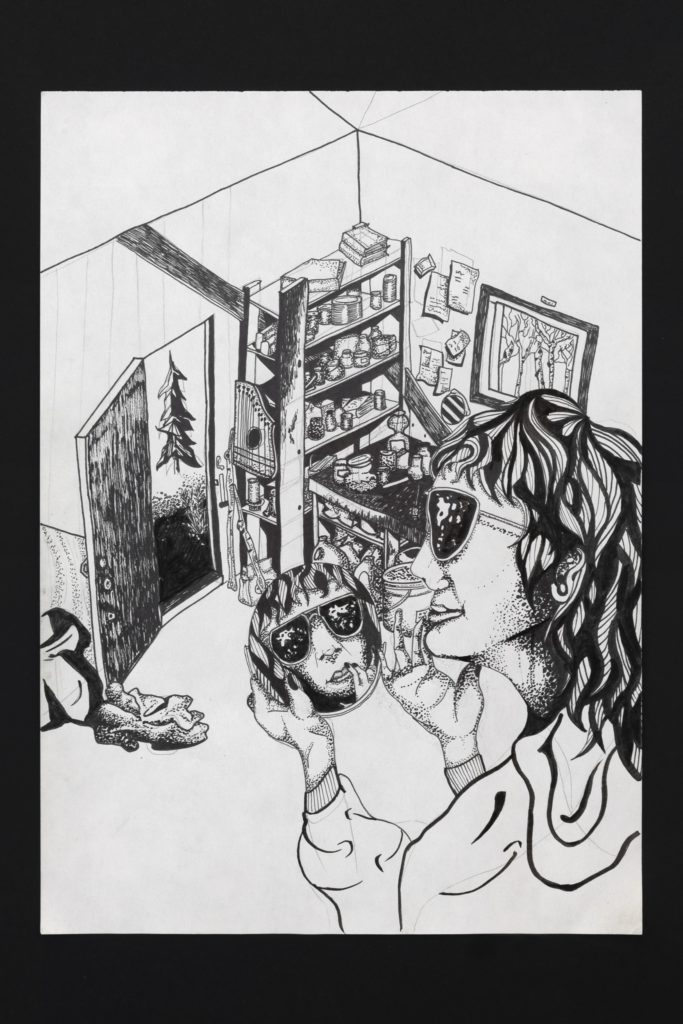
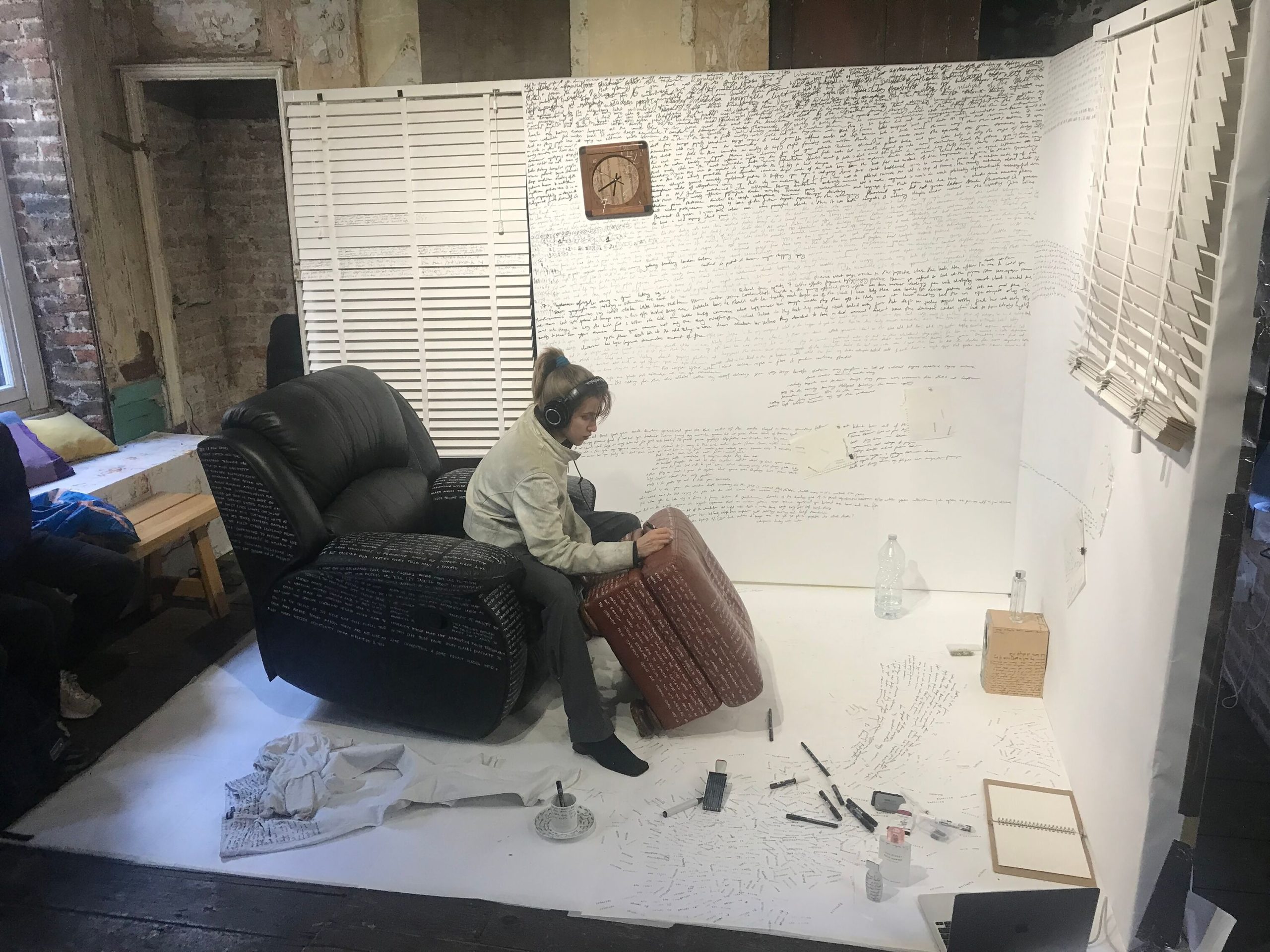
Materially, this refusal is articulated through works that privilege construction and fragmentation. Caspar Heinemann’s drawings Theodora and Her Cabin (Exterior) and Theodora and Her Cabin (Interior) (2023) are made in ink and marker, using dense line work and schematic shading that recall underground comics of the punk era. They reimagine Ted Kaczynski as “Theodora,” depicted within a log cabin interior populated by improvised chemical apparatuses and domestic fragments. The surfaces are rough and unstable. Heinemann’s sculptural works, assembled from mixed materials including wood, metal, and found objects, and partially obscured with black carpet tape, introduce physical redaction as a visual strategy. This aesthetic quality of packaging makes the sculptures appear as if they might physically contain other objects, treating concealment as a surface condition.
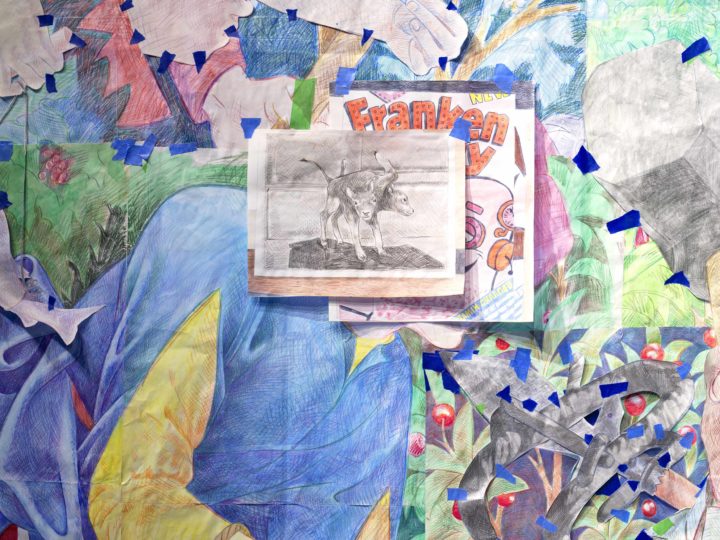
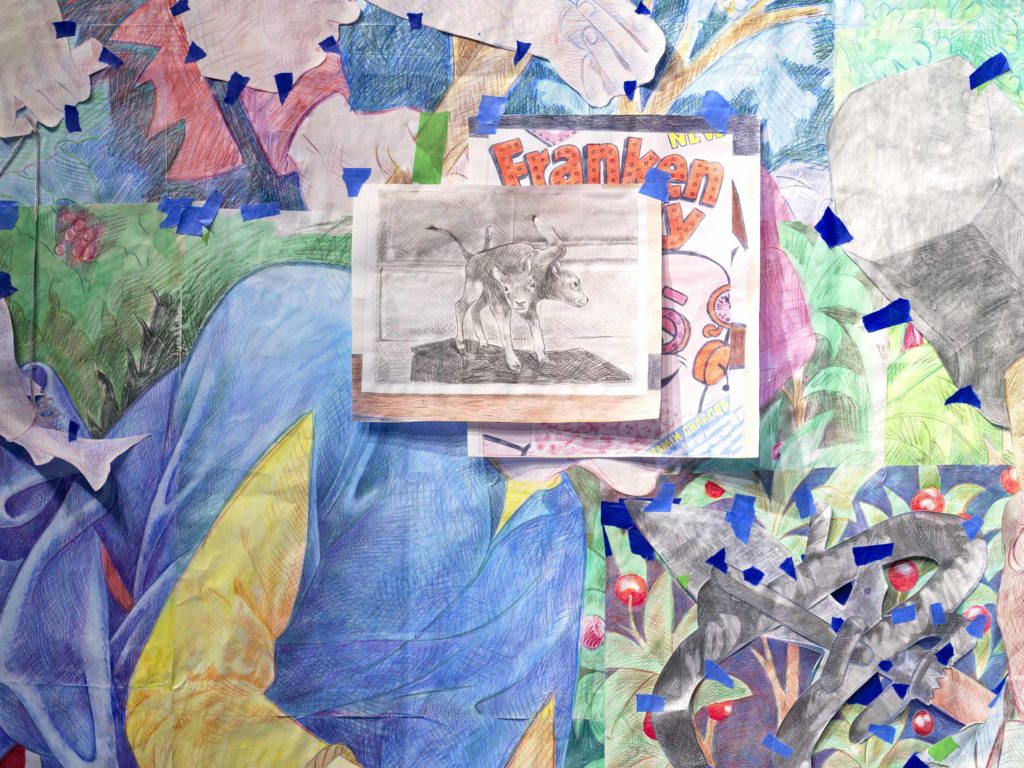
Sam Keogh’s large-scale collage The Unicorn Crosses a Stream Cartoon (2026), made from acrylic, watercolor, colored pencil, and painter’s tape on layout paper, operates through accumulation and structural layering. It draws together references from medieval tapestry, revolutionary pamphleteering, fantasy cinema, and contemporary surveillance systems. The work explicitly engages with The Hunt of the Unicorn tapestries, a late medieval series depicting the pursuit, capture, and possible resurrection of a unicorn, whose own history of damage, reuse, and institutional relocation becomes a model for visual circulation. Keogh’s use of painter’s tape as both connective and corrective material emphasizes the instability of images as they move across political and historical contexts. The mesmerizing visible labor put into this work, particularly in the carefully crosshatched drawings, points toward another register of politics: one grounded in time, attention, and the persistence of the hand (images of hands recur across the piece), resisting the frictionless reproducibility suggested elsewhere in the work. Activated through a performance that introduces a spoken narrative in which one of the characters searches for an origin point, only to be told by the other character (mediated through Keogh’s voice) that “there are no origins, only beginnings,” the piece itself expresses a multitude of beginnings, every working day.
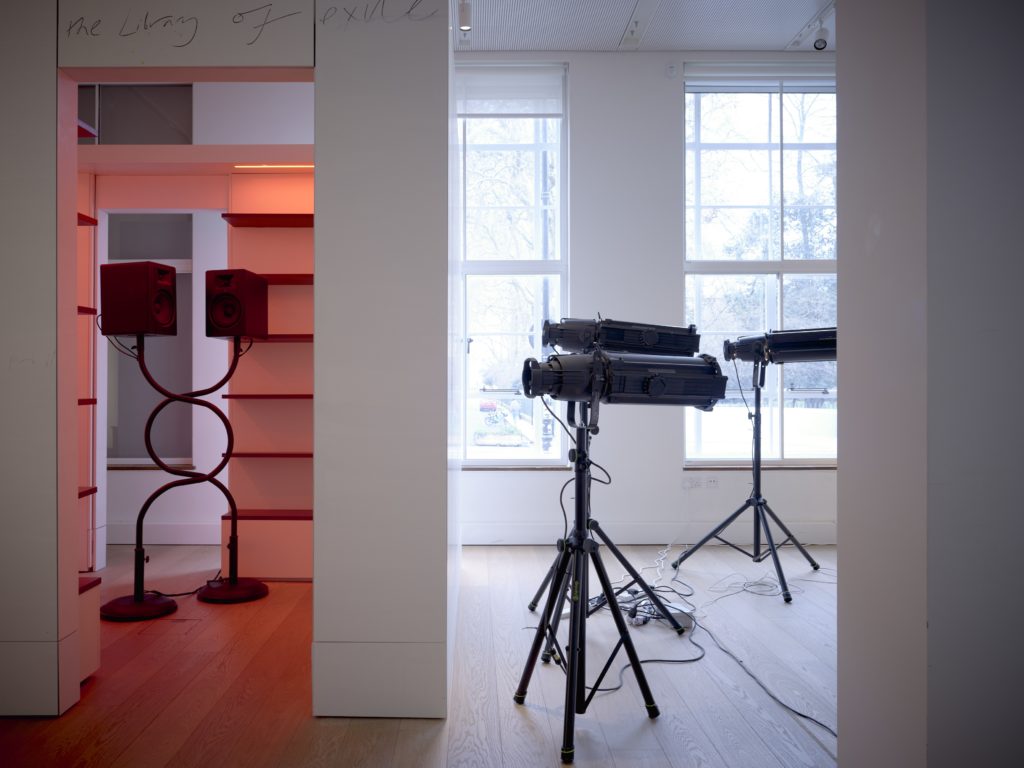
Hannah Black’s Wheel of Fortune (2021), produced in mixed media with rotating metal elements, stages a system of movement structured by chance, repetition, and interruption. A central palindrome, “REDIVIDER,” inscribed on the rotating metal structure, periodically aligns with light to activate surrounding elements in the installation, including references to contemporary financial imagery such as GameStop. At one point a beam of light shoots through a stencil of a cartoon face, giving a face to a pile of rubble. At another point, the light passes through police reports for accidents that took place on the artist’s birthday, although this is only revealed by the information panel hanging alongside the work. There is an abundance of interpretation panels in the exhibition, and perhaps there is a missed opportunity to intervene more directly to conflate or complicate the conventions of exhibition-making. In this small space, Hannah Black’s work comes closest to doing so.
Shenece Oretha’s sound installation Conspiracy: After Jeanne Lee (2021), by contrast, is constructed through voice, speaker arrays, and warm red spatial lighting. The work arranges sound sources as if engaged in intimate dialogue, producing an environment of resonances. Two figure-sized audio speakers curl, entangle, and appear to embrace each other in a confined space. It seems as if we’re interrupting the work rather than being invited in. Drawing on the etymological root of “conspiracy” (conspirare, to breathe together), it reframes the term “conspiracy” as collective attunement rather than secrecy or deception. The reference to Jeanne Lee in the title is in relation to the American vocalist, poet, composer, improvisor, activist, and educator. More specifically, the work is named after Lee’s 1975 album Conspiracy.
I encountered the exhibition over multiple visits, two of which I folded into a field trip with university students. In the seminar that followed our visit, usually a space of active discussion, there was instead a sustained and unusual silence. This hesitation contrasted sharply with the typical loudness and rhythm of such sessions. Even when conversation began, it remained fragmented, stifled, and uncertain, suggesting that something about the exhibition exceeded easy articulation. While many students eventually said they “liked” the works, they struggled to explain what that liking referred to. In subsequent informal conversations on the journey back to South London, several students were generous enough to expand on this uncertainty. For them, “conspiracy” is inseparable from the contemporary media ecology of misinformation, algorithmic amplification, and political extremism. Within this framework, the term already carries a sense of contamination, making its appearance in an art context feel precarious or suspect. At the same time, there was clear frustration that the exhibition did not offer resolution. The works neither expose hidden systems nor provide explanatory closure; instead, they sustain ambiguity and seemingly withhold revelation. This refusal ran counter to student expectations that art should clarify its subject, translating complexity into legible critique.
Ultimately, “Conspiracies” is less concerned with revealing hidden structures than with examining how structures of meaning are assembled in the first place, through image, material, sound, and narrative association. Its lack of interpretive closure may initially frustrate, but it is precisely this resistance that gives the exhibition its critical edge. By keeping systems partially unresolved, it forces attention onto the processes by which coherence is usually produced. The students’ silence, in this context, becomes legible as a confrontation with interpretive uncertainty itself. In a cultural moment that increasingly demands immediacy, explanation, and resolution, the exhibition’s commitment to material and conceptual instability emerges as its most sustained proposition.