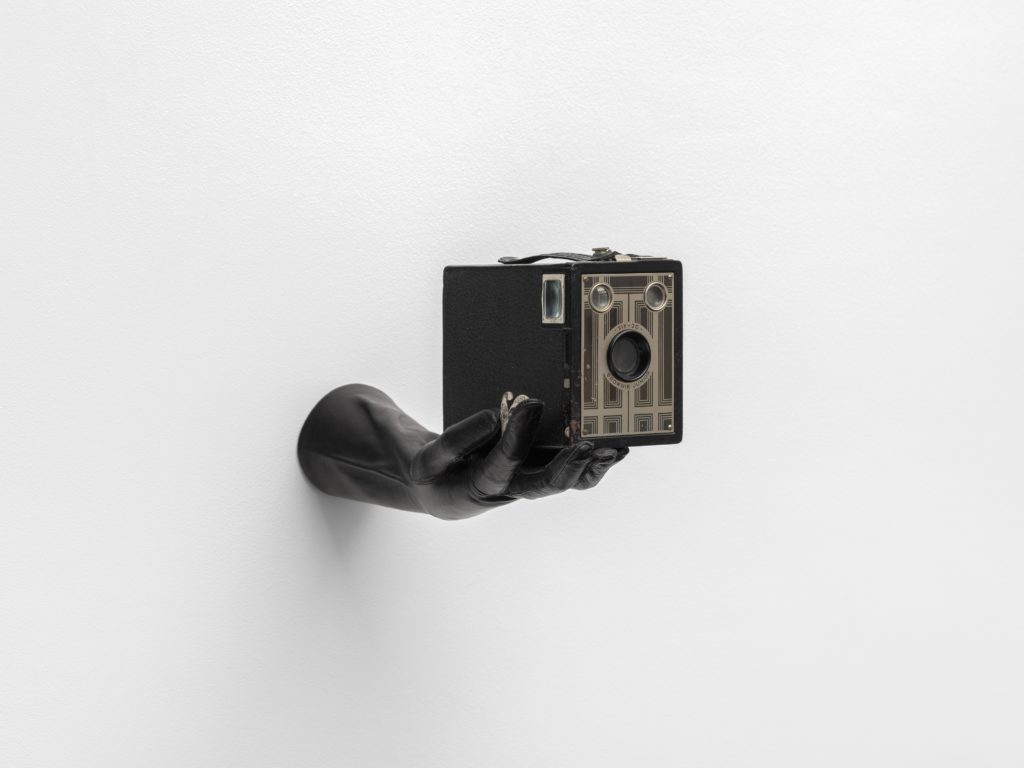
In Bogdan Ablozhnyy’s The Case of Paranoia (2025), a mannequin’s hand is placed against the wall at waist height. It is gloved in leather and holds — almost at the tips of its fingers, in a precarious balance — a camera, a Brownie Junior Six-20. The hand here exists in complete autonomy, detached from anybody. Viewed from above, the work might initially be understood within a logic of offering, in a movement that advances toward me and suggests the motion of my own hand reaching out to retrieve, and perhaps use, this camera. Instead, one would later notice the fingertip pressing against the camera’s lateral shutter, itself arrested within the very act of photographic capture: we are being photographed. The reference here, invoked first through the title and subsequently through the work’s various elements, directly relates to Sigmund Freud’s 1915 text “A Case of Paranoia Running Counter to the Psycho-Analytical Theory of the Disease.” The essay introduces the study of a woman gripped by an “episode of paranoia”[1] following a sexual act with a colleague, during which she believed she heard the shutter of a camera, thus assuming she had been photographed for the purpose of subsequent blackmail. The presence of two men in the stairwell that she descended upon leaving the man’s apartment — one of whom held a box in his hand, within which she suspected a camera to be concealed — intensified her sense of being observed and entrapped. The patient then wrote letters to her lover in an attempt to dissociate herself from the event, never receiving any acknowledgment from him that would confirm her perception, thereby abandoning herself, in Freud’s terms, to this “morbid idea.”[2] Moreover, Freud inferred in his study that the woman’s fixation could only be interpreted as a projection of her own desire: she did not hear the ticking of a clock or the click of a camera, but rather the sonic projection of “the throbbing of her clitoris.” The purported event of the click, according to Freud, thus concerned the interior of the woman’s own body; the fear and fantasy were grounded in herself, giving rise to a hallucinatory crisis in the very denial of desire. Ablozhnyy reverses this logic. The camera is no longer imagined; it confronts us directly, as though poised to capture our image. The paranoid premise that a camera might be concealed within a box is here negated by the very presence of the device itself, which appears to be photographing us. The instrument of the crime, in this instance, undeniably exists.
In 0,01s (2025), the interval between object and subject is conditioned centrally: the work unfolds within the suggestion of the physical and sonic distance separating a Castle Lighting C-50 strobe (the camera) and a London blue topaz (the subject), as well as the coexistence — within this same schema — of the elements of the patient’s discourse in Freud’s case of paranoia (their reiteration in discourse). From the action of the finger upon the camera’s shutter to the production of that very sound, and thus to the event itself, 0,01 seconds elapse.
Within psychoanalytic theory, Freud situates paranoia as a defensive formation structured against the homosexual components of affective life. In this account, same-sex attachment is disavowed through a mechanism of projection, whereby desire is displaced onto a third figure, precipitating a crisis of identification that destabilizes the subject’s relation to self and others. In The Case of Paranoia, this alteration of the self is reinscribed at the level of the cinematic apparatus (charged with its own sexual existence), as a dispositif organizing the conditions of perceptual intelligibility and projection. The camera becomes the instrumental object of persecution, embedded in the machinery that claims to secure the real while simultaneously producing it as an effect of inscription. As Jacques Lacan suggests with respect to photography, vision is less an act of mastery than a condition of exposure: the subject does not simply take images but is constituted within the gaze and seen from all sides.[3]
In The Gold Rush (1925), Charlie Chaplin finds himself lost amid snow-covered mountains, equipped with nothing more than a sheet of paper bearing a rudimentary diagram of orientation: north, south, east, west. As he becomes aware of the fragility of the spatial guidance offered by this document — whose “north” is contingent upon the paper’s position in space, and thus the position occupied by his own being — one comes to recognize his subordination to his own gaze upon the world, as well as to his placement within a space more powerful than himself. This Lacanian condition of alienation — in which the subject confronts the doubling of the gaze through the realization that, in looking, he is also being looked at, and thus exists outside himself — became a central concern of postmodern theories of artistic discourse in the late 1970s and early 1980s. Writing on Cindy Sherman, Hal Foster frequently referred to Lacan, arguing that the gaze “preexists the subject, who, ‘looked at from all sides,’ is but a ‘stain’ in the ‘spectacle of the world.’”[4]
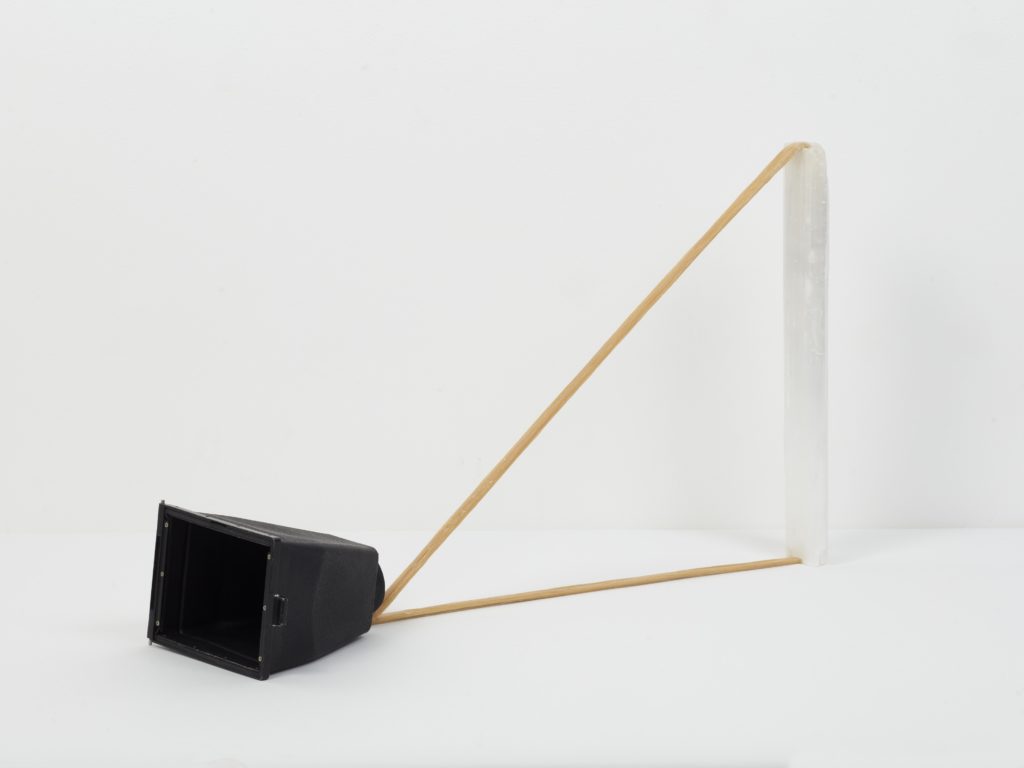
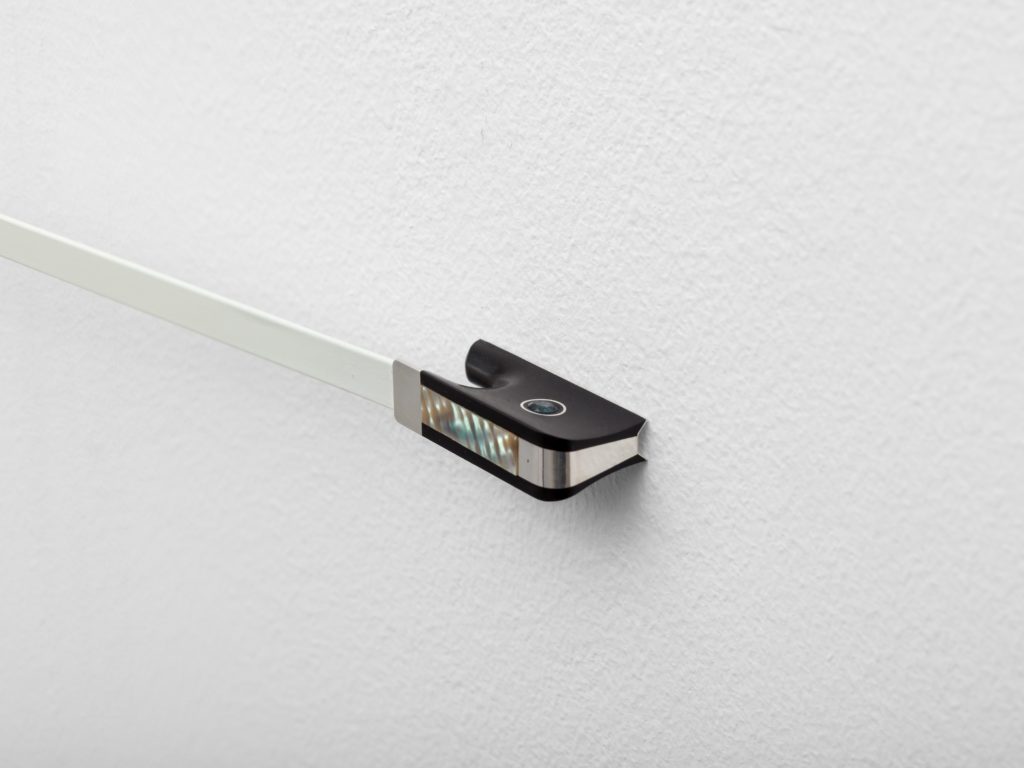
The gaze exists in externality, lived through the consequences of the very doubling of that gaze upon oneself. Every object is thus an image: a spectacle apprehended through the totality of objectification, through our own alienation. In this sense, the object is lost. It is a fetish, insofar as it is desire and fear, existing only through the acknowledgment and denial of castration. In Rencontre Manquée (2025), a monocular viewing hood is placed directly upon the pedestal, like a body laid out and wholly eviscerated; beyond it, there unfolds only a zone delimited by absence itself. Residual rods, accompanied by violin-bow horsehair and selenite, extend the apparatus of the camera in its capacity to dilate the field of vision between the real and the opaque, opening toward another point of consciousness. In a similar manner, Absent Object (2025) operates from a system derived from an Packard-Ideal shutter, sheathed in faux leather — reminiscent, almost, of a circus tent — whose “eye” branches into the narrow apertures inscribed within it, as well as into the very presence of the shutter itself. Such a configuration establishes a series of parallels: between light and obscurity, sight and evasion, secrecy and evidence, structuring the conditions under which concealment becomes perceptible. The artist’s repetition of these triangular structures — as likewise evident in Everything I wish to own becomes opaque to me (2025) — indicates a mental space apprehended within absence, in the very exteriority of the dead body, and recalls the geometric scheme of the point of light invoked by Lacan in his theorization of the scopic drive: object, image, geometrical point; point of light, screen, picture; the gaze, the image-screen, and the subject of representation.
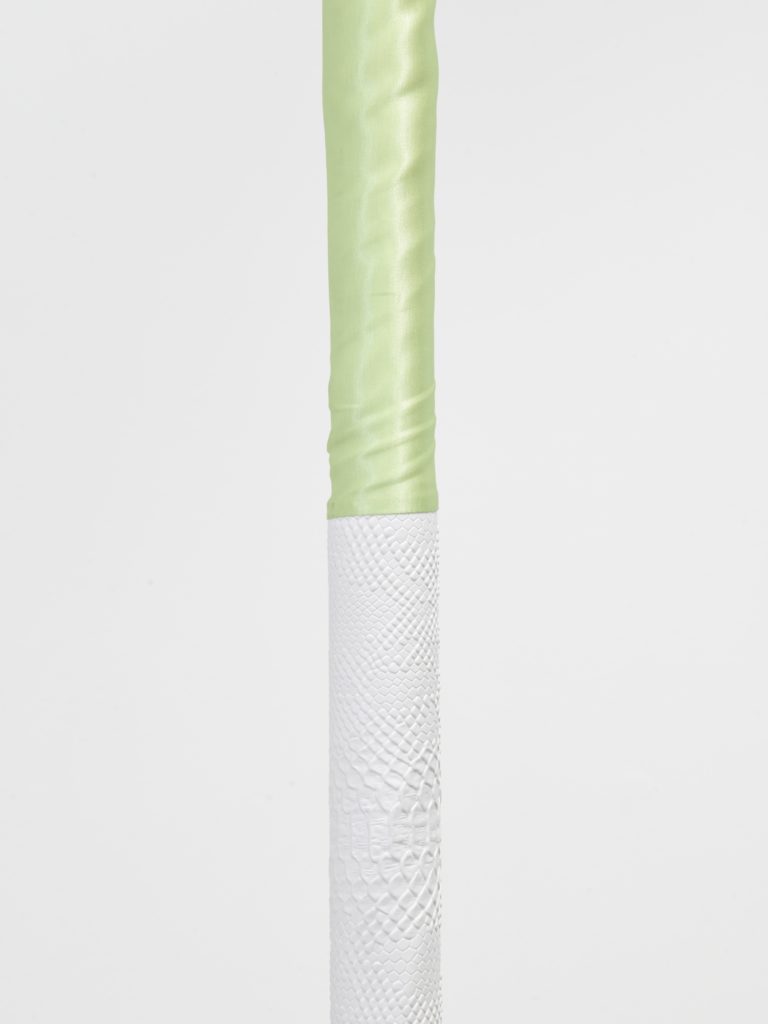
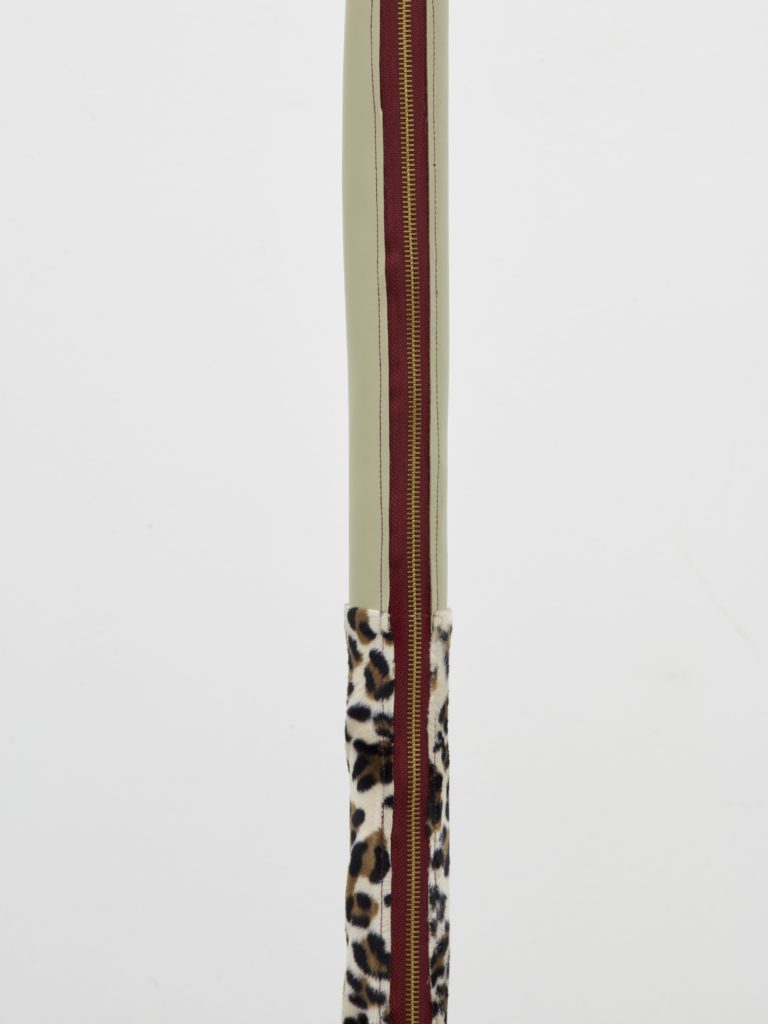
Ablozhnyy’s A Man of Dreams and a Man of Actions (2025), a balloon poised atop a tube adorned with fabric, vinyl, and zippers, establishes a direct dialogue with Henri Bergson’s distinction between two modalities of consciousness: one oriented outward — expressed through decision-making, engagement, and responsiveness to circumstances — and another directed inward – characterized by observation and imagination, whose psychic energy does not translate into action or movement but remains confined within the interior realm of the self. In both instances, the subject manifests what Bergson would describe as an attention to life: a fundamental orientation toward existence that precludes any possibility of being situated elsewhere than in relation to the world itself.
Throughout Ablozhnyy’s oeuvre, the object unfolds within the loss with which the subject is confronted; it may be apprehended through the Freudian libidinal register of melancholy, understood as the enduring effect of the irrevocable loss of the beloved object. In mourning, as Giorgio Agamben also observes, “the libido reacts to proof of the fact that the other one has ceased to exist,” and “such loss is not followed by a transfer of libido to another object, but rather by its withdrawal into the ego, narcissistically identified with the lost object.”[5] The melancholic element becomes the tragic realization of our incapacity to dwell within lack — the absence of the other within ourselves. Love, we must realize, constitutes the apparatus through which we confront our incompleteness: to attain totality, one must undergo the arduous recognition that, throughout the course of our lives, we remain engaged in an unending struggle to preserve the very idea of our wholeness. “At this junction of nature and culture… psychoanalysis alone recognizes this knot of imaginary servitude that love must always re-undo again, or sever.”[6]
[1] Sigmund Freud, “A Case of Paranoia Running Counter to the Psycho-Analytical Theory of the Disease,” 1915.
[2] Ibid.
[3] Jacques Lacan, Les quatre concepts fondamentaux de la psychanalyse (Paris: Seuil,1973).
[4] Hal Foster, “Abject,” in Bad News Days: Art, Criticism, Emergency (London/ New York: Verso Books, 2015). In this text, Foster is referring to Jacques Lacan’s Les quatre concepts fondamentaux de la psychanalyse (1973).
[5] Sigmund Freud, “Mourning and Melancholia,” 1917.
[6] Jacques Lacan, “The Mirror Stage as Formative of the Function of the I,” 1949.