Éric Rohmer’s 1967 New Wave romp La collectionneuse introduces the film’s three main characters through short, enigmatic prologues before its primary story unfolds. As a result, each character is endowed with a certain mythic quality, rendered less a transparent element in the film’s plot than an acknowledged product — a character seen in the making — within Rohmer’s cinematic universe. Rachel Haidu offers a succinct definition for thinking through the vexed ontology of these strange beings we call characters, describing them as “both ‘others’ to ourselves and forms of being separate from that which we know as ‘real’ selves.”[1] We might then begin to think of “character work” and the estrangement therein as not only part of the research process behind writing a novel or screenplay, but something potentially more active and forward-facing. Namely, such work allows an author conceptual space to play with, to make ludic, to defamiliarize, and to turn sideways all that they come across, a strategy more akin to amplification or distortion than dry deconstruction. It is this discrepant envelopment of institutional structures, people, and products into characters of his own design that we find animating the work of Bruno Zhu. At least this is the case in my characterization of the artist.

The importance of character work for Zhu was made clear in his recent exhibition at Chisenhale Gallery in London, “License to Live” (2024–25). While the artist has a body of sculptures, works on paper, and vinyl wallpaper that could be assembled into the familiar format of a solo presentation, for this exhibition Zhu largely eschewed the display of his own work. Instead, the artist devised a contractual spin on the Fluxus score consisting of a set of scenographic conditions the institution was tasked with materializing. The signed and countersigned result was a license that the Chisenhale temporarily held to produce Zhu’s readymade exhibition, one that could later be passed on to other institutions to the same effect (and indeed, as I write this text, the Centro de Arte Moderna Gulbenkian in Lisbon has taken on the work’s second iteration, “Belas Artes” (2026)).
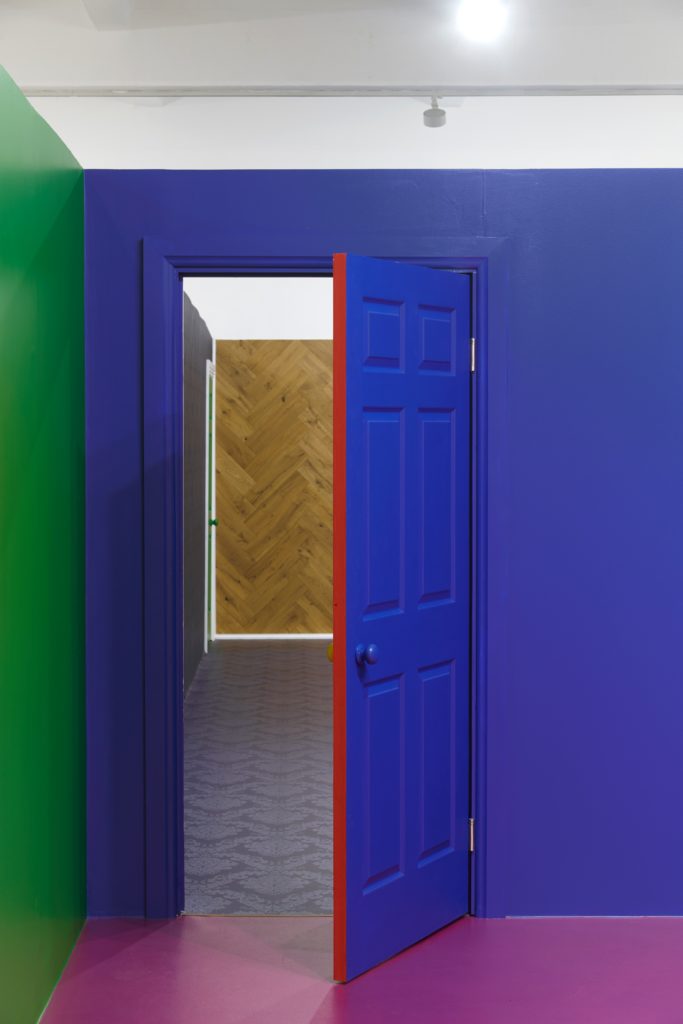
Zhu’s license instructs the institution in question to produce his exhibition across four interconnected rooms, the arrangement of each scripted by the artist down to the finest detail. In the first room, visitors enter a barren, day-glo environment defined by monochrome murals on each of the four walls. Here, all existing objects and architectural elements must adhere to the Pantone colors specified by the artist, which are assigned according to cardinal direction: surfaces facing north are painted vermilion (cinnabar); those facing south with Scheele’s green; Naples yellow for those facing east; and Perkin’s mauve for those facing west. The second room is animated by a flurry of bows custom-made for each object on display, which are selected by the museum in consultation with Zhu or on their own. Room three consists of a four-part, modular arrangement of mirrored vitrines, each side branded with a different playing card suit (a motif Zhu uses in his work more broadly), within which objects from the museum collection are grouped together. The fourth and final space within Zhu’s installation is a recreated period room turned sideways (the period in question decided in dialogue with the artist based on the institution’s holdings): parquet flooring and ceiling moldings are set on parallel walls, wallpaper is laid across the floor, a floor-based object from the collection is mounted on the newly created parquet wall, a wall-based object is installed sideways, and a ceiling-based object rests on the ground, wallpaper and all.[2]
On various occasions, Zhu has referred to himself as the love child of Michael Asher and Thierry Mugler; and indeed, his license recalls the artist’s tactic of museological displacement shot through with the fashion designer’s baroque theatricality. Take, for example, Asher’s work at the Art Institute of Chicago’s “73rd American Exhibition” (1979) in which he moved a cast of Jean-Antoine Houdon’s 1788 sculpture of George Washington from its original location at the front entrance of the museum to a gallery inside devoted to art of the eighteenth century. For Benjamin Buchloh, with works like this Asher ushered in the “conclusion of modernist sculpture,” shifting the medium away from its former concern with materiality to instead become constituted by conceptual gestures, instructions, and pre-existing contexts.[3] Such a perspective champions Asher for his acts of negation, which carve out space in which normative museological operations are put into relief, a strategy of demystification or laying bare perhaps most bluntly articulated again by Asher with his 1974 project at Claire Copley Gallery in Los Angeles.
“License to Live,” however, achieves a fantastical underhandedness not through negation but exaggeration. If museological practices of exhibition design, installation, and collection management are still Zhu’s primary focus, ideologically calculated one-to-one substitutions and an abiding sense of institutional realism are no longer the names of the game. Within Zhu’s environment, such curatorial decisions are instead pushed to discomforting extremes. White walls are replaced with garish colors, artworks are adorned — indeed, changed — with common frippery, others become organized according to seemingly delirious logics, or are flipped on their heads altogether. So, while we might say that Asher also reveals the museum as an active character in the construction of aesthetic experience, Zhu’s license, while articulated through legalese, pushes this role to melodramatic lengths. The result, rather than yet another endlessly iterative example of artists calling our attention to the site of display, is an awareness of the museum’s capacity to produce other types of viewing conditions and installation schemas (akin perhaps to Marcel Duchamp’s design of the 1938 “Exposition Internationale du Surréalisme” or the curved walls installed by Frederick Kiesler at Peggy Guggenheim’s gallery, Art of This Century, or the work of Judith Barry). In a 2020 exhibition at UKS in Oslo, this idea of redressing the institution was made quite literal, with Zhu outfitting gallery attendants in clothing of his own design for the length of the show.
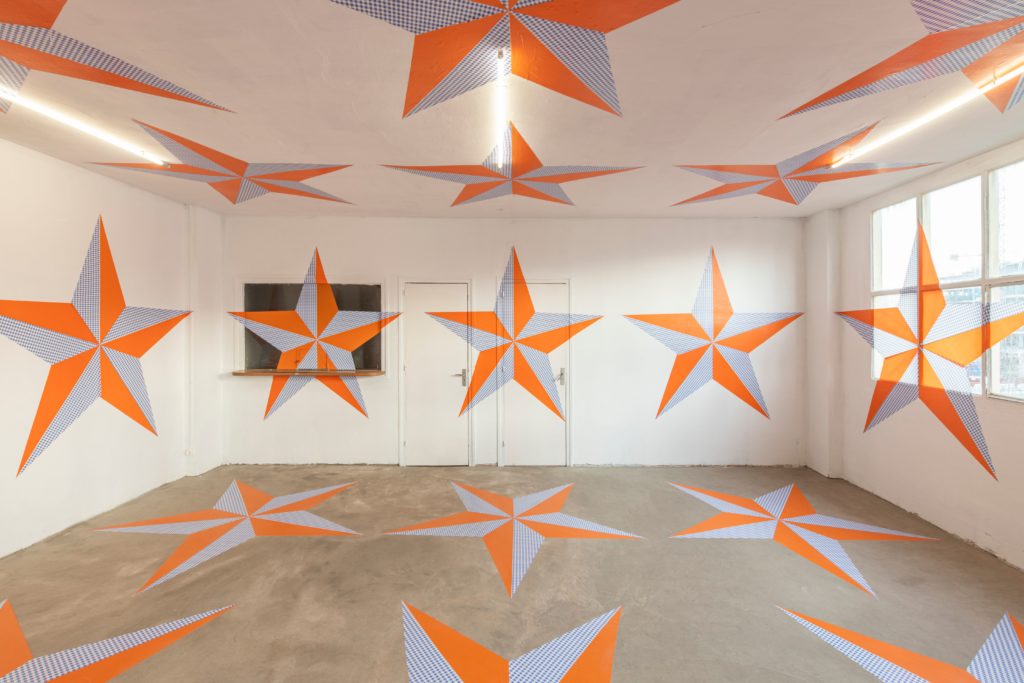
Zhu’s interest in playfully augmenting institutional conditions is carried out elsewhere in his work as well. For instance, the vinyl stars Zhu has used in various spaces over the years form a sleek, pleasurable, yet oddly generic pattern that transforms the calculated neutrality of white walls into affectively overloaded surfaces that — especially when installed alongside, or behind, other artists’ work — render exhibition design a charged, highly visible, and authored component of the viewing experience. Furthermore, this animism that Zhu regularly attributes to arts institutions is perhaps most obviously modeled by his “Hug O’Clock”sculptures (2023), composed of sequined ropes that extend across the gallery and caress the architectural perimeter, each punctuated on both ends by hands outstretched toward the viewer.[4]
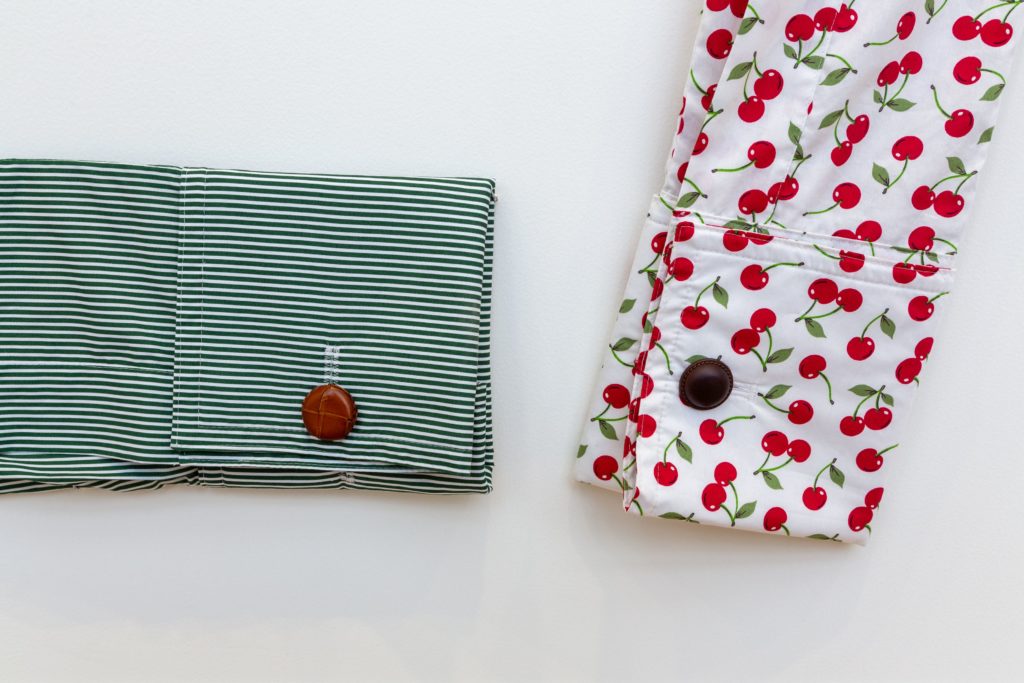
Beyond institutions themselves, however, Zhu has also targeted a more diffuse notion of “context” that governs the display of his and others’ work. At the Liste Art Fair in Basel this past June, for instance, he opted to show a work consisting of a sewing pattern that, when assembled, would approximate the average-sized penis in Switzerland, while for Art Basel in Paris two years ago, Zhu showed a sculpture made of shirtsleeves spelling out “VOILÀ!?” across the booth’s long wall. In both cases, there is a familiar situational awareness that grounds the viewer in real space (the Paris work does this quite literally); however, this is done with humor and a Pop sensibility such that the anodyne navel gazing of certain institutional critique practices is avoided. Instead, in Basel, the fair was deconstructed alongside the phallocentric economy governing this glorified trade show — detumescence as commodity critique — while his Parisian audience was asked to grapple with the sardonic question mark added by the artist at the end of the word, a subtle interrogative that placed the fair’s location in critical if open-ended relation to the broader spatial politics of the art world’s commercial circuitry: “Here? Really? Another one?”
While the museum and other infrastructural conditions informing artwork are made into characters across Zhu’s work, he also understands the inevitable process of his own narrativization. In stark contrast to previous avant-gardes’ efforts to efface the artist to avoid questions of style and biography, Zhu understands that in a neoliberal landscape in which influence, persona, avatars, and lifestyle are increasingly pervasive commodities, it is ultimately irresponsible to lose track of the distribution of the self.[5] To keep this idea in view, Zhu has, among other things, turned himself into a working model across his series “Job Centre” (2019–ongoing). For one such work, Opening Hours (2022), Zhu installed an adhesive vinyl across the front windows of the Detroit-based gallery What Pipeline.
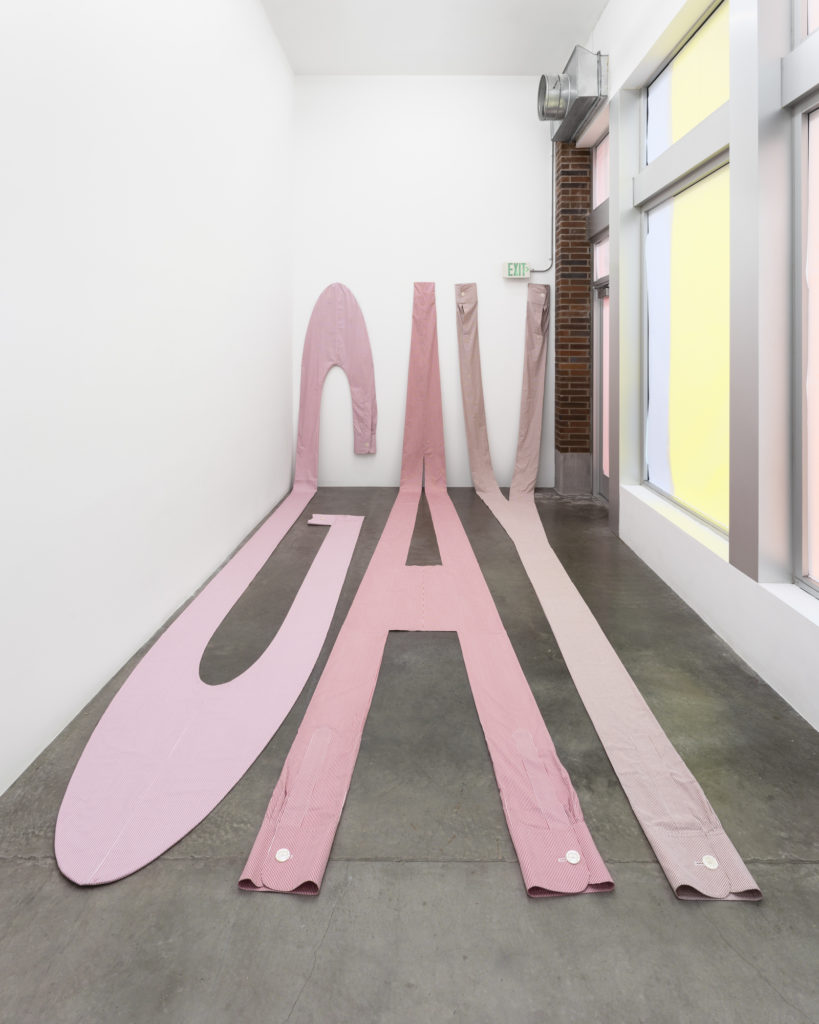
The intervention was virtually indistinguishable from a fashion or cosmetics campaign with its slick, airbrushed, brightly lit imagery, in which the artist appears alongside a series of texts like “LIFE” and “LONELINESS IS A POISON.” With this series, the relationship between Zhu the maker and Zhu the product collapses, his status as both subject and object of the work marking a relationship between figuration as representational modality and figuration as marketable presence. Scripting himself as a model, he materializes a “troubling ontological blur” that defines this figure, one that resonates with Haidu’s writing on the character: “a real person who becomes artificial in posing and gives rise to a quasi self in the form of an artistic image.”[6] This easily commodified image-self is put into relief by Zhu through the series title, “Job Centre,” with each location he chooses subsequently narrated as one venue in which his job as an artist – to appear, to figure – takes place. Zhu speaks to this dilemma in other work as well. For instance, a large sculpture constructed from clothing hanging off the wall and draped onto the floor — included in his 2024 show “I believe you” at Veronica in Seattle — spelled out “GAY,” the work grandly announcing sexual identity in a way that services a contemporary thirst for tautologies of artistic self and artistic practice.
The ongoing map of such laboring conditions is the critical result of Zhu’s decision to linger in the “blur” of the model’s, the character’s, vexed subjectivity. In doing so, he offers a strategy rather different from the familiar avant-garde refrain of demystification, one that instead participates in myth-making, in character-building, in order to hyperbolize to the point of breakdown the spectacle of the art world and its everyday operations.
[1] Rachel Haidu, “Part II: Character,” in Each One Another: The Self in Contemporary Art (Chicago: University of Chicago Press, 2023), 121. This quote comes in the second portion of Part II where Haidu discusses the work of filmmaker Steve McQueen.
[2] Bruno Zhu, “Display Guidelines,” in the License Agreement for License to Live made between Zhu and Chisenhale Gallery, London, where the exhibition was on view from November 22, 2024 – February 2, 2025.
[3] Benjamin H. D. Buchloh, “Michael Asher and the Conclusion of Modernist Sculpture,” Art Institute of Chicago Museum Studies 10 (1983):290. While Buchloh’s essay, which proposes Asher’s intervention as emblematic of postmodern sculpture’s dematerialization into conceptual gesture, has been the most widely disseminated interpretation of the artist’s 1979 action in Chicago, others emphasize that it is precisely issues of materiality that define the work’s critical accent. See Jennifer King, “Perpetually Out of Place: Michael Asher and Jean-Antoine Houdon at the Art Institute of Chicago,” October 120 (Spring 2007): 71–86.
[4] These works appear to reference Mel Bochner’s famed Measurement Series from the 1960s, which also drew viewers’ attention to the dimensions of the aesthetic container, but do so by means of acephalic, disembodied avatars who hug the interior space. The gallery as character, its humanoid presence, is revealed here as a glittering, skeletal embrace.
[5] See, for instance, Maurizio Lazzarato, “Immaterial Labor,” in Radical Thought in Italy: A Potential Politics, ed. Paolo Virno and Michael Hardt (Minneapolis: University of Minnesota Press, 2006) or Wendy Brown, Undoing the Demos: Neoliberalism’s Stealth Revolution (Princeton, NJ: Zone Books, 2015). There are important critiques of this emphasis on neoliberalism as a system in which subjectivity is financialized: one being that this idea is primarily centered on the West, as industrial labor of course persists around the world, another being that the notion of a completely rationalized subject had historically materialized for many before the period of “post-Fordism” in the second half of the twentieth century; for instance, with the rise of the transatlantic slave trade. For a useful overview of this debate, see Annie McClanahan, “Serious Crises: Rethinking the Neoliberal Subject,” boundary 2 46, no. 1 (2019): 103–132. I choose to maintain the idea of the commodified subject here in relation to Zhu’s artwork as I see his projects themselves helping to theorize and flesh out the relevance of these concepts for the laboring conditions of the contemporary artist.
[6] Wendy Steiner, The Real Real Thing: The Model in the Mirror of Art (Chicago: University of Chicago Press, 2010), 4.