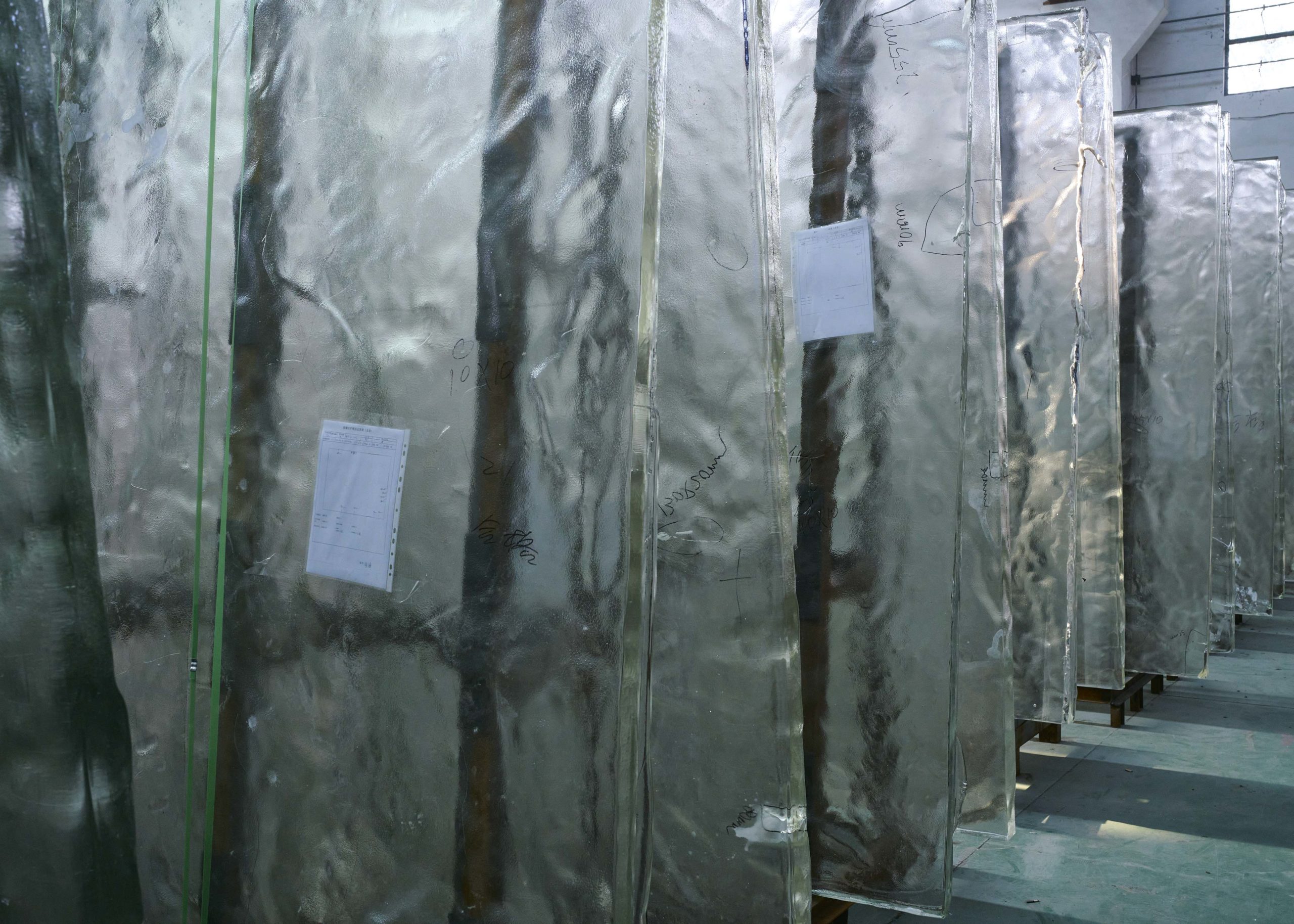
As the first patents for industrial applications of polyethylene terephthalate (PET) were filed with the US Patent Office in the late 1940s, the New York City neighborhood of Gowanus had already become toxic. Since the mid- nineteenth century, the Gowanus Canal provided a shipping conduit for hundreds of manufacturers, which, in turn, dumped all kinds of effluents, including human sewage, into the man-made waterway. But today, newer, sleeker pollutants such as PET — which breaks down into tiny particles that accumulate everywhere from the middle of the ocean to the insides of our bodies — engender environmental effects on a much vaster scale than turn-of-the-century industry. PET is plastic, and this plasticity is material, morphological, and aesthetic at once, taking forms as varied as disposable water bottles, photographic media, and microplastics as it transits from production to use to waste. Scientists estimate that it takes between four hundred and fifty and one thousand years for PET to break down, a vexing timeframe far longer than the recent cleanup efforts targeting the chemicals that historically spilled from Gowanus’s once-thriving factories.
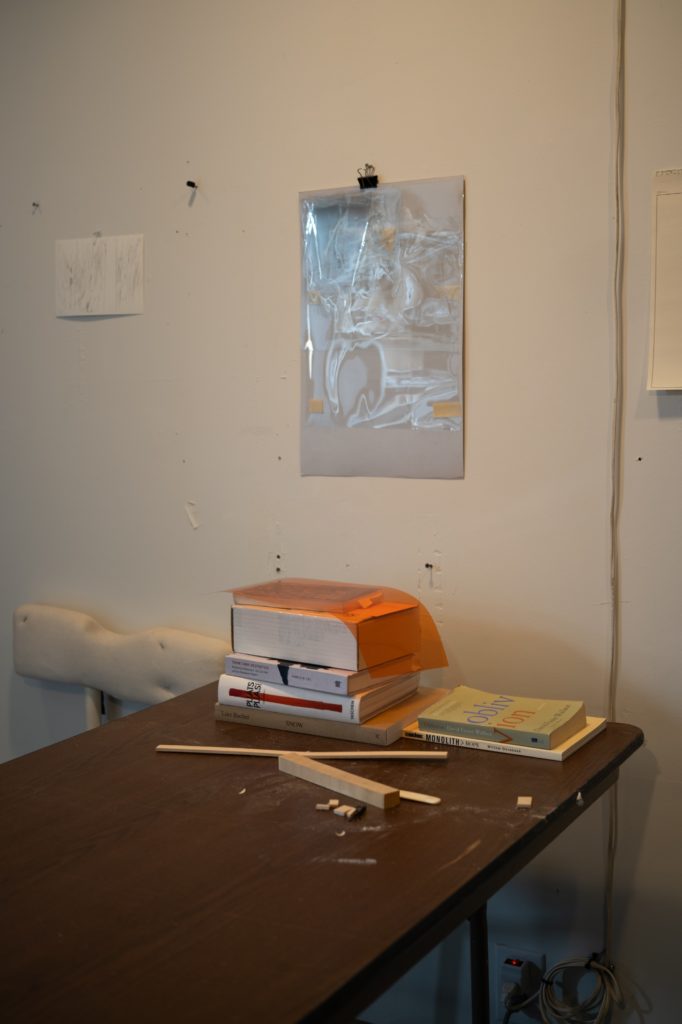
I met up with Tony Chrenka in Gowanus, where his studio occupies the second floor of a former industrial building. Chrenka’s studio is an exercise in economy: it is full of salvaged objects and cheap materials typically used as intermediary products in industrial processes. On the walls are several collages comprised of inkjet-printed photos overlaid with leaves of PET film — commonly known by its commercial name, Mylar — that emit metallic hues. There is also furniture salvaged with exacting taste, a collectible Telefunken sound system acquired for a bargain from an older artist, and books. For Chrenka, gleaning and tinkering are not just typical New York hustle, but part of his practice. The point is to explore the gap between use-value and exchange-value. Often this entails a form of corporate espionage, with the artist embedding himself among vendors of product packaging or semi- artisanal manufacturers of complex textiles only to absorb into his artistic practice commercial techniques for transforming cheap matter into valuable commodities.
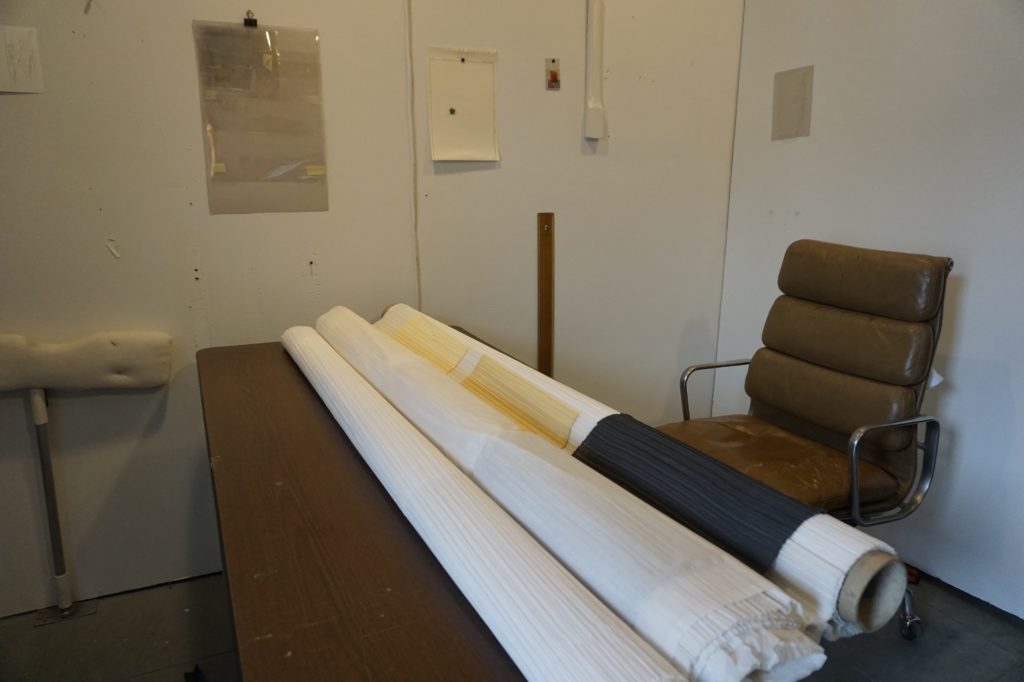
Chrenka opens a small gray box and pulls out a beige accordion of polyester fabric with serged edges. Having spent much time around the white- collar fashions of the culture industry, I instantly recognized the material as the same one used for Pleats Please clothing. Launched in 1993 by the Japanese designer Issey Miyake, Pleats Please has become a business-casual icon for office workers in the arts and beyond. Its catalogue of simple, practical items is entirely constructed from a tightly pleated textile that retains its shape even when crammed in a suitcase after a long-haul flight to an art fair. The fabric’s memory results from polyester’s plasticity, its ability to be molded into relatively permanent geometries with specialized heat pressing machinery. In this way, the pleats operate as an intermediary stage in a plastic history that begins with fossil fuels and spans potentially millennia of physical transformations.
Chrenka holds up the rectangular sheet of fabric and explains that it is a prototype for a new series of works that will be shown at Toby78 in Brooklyn this spring. He plans to fold the minutely sculpted textiles loosely atop one another. Produced in various colors, the textiles’ polymer topographies will produce undulating fields of color. These sculptures are plastic — indeed, polyester is derived from PET. But their plasticity also extends to their facture as their forms are determined by the gentle manipulation of fabric and the contingencies of lighting conditions. They transpose a familiar textile from the wardrobes of paid creatives into the world of light and shadow, from the domain of financial abstraction into the same material plane as photography and cinema. In this process of translation, pleated polyester functions as a physical link in a network of extraction and trade spanning oil wells, shipping ports, and the workshops where proprietary methods are used to permanently pleat petroleum-based clothing.
Rather than acquiring premade sheets of pleated polyester — a simple task for an artist as resourceful as Chrenka — he instead decided to make the material himself by commissioning a company in New York’s Garment District specialized in making pleated fabrics for clients like hotels or mid- sized fashion houses. For his pleated sculptures, and throughout his practice, Chrenka conceives of artworks not as singular, finished objects but, instead, almost as performances through which industrial expertise and techniques are explored and exposed. By intervening into commercial networks like these, Chrenka’s practice concerns the managerial and logistical techniques that underlie divisions of labor and global supply chains. Wrinkle resistant, durable, and comfortable enough to wear on the human body, polyester was originally marketed in the 1950s as a “miracle fabric.” Polyester begins with a chemical reaction between terephthalic acid and ethylene glycol, a substance synthesized from carboniferous matter such as crude oil or natural gas, to produce hardened polymer chips which are melted, then spun into long fibers and finally woven into planar sheets. Chrenka’s manufacturer transforms smooth sheets into permanently pleated fabric through a machine that uses steam and pressure to mold polyester into a predetermined form. By engaging these mechanized labor processes, Chrenka traces how the institutional structures of contemporary art are embedded in the extractivist logics of the twentieth century with its global circulatory infrastructures and differential distributions of capital.
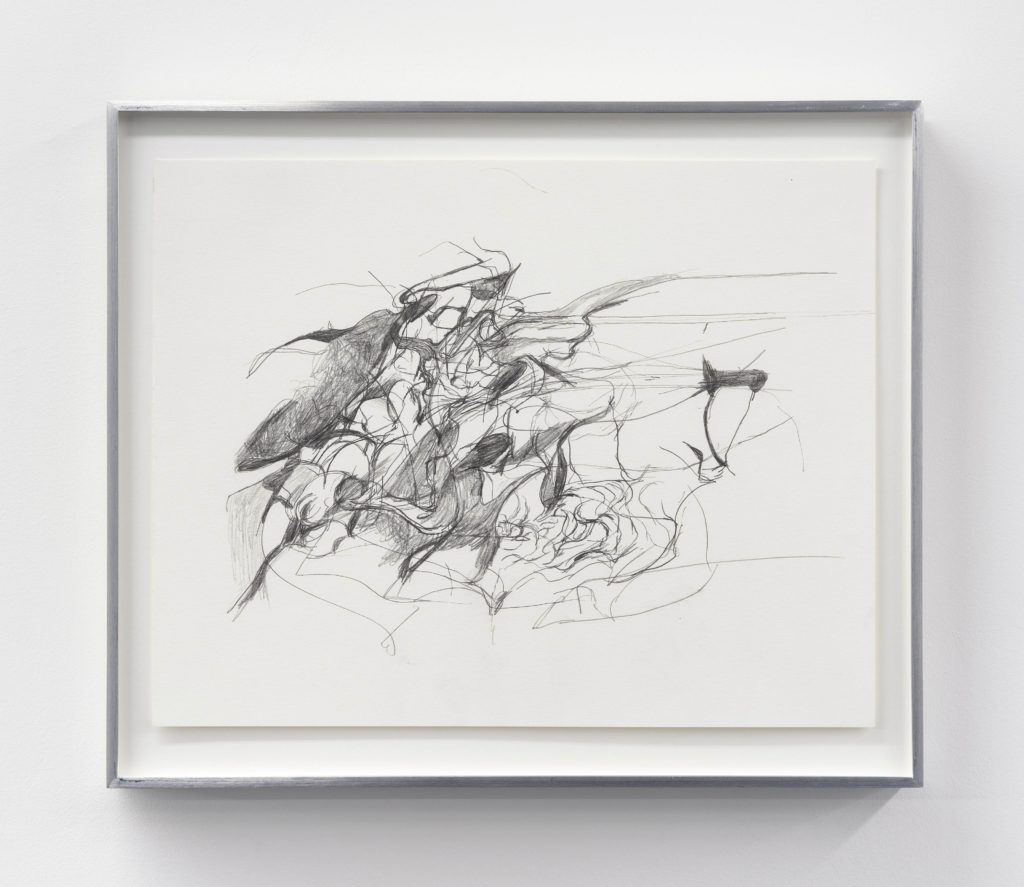
This is exactly what Allan Sekula had in mind in Fish Story (1995), his seminal investigation of the sinews of maritime logistics. For Sekula, modern fossil-fuel-powered cargo vessels had shed ships’ traditional associations with “the sea’s archive of primal organic structures,” morphologies that have been since displaced onto “the ponderous and cynical ‘fishbuildings’ of the Canadian-American architect Frank Gehry or… the mournful and delicate clothing of the Japanese fashion designer Issey Miyake.”1 Sekula and Chrenka both turn to Miyake as an aesthetic cipher for the immense chains of interconnection through which raw materials are combusted and transited across oceans into terrestrial circuitries of commodification. In this way, the glints of color variously reflected off Chrenka’s pleated artworks signal capital’s ever-inventive transformation of the elements. Earth, water, and fire produce the matter and temporalities through which fast fashion and other goods accumulate in TriBeCa and SoHo as well as Ulsan, Manila, and the islands of floating plastic waste said to be drifting in the Pacific and Indian Oceans.
Chrenka uses the same forces to fabricate a different body of work investigating the malleability of wood. Pressure and steam have long been used to shape wood into non-Euclidean geometries, most famously in wooden shipbuilding and, later, modernist design objects such as Ray and Charles Eames’s molded plywood splint produced for injured American soldiers during World War II. In Chrenka’s studio, a set of wooden planes formed into curvilinear surfaces is arrayed on a table above the artist’s handmade pressure molder. The objects’ surfaces are defined by series of curves, cut into backing supports that contort the panels’ contours when subjected to heat, water, and energy. Resembling upright topographic relief models or offcuts from a luthier’s workshop, the works transform standardized units of humble spruce into multi-dimensional inquiries into the technics of valorization. And, as in the pleated works, sculptural form is rendered indissociable from light as the complexities of the wooden works’ stained surfaces are continually rearticulated by shifting conditions of illumination.
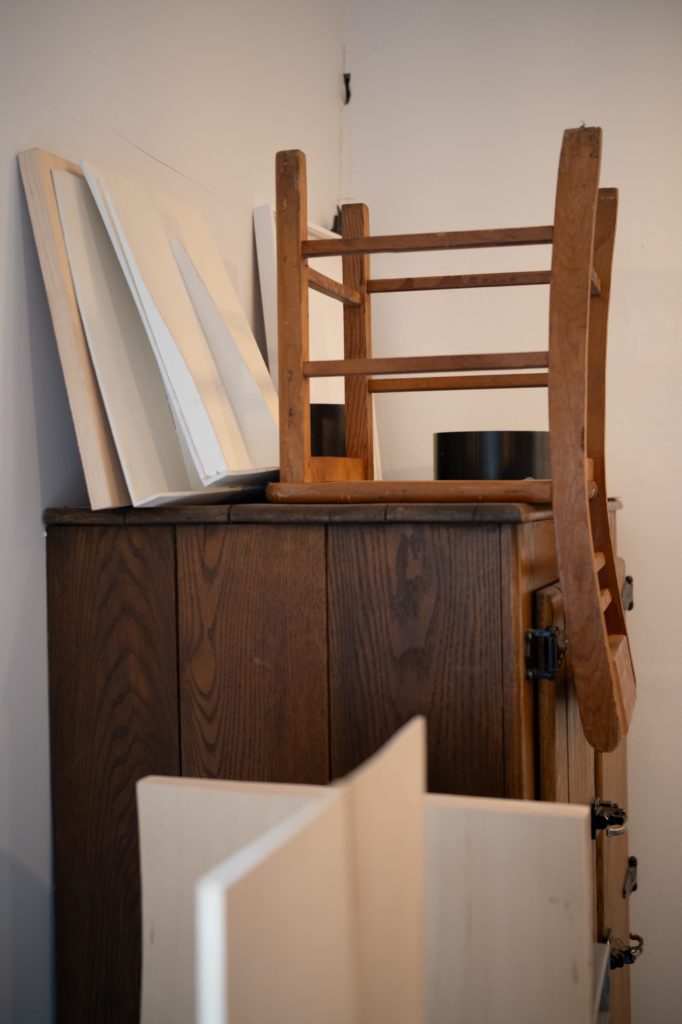
Chrenka’s practice centers the material conditions of light and temporality as questions of both perception and political economy. The shimmering surfaces of Chrenka’s works restage the allure of commodities not as fetish but instead as a means of directing viewers to observe the physical operations through which objects arrive at various forms, wrapped in plastic. Through luminous — often petroleum-derived — products, Chrenka’s work articulates that while global flows of capital are made to appear smooth and frictionless, they are actually material processes continually reshaping concrete existence. Over the past several years, Chrenka has engaged these issues through a series of sculptures that reflect and recompose their environments through subtle variations in color and mirror-like distortions.
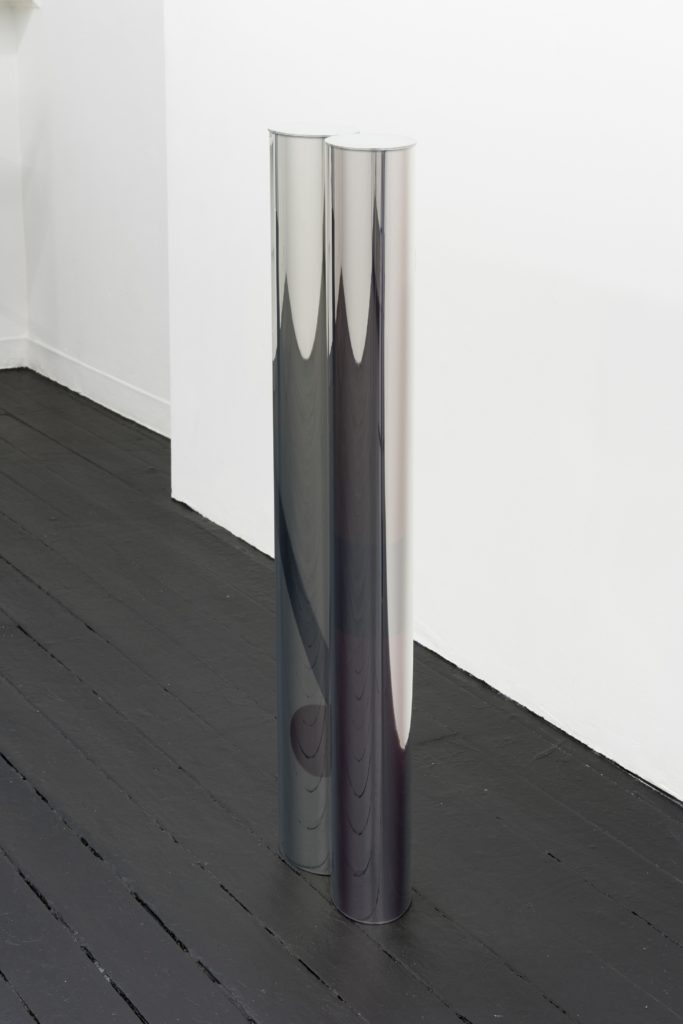
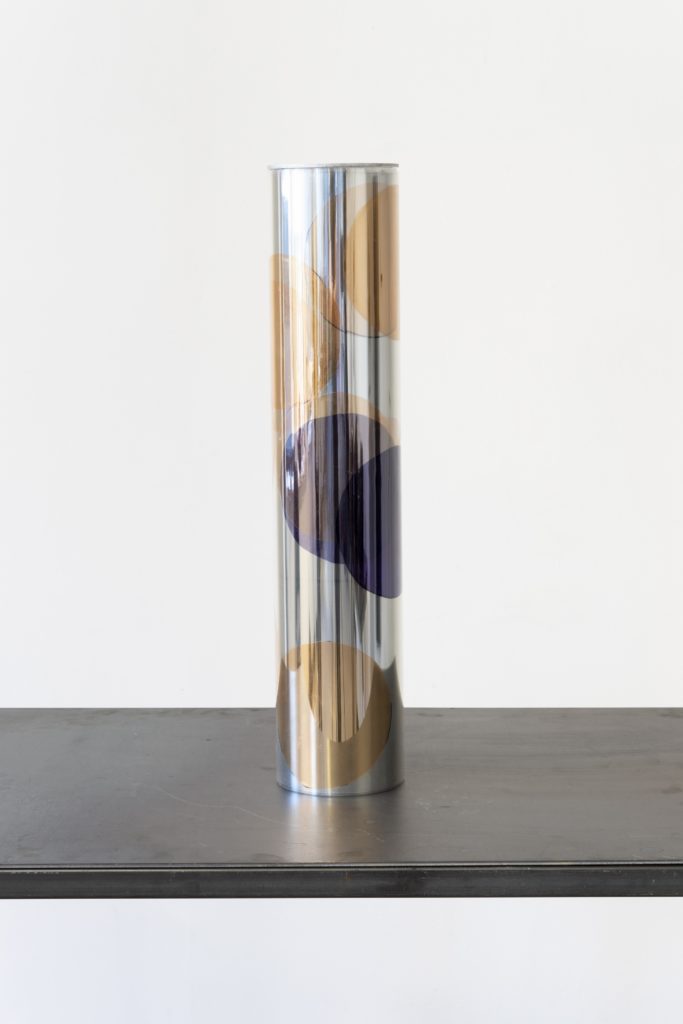
At first glance, these works seem to be highly polished metal cylinders, but upon closer inspection, their diffusions of light are understood as the work of recursive layers of semi-transparent plastic that both filter and reflect light. Chrenka produces his tubes by respooling a Mylar film sold by the Mitsubishi Chemical Company of America around a vertical axis and inserting lighting gels into the plastic strata. In this way, the sculptures act as a strip of celluloid folded in on itself or as multiple overlaid panes of glass. As Chrenka describes the sculptures, he notes that their geometry — a tube — resembles how the Mylar was originally packaged for shipping. Through this act of unpacking standardized, portable tubes of Mylar and recomposing it back into its original market-ready form, but this time as a singular object, Chrenka interrupts logistical protocols dependent on multiple identical units. While the material ypically allows visual penetration, in Chrenka’s sculptures it instead redirects vision through an opaque field of reflection and refraction. In these works, the sculptural object literally unfolds PET’s unit of sale, rendering a material that has been central to the speed and mobilities of modern capital as, instead, an obstacle to vision, a vanishing point that collapses visual projection in on itself.
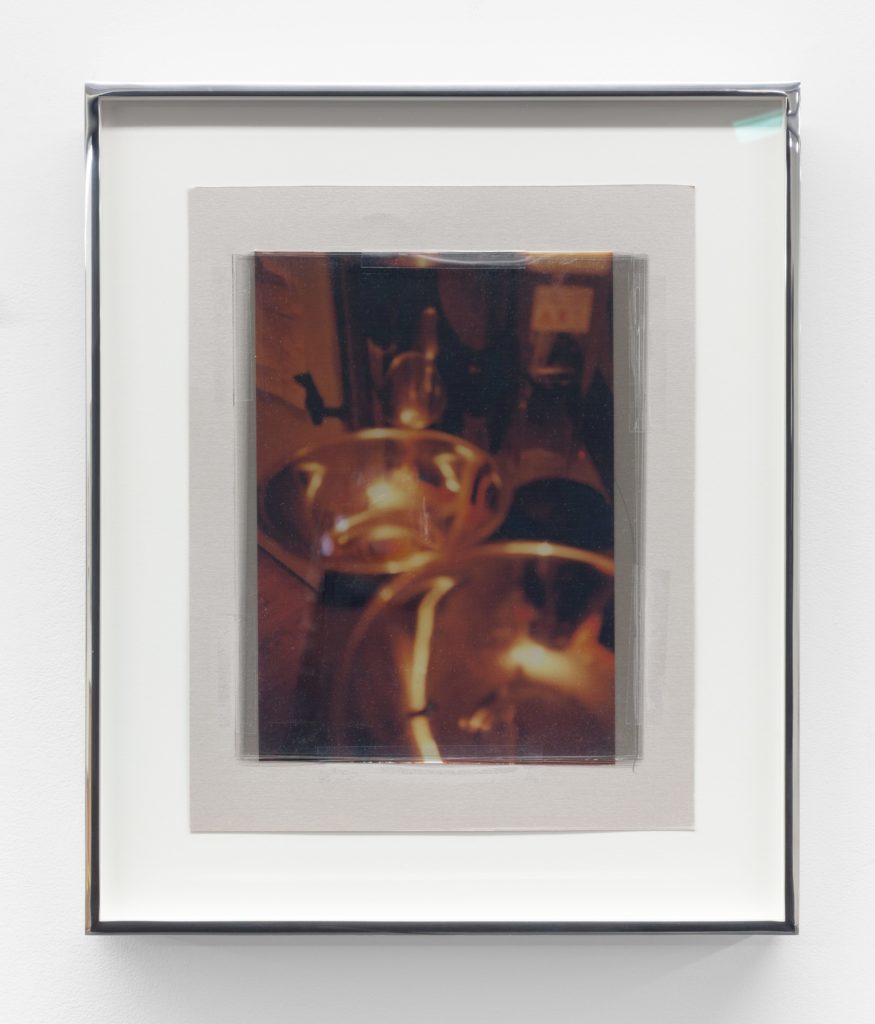
Mylar’s unique properties result from a chemical structure that makes for incredibly smooth surfaces that resist degradation and electrostatic adhesion, an unusual combination of physical traits that have made the material appealing for diverse applications ranging from food packaging to flexible circuit boards. But Chrenka’s use of PET not only investigates its material qualities but also how it provides a lens — both literally and figuratively — for seeing the creation of value. These processes are visible on the walls of Chrenka’s studio where he has taped up several collages that combine drawing, photography, and layers of Mylar. In one collage, blocks of yellow and orange semi-transparent plastic overlay an inkjet print of a photograph depicting stacked rolls of Mylar. Light from the studio bounces off the leaves of plastic, obscuring and revealing the photograph in a demonstration of PET’s status as both an optical device and standardized commodity. Other collages utilize rectilinear blocks of plastic to compose fragile tensions between figure and ground through discrete fields of opacity. In Chrenka’s collages, PET organizes pictorial space just as it shapes geographies of capital and the sites of its accumulation.
As Chrenka works through each of these series, his practice confronts the boundaries that define how materials and forms accrete around specific problems. Each body of work invents a methodology for iterating through predetermined questions and modes of artistic production. Through this approach, he explores how artworks are serialized, insisting that artworks are always plural, involving temporal operations that always exceed a singular object. In Chrenka’s work, plasticity not only provides an opening onto vast systems of extraction and exchange but also specifies a way of making art that centers on the mutability and portability of contemporary things.
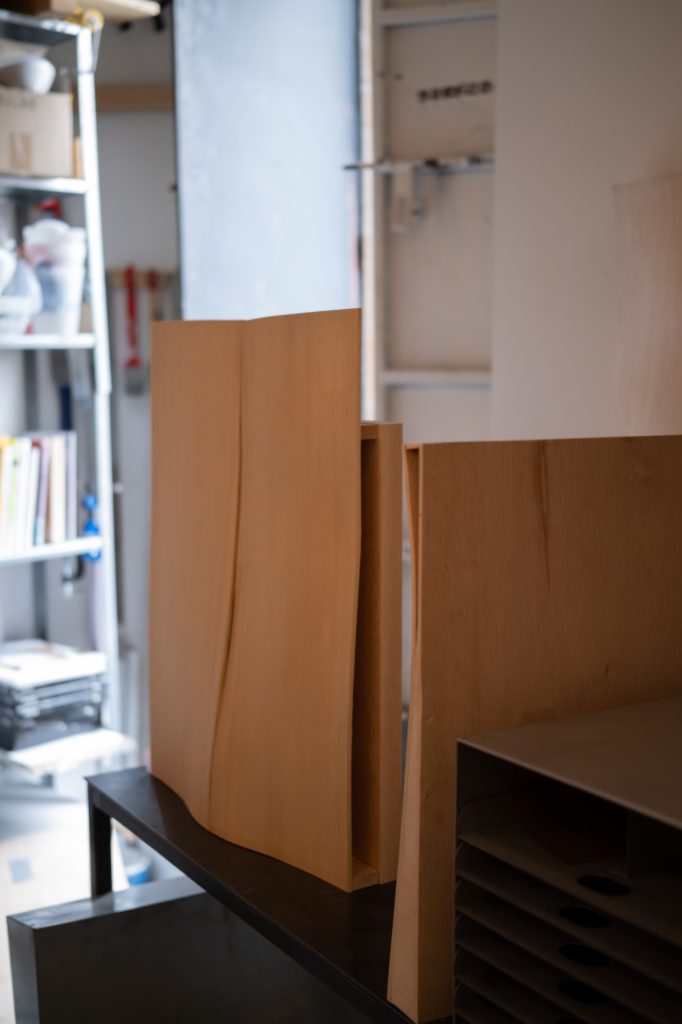
Chrenka and I leave his studio as the sun begins to set. As our conversation turns to the baffling news that morning that the United States and Israel had begun a military assault on Iran, we walk up the hill that separates Gowanus’s light industry from the tony brownstones of Park Slope, a topography that once worked to contain pollution in the Gowanus Canal’s noxious watershed. Since we’re both heading back to Manhattan, I offer to help Chrenka drop off one of his molded wood sculptures at the gallery he’s represented by, Theta. When we arrive at the gallery, we unwrap the work from layers of plastic sheeting, held together with typical brown art handling tape. In these acts, Chrenka’s process has reached something of a conclusion: cheap wood has been trafficked into a valuable form through a mode of artistic labor grounded in the techniques of industry. And the work’s PET-based packaging will outlast us all.