On April 25 we commemorated Italy’s liberation from more than twenty years of fascism and, on May 1, the struggles and sacrifices of workers for fair labor. Last week also marked the resignation of the Venice Biennale’s jury; the release of STORM I & II, the punchy and subversive song and short film by Swedish rapper Yung Lean (Jonatan Leandoer) in collaboration with GENER8ION (a project led by French producer/DJ Surkin and director Romain Gavras); and the opening of a major exhibition by Franco Mazzucchelli at Champ Lacombe, which presents a wonderful medley of his public interventions from the 1970s.
Why are these events related? They all express dissent and renegotiations of authority on the historic moments in which they occur.
In Mazzucchelli’s videos, which document his activities placing inflatables in public spaces without people being aware they are actual artworks, a mix of curiosity, rage, and self-expression is conveyed via moving image.
There is an entertaining silver lining regarding Mazzucchelli ’s hanging pieces: whenever I think of his inflatable wall works titled Bieca Decorazione (literally, crass decoration), I am reminded of the auto-critical and self-ironic nature of Italian humor — not the British kind, but the belittling Paolo Villaggio–Fantozzi kind.
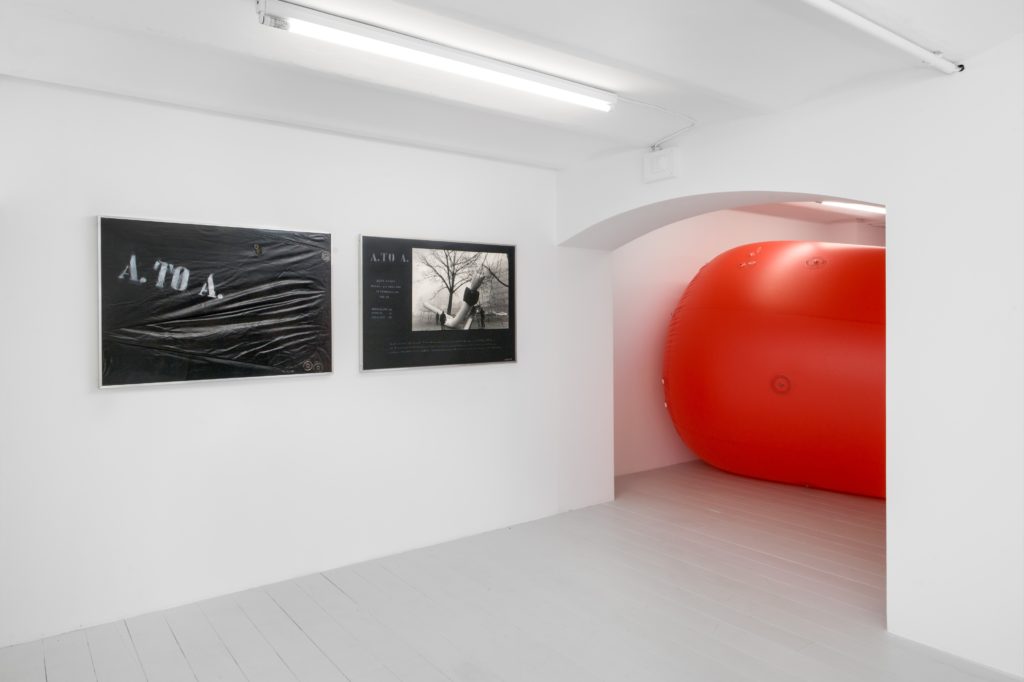
In a way, his black-and-white photographic series that traces the presence of several A.TO A. inflatables (an acronym meaning “art to abandon,” or à toi when read in French) poses the same Italian dilemma: something serious that is mocked and transformed into a pun.
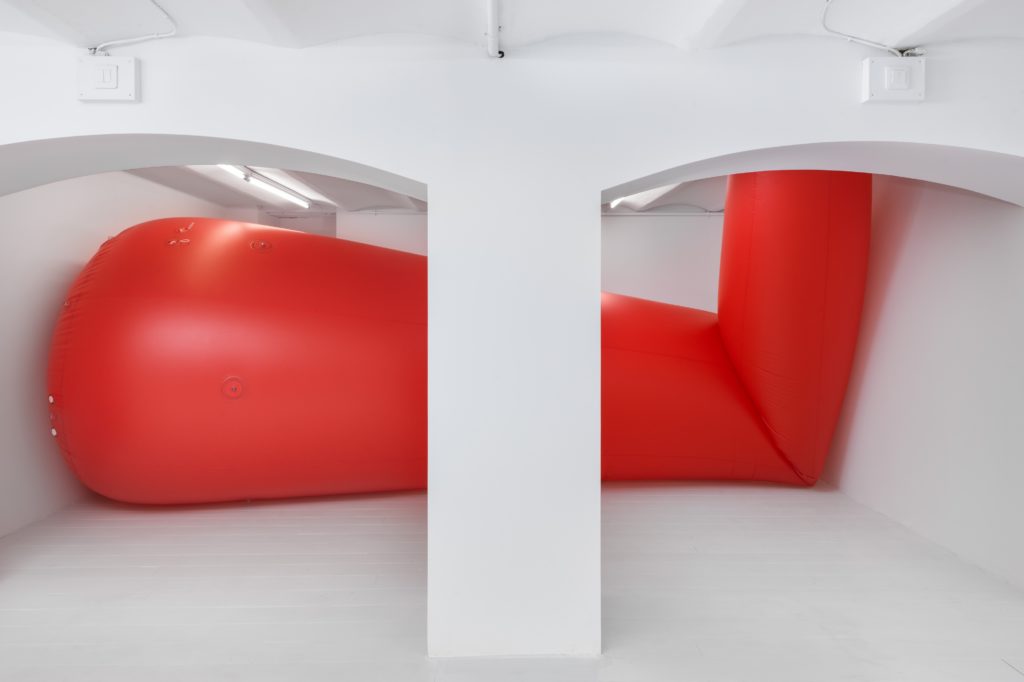
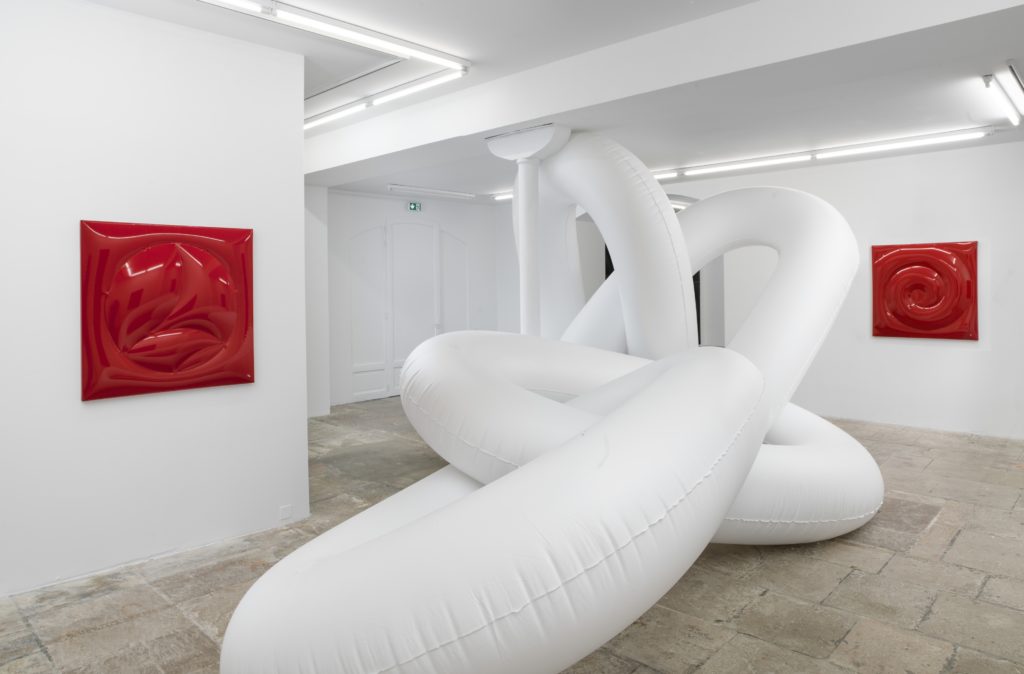
It was somewhat in this spirit that I landed in Biarritz, feeling especially curious about how the gallery would be set up. Were they all going to be crass decorations? Pretty much the opposite. As you enter this cozy and picturesque space on rue Champ Lacombe, you are confronted with just the top of Cono Rosso (a red PVC cone, first made in 1973, then presented again in 2021) sticking out of a manhole apparently never before opened (the other part of the cono is downstairs, totally bent and visually divided by a white column). Continuing walking and you find modular, rectangle-shaped Bieca decorazione in matte black, all displayed next to each other, creating a sort of frighteningly chic wallpaper.
A twisted white inflatable, Catena N.5 anelliis intertwined in the middle of the space to make a ball, making it the central sculptural piece of the show. Rumor has it they will enflate a twisted white one on the occasion of the finissage, from the series Azioni, similar to the one the artist showed on the beach of Saintes-Maries-De-La-Mer in Camargue in 1964, where he went for his honeymoon.
Today, the artist’s inflatables are much more of a “controlled” experience: from anti-monuments they have become precarious monuments, since they are mostly part of the art world’s agenda. The public’s need to activate artworks for leisure in the ’60s and ’70 — as well as the number of spaces dedicated to this need — has dramatically changed now that it is mostly initiated by the art world and its institutional contexts.
Back in the early ’70s, works such as Riappropriazione or various public interventions were treated as single-use environments, objects for leisure, and — from what I can understand from the videos — tension-relief. These human-size shapes, placed in various public places across Italy, were often seen as unmonumental sculptures, to be treated as disposable playgrounds or “usable” objects.
In Milan, which was a cornerstone of Italy’s booming automotive industry in the 1970s — alongside Turin, of course (Mazzucchelli is famously from Milan) — these works served as a moment of respite, a place for breaks after a long day at the car factory. Milan was heavily defined by major manufacturing, design, and innovation, with the massive Alfa Romeo plant being a key player. One of Mazzucchelli’s public interventions was held at that specific factory in 1971.
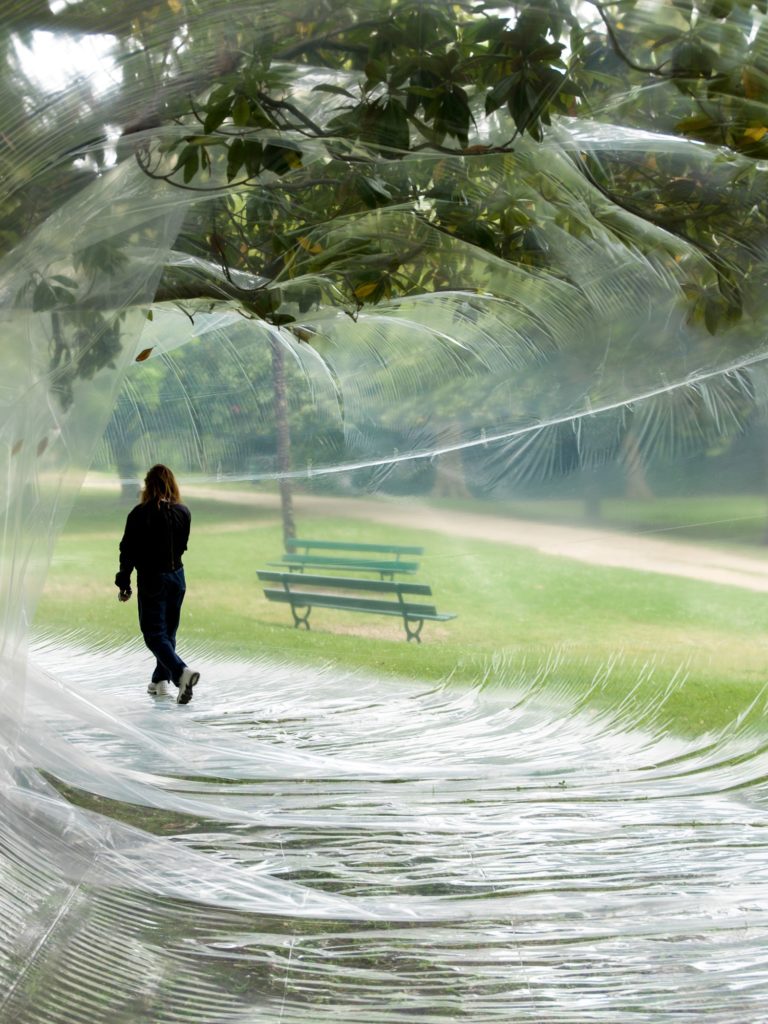
Villa Natacha gardens, Biarritz, France, 2026. Courtesy of the artist and Champ Lacombe, Biarritz/London. © Trevor Lloyd.
When I first visited Mazzucchelli’s studio in 2018, I was immediately struck by the meticulous documentation he kept of his public actions. He had placed his inflatable, human-scale sculptures in unexpected proletarian settings. Together with his wife, Giovanna, and other friends, he created inflatable environments of parallelepipeds in public areas — parks, churches, even the beach. People responded in the most unexpected ways, but there was always an action-reaction dynamic at play.
The way people responded to art during this period was genuinely active and engaged, with a sort of desire to belong to or interact with the objects.
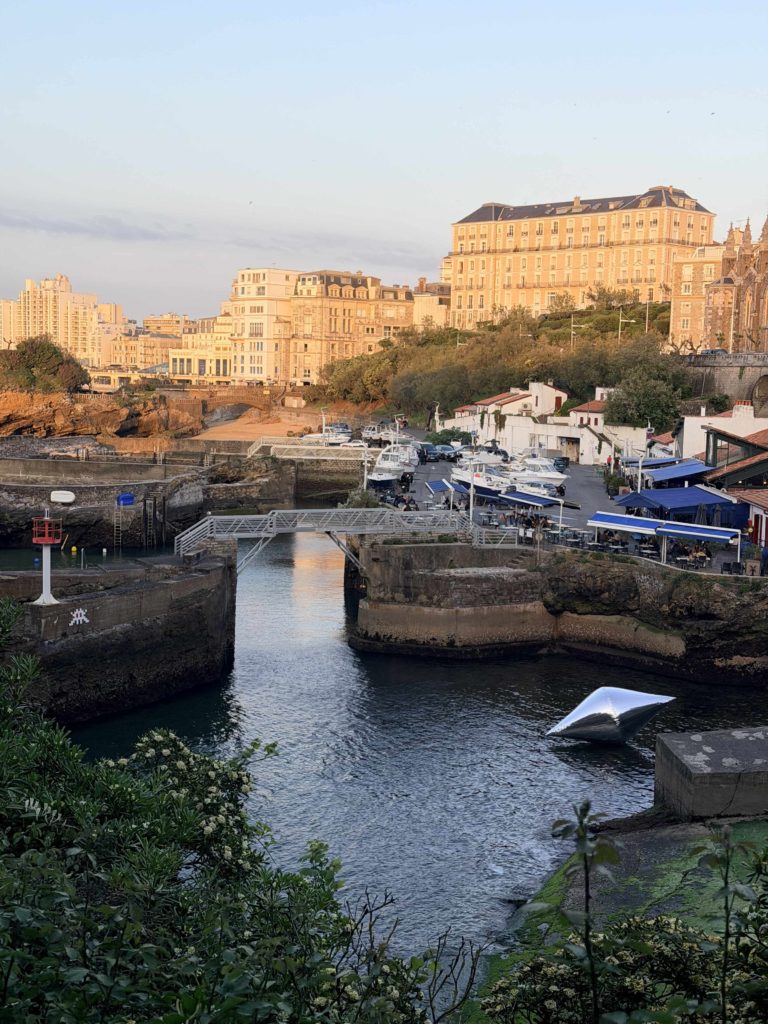
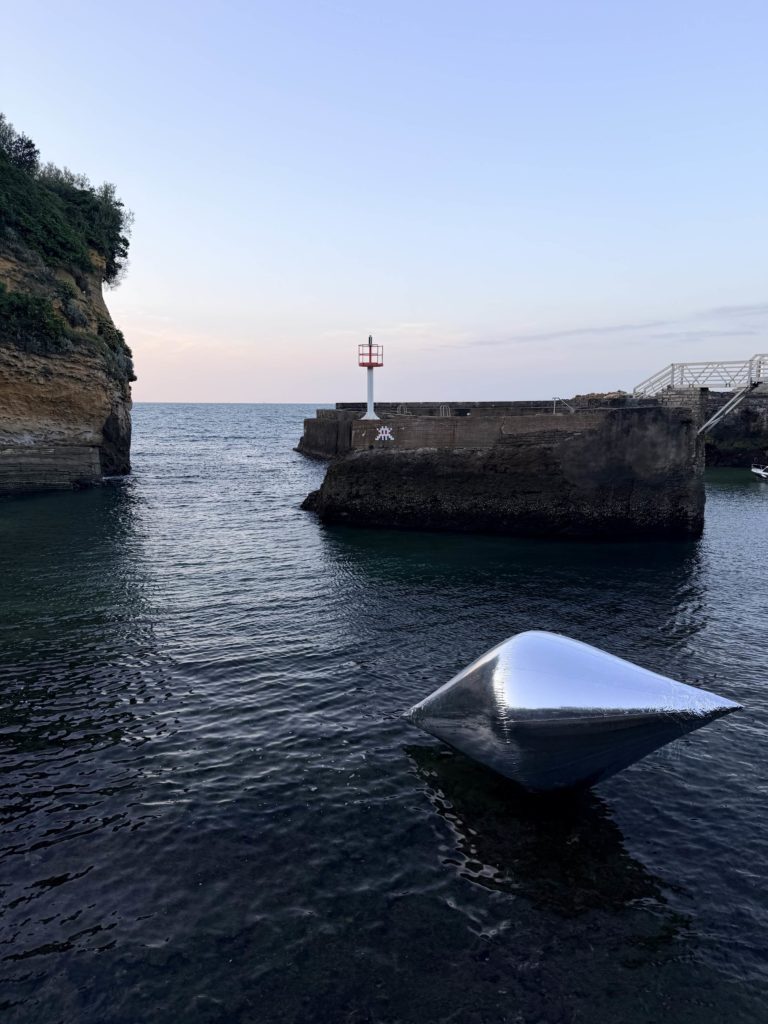
The exhibition presented at Champ Lacombe in Biarritz — staged not only in the main gallery space but also at the fisherman’s port and at Villa Natacha — attempts to restage this history of participation and contingency within the more controlled conditions of a contemporary exhibition framework. Mazzucchelli’s radicality remains intact — his use of air as both material and metaphor, his refusal of permanence, his challenge to authorship — but what emerges in the gallery is less an unruly social experiment than a carefully curated narrative of past disruption.
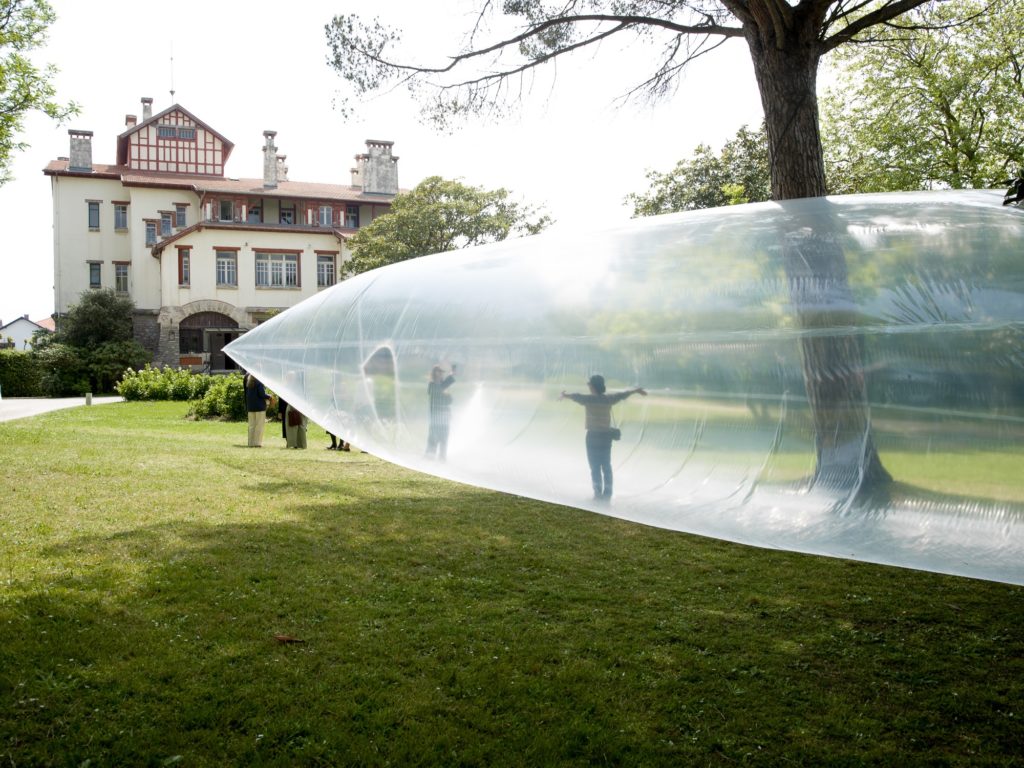
Villa Natacha gardens, Biarritz, France, 2026. Courtesy of the artist and Champ Lacombe, Biarritz/London. © Trevor Lloyd.
Mazzucchelli’s early inflatable works were never designed to be preserved, let alone historicized. They existed in a state of productive vulnerability: exposed to weather, misuse, boredom, affection, and neglect. Their meaning was generated collectively, often unintentionally, through the everyday gestures of passersby. In Biarritz, however, that unpredictability is mediated by institutional framing. The restaging of Riappropriazione at Villa Natacha, even when monumental in scale, appears stabilized — visually striking, certainly, but less socially volatile than their predecessors in industrial peripheries.
The exhibition’s strength lies in its archival dimension. Documentary films and photographs provide a compelling record of actions that might otherwise have slipped into anecdote. One is reminded that Mazzucchelli was not merely producing objects but staging situations — temporary infrastructures for interaction. Images of workers, children, and families climbing, puncturing, or simply resting against the inflated forms reveal a kind of vernacular engagement rarely seen in contemporary art today. Participation was not an educational program or a discursive theme; it was a physical fact, never an act.
Yet the retrospective framing also introduces a certain nostalgia. The works from the 1970s and 1980s, once embedded in the rhythms of industrial life, now risk being read as relics of a more optimistic moment in European social history. Watching the filmography, I’m struck by a beach scene in Santa Margherita Ligure, where a group of bathers carry a long yellow inflatable cylinder into the water. I wonder what people would do with this piece today, knowing it is an artwork. Is there a continuity — do the new outdoor interventions in Biarritz extend the same radical logic — or have the social conditions that once animated these gestures fundamentally changed? The contemporary viewer encounters the inflatables less as tools for collective appropriation and more as passive sculptural spectacles.
This shift becomes particularly visible in public pieces installed around the port, Bicono specchiante and the gardens of Villa Natacha. Their scale and formal clarity recall the artist’s earlier geometric environments, yet their reception feels more contemplative than participatory. Visitors photograph them, circulate around them, and admire their surfaces. Again, the unmonumental sculpture turns into a more monumental object. What is largely absent is the sense of risk — the possibility that the work might be damaged, repurposed, or absorbed into everyday use. Biarritz remains a backdrop rather than an unpredictable collaborator.
Mazzucchelli’s sculpture can be light, temporary, and socially porous. At a time when public art often gravitates toward permanence and branding, his reliance on air remains quietly subversive. Air cannot be owned, stored, or fully controlled. It resists the logic of the monument.
Champ Lacombe brings a unique curatorial approach to this show: as one of the few contemporary art gallery in Biarritz, it assumes a particular responsibility in presenting Mazzucchelli’s work in a resort town.
The show raises a productive question rather than offering a definitive statement: Can a practice built on disposability and collective misuse survive its own elevation? The exhibition does not resolve this tension, but it makes it even more visible. In doing so, it confirms Mazzucchelli’s enduring relevance — not as a nostalgic figure of participatory art, but as an artist whose work continues to test the fragile boundary between object and event, sculpture and social life.