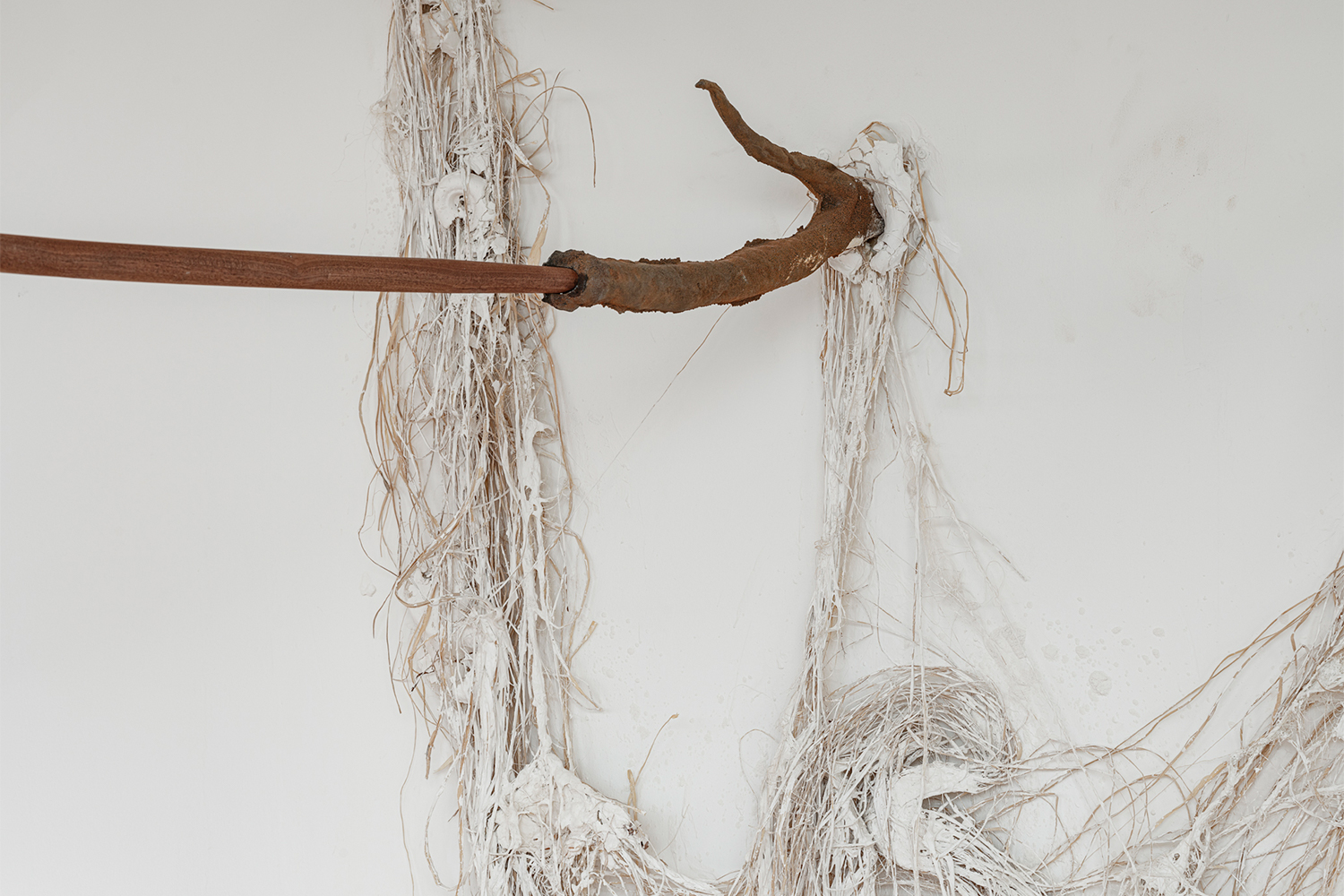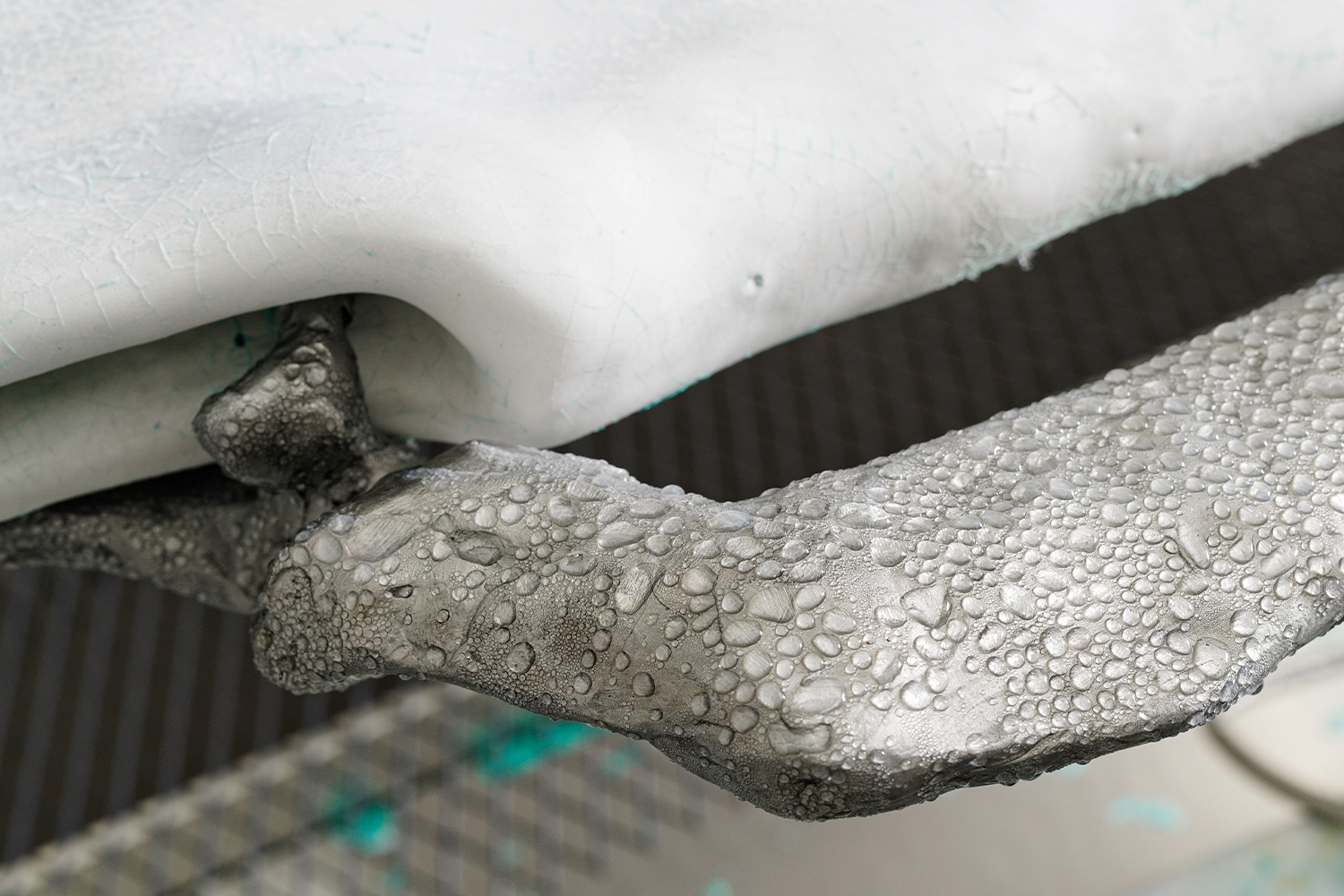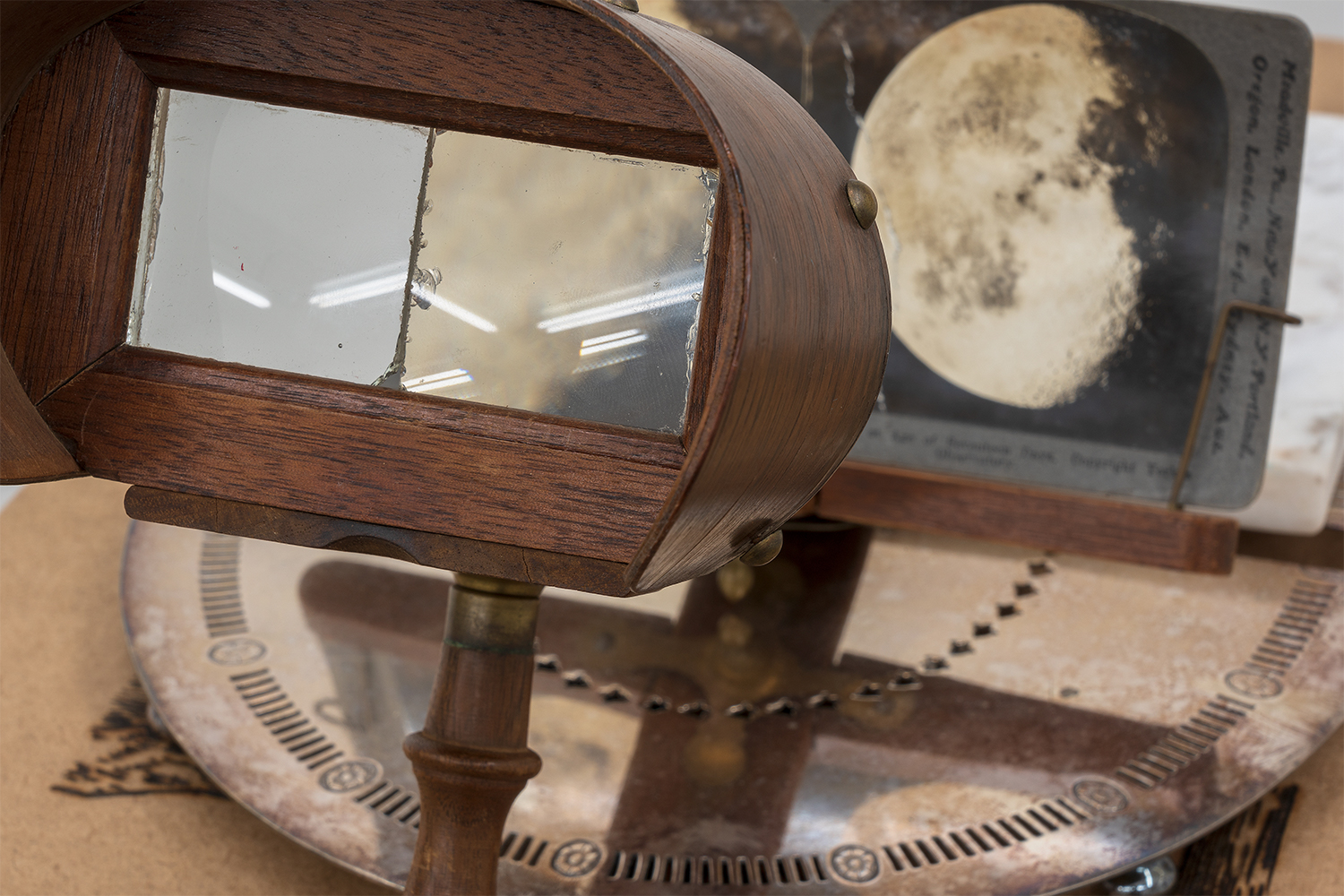
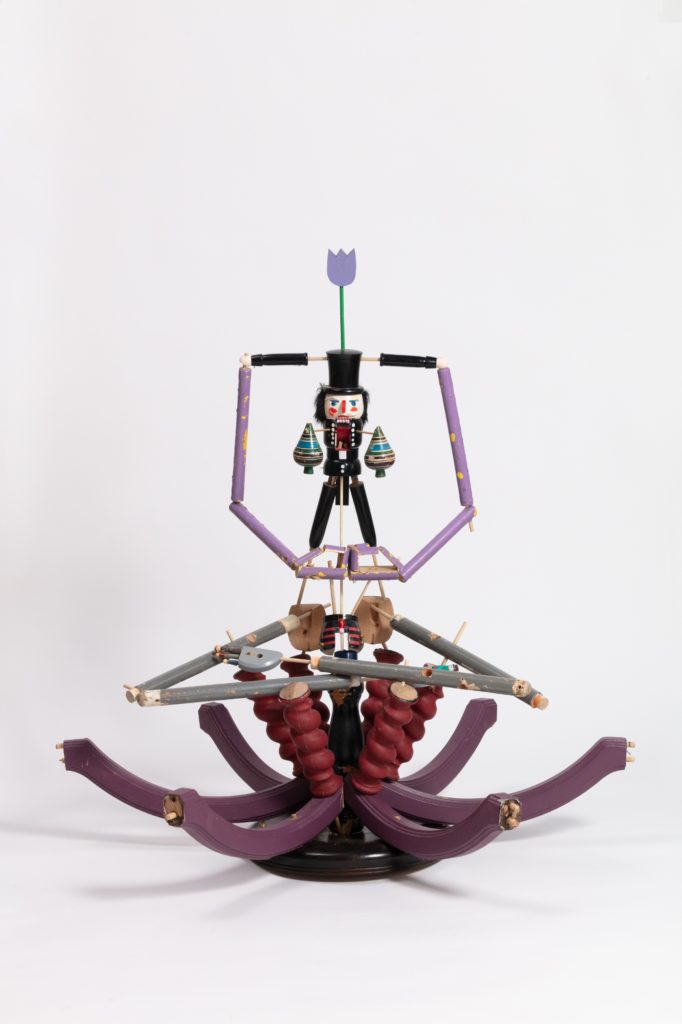
It is taken as a maxim of our age that serious art is secular. Like most broad-stroke claims, this one folds when faced with particulars. It’s not only “visionaries” and “outsiders” that disprove it: histories of modernism are shot through with passing references to artists’ spiritual pursuits. But those interests tend to get subsumed by the idea that art is, above all, a rational, discursive tradition. Elizabeth Englander is one artist who recognizes the false choice. Where some artists might soft-pedal their earnest beliefs through irony, critical distance, or a manicured silence, there’s something exclamatory with Englander. It’s refreshing. Working mostly in assemblage, and using simple, familiar materials — children’s furniture, nutcrackers, scraps of old clothing — she has developed a practice that treads a distinct path between personal experience, rigorous art- historical study, and material savvy. The result is an ecstatic, devastating vision. It taps into deeper currents.
On the day I visited Englander’s studio for this interview, New York’s waters had frozen over. The view outside her Red Hook window was a field of cragged ice between two piers. Inside, we discussed her recent shows, the importance of early teachers, and ways of contemplating death.
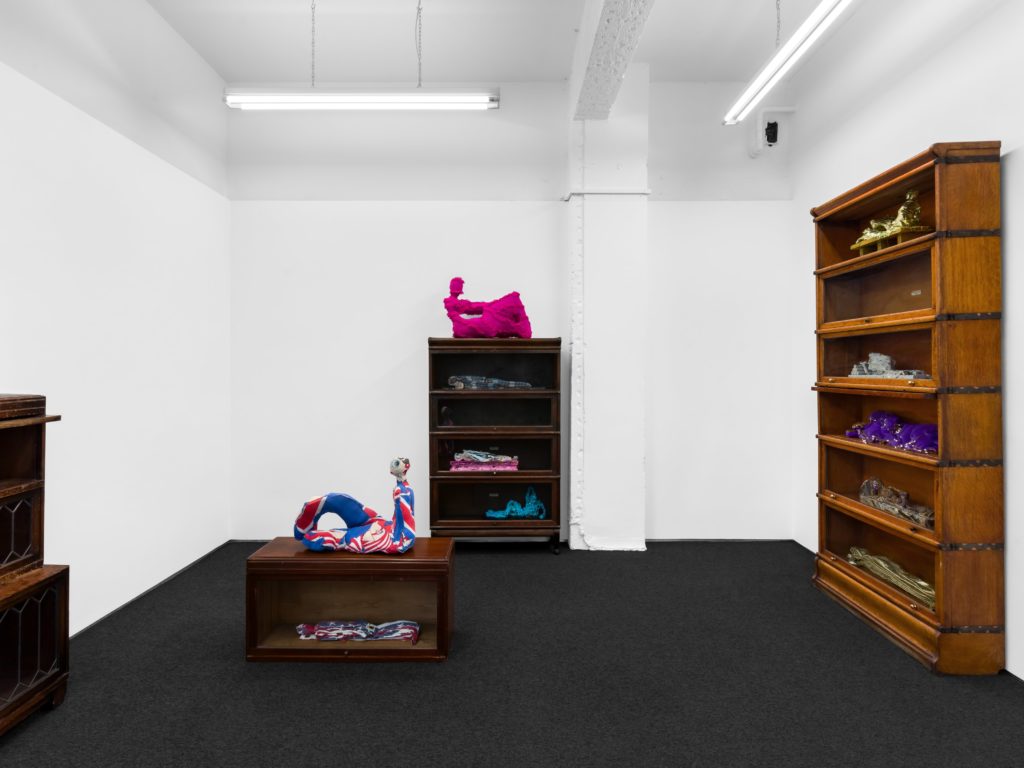
Nick Irvin: Can you tell me about the shelves you used in “The Elizabethan Lumber Room” (2026), your exhibition at a. SQUIRE, London?
Elizabeth Englander: When my mom died, I inherited her Globe-Wernicke barrister’s bookcase. It was sitting in storage, and when I started making the works from the “Parinirvana” series (2025), they just fit. What I didn’t know until I brought it to my studio is that it’s modular — you can stack the shelves and take them apart, like bricks. The idea was that lawyers could travel with their law books in these glass- fronted compartments, instead of putting them into boxes.
NI: It’s interesting because the modularity brings to mind Constantin Brâncuși, who appears elsewhere in your work, and his motif of the endless column.
EE: My graduate advisor, Tom Weaver, once pointed out that I never make anything horizontal. Everything’s upward. And now when I finally make horizontal works, I end up stacking them!
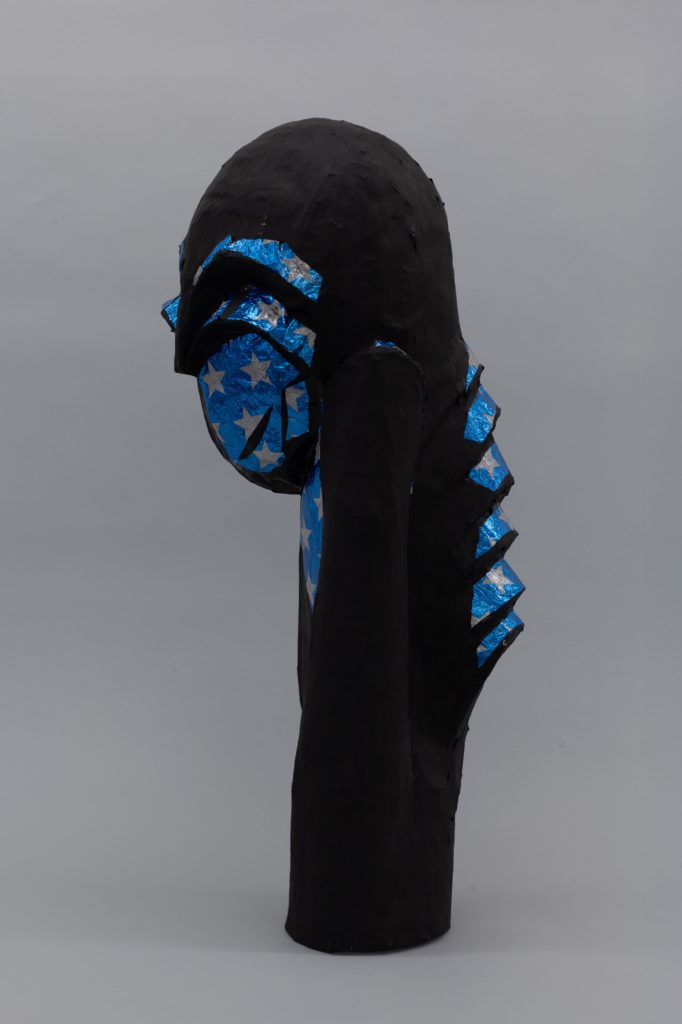
NI: Setting these sculptures in vitrines reminds me of the way you’ve installed the “Yogini” works (2022–24) in past shows. There’s a frontality to them, too. I guess since they’re figurative, in their way; they are meant to “face” us, and we’re supposed to face them. So even when they’re not installed against a wall, they run counter to the Minimalist script that sculpture is meant to be experienced in the round. EE: That’s interesting, because I think most of them are more legible as form when they’re viewed from an angle. But I was inspired by high-relief sculptures designed for one-on-one worship, so maybe that’s part of it. Another factor I’ve been thinking about with the new work is lighting. These pieces want to be in the dark. The bits of mylar attached to them do more in those conditions, in much the same way that gilding and other reflective materials have been used to “light” sacred art for millennia.
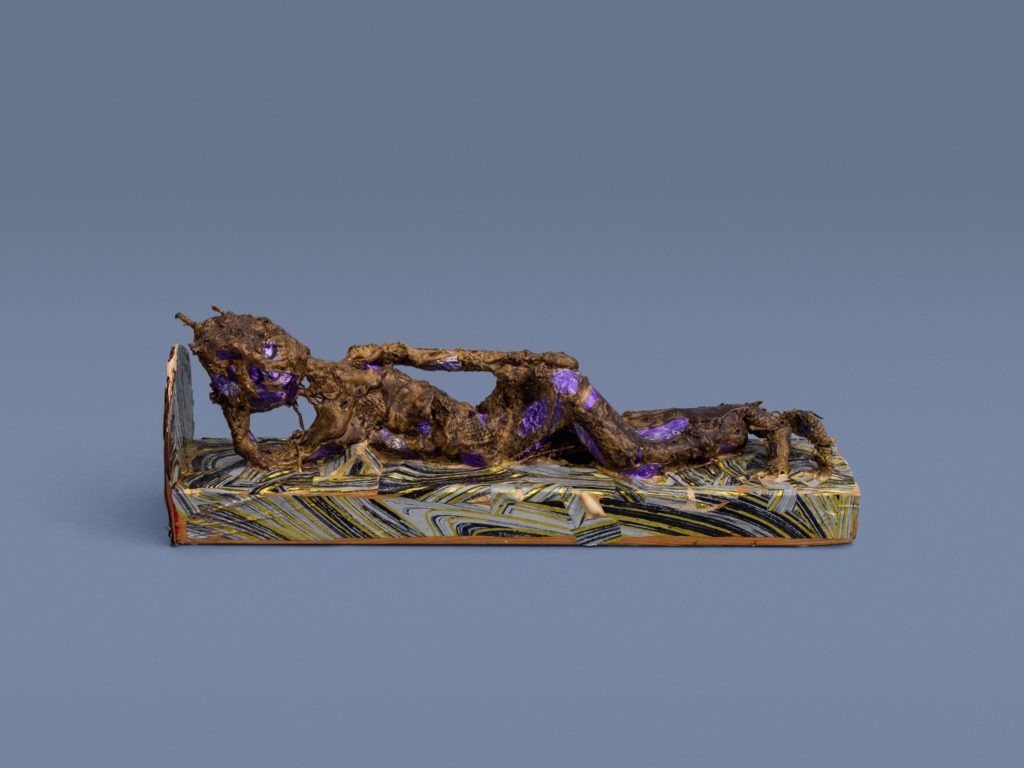
NI: What have you been reading? EE: Erwin Panofsky has this book about tomb sculpture, which has been on my mind with Parinirvana. He traces it all the way from ancient Egypt to Bernini. I really feel that figurative sculpture comes out of dealing with corpses. The facsimile of the body, even the preservation of the body. There’s a medieval tradition of tombs that depict the body twice, alive on top and dead below. We installed two works, Parinirvana (UNESCO Betty) and Parinirvana (American flag) (both 2025) in the London show sort of that way, one reclining figure with US/UK flag motifs on top, and another one made out of a shredded US flag below.
NI: While the series is named after a Buddhist representational tradition, the reclined figure of course also brings to mind the Western motif of the odalisque. Is there an erotic side to these works? Or to depictions of the Buddha, as there is with depictions of Christ?
EE: They’re vulnerable, and also inviting, especially when he’s supposed to be teaching.
NI: From what little I know about Buddhism, part of the thing about teaching and preaching is that it’s not coercive, right? It’s like, you hear it, and if you’re drawn to it, then you elect to move toward it. In that sense, the idea of showing teaching as a supine activity makes sense. It’s not an imposition.
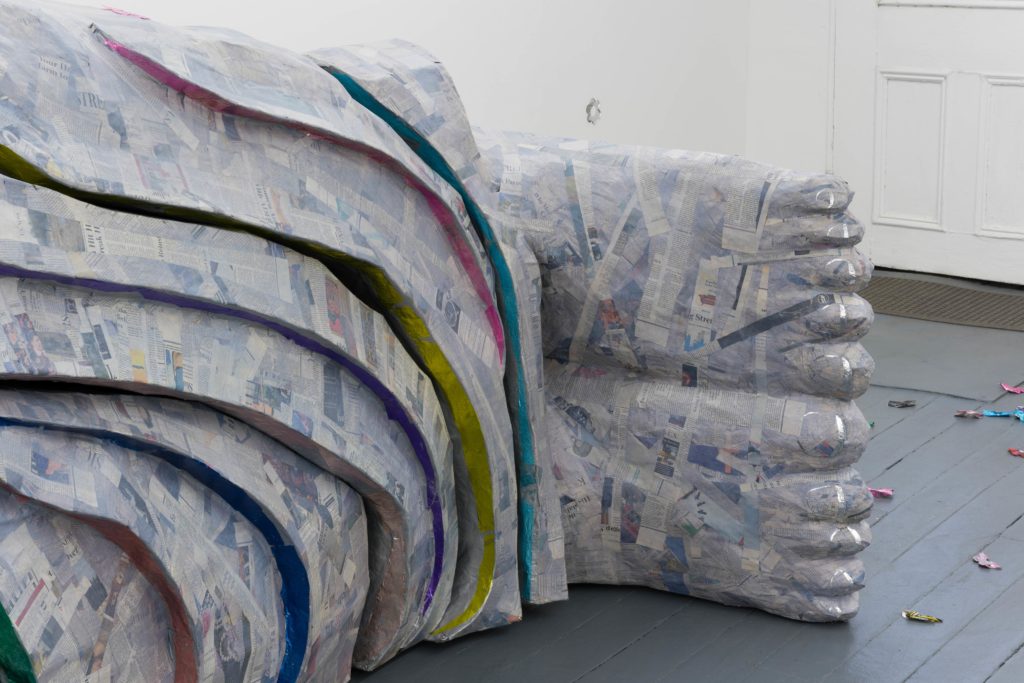
EE: Well, there are different kinds of domination. There’s a Buddhist legend about this king who wants to hear the wisdom, but he doesn’t want to bow down in front of the Buddha. So the Buddha lies down, but he makes himself huge, so the king can be standing, but the Buddha is still bigger. The big Buddhas that I went to see in Thailand draw on that story. But the reclined teaching Buddha is morphologically similar to depictions of the Buddha in death. So the obvious Buddhist thing about death being a part of life and vice versa, there’s something about desire in that too. Sleep, sex, death, and the pose containing all of this. And once I started working on this massive, cut-up figure — the big Buddha had to be made in sections — I had to think about Henry Moore’s reclined figures too, and their involvement with questions of time, the Earth, and regeneration: karmic concerns, basically.
NI: I wanted to ask you about the classical modernist references in your work. There’s Moore here, but there’s also so much Brâncuși: the heads of the two massive works from “Parinirvanas” in your show at Theta, New York, last year are modeled on Brâncuși’s “Mlle. Pogany” works, and the show at Lucy Bull’s apartment in New York also included iterations of that motif. At first I had thought you were just pulling out these cornerstone sculpture references, but then I read the exhibition text and realized that there was a much more personal connection. Your high school art teacher was the grandson of Brâncuși’s model, Margit Pogány!
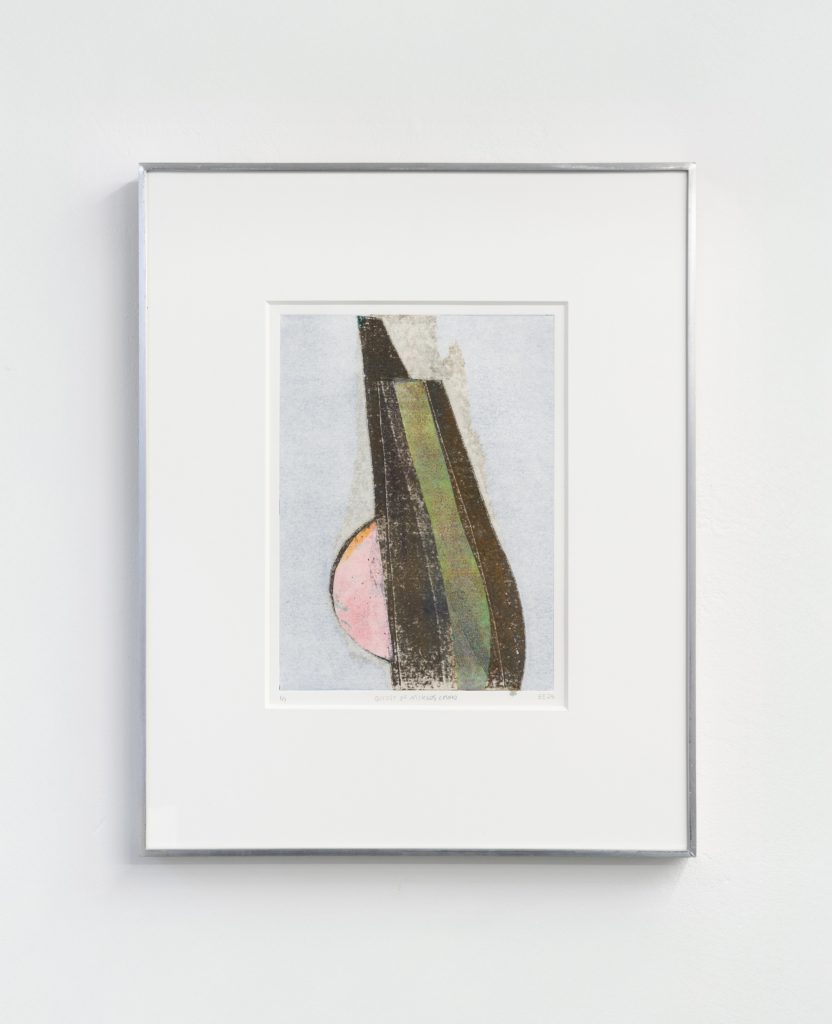
EE: Yes, Miklos Pogany. At first I didn’t see a sculpture project there, because his thing was printmaking. He had a Comparative Literature degree from the University of Chicago, but he bailed and became a self-taught printmaker. He was really funny, and he liked my art best when it was funny. But when I started researching his work in 2024, I discovered that it’s mostly about grief, especially the loss of his sister, who died young. I think he had a vision of her, to be honest, and he worked from that motif for years. I tried to recreate those prints, using what I knew of his techniques.
NI: What were his techniques?
EE: Mostly monotype, using paper cutouts. It was all about chasing the ghost print — maybe flipping or removing one element, maybe re-inking, then cranking the pressure and printing, on repeat. With some of his most beautiful prints, you can tell that it’s like the twentieth impression off that plate. I had a hard time figuring out how he had achieved certain effects, but it really felt like he was there. Every little gesture of the process was something that I had learned from him.
NI: How did that work in the classroom?
EE: We were in these weird little trailers that were supposed to be temporary classrooms but ended up being permanent. There was only one press, so we could only make one print at a time, and we’d take turns, one student at a time. When something cool happened, he’d get excited and we’d keep printing. The press had this big wheel. It kind of felt like we were sailing.
NI: Printing is pretty different from sculpture.
EE: For me, revisiting Mr. Pogany had to do with recapturing this freedom I’d found in making art as his student, especially in working with color. One thing about monotype is that you don’t quite know what you’re going to get. This welcoming of unexpected effects — I think it was a nice introduction to art as practice, as ongoing, open-ended, receptive activity. After his death in 2022, I learned that he was a Buddhist. I met him and decided to become an artist, but maybe it was always about the Buddhism.
NI: Thinking religion alongside modernism, I wonder if you’ve read much about Theosophy? It was so influential on so many artists — like, even Mondrian — in a way that runs counter to this clinical idea of modern art as a secular, rational exercise.
EE: Kandinsky too! I think a lot of that history has been suppressed, at least in the US. There’s a lot there.
NI: Brâncuși too, in his way.
EE: There were a lot of spiritual concerns being worked out in the avant-garde. And it carried on. Tom Crow writes about this with people like Sister Corita Kent, and even Robert Smithson, who has all these crazy Jesus paintings that a lot of people don’t know about. James Turrell, even. There’s a lot there.
NI: It’s an interesting subcurrent. You have a temple that you go to. What is your meditation practice like?
EE: It’s pretty unstructured. In the kind of Zen I practice, they talk about “just sitting.” Basic mindfulness stuff, seeing what your body is doing, noticing, being gentle with yourself. I cry a lot, or I get bored. But at this point my body is conditioned so that when I sit down, it feels like such a relief.
NI: You held a “Death Meditation & Dialogue” evening in your last Theta show. I was really sad to have missed it. How did that go?
EE: It was my friend Sara Lamm’s idea. Did you ever see that documentary film, Dr. Bronner’s Magic Soapbox (2006)?
NI: I love Bronner lore but I haven’t seen it.
EE: Well, Sara made a great film about him, with all this incredible archival footage. Anyway, she led this session. She’s a meditation facilitator with training in hospice care. She led us in this Tibetan practice where you’re supposed to get into the “lion’s pose,” the position the Buddha was in when he died. So everybody was lying down in the same pose as the sculpture. And then she read a text which basically takes you through the process of your own death. It’s interesting because on the one hand it tracks this system of the elements — earth dissolving into water, water dissolving into air — but at the same time it’s describing, in clearly observational medical terms, what the body goes through. “Now you are passing less urine,” things like that.
NI: That’s way outside the standard activity of art galleries these days!
EE: Yeah, it was a little weird to be doing this in a gallery. But it’s an intimate space, and it worked.
NI: If the lights were down, the shiny mylar details on the sculptures were probably coming out, too. When I think about that show the first thing I think about is the careful fingernails and toenails in mylar.
EE: There’s a practice in Thailand of sticking a little piece of gold leaf on the Buddha when you go to worship, and people always go for the fingers and toes. Since they’re not glued, the pieces of gold leaf are kind of fluttering. This is usually on a smaller Buddha. Wherever there is one of the really large Buddhas, there are usually also smaller Buddhas in the same pose that you can interact with. The play of scale is interesting to me. In one frame you are the small king and it’s the big teacher, and in the other you are more face to face. But from a Zen perspective, of course, everything is kind of a Buddha, with something to teach us — dead or alive.