Titled “The Width of an Eye” and curated by Emilie Ryan, this exhibition functions more or less like a genealogy of its geographic setting. It features works by Kai Althoff, Edward Barber, Lisa Brice, Peter Doig, Lucio Fontana, Behrang Karimi, Marcus Leotaud, Seboo Migone, and Spencer Sweeney. I spent the past few months in the Aeolian Islands, watching how each little microcosm revolves at its own pace, one that, surprisingly, breathes in the air of the world outside it. Art-wise, these places have always been fairly teeming.
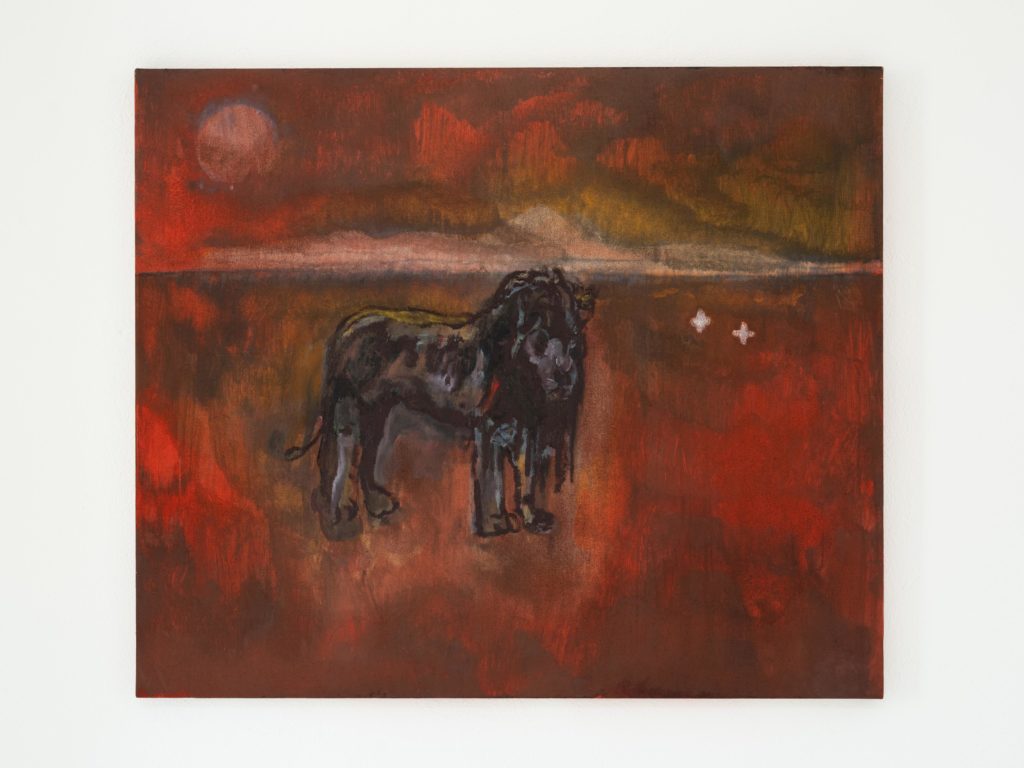
Take a young Giovanni Anselmo, whose series “La mia ombra verso l’infinito dalla cima dello Stromboli durante l’alba del 16 agosto 1965” (1965–2000) was about locating latent energy in inert materials while resisting the crystallization of a work into a static object. In this sense a shadow, cast and gone, is the perfect Arte Povera sculpture. Filicudi has been active on this front for years, with Studio Casoli having relaunched the hot season with the group show “The Width of an Eye” (2026). Peter Doig, not entirely coincidentally, is particularly welcome there, where his lions seem to have found fertile ground. For the show he drew on a childhood story of Casoli’s, the memory of a bizarre woman walking through central Milan with a lion on a leash. In the painting, titled Lion (Filicudi) (2026), the beast stands on a flat, unmodulated red ground, flanked by two schematic crosses like the signs on ambulances, and topped by two black, morphologically accurate mountains. The lion’s body is shown in profile while the huge furry head is frontal; this kind of composition is mildly absurd in his heraldic emblematicity. The oddity is in the handling: dry scumbles over the red field, the animal’s hide stippled and faded like a photograph left in the sun.
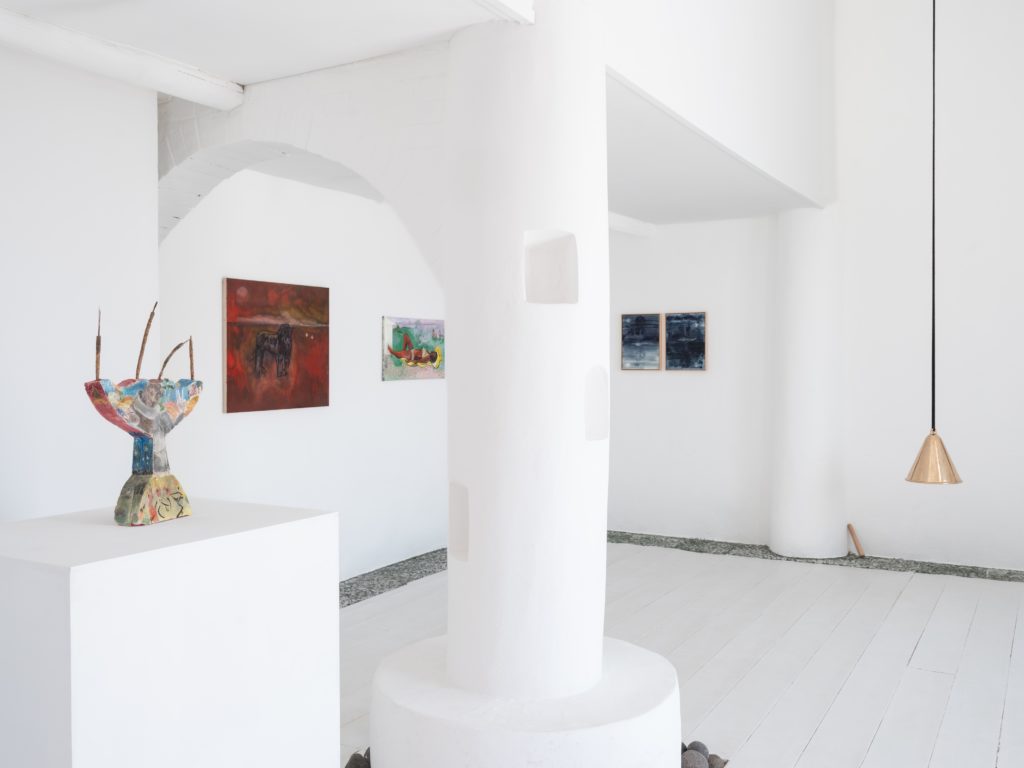
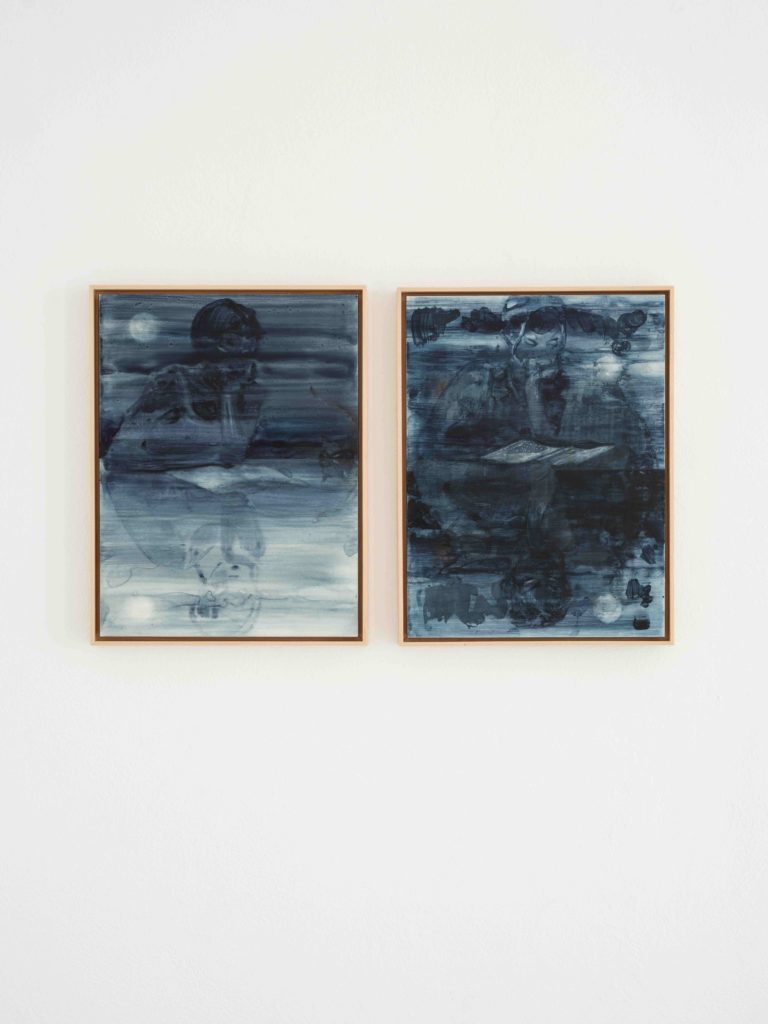
Characteristically, this is an updated romanticism, detached and wonder-struck, the kind of narrative painting that Doig keeps relevant by working in the register of a dream. Another work of his, Bather (Filicudi) (2026), is just as firmly rooted in the genius loci: a woman sunbathing inside what looks like a yellow banana peel, her body tucked into a huge, high-key curve of cadmium that is pure ornament and sarcophagus at once, again on the unsettling scale of a dream. The bright yellow spikes make it hard to overlook, and they sit perfectly with a sense of stoic calm. There is nothing quite so difficult as looking easy, a skill both Doig and holiday-goers have mastered. Lisa Brice’s Untitled (2026) comes as two male-gazed, mirrored portraits of a ghostly magazine reader under the moon, rendered in watercolor and flashe on clayboard, hanging side by side. Brice has repainted art history’s women in this same indigo before — Manet’s 1863 Olympia, Degas’s bathers — and these two belong to that lineage.
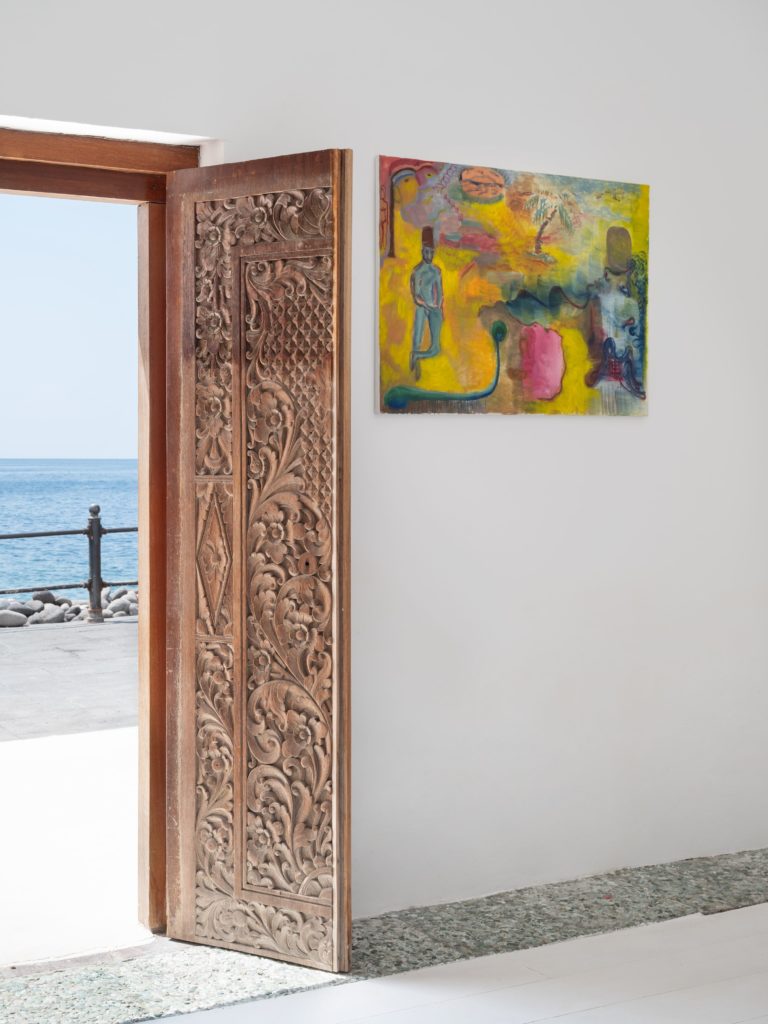
The melancholy is as always in the color, and in the companionship; or rather, in the lack of it. The “young master of touch” Behrang Karimi, as Doig defined him, contributed a Nude and Fearless (2022) oil painting of a couple of lovers embraced in a purplish haze amid deep grass, oblique lines, and yellow flowers. The pigment is laid on wet-in-wet and pushed around with an expressionist fervor, violets and acid yellows smeared into charcoal darks. The stiff, decorative poses flirt with the kitsch end of the spectrum, which seems to be where the broader picture wants to sit. It smells of joy, with something faintly ghoulish underneath, like love itself, sometimes. Karimi’s 2026 Dream Police arrives dazed and confused: a lysergic landscape crossed by a long blue man, à la the genie of the lamp, floating in a mist of faces and places — maybe Woodstock. The figure is pushed almost entirely flat, a luminous cobalt cut-out against a churning, high-chroma ground of collaged faces and dissolving horizons. The works all seem perfectly at ease in their surroundings or, as the phrase goes, “in dialogue” with them.
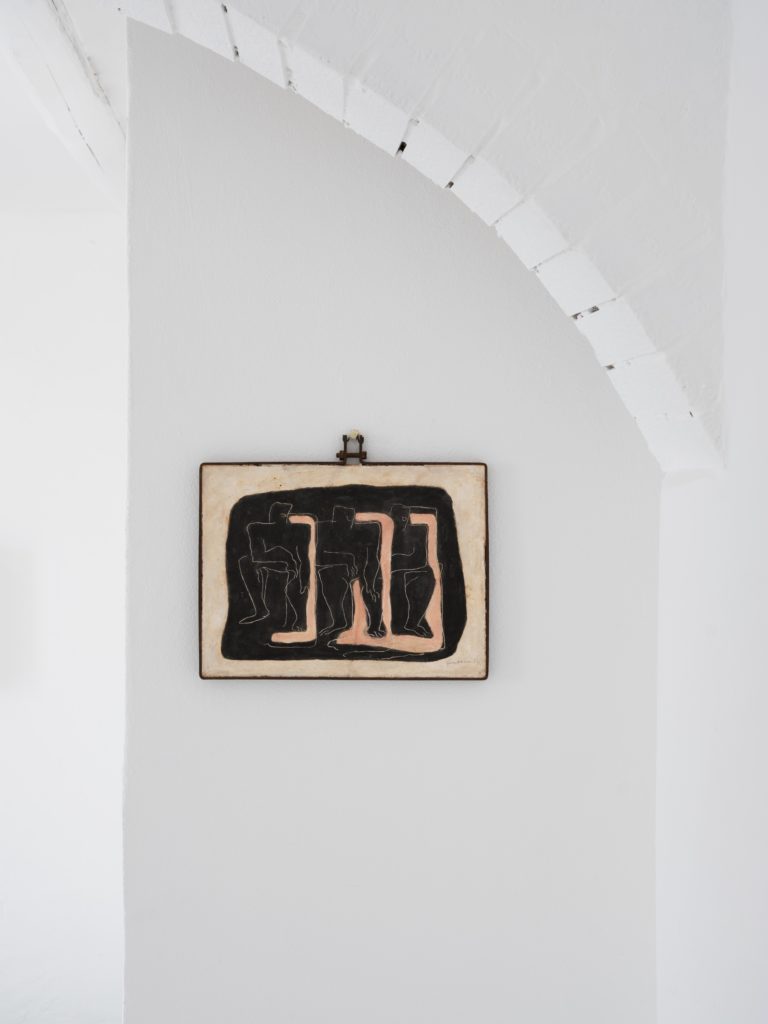
That phrase is often a way of saying very little. On the other hand, what genuinely stands out here — and says a lot — is a candelabrum by Kai Althoff: an Untitled (2026) object resembling a chalk-drawn, pre-industrial folk relic, topped with four twigs standing in for candles. It is intensely colorful, made for the eight-hundredth anniversary of Saint Francis of Assisi, and it operates in Althoff’s usual registers: faux-naïve drafting that isn’t naive at all, dusty pigments that look extracted from the earth, and a composed presence. The hagiographic vignettes read like a comic strip for believers: Saint Francis, soaked in grace, holding a green mantis, smiling as he blesses all around, then floating toward the sun as three little birds accompany his ascension. The most interesting feature of this artifact is that it puts the viewer in the same condition that a Mass puts an atheist. We circle it with charmed respect and fascination, until we realize that this appraisal runs both ways — that its reality, as much as our own, is what is really happening.