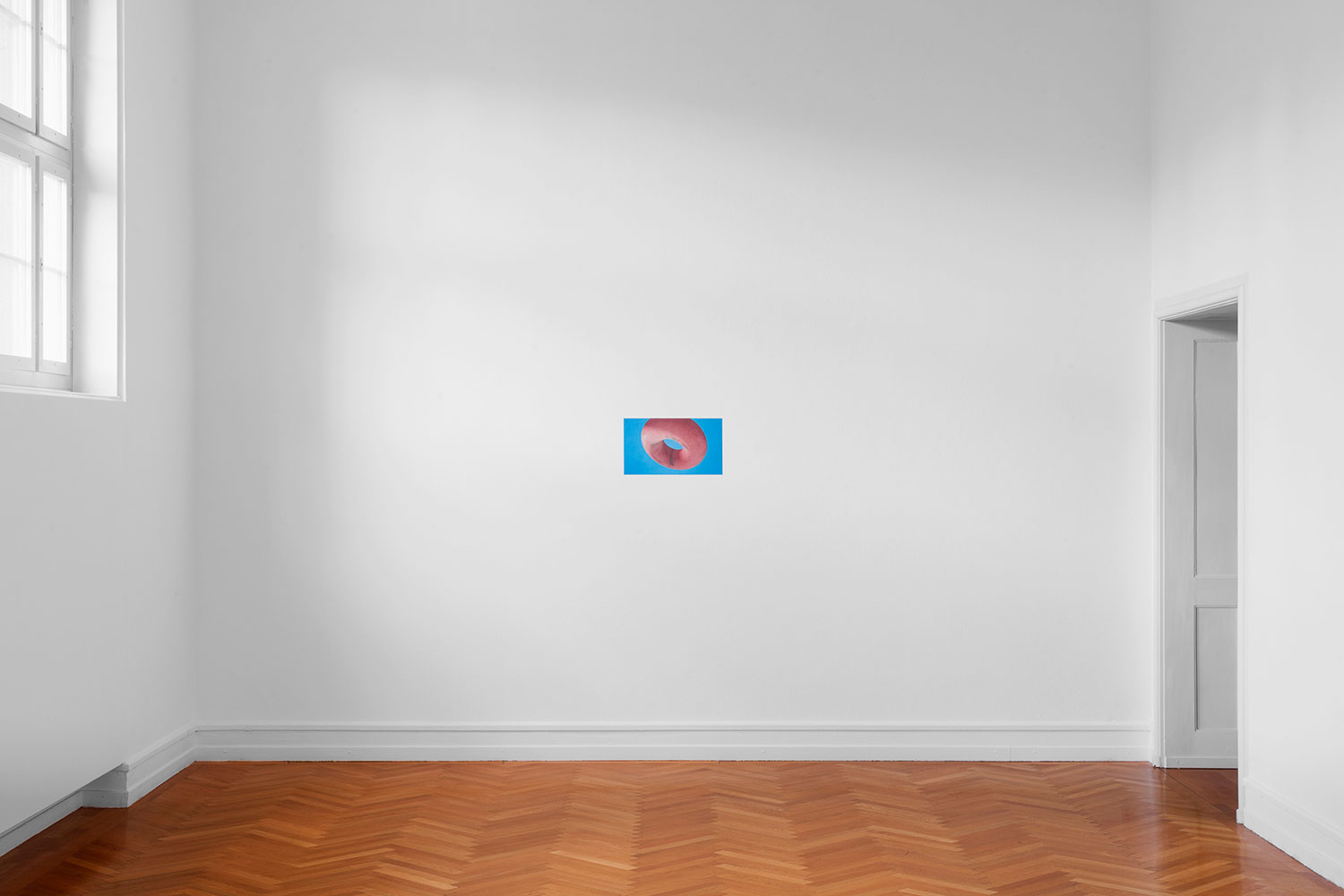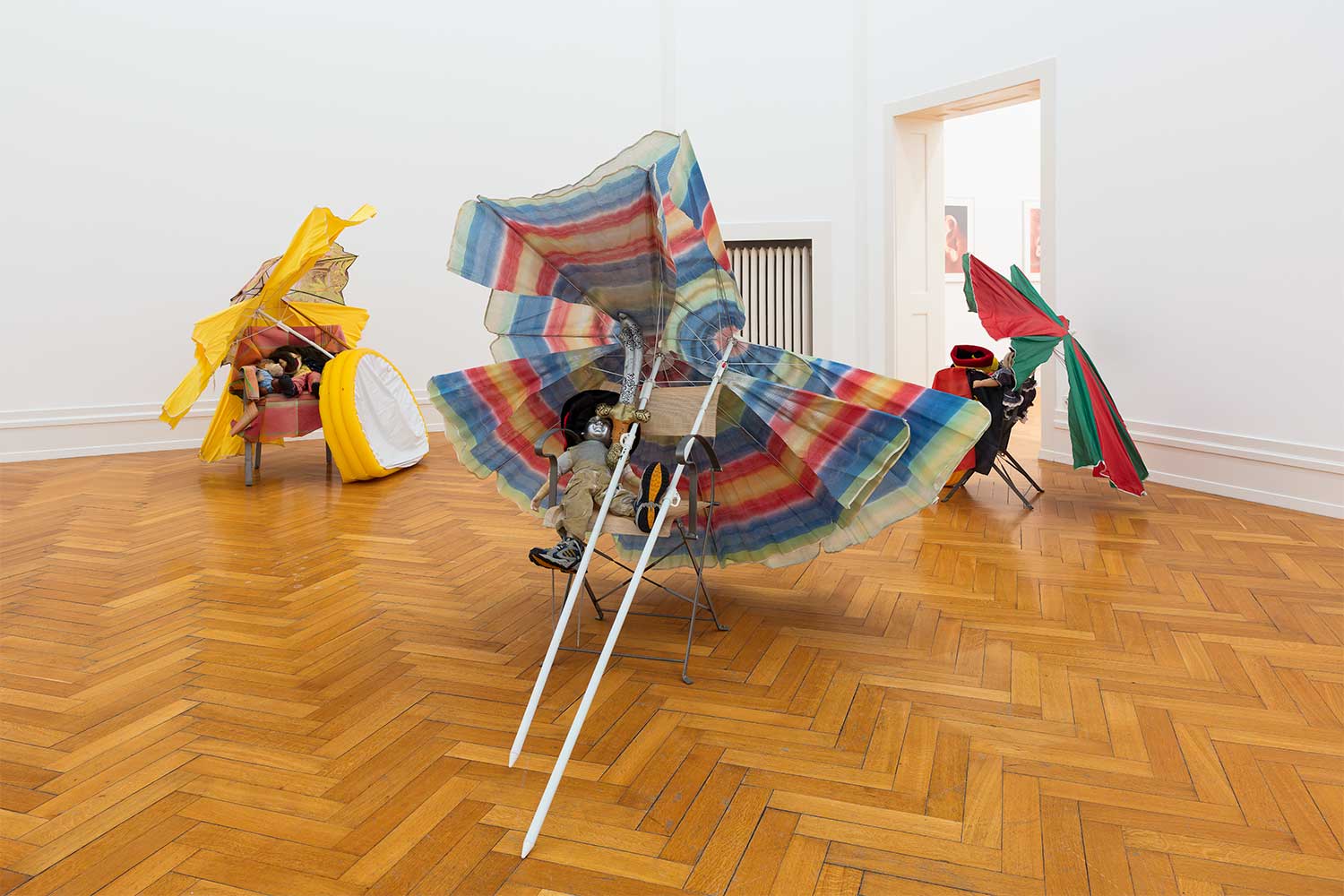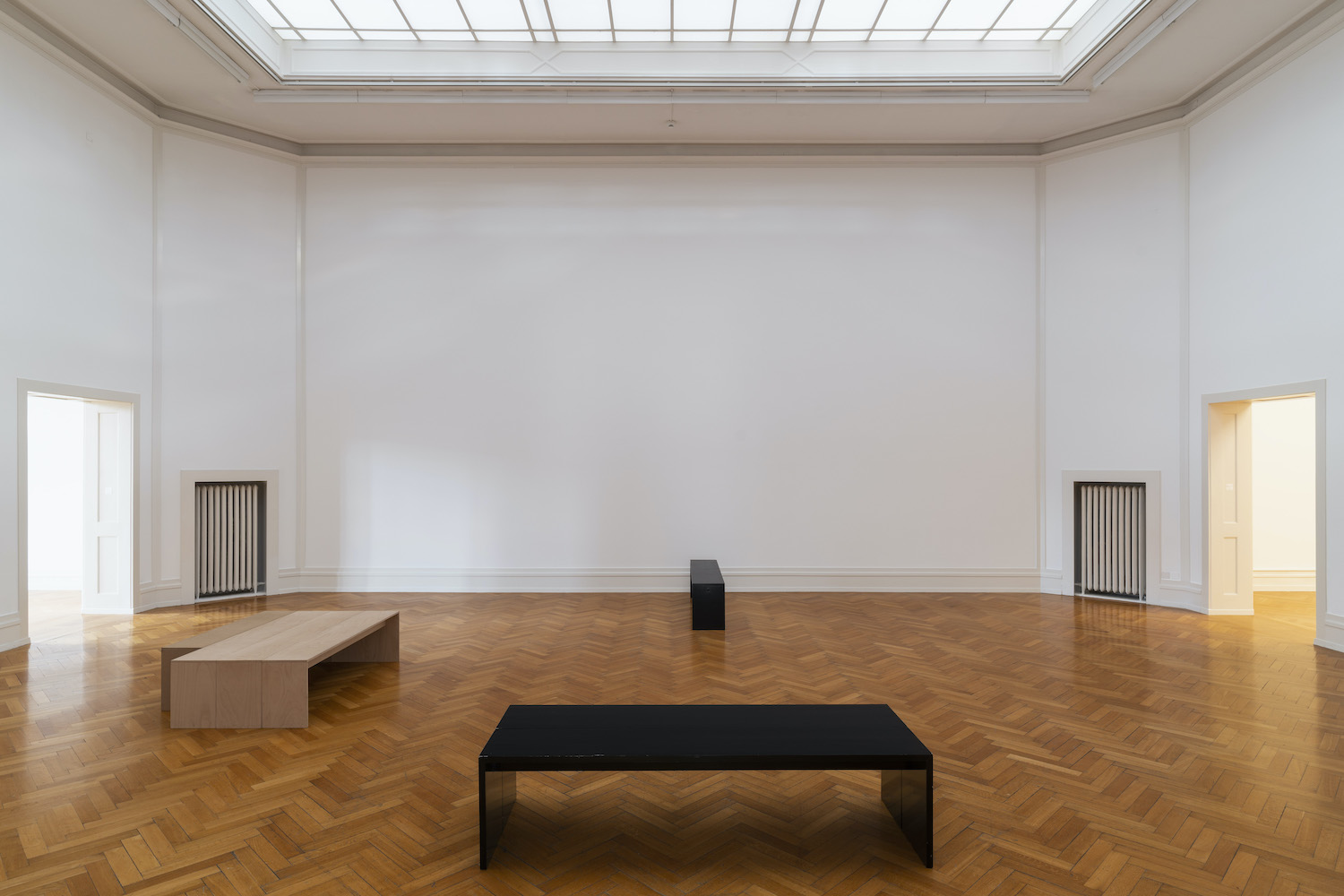
Tai Shani’s work is post-spooky, and experiencing it at Kunsthalle Bern heightens this quality even further, due to the strong contrast of its clean architecture. Perhaps my urge to define it as post-spooky is a way of escaping its real nature: Antigone, the ancient Greek tragedy around which the show revolves, stands as a symbol of lucid, grieving, painful resistance to the contemporary polycrisis. Yet you just bump into it, not in a terrifying way but in a playful-scary one. Commissioned jointly by Kunsthalle Bern and Jupiter Artland, “M.I.A.S.M.A.” (2026) is the first institutional solo exhibition in Switzerland for the London-based artist, joint winner of the 2019 Turner Prize.
In Sophocles’’s play, Antigone is the daughter of Oedipus, heir to a family curse. Her two brothers, Eteocles and Polynices, kill each other fighting over Thebes. Their uncle Creon, the new king, buries Eteocles with honors and orders that Polynices, the traitor, be left unburied for the dogs and vultures, with no mourning allowed. Antigone defies the decree and covers her brother’s body with dust. Her sister Ismene, afraid, refuses to help. Creon sentences Antigone to be sealed alive in a stone vault, where she dies. Shani builds the exhibition like the play itself, around a chorus. She has written twelve choruses, each beginning “We the…,” which weave Sophocles’ lines into her own voice. Each chorus gives its title to a sculpture, “We the pollen drunk bees” becoming Pollen Drunk Bees and “We the morally injured star” becoming Morally Injured Star, and each is sung through the wall in the next room. The three siblings, meanwhile, become three paintings. The whole show is a tragedy staged by “somehow cheerful” objects.
Shani’s question is ancient and urgent: who is allowed to be mourned and to mourn? Her answer is not a slogan but a room of strange, tender objects that refuse to look away and function as cultural totems. Post-spooky, then. Haunted, but wide awake.
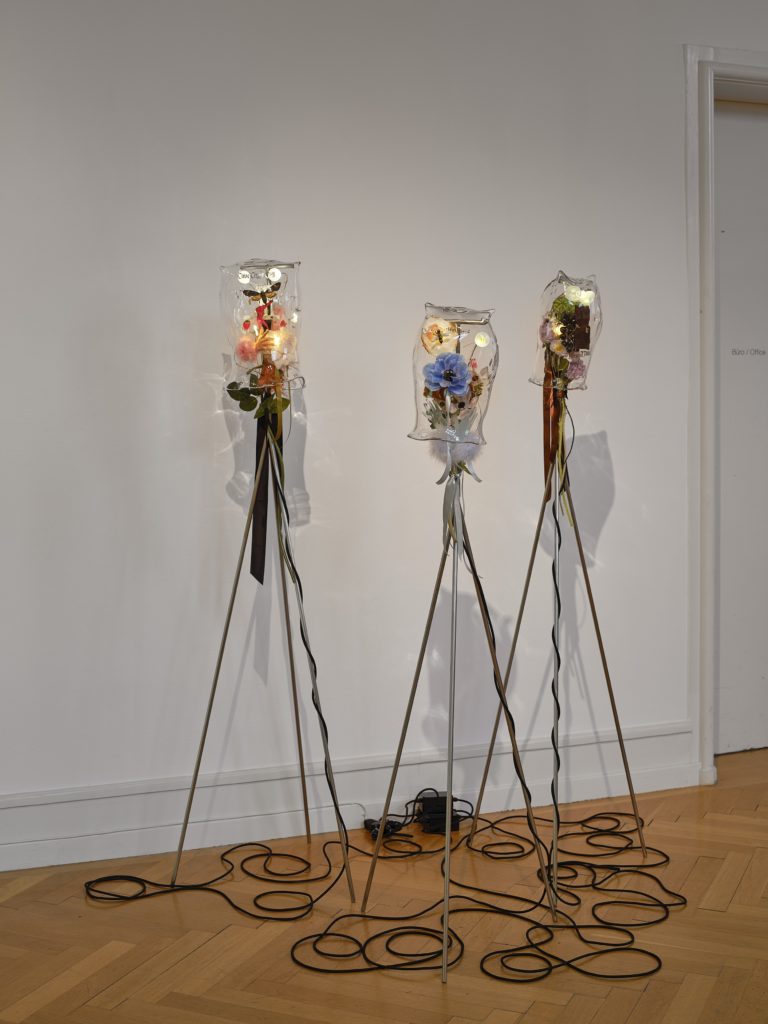
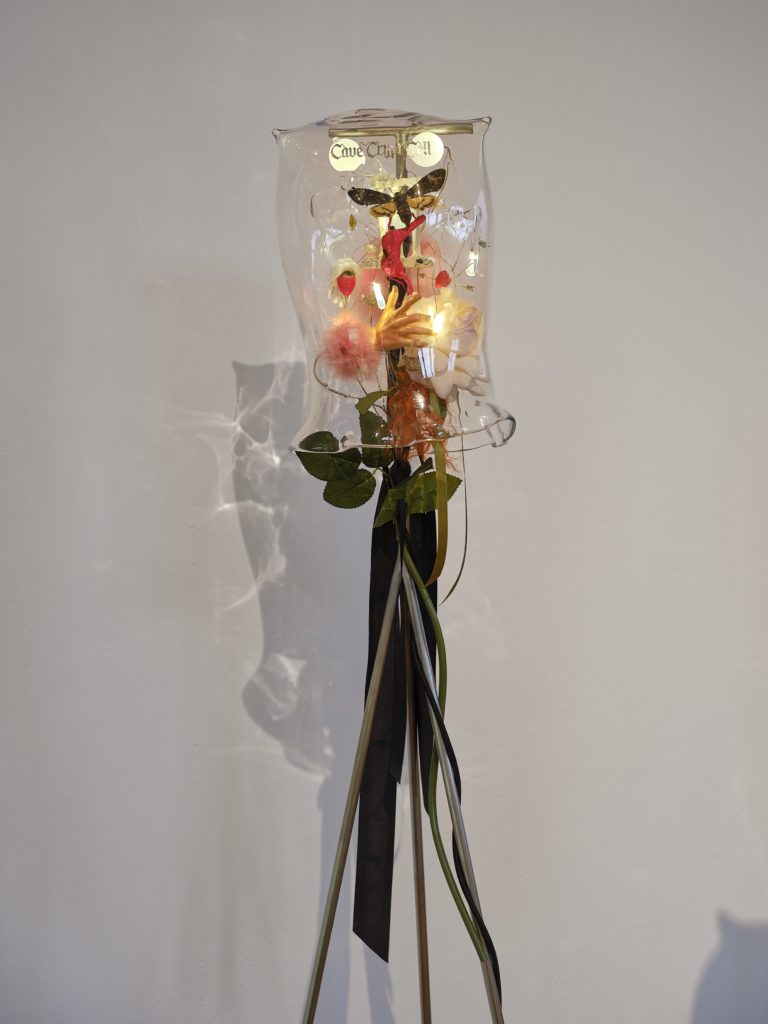
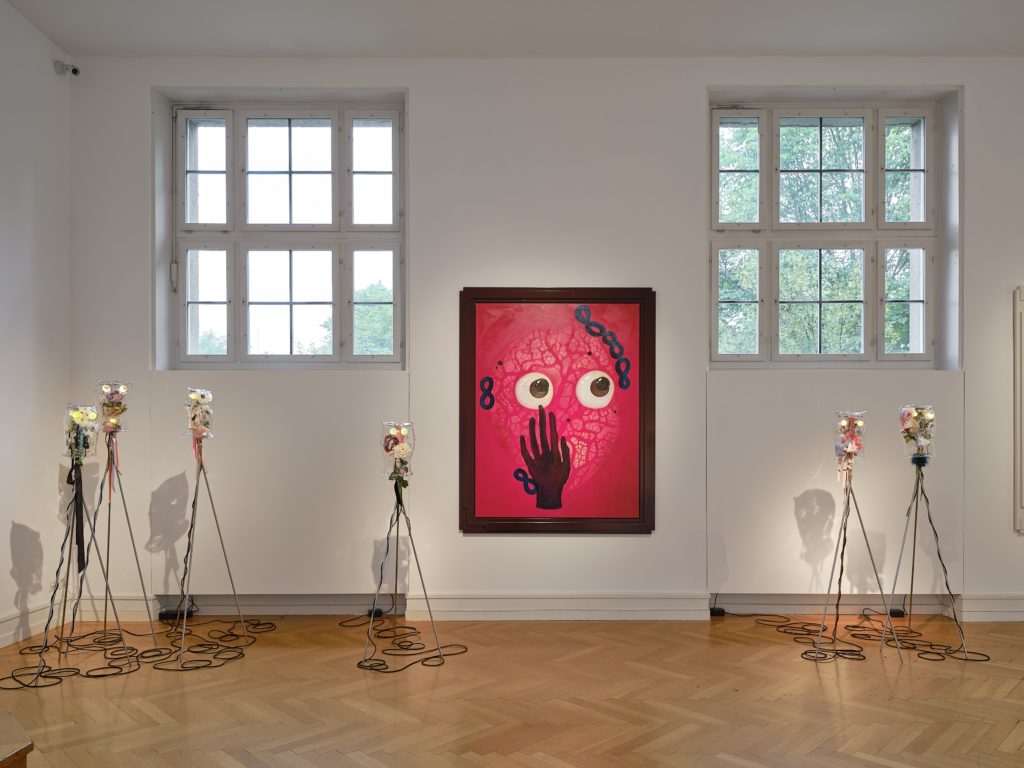
Twelve sculptures stand like mourners on steel tripods, each topped by a handblown glass cloche, one for each voice of the chorus. Inside these “galss heads,” Shani packs the debris of devotion: silk roses, pearls, doll hands, beetles, satin ribbons, tangled synthetic hair, a glass eye blooming where a rose’s heart should be. In Human Glyph For Love (2026), two acid-green glass orbs stare out over something red and fleshy, part reliquary, part prom corsage gone bad. A Pattern Recogniser (2026) is quieter: cosmos flowers, a bee, a small black mask, its title etched on the glass in gothic script like a tattoo. The kitsch does serious work and becomes the code of the exhibition. It is how grief dresses when it is denied a funeral.
Three oil paintings, Miasma: P, I and A (all 2026)act as spiritual portraits of Antigone, Polynices, and Ismene. Their faces dissolve into webs of blood-red dots. Two black eyes hold still, orange ribbons flicker like flames, glassy bubbles slide down like tears. The stained, layered frames look excavated. They might belong to a ruin from a moment that hasn’t happened yet, a potential future-ruin.
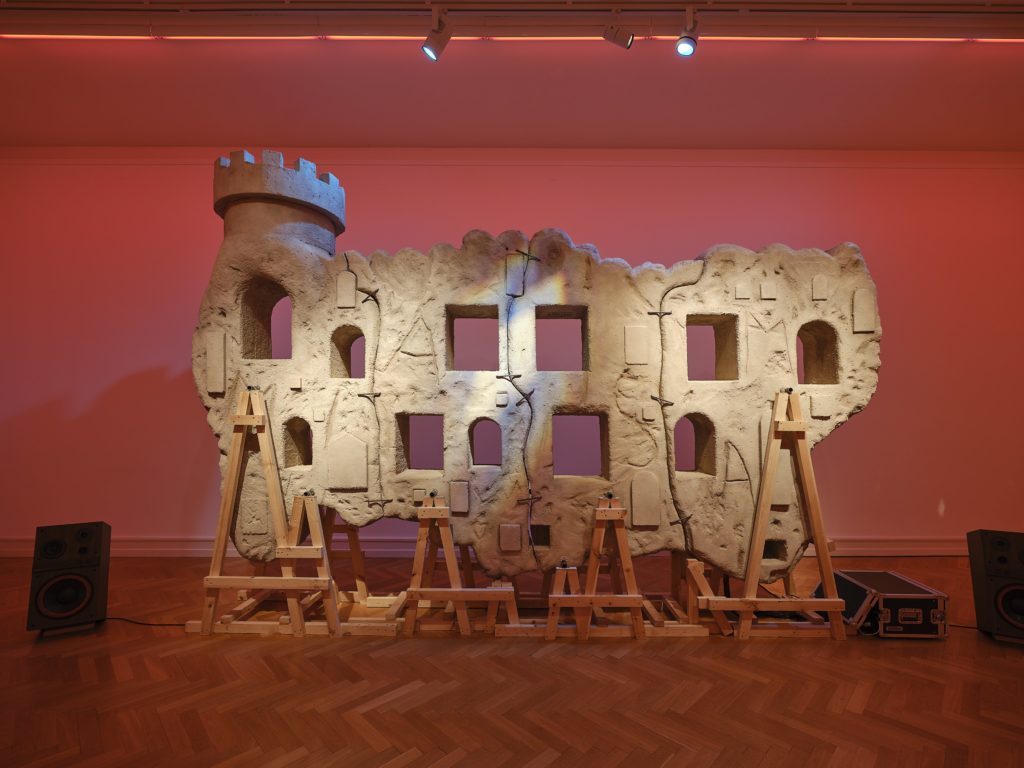
Then there is the sound installation, MIASMA (2026). A monumental wall, part ancient fortified-castle-ruin, part domestic, FYI- style façade, opens into twelve windows that release a choral work composed by Aga Ujma. The wall also sings. The pamphlet sets Sophocles’ lines against a first-person voice that fears seeing a loved one’s dead body. Other choruses travel from Thebes to the Sahel and to a demolished street in Jabaliya. The final one, “We the ghostwriters of the book of love,” closes on a single word, repeated: love.