Art Genève opened the international art fair calendar for 2026 with its 14th edition. The format remained largely unchanged, with a structure that continues to prove resilient. Eighty-one galleries participated, many operating at a solid professional level, alongside strong involvement from local and international art institutions. Special projects and off-site events extended the fair beyond Palexpo, reinforcing its role within Geneva’s cultural landscape. The presence of institutions and higher-education art schools further defines Art Genève as a platform for consolidating professional relationships and expanding networks, particularly for younger artists. This role has long been reinforced by initiatives such as the Prix Mobilière, which provides tangible visibility and support for emerging talent. This year, Cassidy Toner won the award — an artist who subtly mocks the art system from within. That the prize comes from a fair only sharpens the irony.

This positioning is reflected in the fair’s reception. Attendance was once again solid, not only during the professional preview but throughout the public days. Sales appear to have met expectations, despite ongoing global economic uncertainty. Yet numbers alone tell only part of the story. Beyond market considerations — which remain central to any art fair — Art Genève also offers an opportunity to take the measure of its overall atmosphere. The plurality of voices involved — galleries, institutions, and solo presentations — produces a composite picture that reads symptomatically rather than according to a fixed agenda.
Seen from this perspective, what emerges most clearly is an absence of risk. Many of the works on view respond to a pacified context, favoring reassuring formal choices in both color and technique. Soft chromatic palettes prevail. Painting occupies a central place, alongside a significant presence of collage, drawing, and works on paper. The resulting impression is one of careful calibration rather than bold experimentation. This tendency can be read as an implicit search for balance: a measured, restrained response to the instability of the present moment, translated into sober and cautiously articulated artistic propositions — well aligned with the fair’s human scale and its professional ecosystem.
Several galleries stood out for their measured approach. Louise & Sacks (Paris), specializing in Asian art, presented a focused solo show by Paris-based Korean artist Seungsoo Baek, in collaboration with Ditesheim & Maffei Fine Art. The works revealed a refined spatial sensibility and a delicate handling of form, unfolding through restraint rather than spectacle. A similar composure characterized the stand of Vienna’s Galerie Krobath, which brought together works by Elisa Alberti, Sebastian Koch, Julian Opie, Gerwald Rockenschaub, Simon Schubert, and Ugo Rondinone. Schubert’s striking white-on-white pieces anchored the presentation, contributing to a quiet minimalist coherence. From Busan, Lee & Bae highlighted atelierJAK (Jangyoung Jung and Andreas Geisselhardt) alongside Sangmin Lee from Seoul. Lee’s glass-based reliefs — engraved impressions on transparent surfaces subtly recalling traditional ceramics — resonated with the fair’s prevailing atmosphere of calm, muted color, and restrained materiality. At Fabian Lang (Zurich), works by Xiao Guo Hui and Sara Anstis offered complementary inflections within this overall quietude: Xiao’s fresco-like, detail-rich compositions evoke layered urban memories, while Anstis’s soft pastels open onto poetic, imagined worlds hovering at the threshold of figuration. If restraint set the dominant tone, the fair was not without moments of playful vitality.
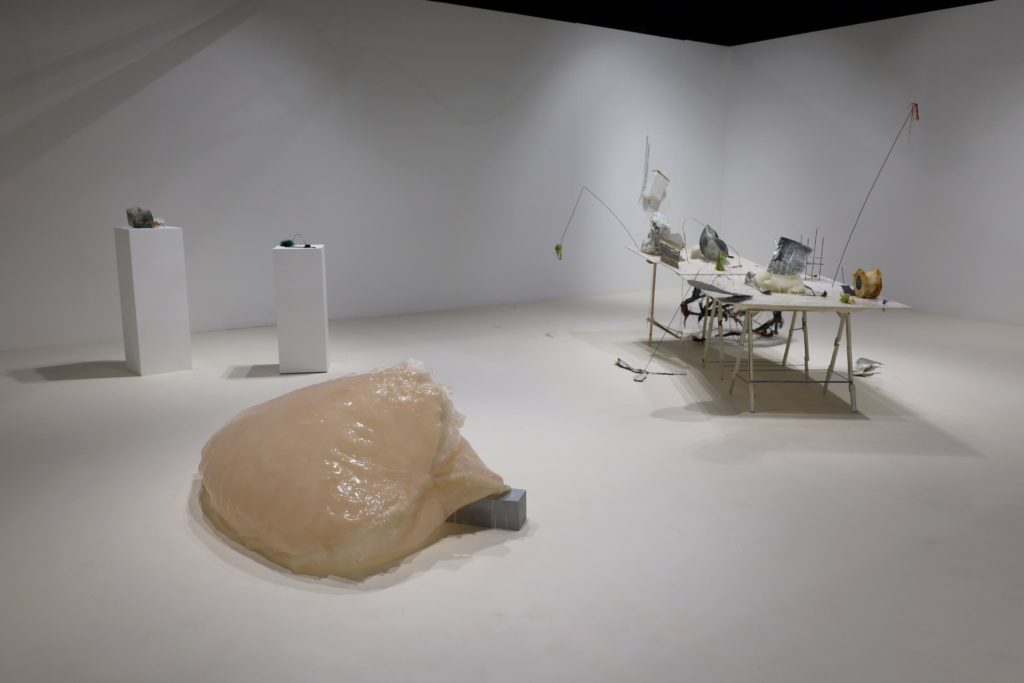
Within this measured context, Geneva-based gallery Xippas stood out with works by Marina Faust –– most notably her plush-covered stools –– presented alongside Franz West’s Garden Poof (2026) and works by Marie-José Burki. Together, they introduced touches of color, tactility, and subtle irreverence into the fair’s otherwise subdued register. Among the solo presentations, Flo Kasearu’s exhibition for Temnikova & Kasela Gallery offered one of the most incisive departures from the prevailing calm. Transforming everyday objects and infrastructural materials into poetic yet disquieting constellations, the Estonian artist mobilizes humor and absurdity as analytical tools, exposing the pressures and fragilities underpinning contemporary existence.
This heterogeneity extended beyond the gallery stands and found more explicit expression in the fair’s special projects, developed in close collaboration with local and international cultural institutions. One such project, Espressobar, presented by the Swiss Institute New York, marked the fourth iteration of a participatory installation initiated by Icelandic artist Egill Sæbjörnsson in collaboration with Theo Triantafyllidis and Polina Miliou. The project reimagines the traditional coffee bar as a hybrid social space where conversation, play, and artistic action seamlessly converge, transforming an everyday ritual into a shared, subtly surreal experience that quite literally offered the best “espresso” of the fair. A more introspective institutional approach emerged with the Fondation Antoine de Galbert, which chose not to draw from its collection but instead highlighted the work of Japanese artist Nobuko Tsuchiya, the second recipient of the Jean Chatelus residency framework. Through fragile assemblages made from humble, recycled materials, Tsuchiya creates poetic, time-shifting environments that balance material sensitivity with historical depth, privileging process, intuition, and transformation over monumentality.
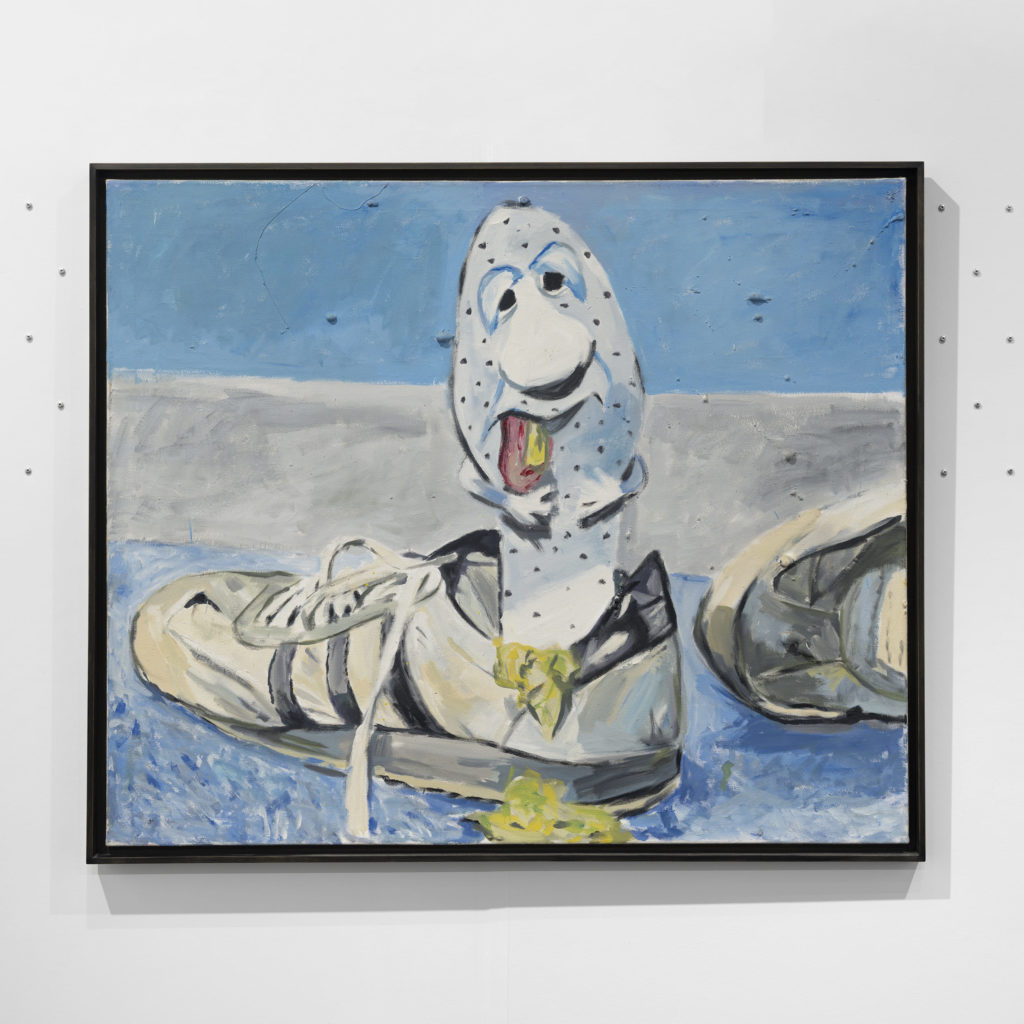
As part of Art Genève’s special projects, MAMCO’s “In Course of Acquisition,” conceived by Lionel Bovier, has become a defining feature of the fair over the past decade. The museum actively acquires works during the event, making the process transparent to the public. Many acquisitions complement existing series in the collection, such as those by Martin Kippenberger (1953–97), known for his provocative humor, institutional critique, and playful use of media. This year, the collection was further enriched by Reginald Sylvester II’s Turmoil, added through the stand that won the Prix Solo Art Genève – Piaget 2026. The prize, awarded for the best solo exhibition at the fair, directly contributes to expanding the city’s public holdings. To mark a decade of the initiative, MAMCO occupied two stands: one showcasing works in acquisition and a second offering a glimpse into its broader collection, emphasizing the museum’s dual role as both a collector and public platform.
Running alongside the fair since 2013, Art Genève / Musique extends the event beyond the exhibition halls, establishing a dynamic dialogue between interior and exterior spaces. This year, in collaboration with MAMCO, the lineup featured Monica Bonvicini’s Before Demolition, restaged with curators Augustin Maurs and Catherine Othenin-Girard at the church of La Servette, a building slated for demolition to make way for new housing. Set within this temporary architecture, the performance — centered on the sharp, rhythmic cracking of leather belts — took on added intensity, unfolding as a brief occupation of a space already marked by its impending disappearance. The evening continued with works by Alicia Frankovich and the duo Hanne Lippard & Renato Grieco, further expanding the initiative’s exploration of sound and collective presence.
It is worth considering the events that took place alongside Art Genève, outside its official program. Initiatives organized by local institutions in parallel with the fair underline one of its often-cited strengths: a scale that remains manageable, allowing viewers to look beyond the halls without the familiar fear of missing out. This outward movement takes on particular significance at a moment of transition for Geneva’s institutions. For more than a year, MAMCO and the Centre d’Art Contemporain have been operating in a nomadic phase, following the closure of their shared building for renovation. This condition, rather than constituting a mere pause, appears to offer an opportunity to rethink their public role, interrogating formats, timing, and modes of presence. While MAMCO is set to announce its forthcoming activities, the Centre has already made its schedule public, presenting a series of projects unfolding across multiple sites, both locally and internationally –– including collaborations with MAXXI in Italy and the Kamel Lazaar Foundation in Tunisia.
During the fair, the Centre inaugurated Arcade, a new operational base in Geneva conceived as a temporary hub for events and initiatives. The space opened with “Anti-Nymphs,” a cycle curated by Giovanna Zapperi and inaugurated by Josèfa Ntjam’s performance A Constellation of Blackness. The cycle explores the nymph as a liminal, unstable figure, stripping it of normative constructions of femininity and restoring its Greco-Roman ambiguity. Bringing together performances, conversations, and screenings, it reactivates a critical space for reflection on the feminine. It is reassuring that the cycle is led by Giovanna Zapperi, full professor at the University of Geneva, whose expertise ensures a grounded framework. At a moment when feminist discourse in art risks being instrumentalized or reduced to slogans, “Anti-Nymphs” offers a welcome sigh of relief –– not for the answers it provides, but for reopening a space in which the question of the feminine can be approached with complexity, ambivalence, and nuance. A project to keep an eye on.
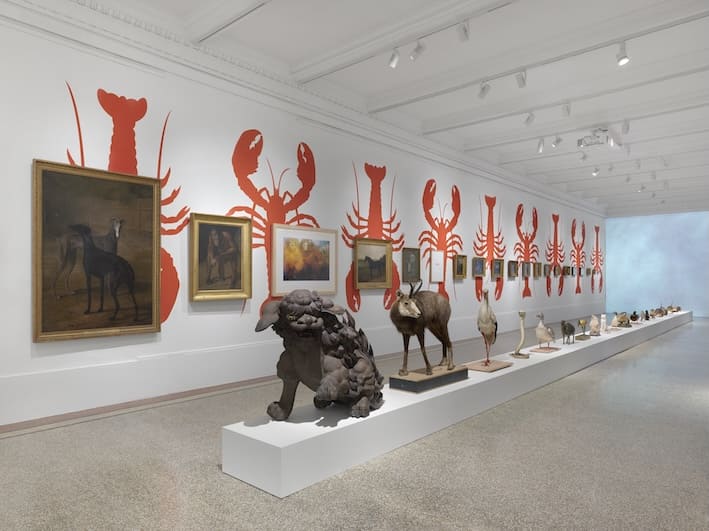
The MAH entrusted John M. Armleder with a carte blanche project, Observatoires, inviting the artist to intervene within the museum’s permanent collections. Rather than imposing an external narrative, Armleder activates dialogues between his own works, long held by MAH, and pieces by artists such as Verena Loewensberg, Imi Knoebel, and Arman, tracing a lineage from Duchamp’s readymades through Concrete art and Fluxus. The exhibition enacts a subtle process of defamiliarization, gently displacing MAH’s identity as a museum of Swiss art and history and prompting a recalibration of how objects are seen in relation to one another and to the space they inhabit. The risks inherent in such an open-ended format –– overstatement, visual saturation, even a form of institutional horror vacui –– are deftly avoided. A seasoned practitioner of semantic leaps and playful shifts in meaning, Armleder orchestrates the exhibition with a careful sense of rhythm. The resulting pauses allow the exhibition to breathe, engaging the viewer in a dialogue that remains playful without tipping into mockery.
Under Charlotte Diwan’s direction, Art Genève has preserved a format that already works, while reinforcing its defining qualities: balance, coherence, and tangible engagement from institutions and art professionals. The fair succeeds at a near-impossible task –– holding together different audiences and expectations –– remaining legible and consistent without diluting its standards. Art Basel, just a few hours away, inevitably comes to mind, yet the parallel is ultimately misleading. The two fairs differ markedly in scale and ambition, and it is difficult to position Art Genève in direct competition with its Basel counterpart. If anything, the contrast helps to clarify Geneva’s identity: a fair of human scale, navigable without excessive investment of time or energy, offering both professionals and visitors a measured, coherent, and satisfying experience.