In the taxonomy of science fiction, the “Big Dumb Object” is a term of art. Coined by Peter Nicholls in The Encyclopedia of Science Fiction in 1993 with affectionate derision, it refers to those unfathomable monoliths – Kubrick’s obsidian sarsen in 2001: A Space Odyssey, Dan Simmons’s Time Tombs in Hyperion, Stephen King’s eponymous structure in Under the Dome – that dominate both the diegetic horizon and the moral imagination of the genre. They arrive without explanation, resist interpretation, and yet exert a gravitational pull on their encountered observers.
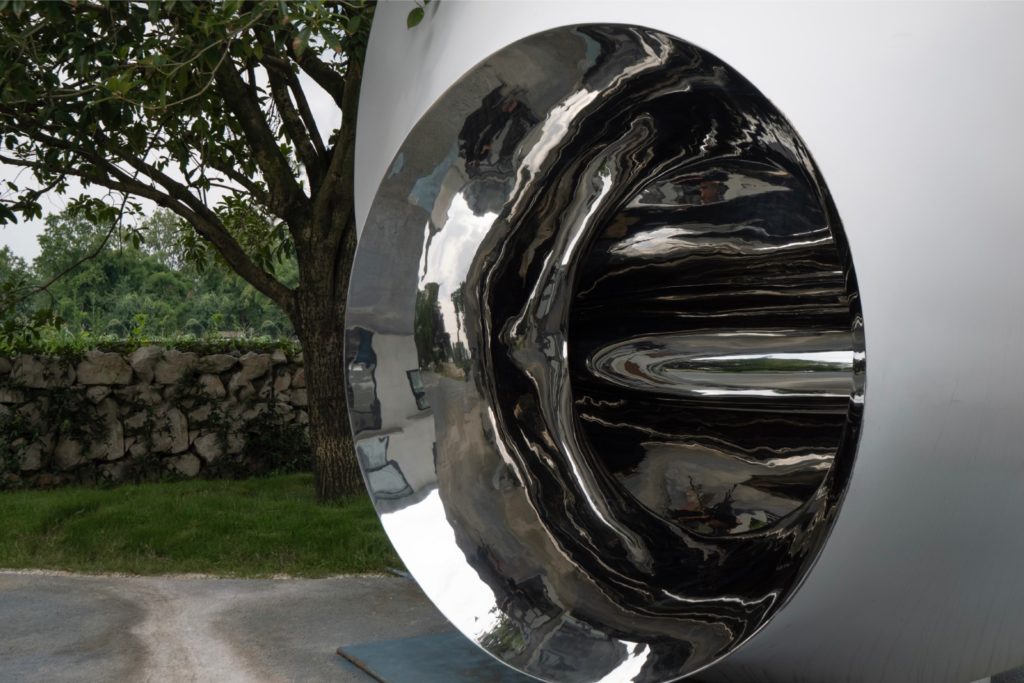
In BDO (2024), artist Xiao Deng stages her own terrestrial entry into this tradition. Installed outdoors, the sculpture – a slow-turning mirrored ellipsoid nested inside a concave, planet-like shell – refracts the viewer and their environment into an endless loop of warped reflections. As Nicholls notes, BDOs “function not only as narrative devices but also as metaphors for the limits of human comprehension in the face of the sublime.” The piece both frames and shelters the mirrored core, creating a microcosm in which every reflection is both familiar and estranged.
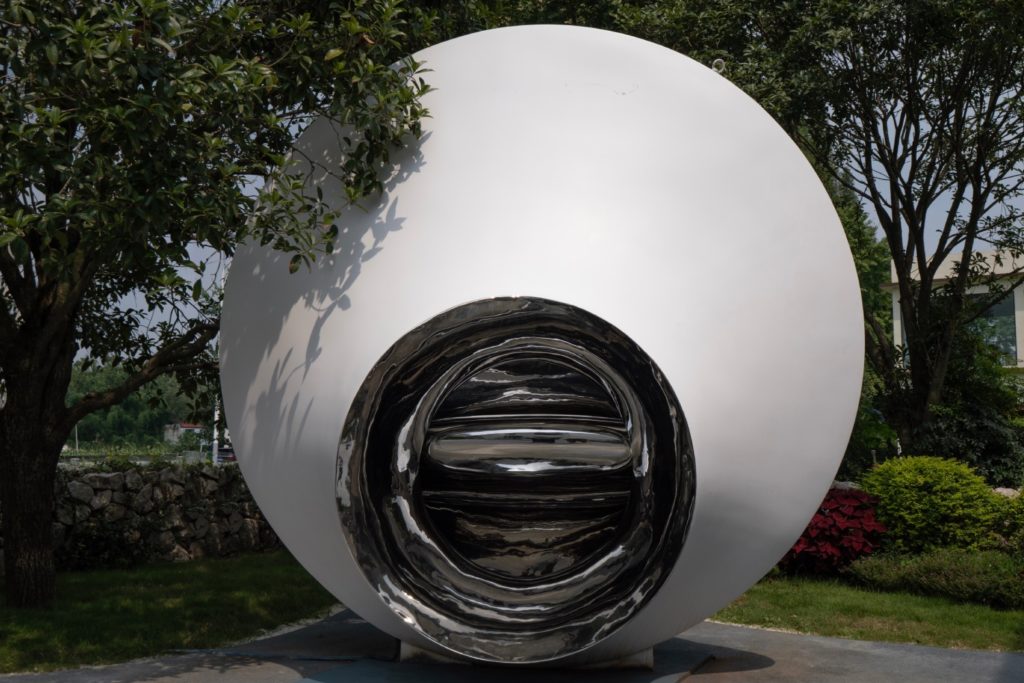
The Big Dumb Object becomes a paradox: at once an instrument of infinite reflection and a barrier to full apprehension. Its rotation forces the viewer into a durational encounter with both themselves and the work, collapsing the distinction between observer and observed, presence and image. BDO condenses the vast, speculative charge of science fiction into a tangible, navigable encounter by confronting its audience with the same unyielding opacity as its fictional predecessors. Like Clarke’s monolith or Simmons’s Time Tombs, it refuses sublimation, forcing the viewer to map meaning onto a form that remains resolutely Other even as it reflects the Self back in endless, shifting fragments.
This ambivalence is key to Deng’s broader practice. Trained at Central Saint Martins and a longstanding member of China’s International Kinetic Art Organization, her work has often sought to problematise the interface between object and viewer, especially in civic space. Public art, as noted by Frazer Ward, is a “is a temporal event or act” in that it requires its audience to exert their own communicative function. In this sense, BDO is not a standalone experiment but part of an evolving lexicon: from the Mobile Bamboo Pavilion at the Venice Architecture Biennale to the world’s largest kinetic sculpture at Shenzhen Railway Station, Deng’s practice commits to embedding sculptural and kinetic forms in lived environments, structures that alter their surroundings as much as they are altered by them.
In this disorientation lies the philosophical core of BDO, an object that stages the sublimity of space as a terrestrial echo of science fiction’s most pressing preoccupation: how do we reconcile our desire to see without being seen?
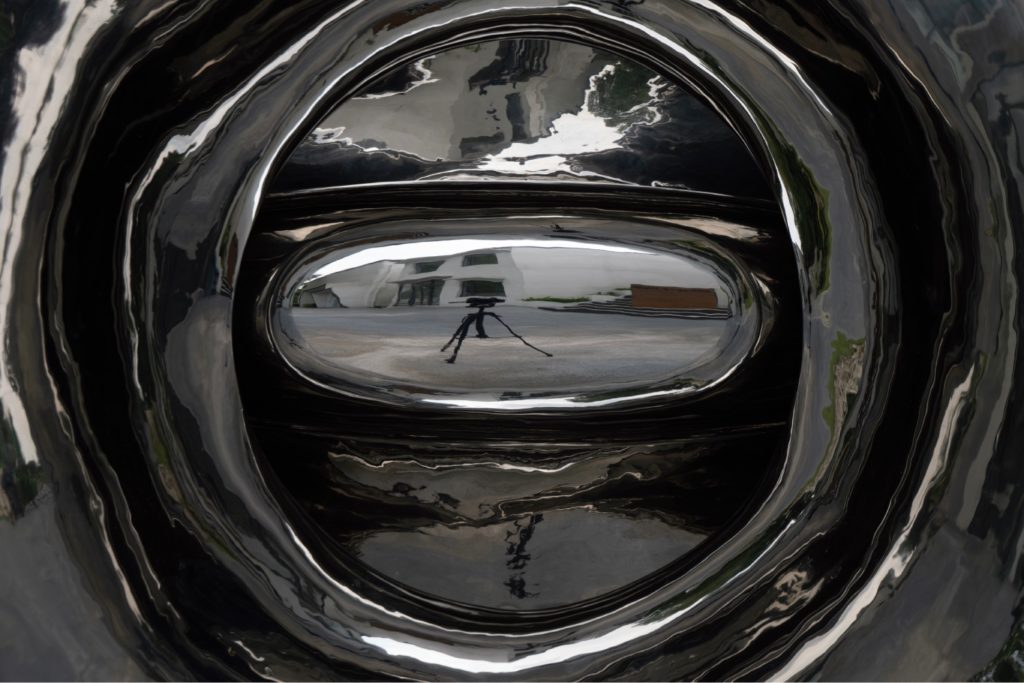
“BDO – Big Dumb Object”, Xiao Deng, 2024. Courtesy of the artist.