In his latest solo exhibition at David Zwirner’s gallery in London, American painter Louis Fratino showcases a grounded, luminous vision of contemporary queer life. Titled “Prose,” the exhibition marks a distinct shift in figurative painting within a gallery landscape increasingly willing to examine, in depth, the structural and systemic norms that give everyday queer life its depth and nuance. Where previous generations of queer figurative artists leaned on grand allegories, tragic subtexts, or mythic heroics — drawing upon the legacies of those lost to us in the fire and fury of the AIDS crisis — Fratino focuses on the ordinariness of the present; in doing so, he helps anchor a movement that can best be described as New Gay Realism.
For decades now, gay representational art has faced a persistent pressure to perform. Since the darkest hours of the twentieth century, the mainstreaming of queer life has too often been co-opted, with representation frequently operating under the shadow of crisis and loss, reaching toward idealized visions to justify its depictions of desire. New Gay Realism — a contemplative aesthetic that focuses on the quotidian, earnest, and tactile sincerities of queer storytelling — abandons defensive postures, yet retains its political force by foregrounding the overlooked gestures of everyday life. Defined not by hyper-stylized fantasy or historical trauma, it commits to something equally as brutal: the domestic, social, and unvarnished day-to-day. Crucially, the term “realism” here refers specifically not to photorealistic technique but to a narrative attitude and emotional tone. It is informed by identity without being restricted by the demand that identity become its single driving force. As such, Fratino’s language, or prose, remains deeply modern, pulling along the thread of Picasso, Léger, and the Post-Impressionists; it treats queer life as a lived reality worthy of an honest, plain record.
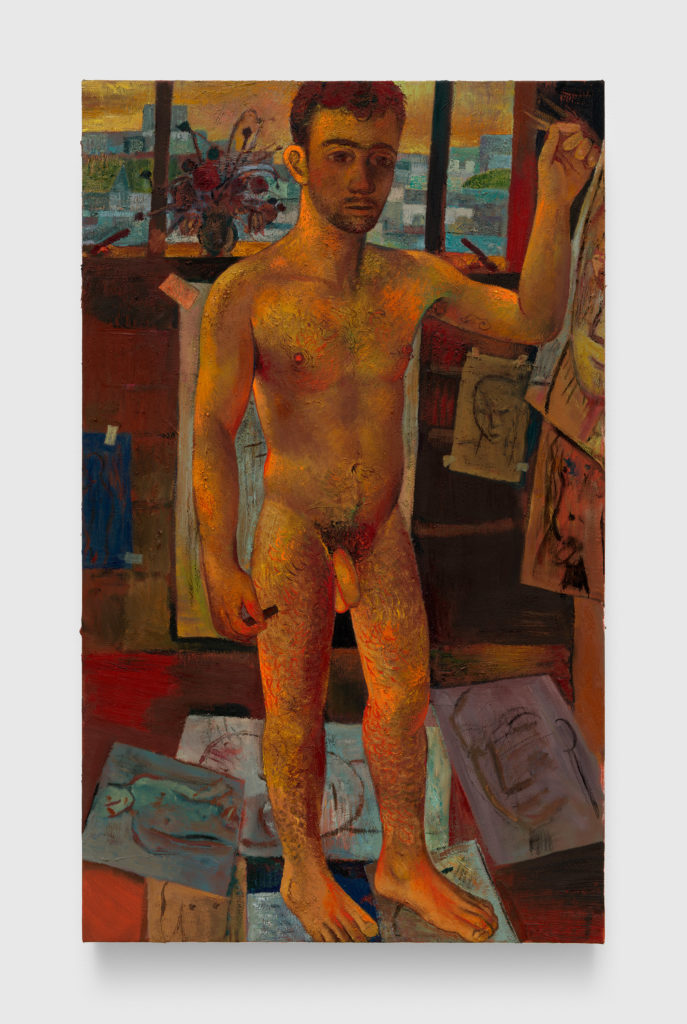
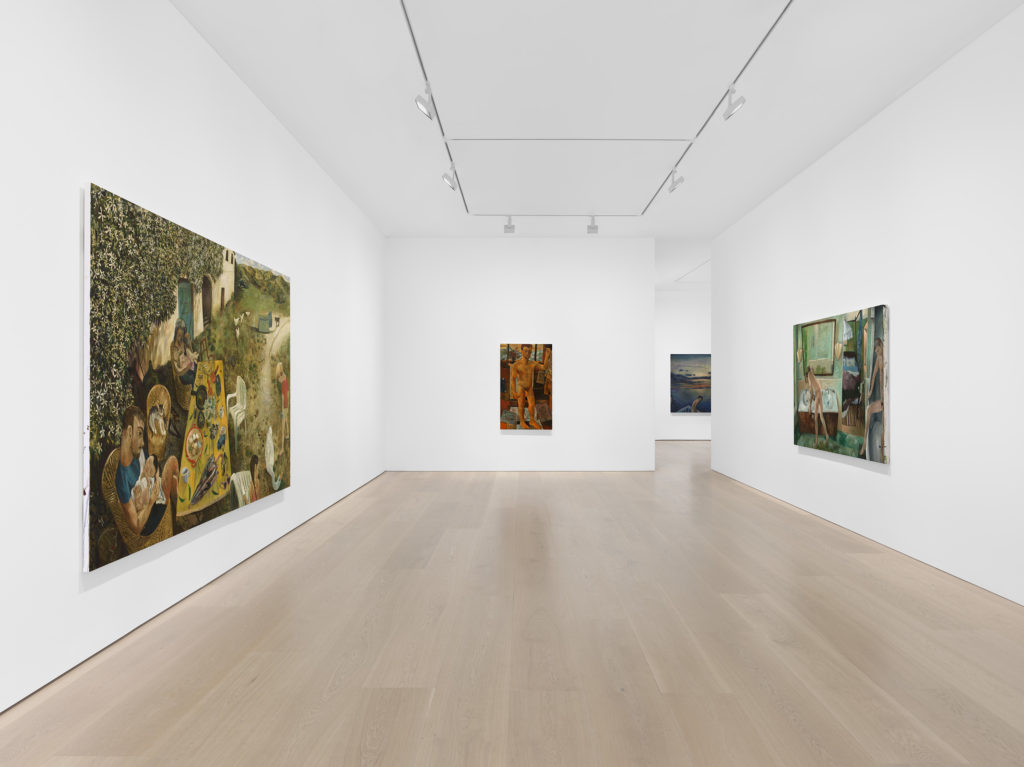
Walking through Fratino’s “Prose,” I can’t help but think that the exhibition serves as a manifesto for this painterly sensibility. The exhibition’s title points directly to its guiding philosophy: these works are not elevated, high-flown, fanciful verse, but something steadier –– a contemplative sentence that ebbs and flows with daily existence. What distinguishes Fratino’s execution though is his tactile, almost topographical approach to paint. His canvases feature dry, chalky impasto alongside cross-hatched, scratched surfaces, their textures lacerated like the groves of skin, with body hair etched into pigment and applied as delicate, drawn upon squiggles. This process extends through the still-life paintings too. Snowdrops and hellebores (2026) and Apples and pears (2026) ground the show in a temporary decay. Flowers emerging from withered beds and fruit ripening in a bowl serve as understudies to the body; a formal focus on texture marks time’s passage alongside human companionship.
In public scenes like Coffee (2026), a vibrant swirl of colors details the slippages between patrons entangled in conversation, solitude, and work within the familiar bustle of a café. The sauna (2026) captures a similar collective image of men slumping across wooden benches under warm overhead lighting. The physical proximity and shared nudity are presented with a striking lack of sensationalism –– erotic in their tension, perhaps, but I read them as part of the city’s communal rhythm: an opportunity to congregate and experience our identities proliferating in the commons, even if we inhabit the solitude of our own minds and bodies. In The subway car (2026), a fleeting physical closeness occurs between strangers sharing the same vessel, if not the same mode of thinking or being. The work captures the urban intimacy in which we so often find our bodies, nearer others without theatricality. A certain non-identification of identity — how it can be both a hyper-visible marker or a place for discrete, private arrivals across varying metropolitan groupings — nestles into the formal logic of the collection. I admire the tension: how our identities appear most striking and bold when entangled within our community, yet so quickly merge into the collective when met with the gracious mutability of shared public space.
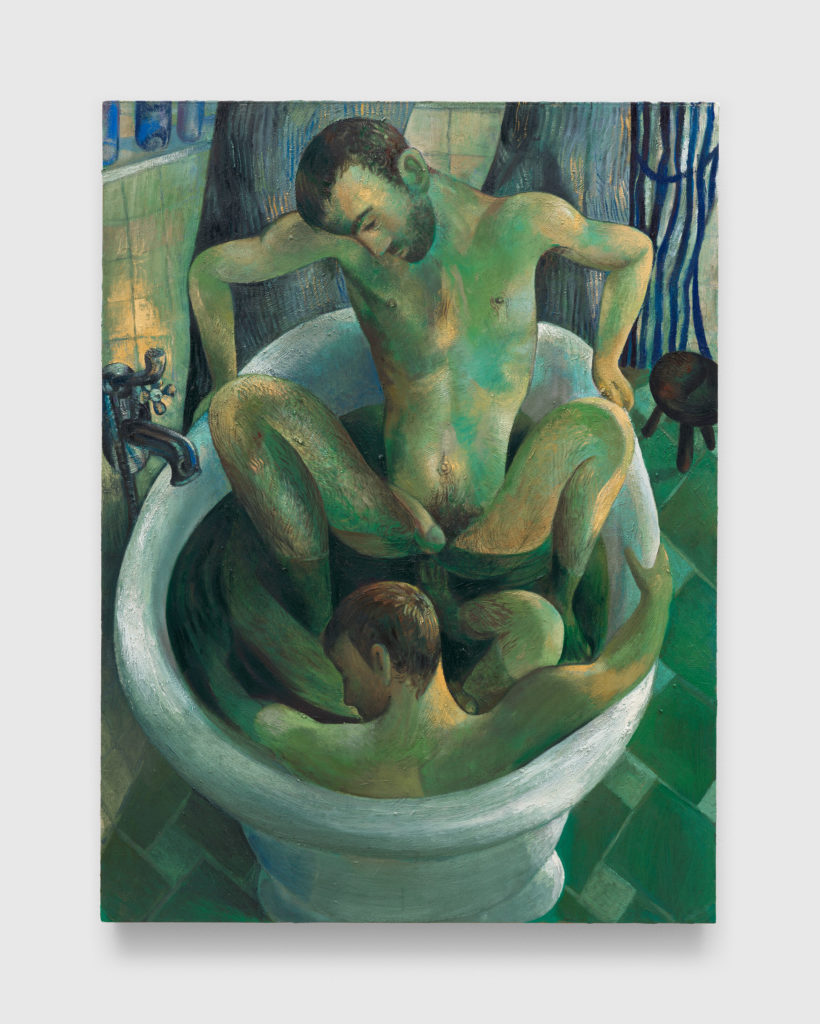
Even in domestic settings, Fratino’s depiction of intimacy finds unpretentious gravity. In the stunning The green bath (2026), sensuality emerges through two figures bathing together, while the eponymous composition Prose (2026) shows two nude figures tumbling across a vibrant orange throw as perspective, pattern, and color overlay one another to capture what Lauren Berlant has described as “the collaborative risk of a shared disorganization.”[1] They write, “Sex forces us to desire to become disorganized […] Being overwhelmed is exciting, except when it’s exhausting.” Rather than offering a sleek, performative spectacle of passion, Fratino mirrors the physical and subjective disorientation of sex — its awkwardness, clutter, and unscripted closeness — as they take shape in the ordinary, without phallic primacy or dramaturgical falsity. While some critics have dismissed these interiors as bourgeois, bordering on “cozy” or expressing a certain middle-class sentimentality, I find Fratino’s raw, scraped material surfaces prevent the works from so simply sliding into such casual nostalgia.
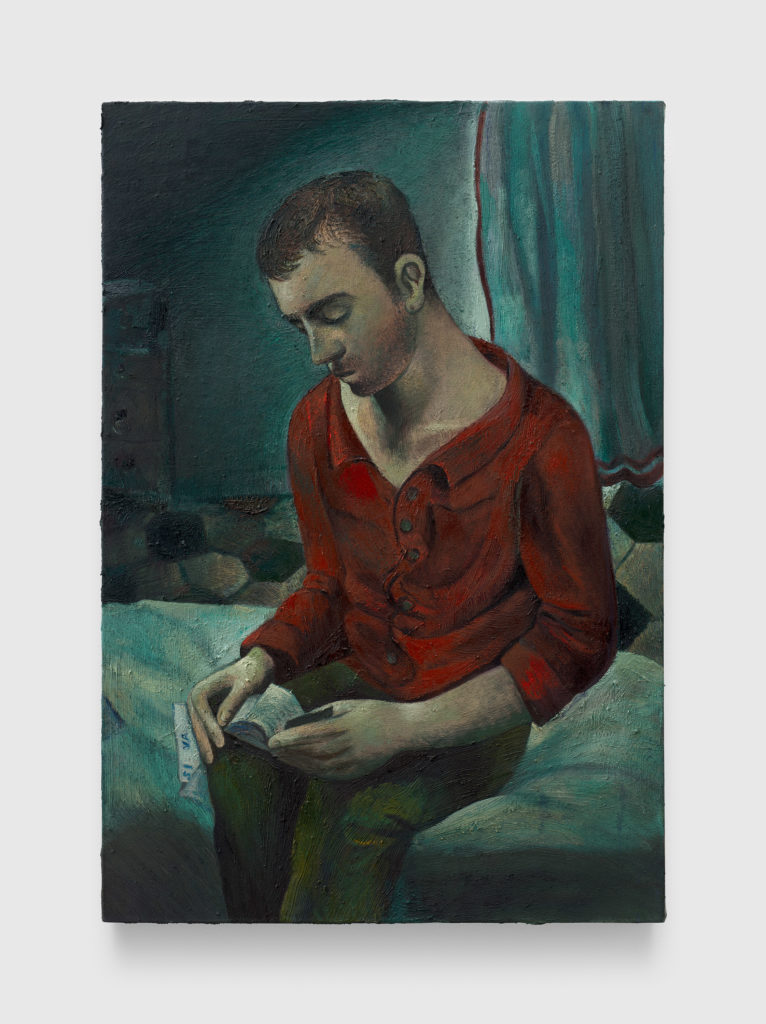
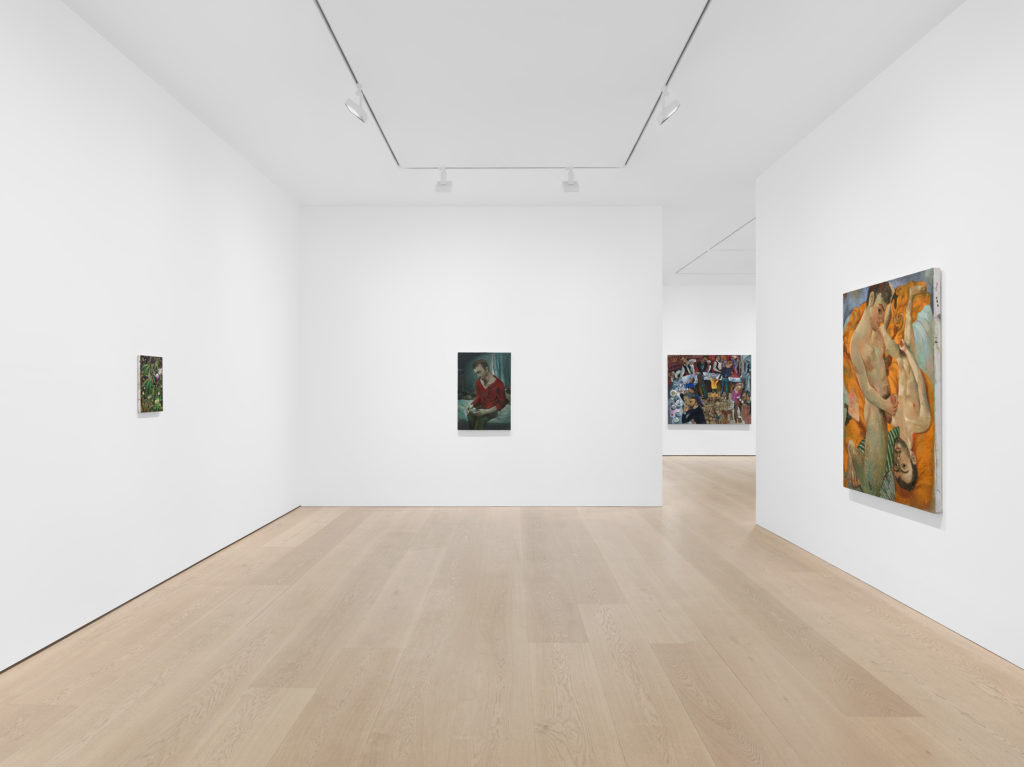
Furthermore, this realism doesn’t reject art history, but reframes it. Fratino cites his influences directly, bringing together nineteenth-century French landscape traditions with modern portraiture. In Ale in his mom’s bedroom (after Corot) (2026), a sitter rests in a cool, blue-green light wearing a rich red shirt and adopting a posture that nods to Jean-Baptiste-Camille Corot’s A Girl Reading (ca. 1845–50) while remaining thoroughly modern. Meanwhile, Self-portrait in studio (after F. N. Souza) (2026) turns a critical eye toward the artist’s own role within the lineage of figurative painting.
Rather than offering a conceptual revolution, Fratino’s exhibition at David Zwirner suggests that the potency of contemporary queer figurative painting may now lie in something far quieter: an attentive, material act of recording. Yet, I do think “Prose” avoids becoming merely a passive exercise in memories of the domestic or historical citation. By placing quotidian queer life alongside an explicit, modernist borrowing from the canon, Fratino insists that these personal histories are neither fragile subcultures to be defended nor decorative commodities to be consumed; or worse yet, subsumed by that which has come before it. Instead, the gestures in “Prose” prove that what occurs everywhere, what is commonplace, when observed with rigorous formal devotion, holds more than enough weight to sustain a vital, evolving grammar for modern painting.
[1] Lauren Berlant, “Starved,” in After Sex?: On Writing since Queer Theory, ed. Janet Halley and Andrew Parker (Durham, NC: Duke University Press, 2011).