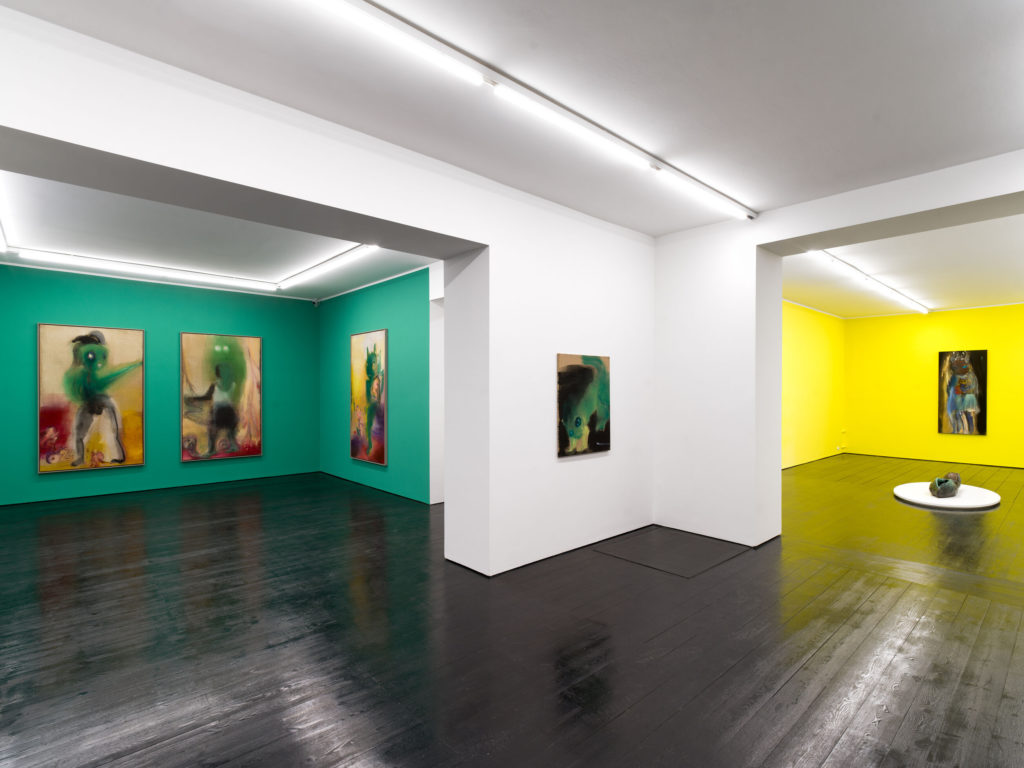
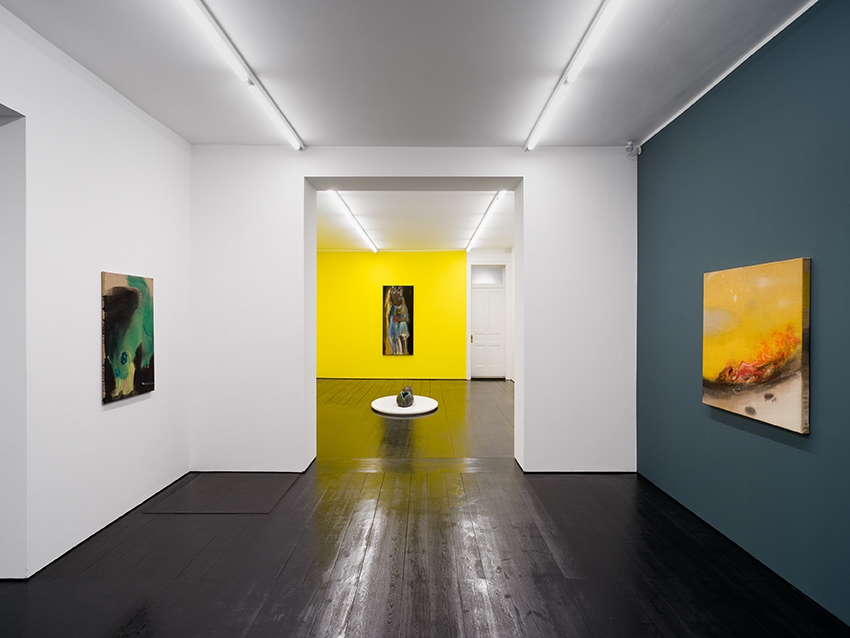
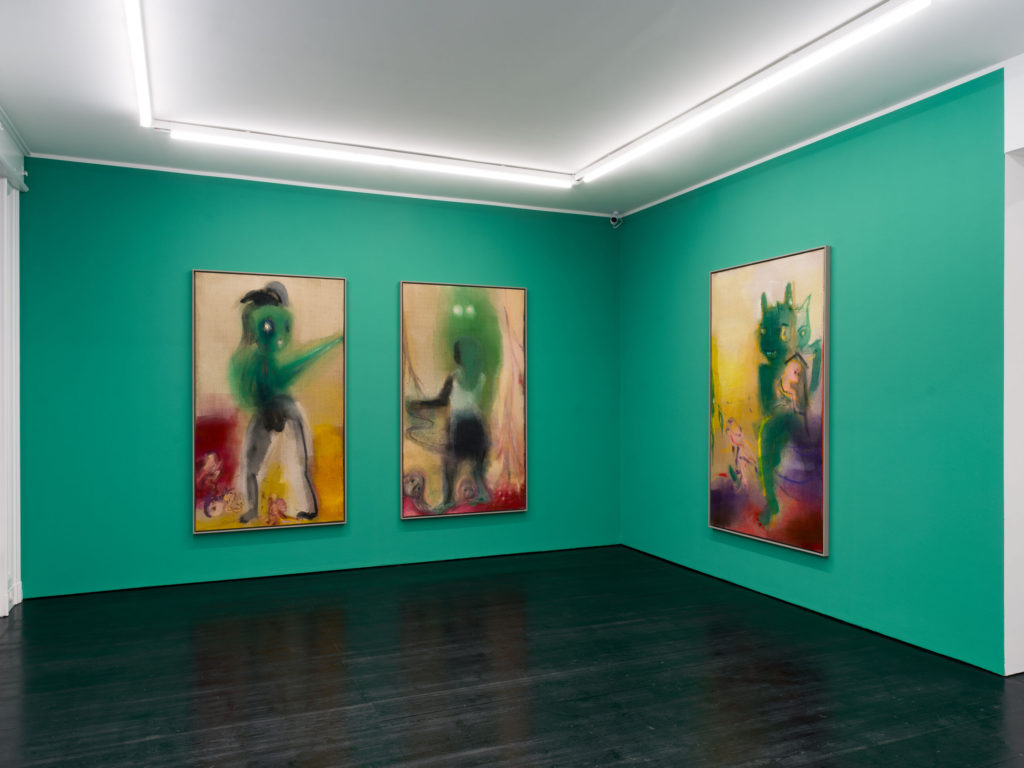
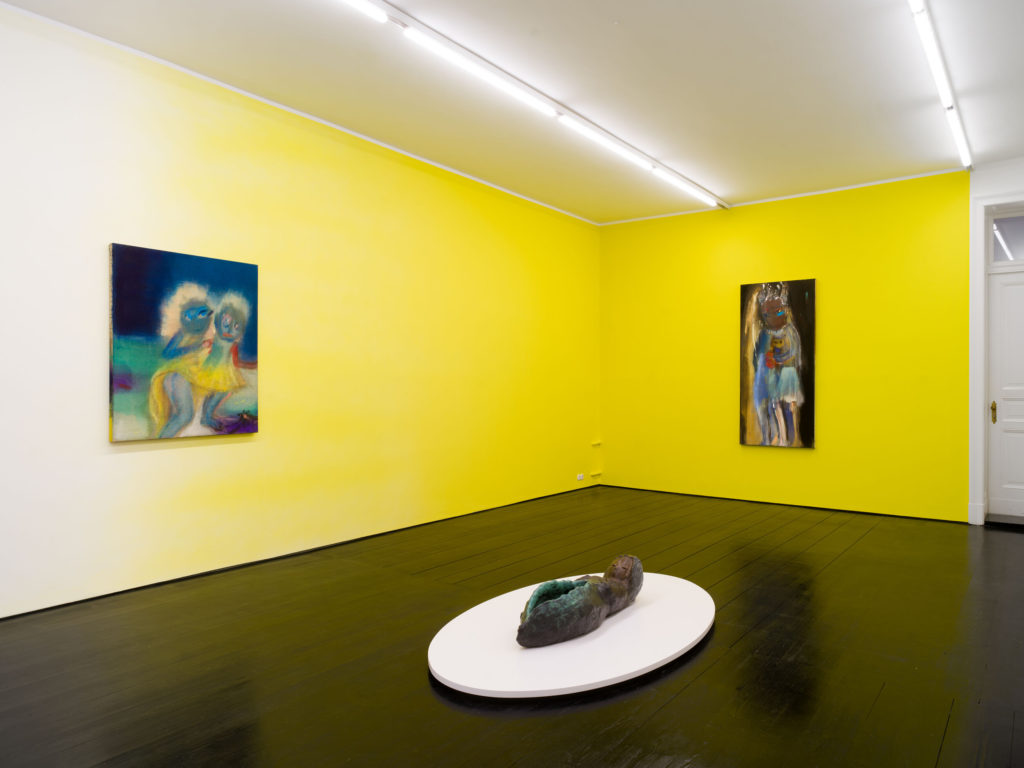
Leiko Ikemura’s exhibition “de sensu” promises a direct, sensual contact with the world, and it is as immersive as a painting show could be. Contemporary Fine Arts, the gallery in Berlin’s west, has had its walls painted according to specifications by the artist, foregoing the white cube setup: a vibrant sage green complements the green in three paintings near the entrance of the ground-floor space; a white-to-yellow gradient contrasts with a canvas on which blue dominates.
However, this is not a formalist exercise. Ikemura’s paintings are figurative, and they draw on her repertoire of recurring characters. The artist, born in 1951, also works as a sculptor and a ceramicist. She was born in a small town in Japan and moved to Spain in 1973. In Andalusia, she found an art world in churches; figurative painting and sculpture were embedded in lived experience. Ikemura learned to paint in egg tempera and witnessed the end of the Franco dictatorship while in Seville. Francisco Goya must have made an impression on her, and she would later directly quote the Spanish painter’s Saturn Devouring His Son (1820–23) in a work with the tongue-in-cheek title Goyesca (2015). Goya’s fearful god looks more like a wanton child, nibbling on a doll. After a period in Zurich and a year in the Swiss mountains, in the mid-1980s, she relocated to the male-dominated art world of Cologne, where she was lumped in with the neo-expressionists of the Junge Wilde group. One triptych from that era, Yokai Night (1985), suggests an interest in flatness, brushstroke, and modernism, while already featuring the masked figures that would inhabit her later paintings. She eventually moved to Berlin, where she still lives and works.
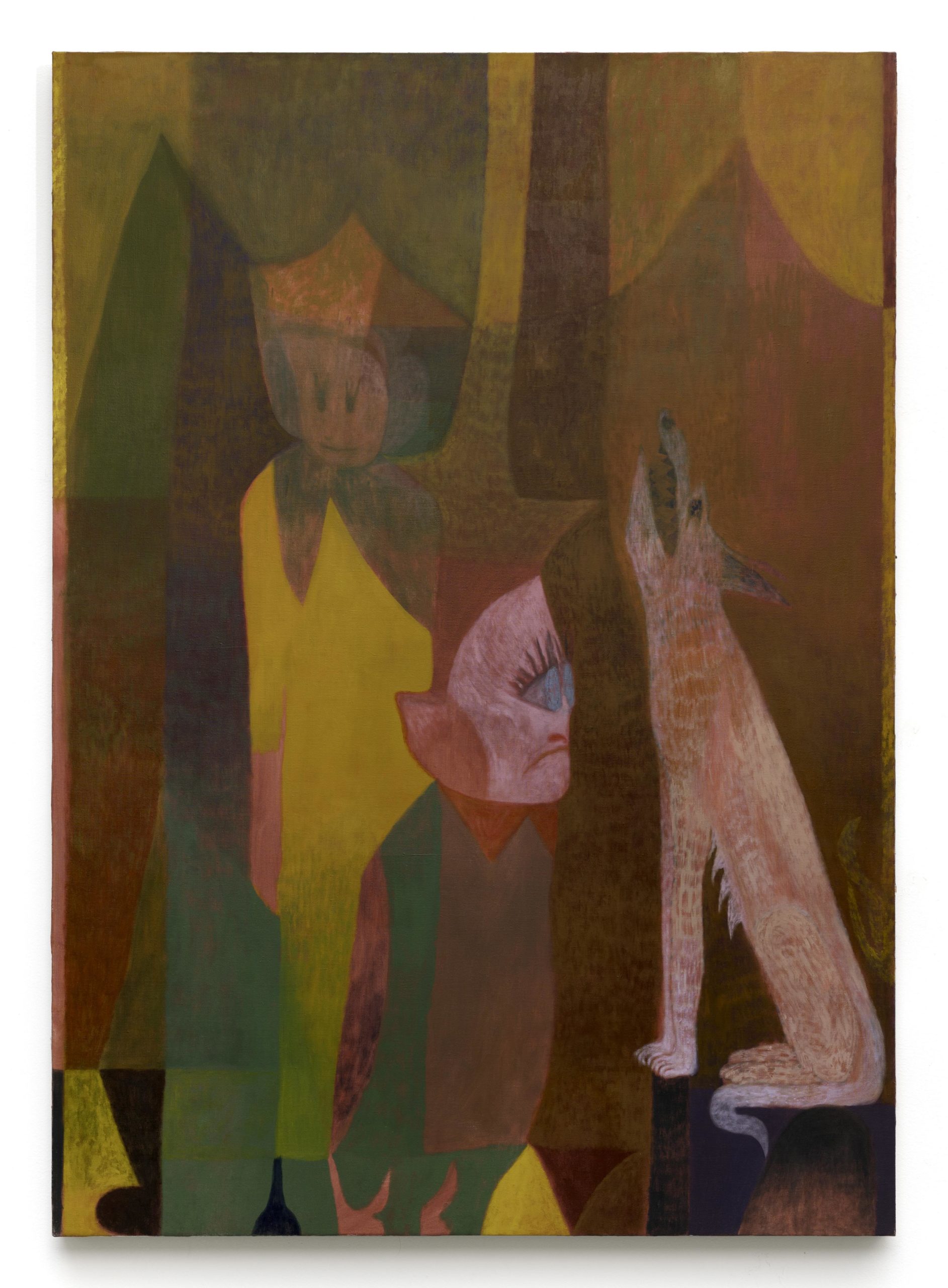
Like distant echoes, these waypoints resonate throughout Ikemura’s very recent works, which are the focus in Berlin. But unlike her mid-1980s paintings, they appear softer. Take the triptych comprising Green Baby, Dear Spirit, and Green Mom (all 2025), painted on coarse jute. The paint dispersed as soon as the brush hit the canvas, granting the works the lightness of watercolor and defying contour, figuration, and somehow also gesture, creating an effect not unlike Helen Frankenthaler pouring paint onto a flat canvas. Perhaps the green figure in the first painting is striking a defiant dance pose; in the second, a head dissolves into a ghostly, googly-eyed shape, and in the last, a figure holds an embryonic homunculus, while grinning mischievously. In all of them, small figures scurry around the bottom of the frame like friendly ghosts. Goya’s monsters, which the sleep of reason produced, are domesticated.
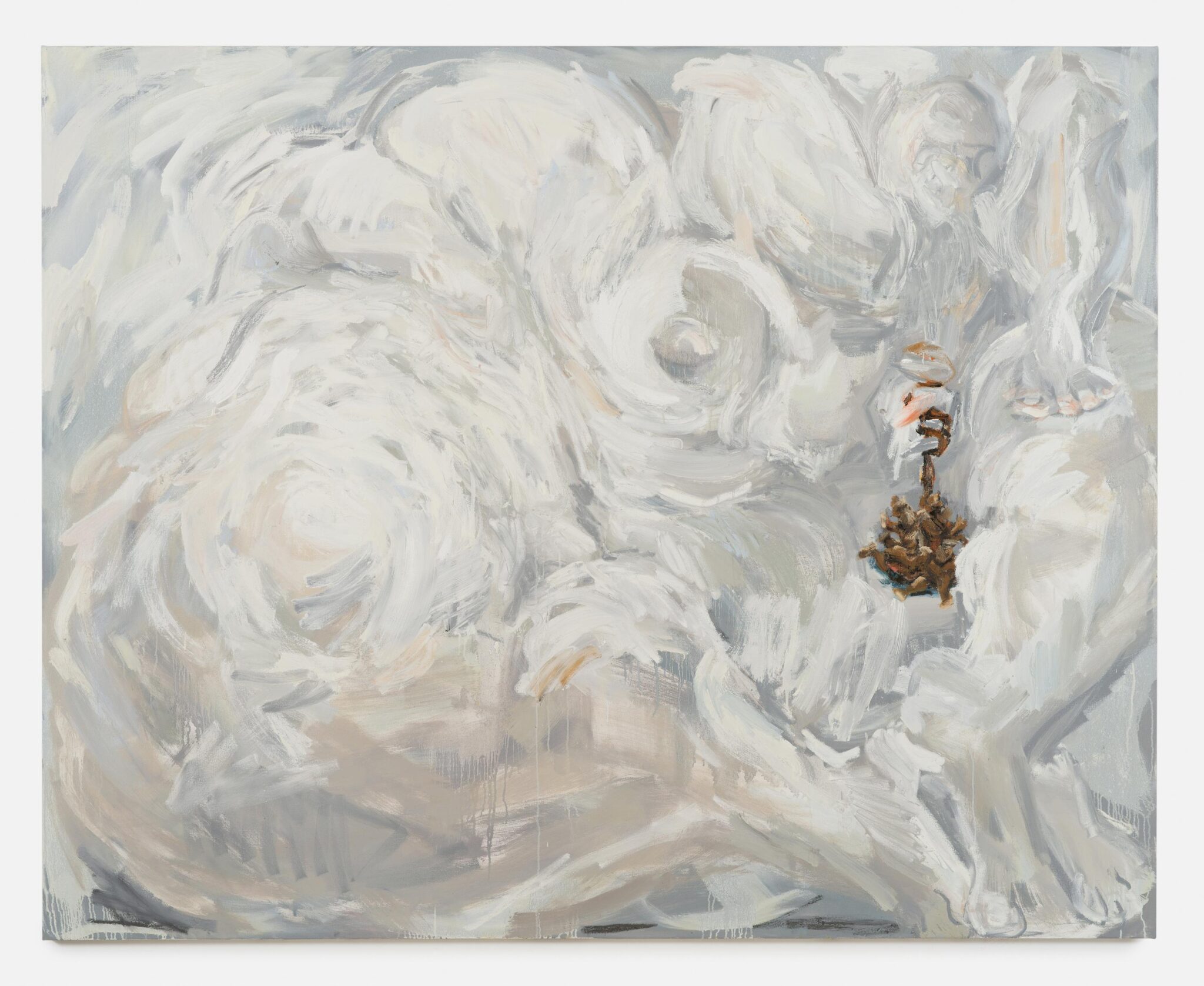
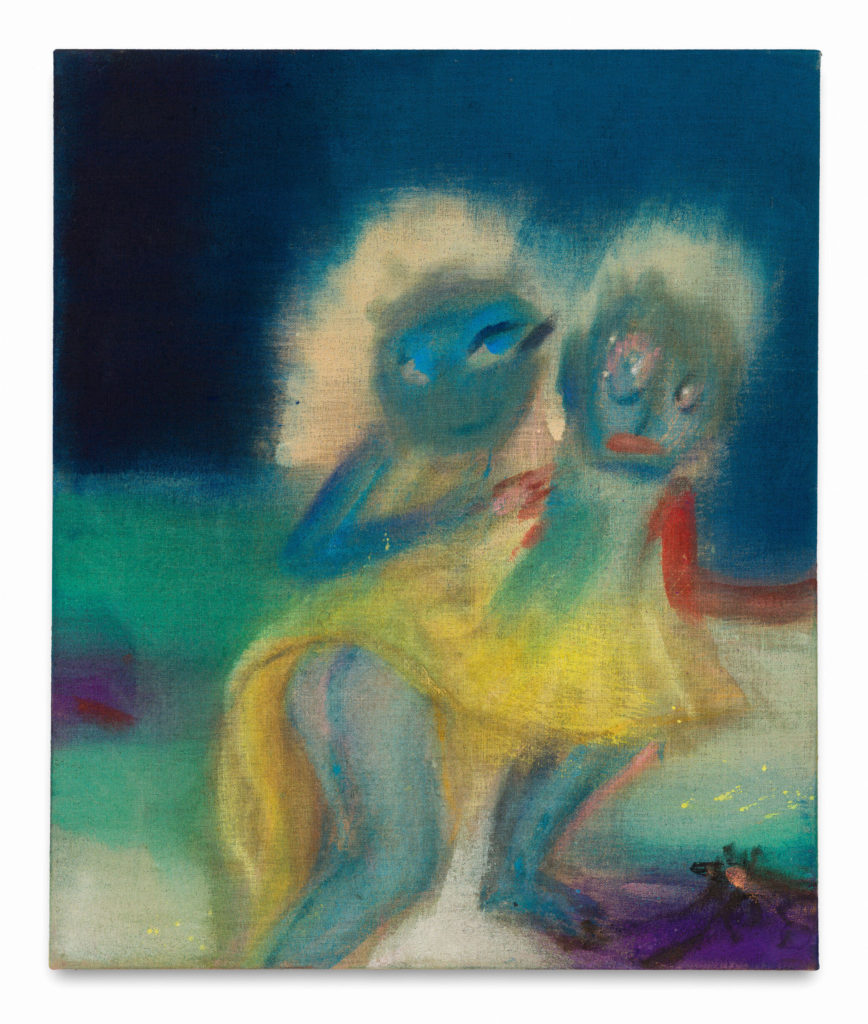
Others, in landscape format, seem like hyper-detailed blobs on their surfaces when viewed from afar, but they consist of paint splatters on softly rendered backgrounds in warm hues of orange. The contrast between sharp splatters and hazy ground creates a fever-dream-like realism, while really, painting itself is depicted. The work sisters (2025) — set against the white-to-yellow gradient — features figures again, two blue ones in a tender scene of care. The whimsy of it all may recall other painters, but Ikemura’s technique is unmistakably her own. The painting at the back of the gallery, mamagirl (2025), looks like a throwback to Ikemura’s earlier work. The brushwork is expressive; the dark background makes it stark, creating something of a synthesis between expressive gesture and the languid tenderness of her other paintings.
Motherhood is a recurring theme in Ikemura’s work. Her first solo exhibition at Contemporary Fine Arts, in 2024, was titled “Momstars,” a portmanteau of “mom” and “monster,” and possibly an allusion to the fantastical figures in her paintings. In Ikemura’s work, however, figuration always hints at the monstrous, which then easily morphs into the cute.
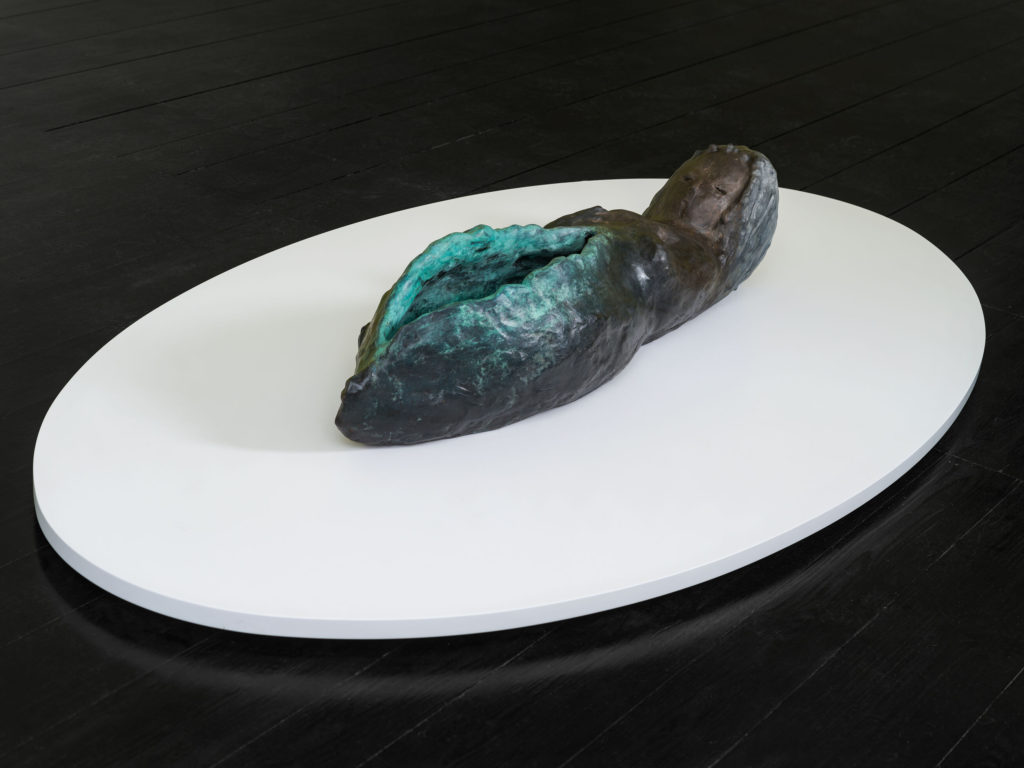
Reviewers of her work often remark that Ikemura has no children of her own, while motherhood is a trope that stands in for transformation. Her 2025 solo show at the Albertina in Vienna, “Motherscapes,” was populated with hybrid figures, among them the Madonna-like Usagi Kannon Janus (340), a tall female figure with the ears of a hare and an empty, perforated cloak, open at the front. Its inside looks like a starry sky — or as if it contained the cosmos. In “de sensu,” there is only one sculpture, placed on a low, almond-shaped pedestal. The patinated bronze is variegated and complex. In the harsh light, it recalls glazed ceramics. The larva-like figure, eyes closed, seems to gaze inward; its lower half is burst open. The vagina-like gash reveals not the cosmos, but it allows emptiness to flow inside.