Vienna’s street grid is voiced by its traffic lights. To help blind and visually impaired pedestrians orient themselves and cross safely, the networked system emits acoustic signals in patterned sequences: Tock… tock… tock…, tik-tik-tik-tik-tik!, tac-tac-tac… Amid this ticking, Secession looms at the edge of the street, its gilded Jugendstil cupola monumental with golden foliage. The last time I was here, the traffic-light tempo quickened, the gaps between signals pressing closer and closer, until the rhythm accelerated into an exasperated, mounting climax right there on the building’s staircase: this was Cevdet Erek’s Secession Ornamentation (2012), an ironic gloss on Adolf Loos’s 1908 Ornament and Crime that turned the ATA (Akustisch-Taktile-Ampel or Acoustic-tactile traffic signal) into an acoustic ornament for the famously bare facade. Where Erek applies the ornament to a surface, Bernhard Leitner grows sound into the body itself: the Austrian artist now showing at the institution is a pioneer of treating sound as living matter, an approach formed in the radical, techno-utopian light-and-kinetic art milieu of 1960s Paris. Back in Vienna, the traffic buzzes again against my forehead like a Chinese water torture, a technique that exploits gravity and rhythm. So does Leitner’s sound.
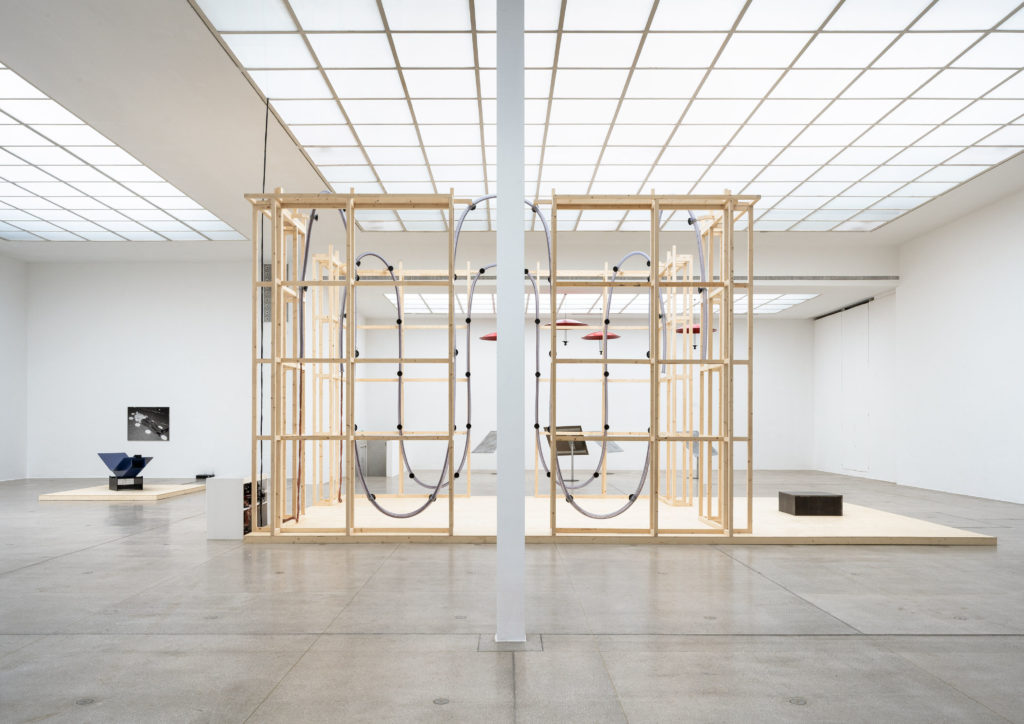
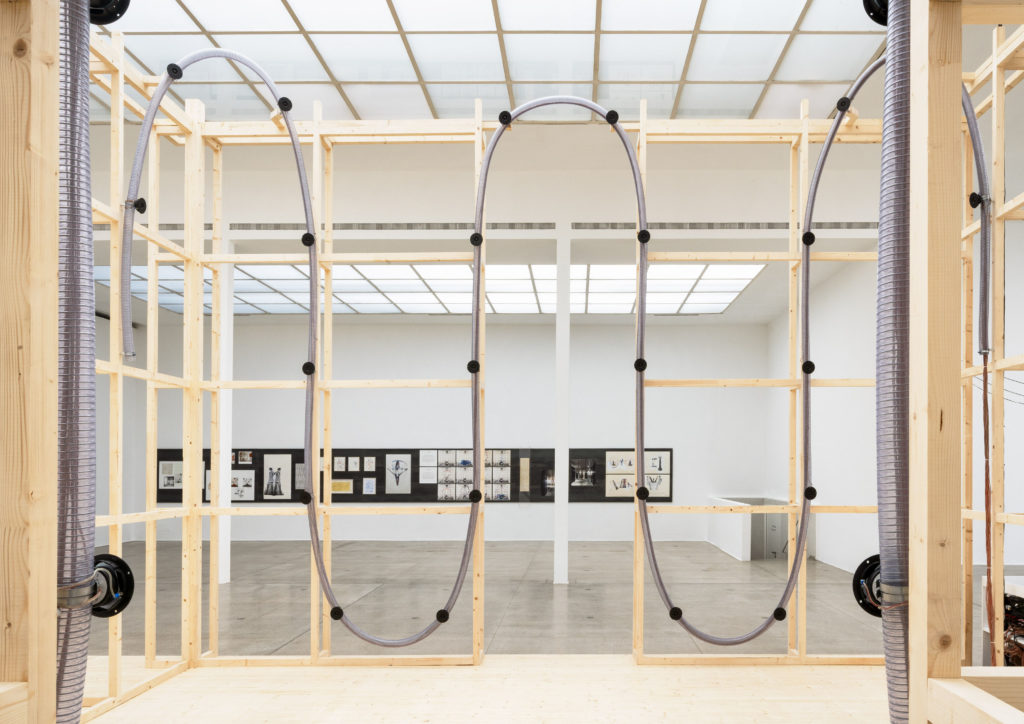
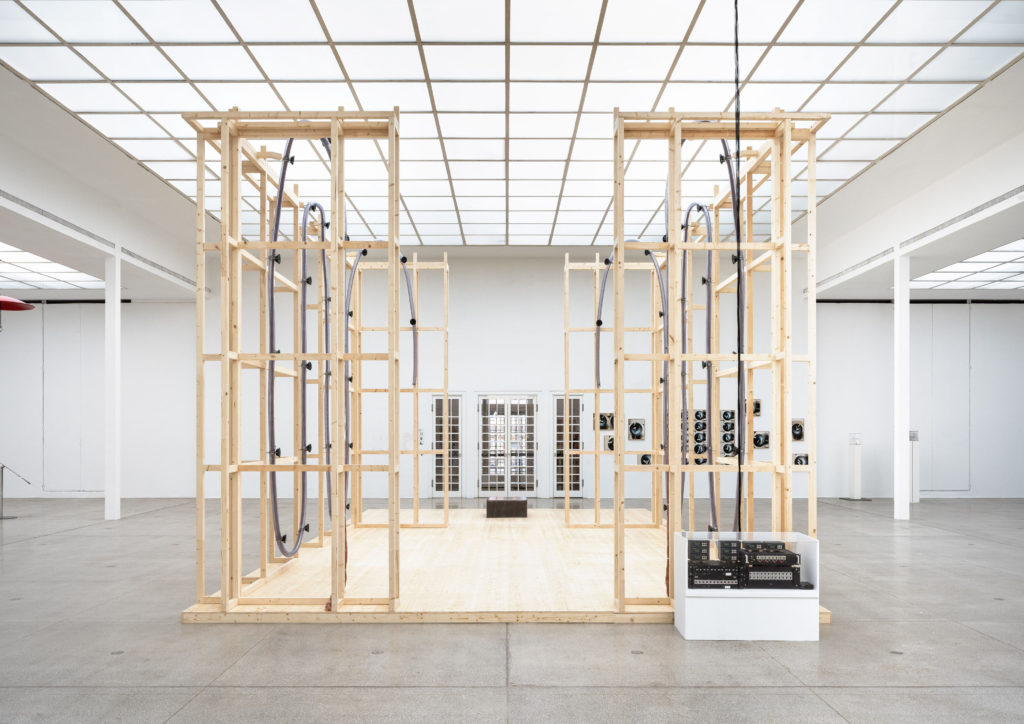
Inside the building, the Hauptraum is a cube. During the opening talk of “SOUNDSPACESCULPTURE,” Leitner sits with his feet together, knees spread, a position open to listening (the opposite would be strange indeed). His new work, Water Cube/Wall Waves (2026), was built for this hall: a forty-eight-channel composition running through speaker chassis and WAV players, housed in transparent PVC. Along two facing walls run the wall waves, each consisting of a single PVC tube fitted with loudspeakers, its wiring concealed so that the curve reads cleanly. Through these tubes, at different heights, travel horizontal circles of water: short and long lines, vertical lines climbing, walls programmed to burst like dry fountains. In everyday life, the artist says, we hear mostly horizontal spaces; the vertical is the acoustic dimension. The horizontal is the axis of matter, of weight. The vertical is the axis of spirit, the only direction in which sound can be said to ascend. Architecture, so the saying goes, is “frozen music,” and music, conversely, is “liquid architecture” — an aphorism popular in the early nineteenth century and already a cliché by 1844, when Schopenhauer asked whether ruins might be called a “frozen cadenza.”[1] Similarly, Bach studies have been treated as “architecture” and the composer as architect.
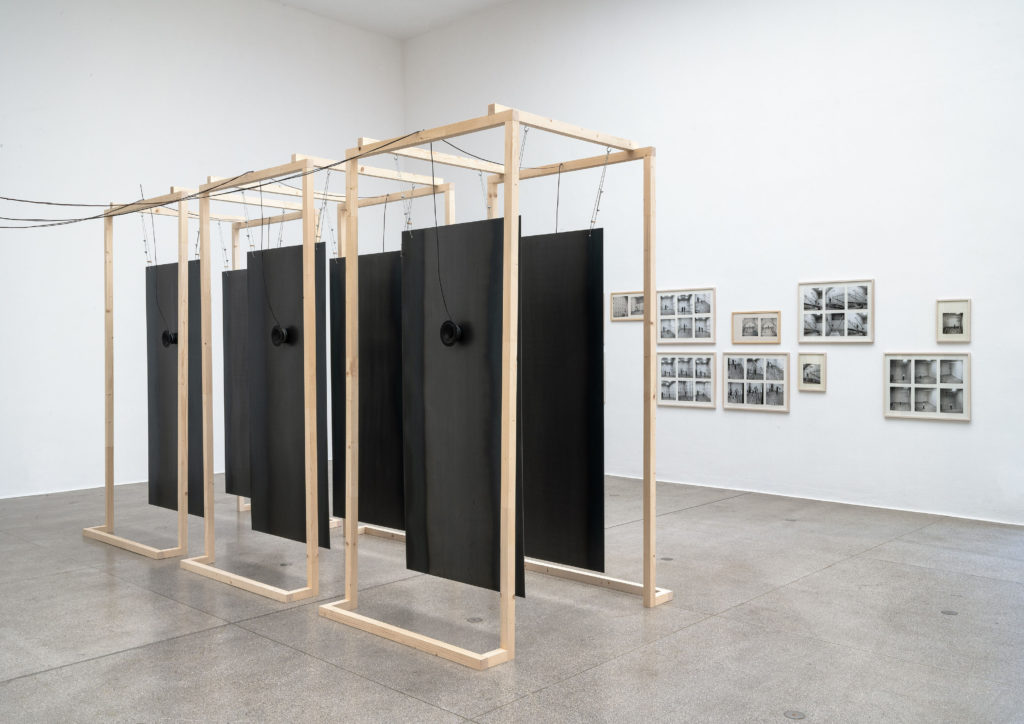
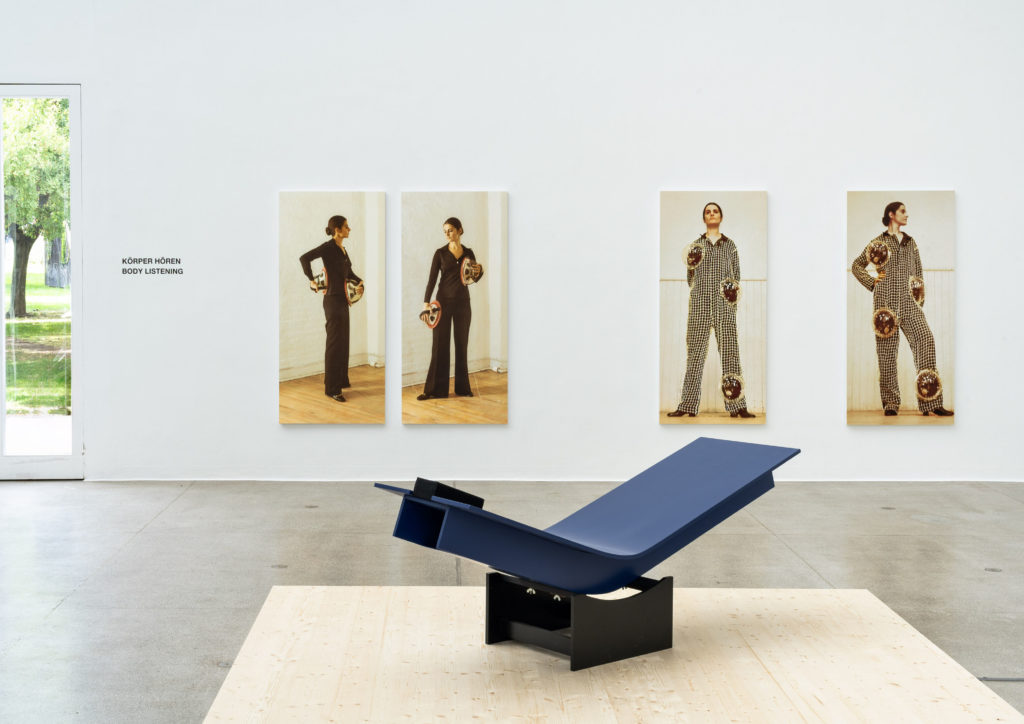
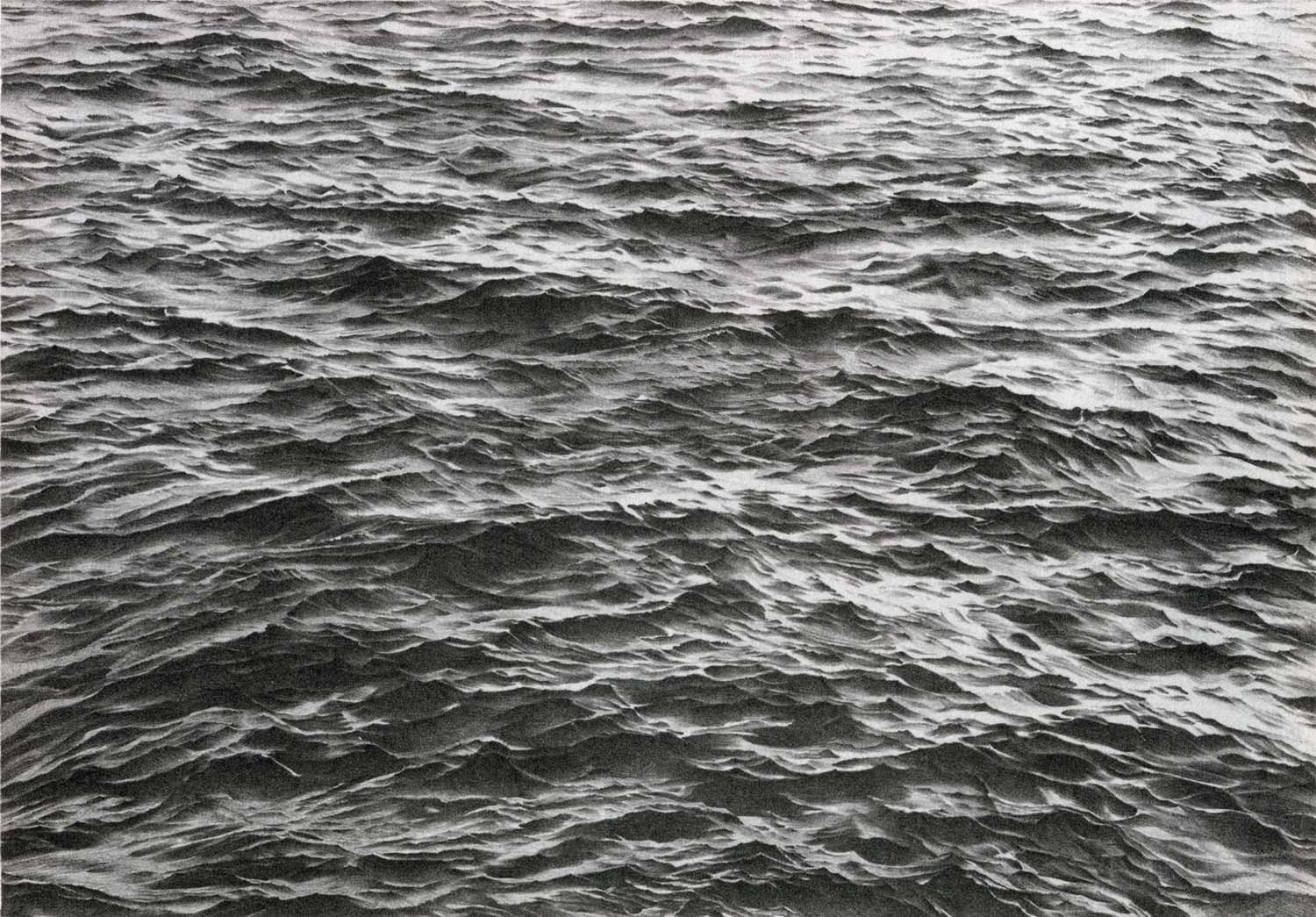
The exhibited boards betray an Actionist approach to drawing à la Arnulf Rainer: the architecture of sound rendered in undulating signs, pastel pressed into paper, the palette held to blue and red. The hand is a seismograph; the mark records the sound’s curve around the body, which it encloses with controlled fury. Leitner’s acoustic space “surrounds and fulfills the recipient,”[2] as he writes in Sound Space Sculpture (2023), his catalogue raisonné; the body is “wrapped in a sound spiral,”[3] made visible here. For Leitner the experience of space is primarily a sensual process, a form of carnal knowledge, which is why architecture must be felt with the whole body. Sound strikes the skin, itself a permeable acoustic membrane, and continues inward. Audiences placed inside the music rather than in front of it drift back within minutes to the frontal posture of the concert hall, domesticated by habit, seemingly unable to listen to the space of music. The act of listening — especially listening to space in the presence of other people — is, lately, not the predominant faculty. Our century has learned to listen mainly through headphones: solipsistic, the head conceived as a hollow volume, a globe-like receptacle for acoustic space.
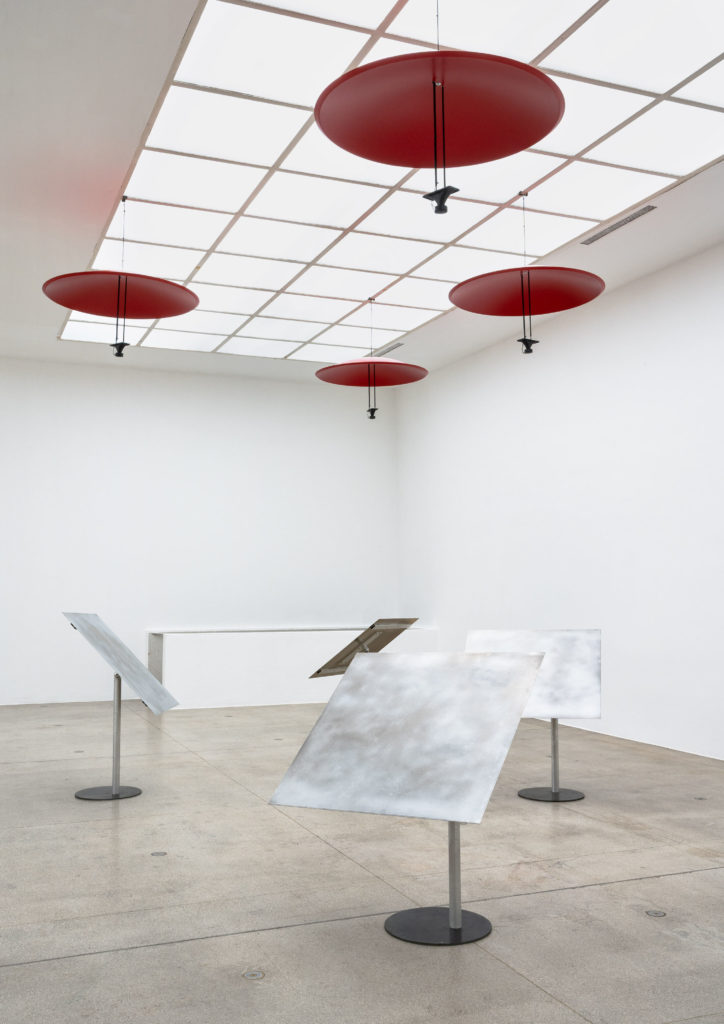
The work is self-affirming in a pretty masculine way: the vertical I have called the axis of spirit is also a gendered axis. Lefebvre read monumental space as repressive male space: “Phallic erectility bestows a special status on the perpendicular, proclaiming phallocracy as the orientation of space.”[4] In “NOB,” Sarah Lucas and Gelatin’s 2014 show in this very room, the phallic presence was made explicit: giant penises lay scattered across the floor, asleep. Monumental in size but prone in posture, the phallus was thus stripped of erectility, of the perpendicular that proclaims phallocracy as the orientation of space. I was just thinking about this last line when a red-haired woman in sunglasses spontaneously embodied Leitner’s sound, turning it into a quasi-orgasmic performance and activating an otherwise sterile space. She is here the ultimate Duchampian spectator, in the sense that “the spectator brings the work in contact with the external world by deciphering and interpreting its inner qualifications and thus adds his contribution to the creative act”; through that contact, inert matter changes “into a work of art, an actual transubstantiation.”[5]
Such a shame the artist was no longer in the room. He would have found a muse. I did.
[1] A. Schopenhauer, The World as Will and Representation, On The Metaphysic of Music,1844.
[2] Bernhard Leitner, Sound Space Sculpture (Verlag Fur Moderne Kunst Nurnberg, 2023).
[3] Bernhard Leitner, Ton, Raum: Ton-Liege, Ton-Feld, Erweitern, Verengen, Raum-Wiege (Krefeld: Museum Haus Lange), 1979.
[4] Henri Lefebvre, The Production of Space (Oxford: Blackwell, 1991).
[5] Marcel Duchamp, “The Creative Act” (lecture in Houston, April 1957), in ArtNews 56, no. 4 (Summer 1957): 28–29.