The journey into Christine Sun Kim’s “FOR EVER” begins before reaching the work itself. A glass corridor leads from Mudam’s main building toward the Henry J. and Erna D. Leir Pavilion, gradually separating the visitor from the rest of the museum and drawing them into an architecture that is smaller, enclosed, and intimate. You feel embraced by the space. By the time you reach the pavilion, the museum already feels strangely distant. It is a fitting setting for a work concerned with something as enormous and elusive as “forever.”
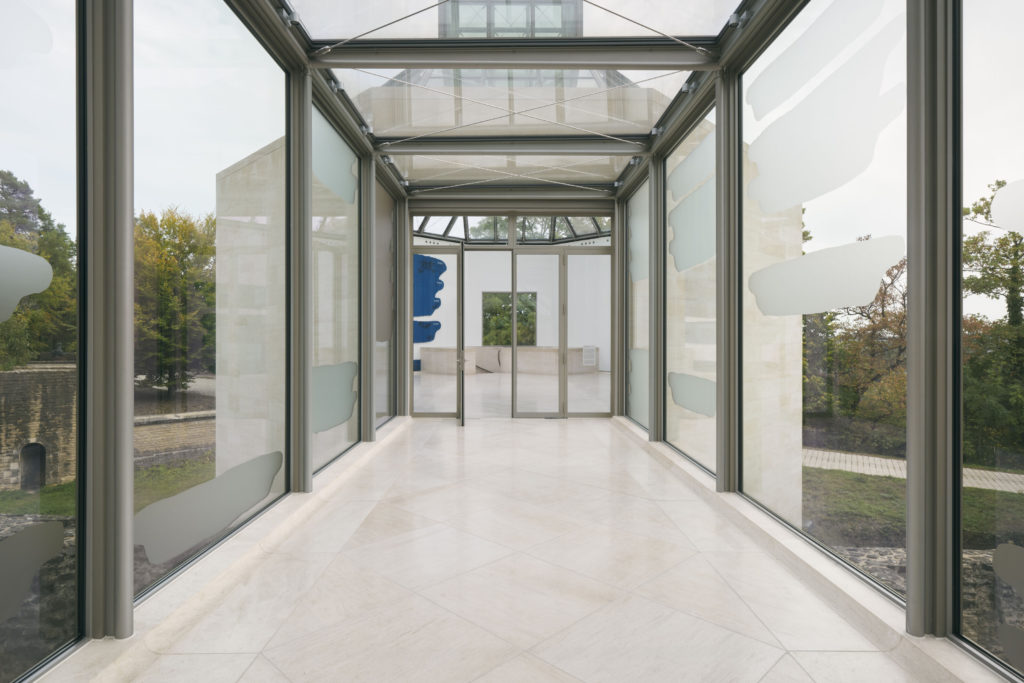
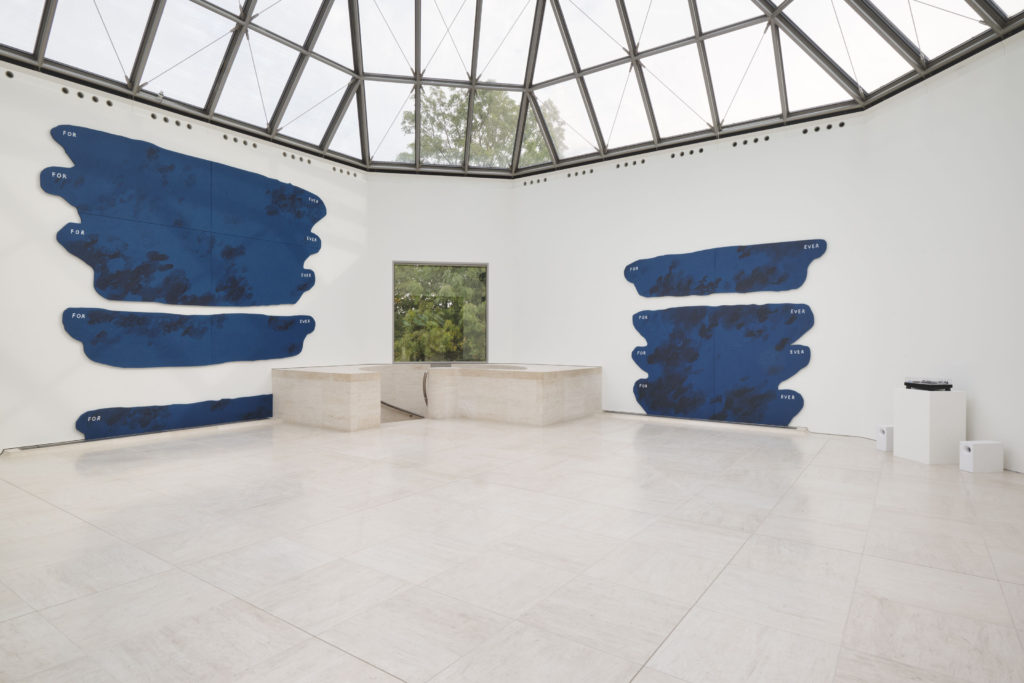
Inside the chapel-like pavilion, four monumental sculptural canvases surround the visitor. Their turquoise surfaces carry the repeated sign for “forever” in American Sign Language. The color is immediately arresting, and its association with Deaf culture gives the installation a visual language before the work has even begun to explain itself. Kim rarely works with color in this way; her practice is more often associated with black and white and strong contrasts. Here, turquoise is almost too present to ignore, announcing the work’s territory: this is a space in which deafness is not something to be explained, but something to be encountered.
In ASL, the sign for “forever” begins at the forehead and moves outward. It is a fleeting movement, existing only for the brief moment in which the body performs it. Kim has been increasingly interested in tracing the contours of ASL signs, looking at the space occupied by a sign and asking what happens when that temporary movement is given physical form. Here, she takes the sign for “forever” and refuses to let it remain temporary.
The sign appears repeatedly, beginning with translucent foil window treatments and continuing through the sculptural canvases. It stretches across the architecture, folds and rises. Looking around the installation, the forms suggest something ascending, perhaps moving toward infinity, or even leaving the ground behind. There is something almost absurdly ambitious about turning a gesture that lasts a second into an object that seems determined to outlive us. The chapel-like architecture, the scale of the canvases, and the depth of the turquoise create a space for contemplation. But this is not a religious monument in the traditional sense. If the pavilion resembles a chapel, Kim seems less interested in worship than in the question of what deserves to be preserved. The work places Deaf existence at the center of that question.
That carries considerable weight. Deaf communities have repeatedly faced attempts to suppress their languages and cultures, from the historical prohibition of sign languages to the continuing tendency to understand deafness primarily through medical intervention. New technologies and genetic treatments can offer important possibilities for individuals, but Kim’s work asks us to consider the cultural implications of imagining deafness as something that should ultimately disappear.
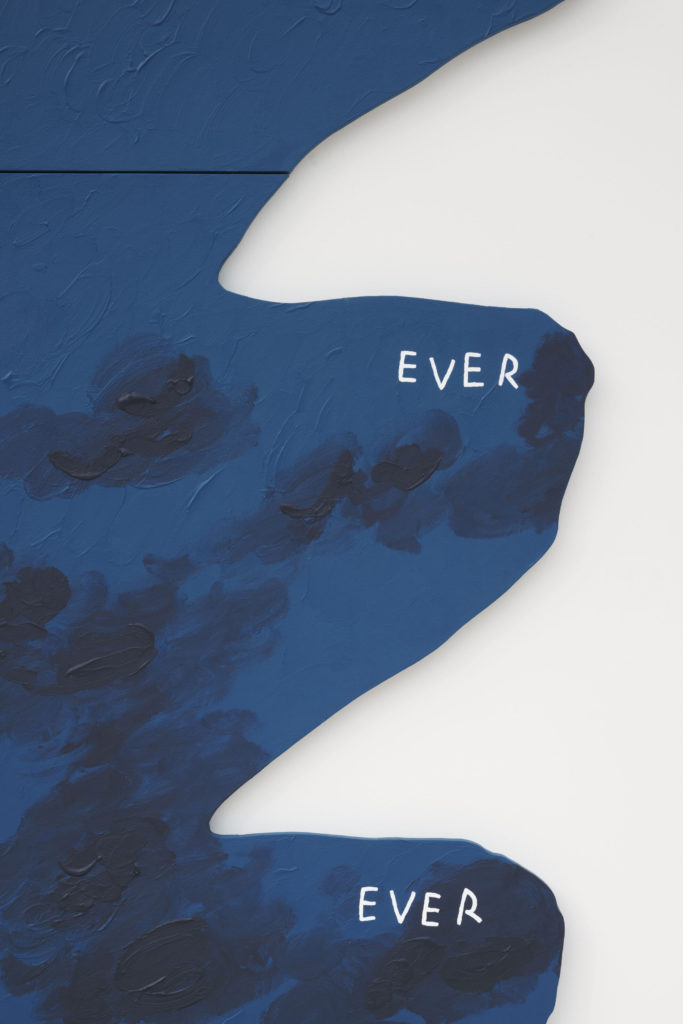
Her position is grounded in a different understanding: Deafness is not merely a problem to be solved. Seen from this perspective, “FOR EVER” becomes an argument against erasure. Its monumental scale gives that argument a physical dimension: What began as a fleeting gesture is enlarged until it occupies the room. Kim takes something that could disappear with the movement of a hand and gives it enough weight to confront the visitor.
This sense of permanence, however, is not entirely reassuring. Against darker tones that begin to surface within the work, it can feel as though something is being illuminated while remaining exposed to the possibility of disappearance. The installation’s serenity therefore contains a quiet instability, a tension that become more apparent through the soundscape.
Kim’s practice has long questioned what sound means for someone who does not experience it through hearing in the conventional sense. Sound, in her work, can be registered through movement, vibration, objects, and the body. Here, however, she deliberately introduces actual sound, created in collaboration with her longtime collaborator, musician Matt Karmil.
What we hear is a Shepard tone, an auditory illusion that seems to rise endlessly. As one pitch moves upward, another enters below it, creating the sensation that the sound is continually ascending without ever arriving anywhere. Unlike the visual repetition of the sign, which accumulates in space, the Shepard tone produces a sensation of perpetual motion. It gives “forever” a temporal dimension: There is always somewhere to go, but nowhere to arrive.
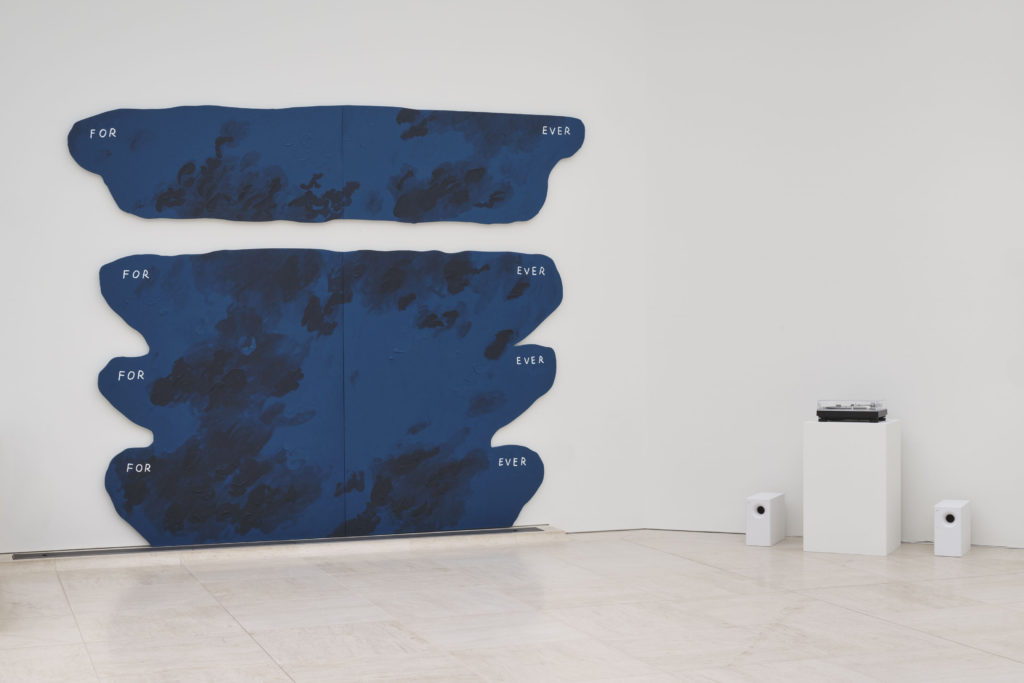
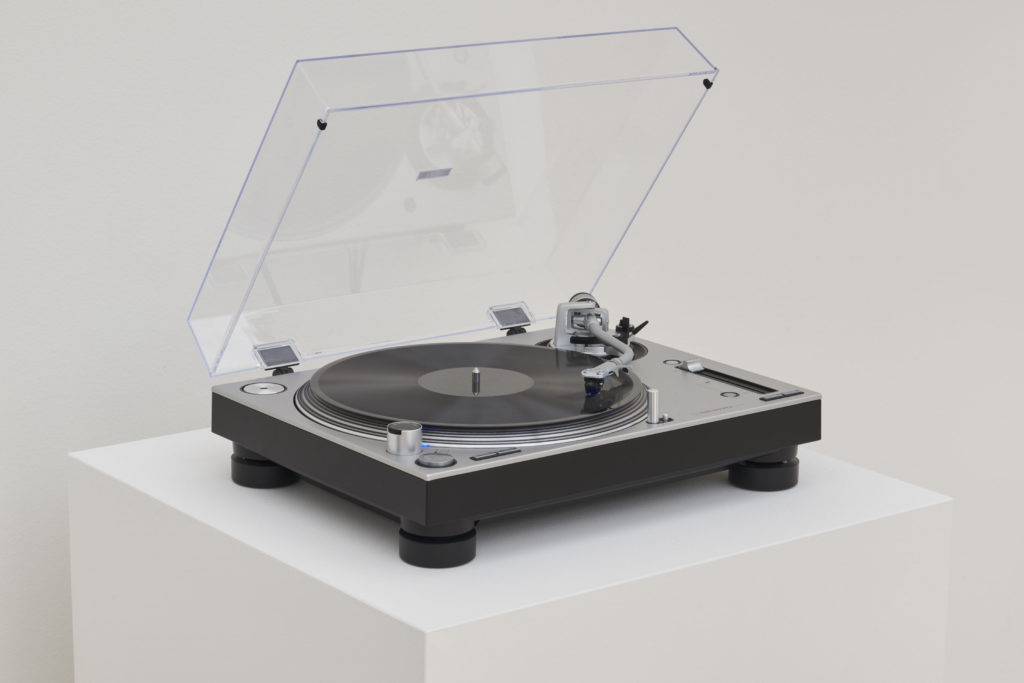
The soundscape also introduces a fascinating new material dimension. The work is played through an analogue medium, and the physical process leaves traces on its carrier. The promise of endless repetition is therefore accompanied by gradual deterioration. The more the work repeats, the more its material support changes. Forever is already wearing itself out.
This contradiction is where “FOR EVER” becomes more than a meditation on permanence. The work does not simply assert that Deaf culture has endured; it suggests that endurance itself is an active process. Cultures survive through repetition. Languages survive because they are signed, spoken, taught, and passed on. Communities survive because they continue to make themselves visible. The repeated sign is therefore not just a representation of “forever” but a small act of continuation.
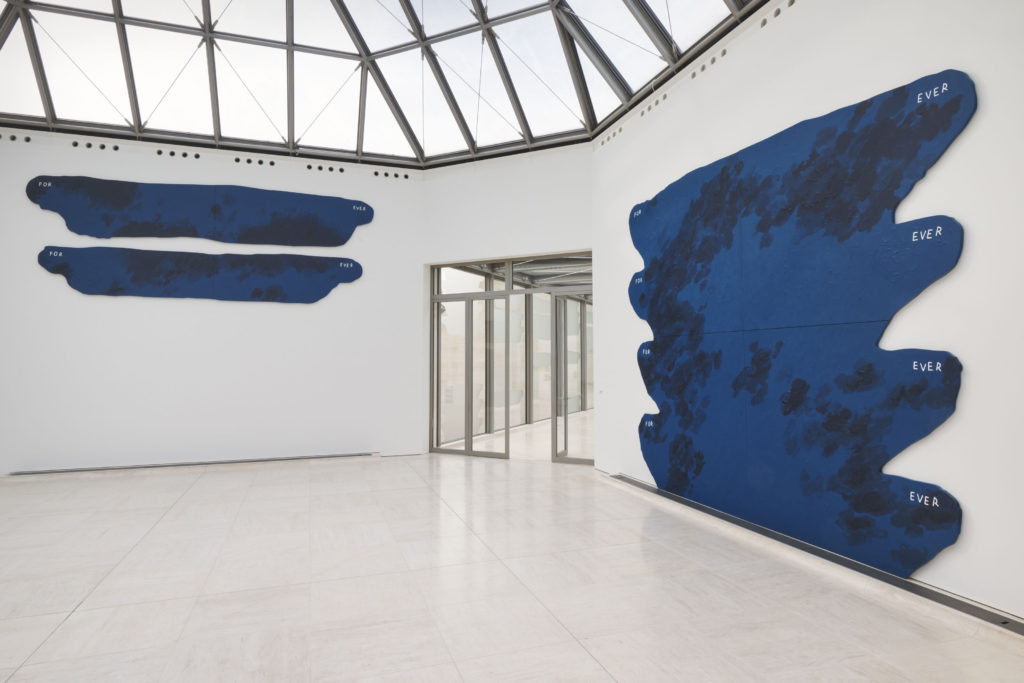
Walking through the pavilion, I found myself thinking less about the word itself and more about the physical experience of being surrounded by it. At some point, the meaning of the sign gives way to its physical presence. The sign no longer belongs to one person or one moment. It has expanded beyond the body that originally makes it. It has become architecture, image, sound, and atmosphere.
And perhaps this is the force of Kim’s work: “Forever” does not describe an eternal state, but the act of repeating something against the possibility that it might disappear.