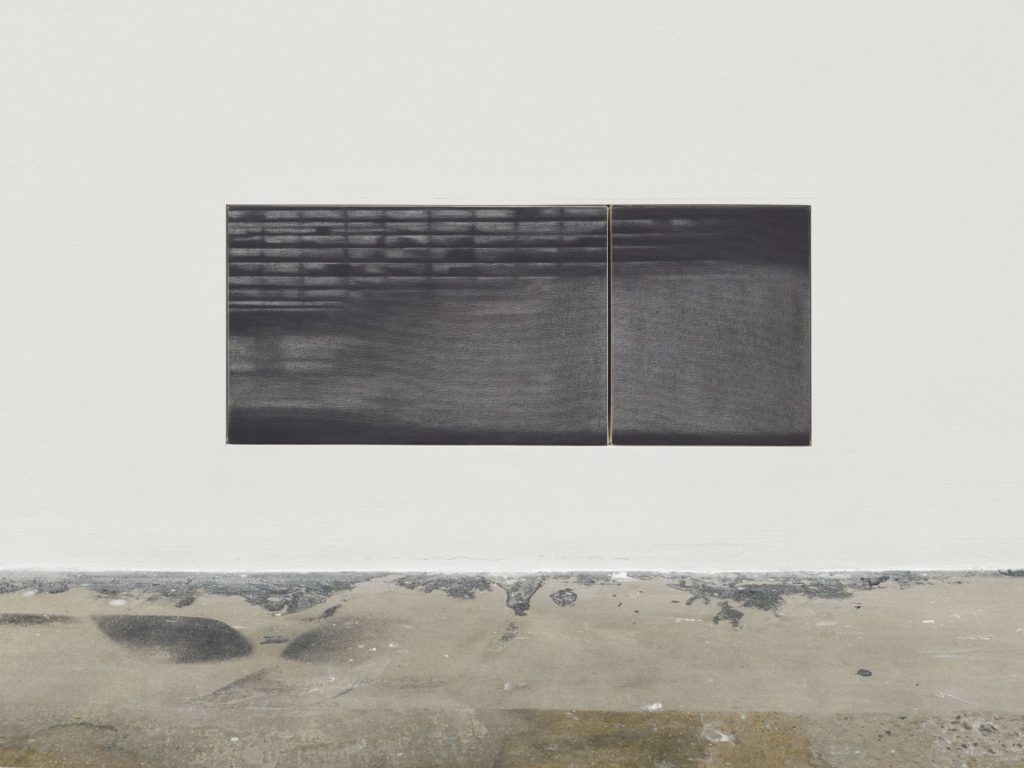
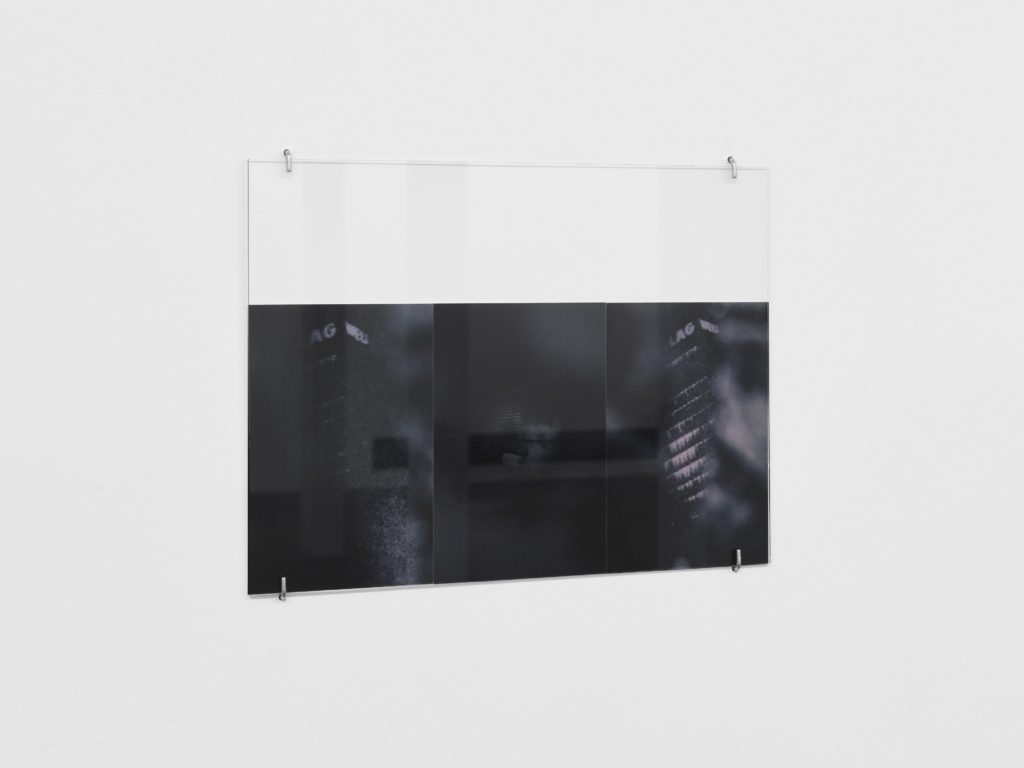
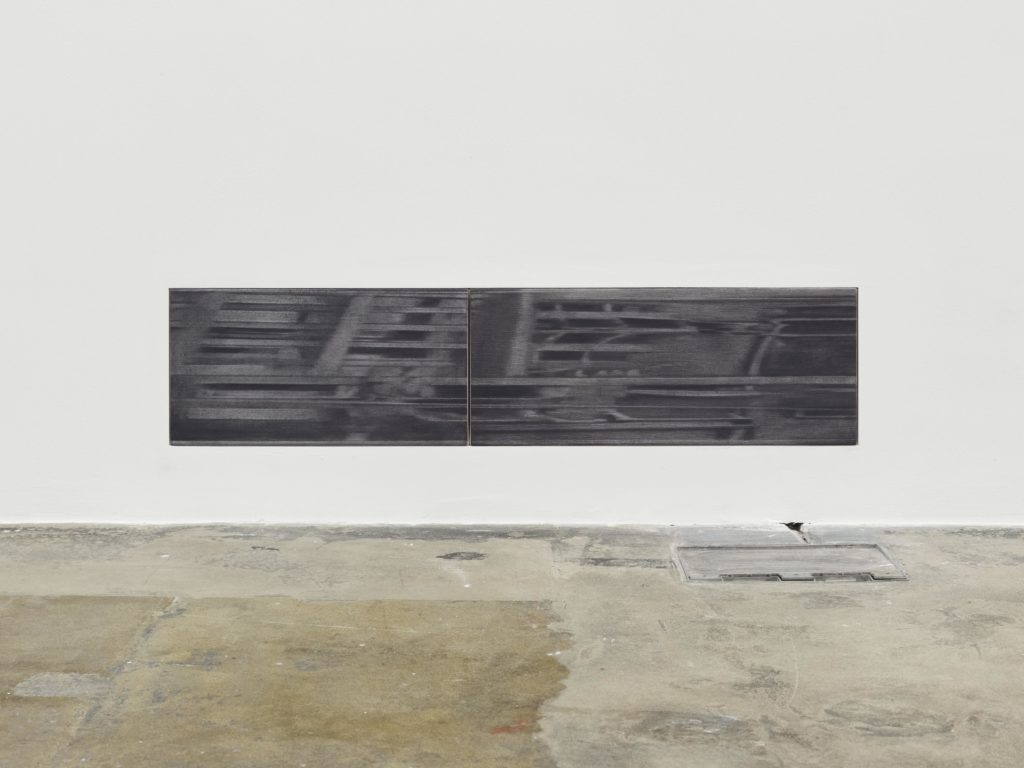
For “LAG” (2026), Maren Karlson has inset fifteen slender paintings into the walls of Soft Opening in London. Positioned horizontally and close to the floor like air vents, the near-monochromatic canvases offer smooth, graphite-and-oil-washed surfaces. Stretched shapes suggest accelerating mechanical action, grilles, and the corporate lattice of windows. The sole other inclusion in the exhibition is a pair of semi-obfuscated photographs of a tower, just identifiable as the historic West German headquarters of Axel Springer Verlag: a conservative publishing corporation that held a spectacularly monopolistic influence on the Federal Republic’s news, accounting for approximately 70% of West Berlin’s print media. Today Axel Springer SE remains the EU’s largest news publisher.
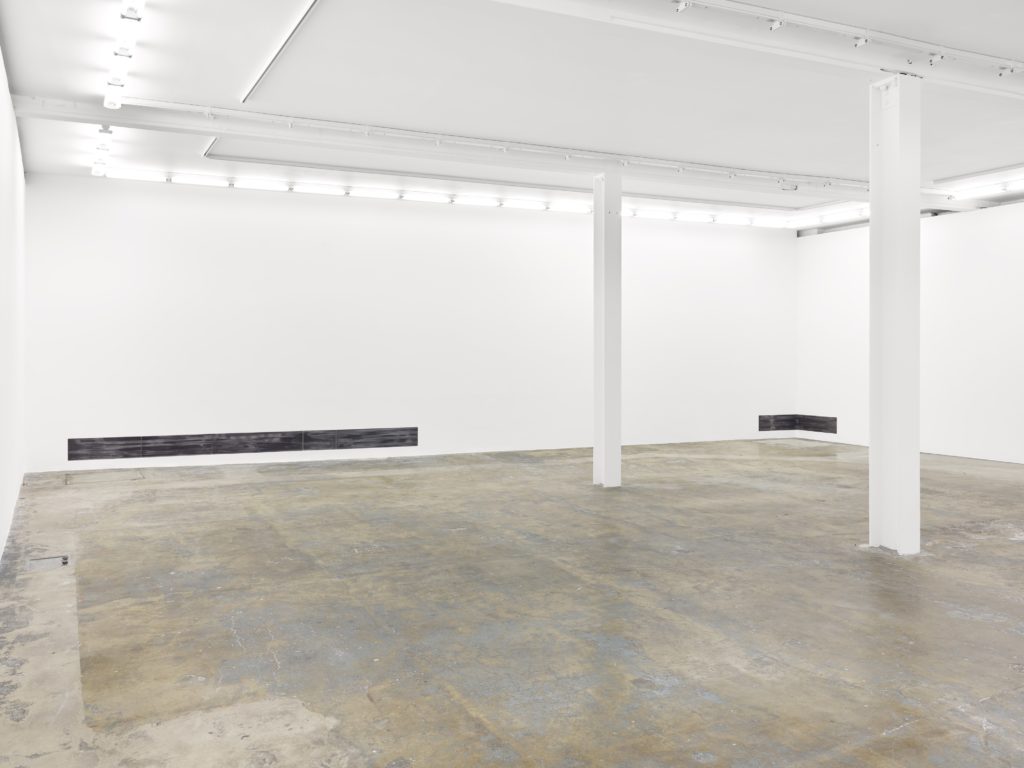
With this new body of work, the German-born artist foregrounds a disconcerting push-and-pull between affect and historical memory. The photographs point to Karlson’s hyper-specific source imagery: press photos of damage caused by the militant left-wing Red Army Faction (RAF, also known as the Baader-Meinhof Group) to the Springer Building and other sites in the late 1960s, 1970s, and 1980s. Karlson views images of blown-out cars, newspaper vans, and police stations through cuts and holes in newspapers, then compresses them to fit dimensions determined by the cavities in the gallery’s three supporting I-beams.
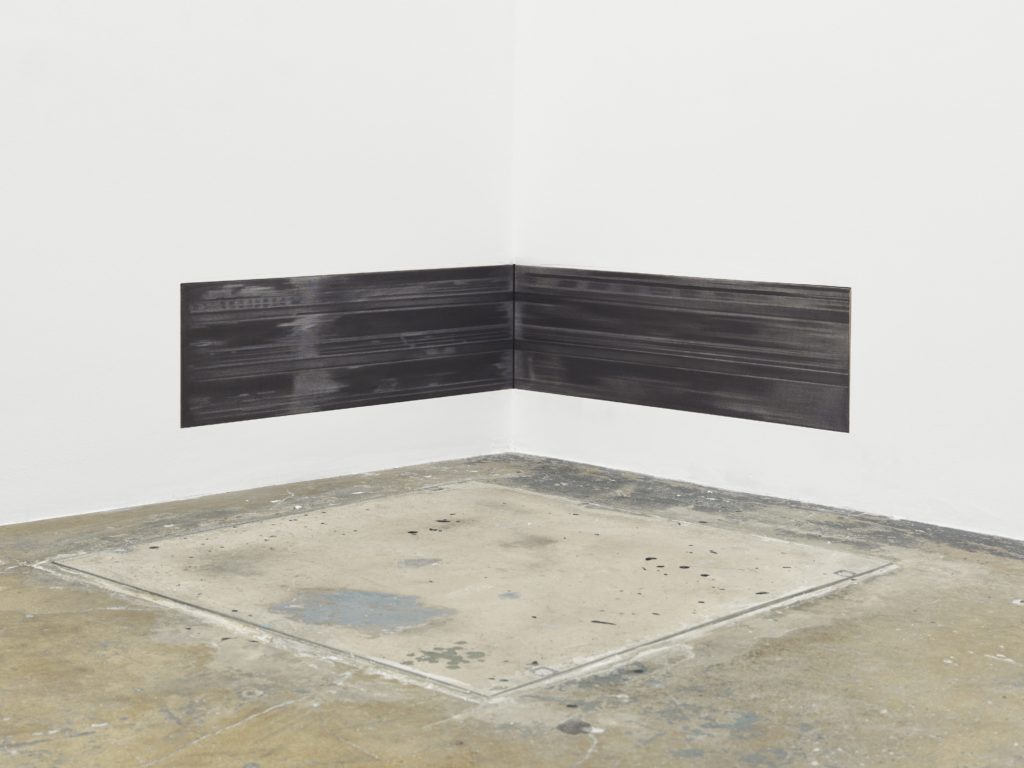
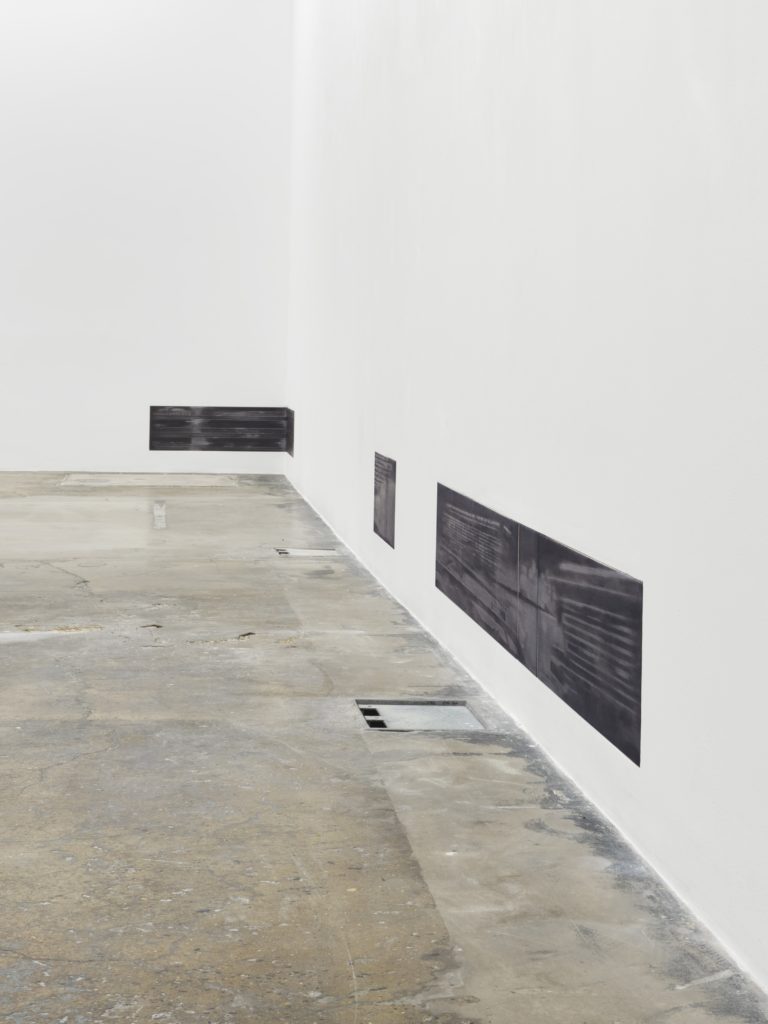
There is an intoxicating ease to the paintings — all 2026 and titled LAG #1, LAG #2 and so on, alluding to the final syllable of Verlag, as well as gaps or delays. One might easily succumb to their discrete withdrawal, taking pleasure in the formal arrangement and architectural cheek. Slyly folding into the environment, their abstraction plays with notions of automation and invisible labor. But the exhibition had the opposite effect on me. I was left with an inexorable desire to dig back into the contested history of image-making, propaganda, and refusal encapsulated by the suppression of student protests in West Germany in the late ’60s, the Red Army Faction’s violent actions, and the bleak fate of its core members in Stammheim prison –– the death of Holger Meins by hunger strike in 1974 preceding the deaths of Ulrike Meinhof (May 9, 1976) and three other RAF leaders on October 18, 1977. The latter four deaths were ruled suicides, a fact that remains disputed by those convinced the group were murdered in police custody. It’s a story entangled with the present moment. Given the RAF media sensation, Stammheim holds a formative place in postwar German consciousness. The decision to hold the current, highly public trial of the Ulm 5, pro-Palestinian activists accused of damaging Elbit Systems property, feels symbolic. All of this is to say: the more Karlson withheld, the more space her abstracted imagery left, the further detail I sought.
The painting cycle’s obvious forebear (or counterpoint) is Gerhard Richter’s 18 October 1977 (1988). Like Karlson, Richter’s monochrome “October”cycle undermines the media’s pretensions to documentary truth; RAF corpses and empty Stammheim cells hover inconclusively between photograph and painting, blurred with the artist’s signature squeegee. While this technique refuses tabloid-worthy prurient detail, the cycle’s relationship to its source imagery is ambiguous, playing unavoidably on the lurid fascination the deaths held. Karlson’s refusal is more absolute, viewing imagery through a literal newspaper filter, a tongue-in-cheek statement on the subjective abstraction media images undergo before they’re viewed.
Perhaps surprisingly given Richter’s easily identifiable subjects, 18 October 1977 feels the more ahistorical project of the two. Richter completed his cycle shortly before the Berlin Wall fell, when Francis Fukuyama famously proclaimed the “end of history”: humankind’s ideological evolution concluding with the triumph of Western liberalism. It was a flagrantly naive, though very popular, opinion. Richter later noted that he was less interested in reflecting the RAF’s story than in that great universal subject: death. He also described ideologically motivated opinions as “false, a hindrance, a menace, or a crime.”[1]
In Specters of Marx (1993), Jacques Derrida countered the notion of the “end of history,” arguing instead for a contemporary haunting, a spectrality or non-presence, that nevertheless has a living legacy: “a politics of memory, of inheritance, and of generations.”[2] Derrida’s “hauntology” is a useful framework for what I perceive to be Karlson’s deeply political paintings. With “LAG,” Karlson engages with events that played out through gaps in walls and the fog of tear gas via occlusions, whispers, and invisible agendas. Rather than drawing blunt analogies between the conditions that prompted the RAF’s emergence and our contemporary moment, although they’re undeniably there, Karlson invokes an enduring sense of haunting, an eerie, if forceful, specter of things concealed or contorted, often in plain sight.
[1] Gerhard Richter, Writings, 1961–2007 (New York: D.A.P./Distributed Art Publishers, 2009), 227, 203.
[2] Jacques Derrida, Specters of Marx (New York and London: Routledge, 2006), xviii.