Since the release of Fritz Lang’s influential silent film Metropolis (1927) nearly 100 years ago, the modern vision of a dystopian future has often been characterised by intense surveillance by government entities, increased disparities between the working and upper classes due to capitalism, and the integration of artificial intelligence across all aspects of daily life. Within this framework, Chonghao Hua’s practice involving moving images and performance dissects the implications of living in a capitalist environment, highlighting the standardisation of behaviours and, therefore, the eradication of individuality among human civilisations.
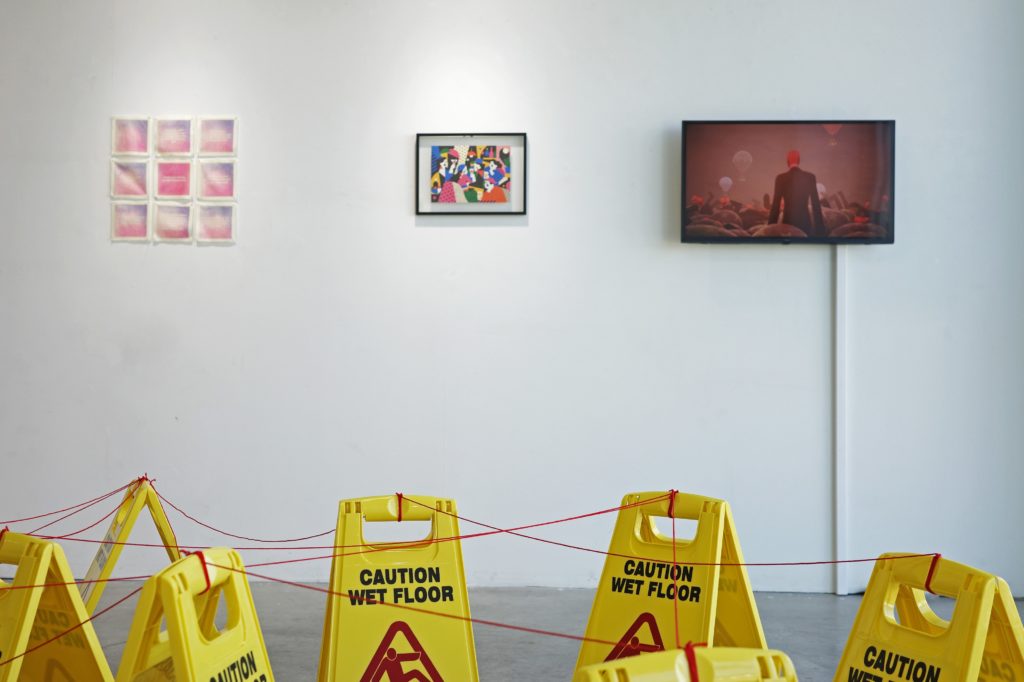
Self in Alienation (2025) uses the setting of an amusement park as a visual parallel to capitalism. Here, groups of faceless people wearing suits play a series of a popular games like Whack-A-Mole, or board attractions like a Ferris wheel and Merry-Go-Round. Although they initially appear to be for pleasure, they are in fact tasks to be completed, with each completion contributing to a timer counting up. Anticipating freedom from the system upon reaching 100, a figure passes with elation through a celebratory doorway only to discover a mass grave filled with past ‘winners’. The message? One can never escape because one’s autonomy is ultimately tied to the system and its labour cycle. Once this realisation hits, our function in society feels like the robotic arm in Sun Yuan and Peng Yu’s installation Can’t Help Myself (2016), forever trapped performing a Sisyphean task that never ends.
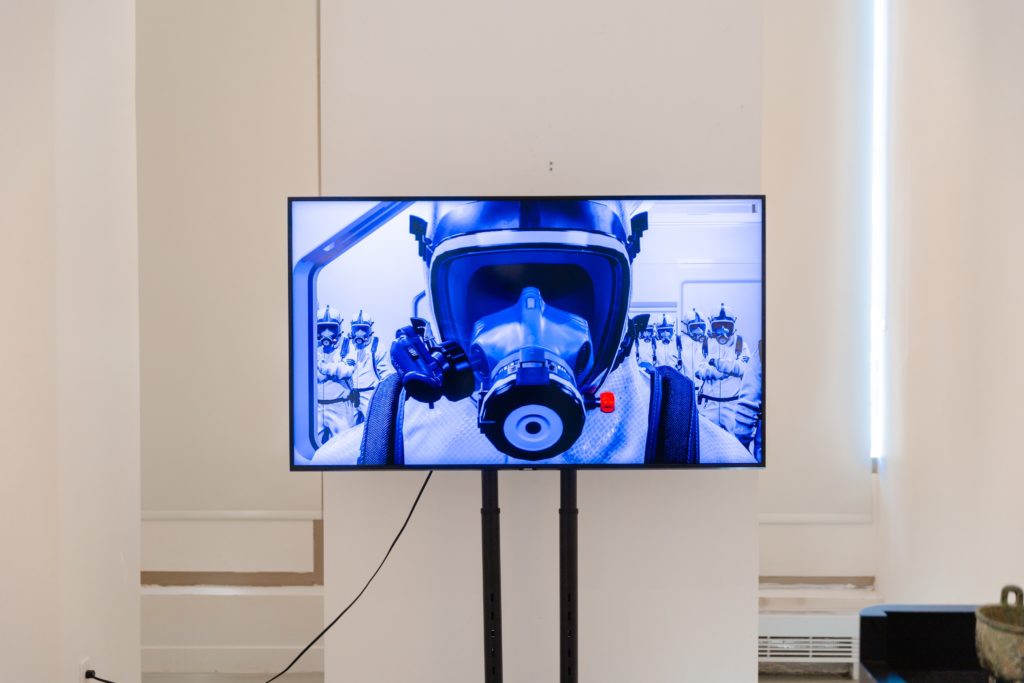
Meanwhile, Burnout Current (2025) expands on this idea by setting its protagonists in a futuristic workshop, where the labour force is dominated by self-manufacturing robots. Only one worker is human, clearly identified by their orange uniform rather than white, and reliant on a tank of oxygen to breathe safely. Highlighting society’s pursuit of efficiency and results, the video shows the human protagonist conducting maintenance on a robotic arm symbolising industrial control and technological superiority over humans. As a result, Hua poignantly alerts us to the dangers of fuelling a system deliberately designed to replace humanity.
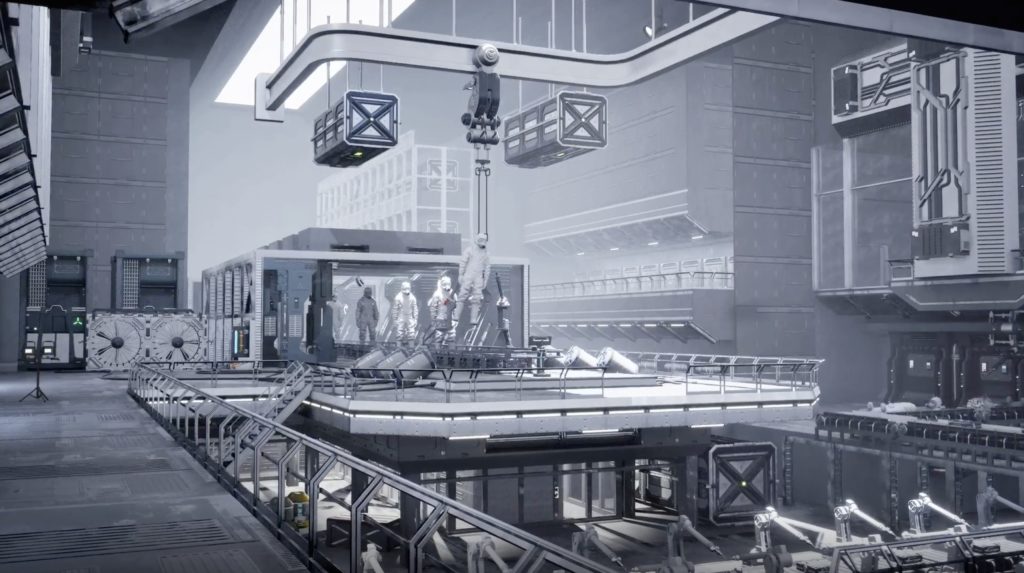
On a slightly different note, Attention Capital in the Age of Surveillance Capitalism (2025) comments on the changeable nature of identities based on society’s pressures. In the first part of the video, we are presented with four figures interacting with a digital mirror containing detailed profiles about their existence and role in society. Look a little closer and the identical subject IDs suggest they are all the same person under different guises. Dressed in green at first, the ‘standard issue’ human possesses a 74% optimisation level, which has alerted the system that they require improvement.
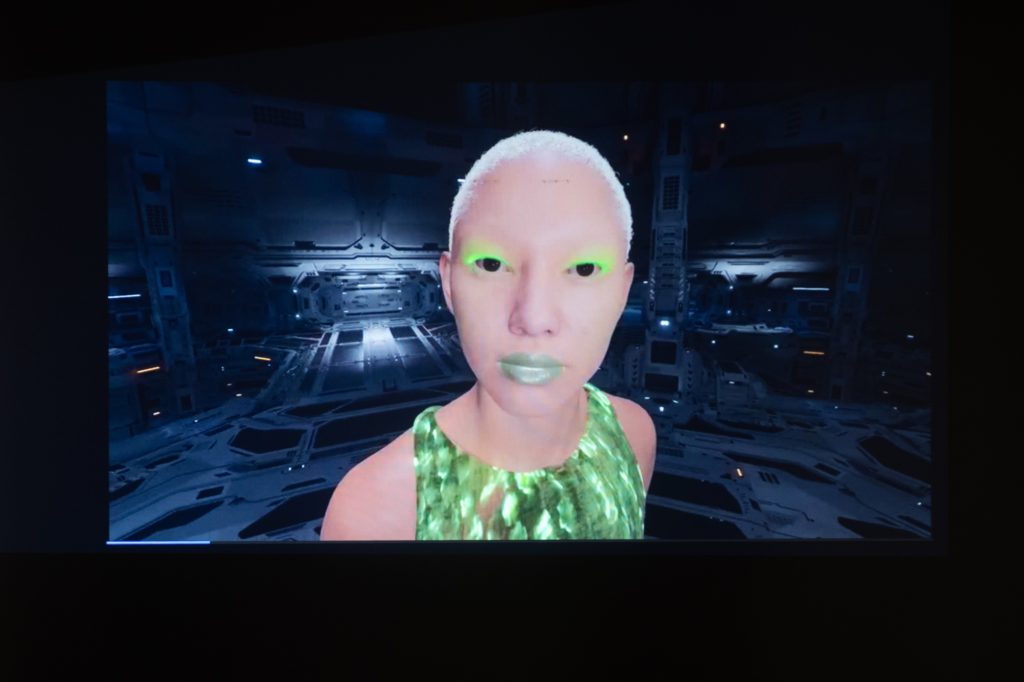
When in yellow, they appear to be some kind of performer or social media celebrity, referencing present-day influencers; their profile contains information about their attention yield and impressions, as well as further insights into how much they blink, daydream, or become fatigued. Disturbingly, a pink version of themselves also exists, designated a ‘replacement candidate’, while a blue version is faced with a contractual screen that reads ‘You have nothing to hide. We checked.’ Works like Rafael Lozano-Hemmer and Krzysztof Wodiczko’s Zoom Pavilion (2015) have previously explored live projection mapping of its visitors and its predatory implications.
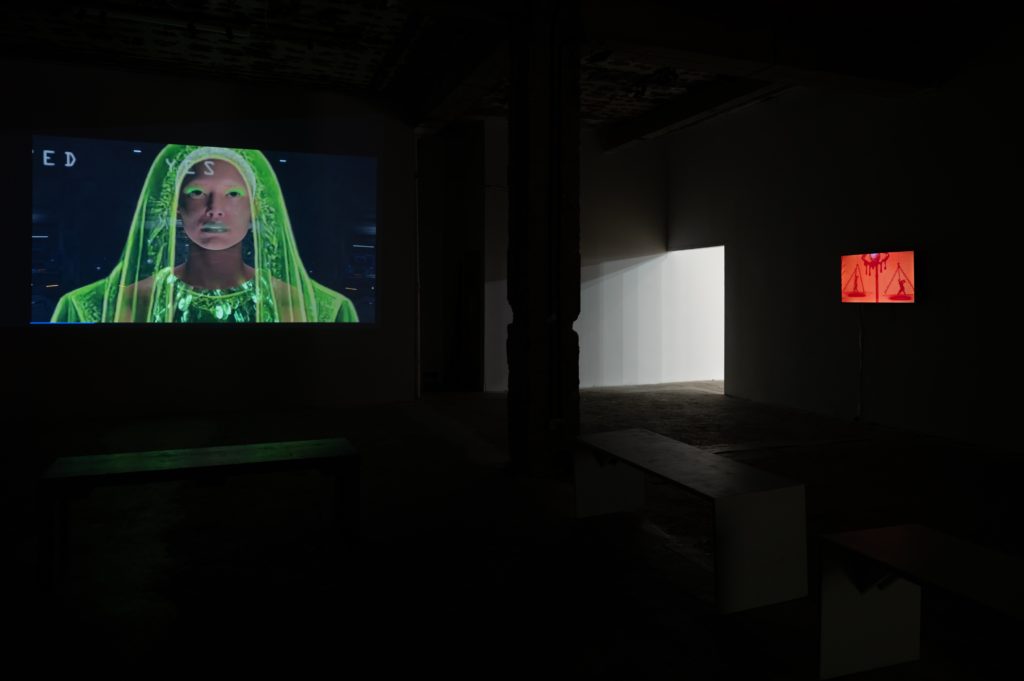
However, it is the second part that speaks most clearly to Hua’s message. These various incarnations have been placed on a set of scales with an all-seeing eye representing mass surveillance and a controlled digital environment. Here, the figures engage in a constant dance, where one’s individual authenticity is gradually erased in favour of a homogonous ideal dictated by the shifting rules of the algorithm.
As human civilisation increasingly descends into a culture of greed and overreliance on technology, Chonghao Hua’s recent works feel more relevant than ever, serving as crucial warnings for the future of humanity and beyond.